

Read the first chapter
The whole of chapter one, free. About 4 min. Turn the pages with the arrows, your keyboard, or a swipe.
Chapter 1
Foundations of Trust: Preparing the Heart and the House
Scripture Focus
Romans 12:1
> “Therefore, brothers and sisters, in view of the mercies of God, I urge you to present your bodies as a living sacrifice, holy and pleasing to God; this is your true worship.”
Before we lead a congregation in song, Scripture calls us to place our whole selves before God.
The first sound check of the week may happen in a rehearsal room, but the first act of worship happens in the heart. Romans 12:1 moves worship beyond a platform, a set list, or a Sunday morning service. Paul connects worship with surrender - our bodies, choices, habits, attitudes, and attention offered to God because of His mercy. That changes the way we prepare.
A worship leader can know every chord and still lead from a hurried spirit. A singer can deliver a beautiful harmony while quietly resisting correction. A drummer can play with excellent timing and still carry frustration into the room. None of these struggles makes a person unusable. They do show us where surrender needs to become practical.
Preparation serves worship when it begins with surrender, not control. We plan keys, transitions, lyrics, cues, and arrangements because people need a clear path to participate. But our preparation isn’t an attempt to manage God or manufacture a response. It’s an act of love toward Christ and toward the people entrusted to our care.
That distinction matters on ordinary days. When you open the Planning Center service order, pray before changing the song sequence. When you review a transition, ask whether it helps the congregation stay focused on Christ or simply showcases the band’s cleverness. When a team member misses an entrance, respond with patience rather than making the mistake larger than it is. Surrender shapes not only what we sing, but how we speak, listen, correct, and recover.
The biblical call to worship also forms our character away from the platform. David worshiped with a harp, but he also learned trust in hidden places. The singers and musicians appointed by David in 1 Chronicles 25 were not treated as background decoration; they were set apart to minister through their skill. Their musicianship mattered, yet their service belonged to God. Skill is a gift to steward, not an identity to protect.
This is where prayer becomes more than a quick sentence before rehearsal. Prayer helps us notice what is driving us. Are we anxious because the service must be perfect? Are we irritated because our idea was not chosen? Are we secretly measuring our value by the congregation’s response? These questions aren’t meant to condemn us. They help us bring the real heart to God instead of presenting a polished version.
A simple prayer before rehearsal might be: “Lord, show me where I’m trying to control what belongs to You. Help me serve the song, the team, and the congregation with a clean heart.” Then leave enough quiet to listen. Surrender often begins in the pause after the request.
Daily Scripture keeps that pause grounded. Read a short passage slowly rather than collecting verses as spiritual decoration. Psalm 24:3-4 asks who may stand in the Lord’s presence and points to clean hands and a pure heart. James 1:19 calls us to be quick to listen and slow to speak. Philippians 2:3-4 redirects our attention toward others. Each passage reaches directly into team life: how we receive feedback, how we handle preferences, and how we make room for another person’s contribution.
The takeaway is simple enough to remember when the room gets loud: the atmosphere we help create publicly is shaped by what we practice privately. A surrendered leader doesn’t need to appear impressive. That leader is becoming trustworthy - steady enough to serve without needing the service to prove anything.
Practice for Today
1. Take ten quiet minutes with Romans 12:1. Read the verse three times, slowly. On the first reading, notice what God has already done through His mercy. On the second, notice what you’re being asked to offer. On the third, name one part of your leadership you tend to hold tightly - your set list, your vocal part, your reputation, or the congregation’s response. Pray specifically about releasing it.
2. Journal before you plan your next rehearsal. Write this prompt at the top of the page: Where has preparation become control instead of service? Give one concrete example. You might write, “I keep adding musical changes because I’m afraid a simple arrangement won’t feel impressive.” Then write one surrendered alternative, such as, “I’ll keep the arrangement clear and use rehearsal time to help the team listen to one another.”
3. Choose one hidden act of worship. Before the next service or rehearsal, do something that strengthens the team without drawing attention to you. Send the lyric operator the final chart early. Thank the sound engineer for a specific way they supported the service. Ask a singer how they’re doing, then listen without fixing the conversation. Let the action remind you that worship leadership includes the work nobody applauds.
Closing Prayer
Father, because of Your mercy, I offer You my body, my skill, my plans, and my motives. Teach me to prepare faithfully without trying to control the outcome. Shape my character through Scripture and prayer, and make me a steady, humble servant to my team and to Your people. May my leadership point beyond me to Christ. Amen.
End of chapter one. 6 more chapters and about 7,567 words in the full book.
Swipe or use the arrows to turn the page


What's inside: 7 chapters
- 1. Foundations of Trust: Preparing the Heart and the House
- 2. Listening Before Leading: Reading the Room with Compassion
- 3. Building the Flow: Prayerful Planning and Musical Architecture
- 4. The Seam Between Songs: Transitions as Acts of Trust
- 5. One Team, One Offering: Cues and Communication on the Platform
- 6. Making Room to See and Hear: Audio-Visual Stewardship
- 7. Leading with Hope: Surrender, Recovery, and Faithful Presence
About this book
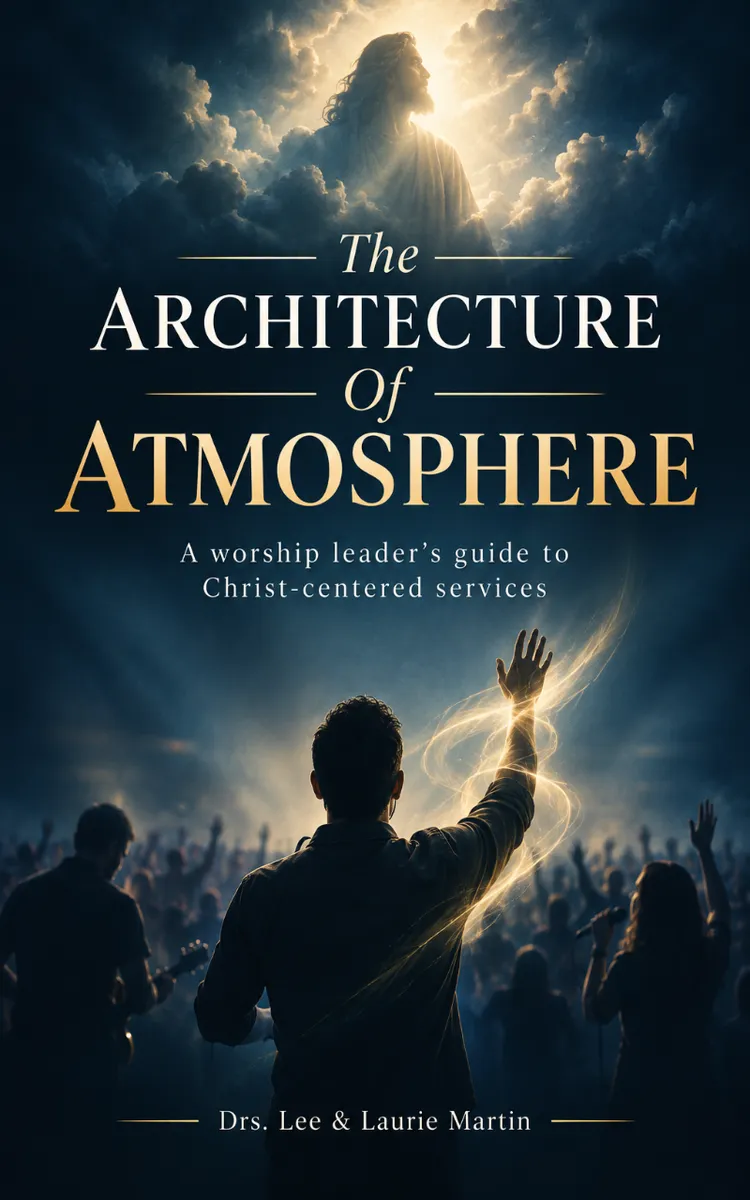
"The Architecture Of Atmosphere" is a religious devotional book by Drs. Lee & Laurie Martin with 7 chapters and approximately 7,567 words. Practical worship-service leadership, transitions, communication, and team coordination.
This book was created using Inkfluence AI, an AI-powered book generation platform that helps authors write, design, and publish complete books.
Frequently Asked Questions
What is "The Architecture Of Atmosphere" about?
Practical worship-service leadership, transitions, communication, and team coordination
How many chapters are in "The Architecture Of Atmosphere"?
The book contains 7 chapters and approximately 7,567 words. Topics covered include Foundations of Trust: Preparing the Heart and the House, Listening Before Leading: Reading the Room with Compassion, Building the Flow: Prayerful Planning and Musical Architecture, The Seam Between Songs: Transitions as Acts of Trust, and more.
Who wrote "The Architecture Of Atmosphere"?
This book was written by Drs. Lee & Laurie Martin and created using Inkfluence AI, an AI book generation platform that helps authors write, design, and publish books.
Write your own religious devotional book with AI
Describe your idea and Inkfluence writes the whole thing. Free to start.
Start writingCreated with Inkfluence AI


