

Read the first chapter
The whole of chapter one, free. About 6 min. Turn the pages with the arrows, your keyboard, or a swipe.
Chapter 1
Why Your Mind Won’t Switch Off
The 2 A.M. Meeting Your Brain Keeps Rescheduling
At 11:47 p.m., you finally put your phone down. Then your mind reopens the email from your manager. You reread one sentence: “Can we discuss this tomorrow?” Suddenly, it isn’t just a meeting. It might be criticism. It might affect your role. You might worry you sounded defensive in your reply. You reach for your phone, check the message again, and start drafting three possible responses.
The next morning, the same thing happens with a different trigger. A friend’s short reply. A customer who hasn’t confirmed. A family member who sounded “off.” Your brain gathers clues, builds explanations, and searches for the one action that will make the uncertainty disappear. You call it thinking. Sometimes it is; other times you’re simply replaying the same thoughts and mistaking repetition for progress.
You solve problems this way at work, in relationships, and in bed with the lights off. You review conversations, predict reactions, and prepare for disasters that haven’t happened. Do you recognise this pattern in yourself?
What If Your Brain Isn’t Trying to Solve the Problem?
What if the real question isn’t “How do I fix this?” but “Is there anything new here to solve?”
Your brain is built to notice possible threats before they become obvious. That system once helped people respond quickly to a sound in the dark or a change in the environment. It still scans for danger now, but the signals are often vague: a delayed reply, an unreadable facial expression, a news alert, an awkward pause on a video call.
The problem is that modern life supplies an endless stream of possible signals. Your inbox, group chats, headlines, work platforms, and social feeds keep handing your threat-detection system fresh material. Information feels like protection, so you gather more of it. You check the email thread again. You search for similar situations online. You ask someone what they think, then ask another person because the first answer didn’t settle you.
Useful problem-solving can shift into rumination when checking replaces deciding. Problem-solving moves toward a decision, action, or clear stopping point. Rumination keeps asking the same question in slightly different clothing. It doesn’t create clarity; it creates the feeling that clarity is one more thought away.
Before, you might receive a passive-sounding message and spend an hour composing the perfect reply, checking your tone, and imagining the fallout. After applying the Signal-versus-Loop Test, you pause and ask: “Is there new information, or am I repeating the same prediction?” If there’s no new information, you choose one reasonable response - or decide to wait until the scheduled conversation. The uncertainty remains, but the mental emergency ends.
That shift matters because your brain doesn’t need certainty to calm down. It needs a clear boundary around what is known, what is unknown, and what you’ll do next.
How a Signal Becomes a Loop
Here’s the chain that turns an ordinary uncertainty into an exhausting mental cycle:
• When you notice a trigger - a short email, delayed reply, unusual tone, or alarming headline - your threat-detection system flags it as potentially important.
• You feel tension and uncertainty, even when you can’t identify a concrete danger. Your body prepares for something that may never happen.
• So you start analysing, replaying details, checking for clues, and imagining outcomes. The thinking feels productive because it’s active.
• Which leads to more information and more possible threats, giving your brain fresh material to analyse. The loop strengthens.
The alternative chain looks different:
• When you notice a trigger, you name the observable signal without adding a story: “The reply was brief.”
• You feel the uncertainty, but you separate the feeling from the conclusion: “I’m uneasy; that doesn’t prove something is wrong.”
• So you run the Signal-versus-Loop Test: “Is there new information, a decision to make, or a useful next action?”
• Which leads to a contained response: act once, schedule a follow-up, or deliberately leave the situation unresolved for now.
The point isn’t to stop noticing. It’s to stop treating every mental alarm as an instruction.
A thought can be loud without being useful, so learn to notice its volume and ask what outcome it creates.
Rate the Difference Between Thinking and Spinning
Use these questions when your mind is busy. Rate yourself honestly, not impressively.
• On a scale of 1-10, how often does your thinking produce a specific next action?
A higher score suggests your thoughts are moving toward problem-solving. A lower score may mean you’re collecting possibilities without choosing a direction.
• Yes or no: When you revisit a worry, do you usually have new information?
“Yes” may indicate genuine problem-solving. “No” points toward a loop, especially if the same facts keep producing the same fear.
• On a scale of 1-10, how quickly can you stop researching, checking, or replaying once you’ve made a reasonable decision?
A higher score suggests you can close an open mental file. A lower score shows that your brain may be using more checking to chase a feeling of certainty.
• Yes or no: Can you describe what would count as “enough” thinking before you begin?
“Yes” gives your mind a stopping point. “No” leaves the process open-ended, which makes another check feel necessary.
If your answers point toward low action, little new information, repeated checking, and no stopping point, you’re probably dealing with a loop rather than a problem that needs more thought. That isn’t a character flaw. It’s a learned response to uncertainty. And learned responses can be interrupted.
The Signal-versus-Loop Challenge
Run the test before your next mental spiral.
• Capture the trigger within five minutes.
Write one sentence containing only what you observed: “The client hasn’t replied since Tuesday,” not “The client is angry and will cancel.” Difficulty: Easy.
• Run the Signal-versus-Loop Test at the next urge to check.
Ask: “What’s new? What decision is required? What is my next useful action?” If you have a clear answer, take the action once. If you don’t, set a specific review time - such as 3:00 p.m. - and return to what you were doing. Difficulty: Medium.
• Close the file for the rest of the review window.
Don’t reread the message, search for reassurance, or rehearse alternative explanations until the time you chose. When the time arrives, reassess using only new information. Difficulty: Hard, especially if checking has become your usual way to lower anxiety.
You’ll know it’s working when:
• You can describe the trigger without immediately adding a prediction.
• You make one reasonable move instead of five anxious ones.
• You notice uncertainty without treating it like an emergency.
The first few attempts may feel uncomfortable. That discomfort doesn’t mean the test failed. It means you’re no longer feeding the loop its usual supply of checking and analysis.
The Firewall Starts with a Stopping Point
Your mind won’t switch off when every thought is allowed to become a task.
• Threat detection is useful when it identifies a real signal and supports a clear response.
• Information overload keeps your brain searching long after the useful facts are already available.
• Problem-solving moves toward action or a decision; rumination repeats uncertainty without producing either.
• The Signal-versus-Loop Test helps you separate new information from recycled fear.
You don’t need to solve every possible outcome before you can rest. You need to recognise when your brain has stopped gathering information and started demanding certainty. That distinction is the first layer of an emotional firewall.
And once you can see the loop clearly, the next question becomes harder - and more important: what happens when your mind tries to control not just the outcome, but other people too?
End of chapter one. 11 more chapters and about 16,344 words in the full book.
Swipe or use the arrows to turn the page


What's inside: 12 chapters
- 1. Why Your Mind Won’t Switch Off
- 2. Escaping the Fixer’s Trap
- 3. Using the Three-Second Circuit Breaker
- 4. Separating Your Feelings from Theirs
- 5. Letting Small Things Crash
- 6. Unsubscribing from Provocation
- 7. Setting Boundaries Without Guilt
- 8. Auditing What You Can Control
- 9. Ending Midnight Anxiety Loops
- 10. Filtering Digital Noise
- 11. Caring Without Taking Over
- 12. Making Peace Your Default
About this book
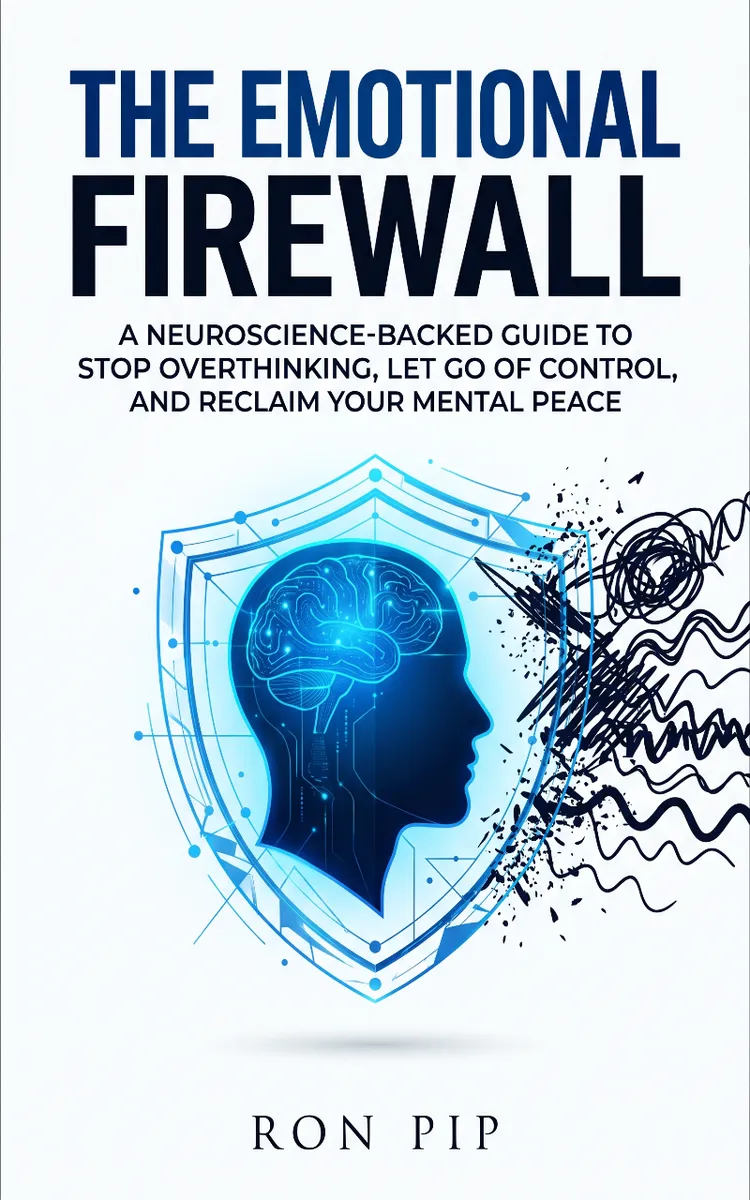
"The Emotional Firewall" is a self-help book by Ron Pip with 12 chapters and approximately 16,344 words. Neuroscience-informed tools for reducing overthinking, control, and emotional exhaustion.
This book was created using Inkfluence AI, an AI-powered book generation platform that helps authors write, design, and publish complete books. It was made with the AI Self-Help Book Writer.
Frequently Asked Questions
What is "The Emotional Firewall" about?
Neuroscience-informed tools for reducing overthinking, control, and emotional exhaustion
How many chapters are in "The Emotional Firewall"?
The book contains 12 chapters and approximately 16,344 words. Topics covered include Why Your Mind Won’t Switch Off, Escaping the Fixer’s Trap, Using the Three-Second Circuit Breaker, Separating Your Feelings from Theirs, and more.
Who wrote "The Emotional Firewall"?
This book was written by Ron Pip and created using Inkfluence AI, an AI book generation platform that helps authors write, design, and publish books.
How can I create a similar self-help book?
You can create your own self-help book using Inkfluence AI. Describe your idea, choose your style, and the AI writes the full book for you. It's free to start.
Write your own self-help book with AI
Describe your idea and Inkfluence writes the whole thing. Free to start.
Start writingCreated with Inkfluence AI


