

Read the first chapter
The whole of chapter one, free. About 8 min. Turn the pages with the arrows, your keyboard, or a swipe.
Chapter 1
The Permit That Smells Wrong
The floatplane’s propeller was still turning when Carl saw the red thread.
It lay beneath the permit tag’s plastic sleeve, a thin bright strand caught in the crimped edge of the paper. The airstrip grass bent flat under the prop wash, silver with autumn rain, while the plane rocked against its lines beside the little outfitter dock.
“Dad?” Frankie shouted over the engine. “Is something wrong?”
Carl lifted one hand for silence. The tag was clipped to the front of his license, stamped with the number he had paid for months ago. Grizzly bear. Kodiak Island. Legal season. His name.
Everything looked right until he turned it over.
The back had been peeled away and pressed down again. Not cleanly. A corner had buckled, and the red thread was trapped in the adhesive.
Carl shut the license case.
“Nothing we can’t handle,” he called.
Frankie hopped from the floatplane’s pontoon onto the wet boards, his pack dragging one shoulder down. At sixteen, he was tall enough to look grown from a distance and still young enough to grin at every new piece of gear. Rain darkened his brown hair. He stared toward the mountains, where low cloud dragged across the slopes like torn wool.
“Tell me that means we’re hunting today.”
“That means we’re unloading.”
“That’s not what I asked.”
Carl stepped off the plane and caught the pack before it slid into the mud. “You want to hunt a bear, you carry your own rifle.”
“I can carry both.”
“You can carry yours.”
Frankie took the pack back, embarrassed but smiling. “You said this was supposed to be once in a lifetime.”
“I said it was supposed to be a hunt.”
“Same thing.”
Behind them, the pilot shouted that the weather window might close by afternoon. The words vanished into the wind. Water ticked against the dock pilings. Somewhere out on the gray bay, a gull cried once and was gone.
Carl looked at the permit again.
The outfitter’s cabin stood twenty yards from the dock, a low green building with a rusted stovepipe and a hand-painted sign over the door. No one answered when he knocked. He knocked again, harder.
Frankie shifted his pack. “Maybe he’s inside.”
“Maybe.”
Carl tried the handle. It opened.
The room smelled of diesel, wet wool, and old coffee. Maps covered one wall. A woodstove crouched in the corner, cold. On the counter sat a ledger, a radio, and a stack of permit envelopes secured beneath a stone.
Carl called out. “Hello?”
No answer came from the back room.
He entered, keeping one hand near the pistol beneath his rain jacket. The cabin had the empty feeling of a place left in a hurry. A mug sat beside the sink with a skin of coffee across its surface. The radio’s red light blinked, but its speaker gave only static.
Frankie waited in the doorway. “Dad.”
Carl came back to the counter. “Stay here.”
“I’m not a kid.”
“Then act like someone who wants to make it into the mountains.”
Frankie’s jaw tightened. He looked past Carl at the permit. “Is that why you’ve been staring at it?”
Carl laid the tag flat on the counter.
“The seal’s been opened.”
Frankie leaned closer. “Could be a mistake.”
“Could be.”
“You checked it at home.”
“I checked the number.”
“And it matched.”
“The number still matches.”
Frankie studied his face. “So what’s the problem?”
Carl ran his thumb over the rough edge of the sleeve. “Someone handled it.”
“Someone at the office?”
“Maybe.”
“Then call them.”
Carl lifted the radio microphone. Static hissed against his ear. He tried the outfitter’s call sign, then the airstrip, then the regional office listed on the permit. Nothing came back except a burst of broken speech too faint to understand.
He set the microphone down.
Frankie’s confidence had thinned, but it had not disappeared. “Could the permit still be legal?”
“Yes.”
“That’s not what I asked.”
Carl looked at his son. The boy had spent the summer shooting at paper targets, cleaning his rifle until the metal shone, and pretending not to care whether his father thought he was ready. Carl had brought him here for the bear, but also for the miles between them to become something easier to cross.
He folded the license case shut. “We’ll verify it before we leave the trailhead.”
Frankie nodded. “And if it checks out?”
“Then we follow the route.”
“And if it doesn’t?”
Carl glanced toward the open door. Rain moved across the dock in fine diagonal lines. Beyond it, Kodiak rose dark and enormous, its valleys hidden under cloud.
“Then we come home.”
Frankie looked at the mountains again. “You’d really turn around?”
“For a bad permit? Yes.”
“And if we’re already out there?”
Carl held his gaze. “Especially then.”
They carried the gear from the cabin to the trailhead, a narrow path beginning behind the dock and climbing through alder. The rain eased as they walked, leaving every leaf jeweled and shaking. Carl took the rifle case in one hand and the food sack in the other. Frankie carried the packs, complaining less with each step.
At the edge of the trail, a wooden post leaned beside a weathered sign. The route map had been covered by a sheet of cloudy plastic. Carl wiped water from it with his sleeve.
The marked trail followed the creek inland, then bent north toward a series of open benches where bear sign was common. Their planned camp lay beyond the first ridge, near a stand of spruce protected from the wind.
Frankie pointed. “That’s our route.”
“That’s the route on the map.”
“You said legal plan and route.”
“I said we’d verify it.”
Frankie pulled the permit from its sleeve. “Here. The tag has the area code.”
Carl took it from him. The printed code was clear. The altered sleeve was not.
A truck engine rumbled somewhere beyond the cabin.
Carl turned.
A dark pickup rolled past the dock road, tires throwing mud. It slowed beside the outfitter’s building, then continued toward the far end of the bay. Carl caught only a glimpse of the driver through the rain-streaked window. The truck disappeared behind a stand of spruce.
Frankie watched him. “Know them?”
“No.”
“Then why are you looking like that?”
“Because they drove past an empty cabin.”
“So?”
“So the cabin may not be empty.”
Frankie glanced back. “You think the outfitter’s hiding?”
“I think we should keep moving.”
They stepped onto the trail.
The first hundred yards climbed through alder thick enough to scrape both shoulders. Water ran beneath the leaves and soaked Carl’s cuffs. Behind him, Frankie’s boots struck stones with careful, uneven rhythm. He had practiced on flat ground. Kodiak offered no flat ground.
“Slow down,” Carl said.
“I’m right here.”
“I know.”
The trail narrowed along the creek. Its water ran brown and fast from the mountain, carrying yellow leaves in spinning circles. Across the channel, a strip of mud showed the fresh impression of a boot.
Carl stopped.
Frankie nearly walked into him. “What?”
Carl crouched beside the bank. The print was deep at the heel, sharp at the toe. Not his. Not Frankie’s. The sole had a square block pattern, with one section worn smooth.
“When did you see that?” Frankie whispered.
“Just now.”
“It’s a trail.”
“It’s a track.”
“Same thing.”
Carl looked upstream. Alder branches trembled there, though no wind reached them. He waited.
Nothing moved.
Then a small stone clicked against another somewhere beyond the bend.
Frankie’s hand went to his rifle.
Carl caught his wrist. “Don’t.”
“I didn’t raise it.”
“You were about to.”
The boy swallowed and lowered his hand. “What do we do?”
Carl studied the boot print again. The mud around it held no water yet. Whoever made it had passed recently.
“We keep going,” he said.
Frankie stared at him. “You said we’d come home if the permit was bad.”
“It isn’t bad.”
“You don’t know that.”
“No,” Carl said. “I don’t.”
He stood and moved forward, placing each boot where the ground was firm. Frankie followed. They crossed beneath a leaning spruce, its roots gripping the bank like black fingers. Ten yards later, Carl found another print.
Same sole. Same worn section.
The trail bent away from the creek and climbed toward the ridge. Carl stopped at the turn. A strip of orange survey tape hung from an alder branch, bright against the wet green. Their map showed no marker there.
Frankie came beside him. “That ours?”
“No.”
“Maybe the outfitter put it up.”
“Maybe.”
“You keep saying that.”
Carl reached for the tape but did not touch it. A knot held it to the branch, pulled tight enough to bite into the bark. Freshly tied. Beneath it, someone had scraped an arrow into the mud, pointing uphill.
The official trail continued along the creek.
Frankie saw the arrow. “That’s not on the map.”
“No.”
“Could be a shortcut.”
“Could be.”
“Dad.”
Carl turned toward the boy. Frankie’s face had lost the easy excitement from the airstrip. Rainwater ran off his hood and down his cheeks, making him look younger again.
“We’re not following it,” Carl said.
“Then why stop?”
“To see if whoever marked it is watching.”
The ridge gave no answer. Wind moved through the spruce with a deep, steady moan. Carl looked back down the trail.
At the last bend, between two alder trunks, something pale showed and vanished.
A face?
A strip of rain gear?
He blinked, and there was only the empty trail.
Frankie whispered, “What did you see?”
“Nothing certain.”
“That’s not nothing.”
Carl took the permit from his pocket. The plastic sleeve was wet and cloudy. Under the edge of the tag, the red thread showed again, bright as a wound.
He made his decision.
“We stay on the marked route,” he said. “We reach the first bench, make camp, and check the permit against the radio when the weather clears.”
Frankie nodded, though his eyes remained on the bend. “And the person behind us?”
Carl slid the permit back into his jacket. “We don’t let them know we’ve seen them.”
They started uphill.
A raven called from somewhere above the ridge. A moment later, another answered from behind them.
Carl did not look back. He listened instead to Frankie’s breathing, to the wet crush of their boots, and to a third sound threading through the trees: the faint scrape of someone stepping onto the trail they had just left.
The permit had gotten them onto Kodiak’s hunting grounds.
It had not gotten them alone.
End of chapter one. 32 more chapters in the full book.
Swipe or use the arrows to turn the page


What's inside: 33 chapters
- 1. The Permit That Smells Wrong
- 2. Frankie’s First River Crossing
- 3. Bootprints With No Scent Trail
- 4. The Shot That Isn’t for Bears
- 5. Carl’s Promise to Keep Frankie Safe
- 6. The Wind Takes Their Shelter
- 7. Following the Wrong Bear Sign
- 8. A Drowned Map in the Tundra
- 9. Frankie Refuses to Be a Burden
- 10. Poachers Light a Signal Fire
- 11. The Radio Code Frankie Hears
- 12. The Snare Line That Wasn’t There
- 13. Frankie’s Injury and the Bear Smell
- 14. The Poacher Shot That Misses
- 15. Tracking the Missing Grizzly Meat
- 16. The Tide That Cuts Their Route
- 17. The Midday Bear That Watches
- 18. Carl Loses Frankie’s Compass Needle
- 19. Poachers Corner Them at the Creek
- 20. The Rifle Shot That Reveals Them
- 21. The Escape Through Alder Maze
- 22. Frankie’s Fever and the Quiet Decision
- 23. Carl Finds the Bear Trap Blueprint
- 24. The Night They Set the Wrong Bait
- 25. Frankie Watches Carl Choose Fear
- 26. The River Ice That Won’t Hold
- 27. Carl Trades His Last Fire Starter
- 28. The Poacher Leader’s Map Confession
- 29. The Ambush on the Bear Trail
- 30. A Father’s Knot and Frankie’s Breath
- 31. Smoke Signals in the Autumn Rain
- 32. Frankie Finds the Poacher’s Evidence
- 33. Kodiak Finally Gives Them Shelter
About this book
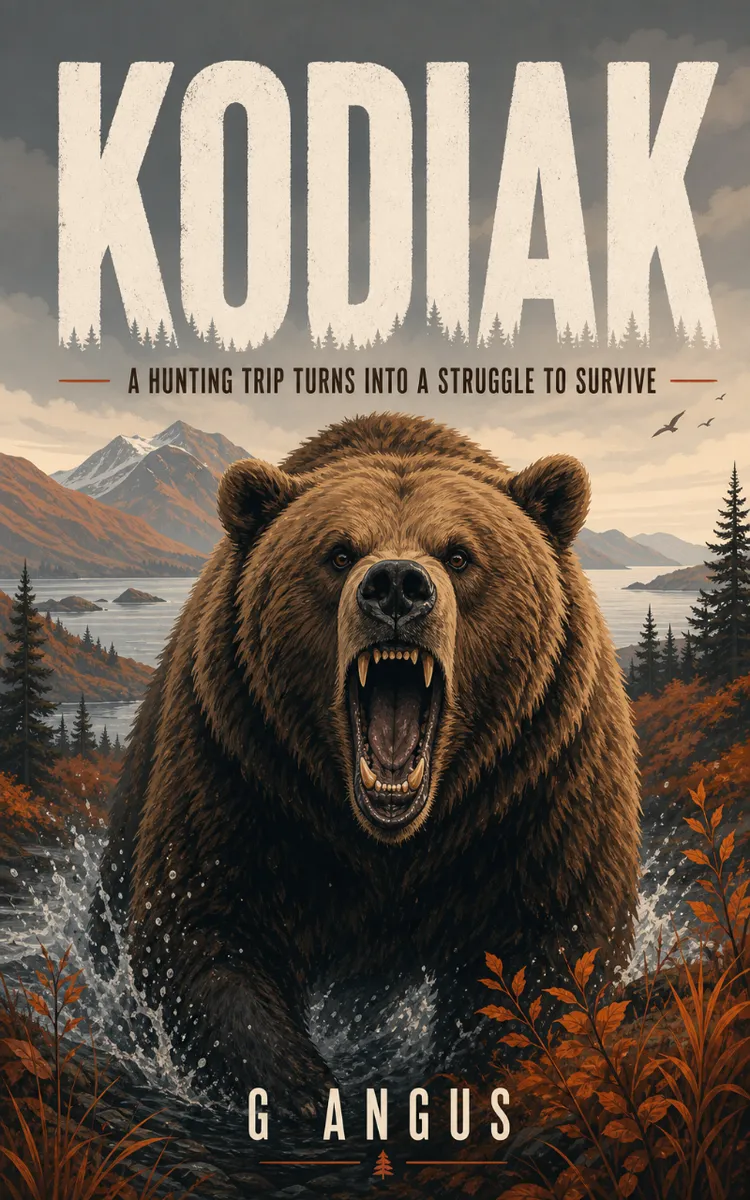
"Kodiak" is a fiction book by G Angus with 33 chapters and approximately 65,535 words. Survival thriller on Kodiak Island involving hunting and poachers.
This book was created using Inkfluence AI, an AI-powered book generation platform that helps authors write, design, and publish complete books. It was made with the AI Novel Writer.
Frequently Asked Questions
What is "Kodiak" about?
Survival thriller on Kodiak Island involving hunting and poachers
How many chapters are in "Kodiak"?
The book contains 33 chapters and approximately 65,535 words. Topics covered include The Permit That Smells Wrong, Frankie’s First River Crossing, Bootprints With No Scent Trail, The Shot That Isn’t for Bears, and more.
Who wrote "Kodiak"?
This book was written by G Angus and created using Inkfluence AI, an AI book generation platform that helps authors write, design, and publish books.
How can I create a similar fiction book?
You can create your own fiction book using Inkfluence AI. Describe your idea, choose your style, and the AI writes the full book for you. It's free to start.
Write your own fiction book with AI
Describe your idea and Inkfluence writes the whole thing. Free to start.
Start writingCreated with Inkfluence AI


