

Read the first chapter
The whole of chapter one, free. About 5 min. Turn the pages with the arrows, your keyboard, or a swipe.
Chapter 1
Prologue: The Keeper’s Daughter
“All right,” her mother said. “Ask.”
Now that she had permission, Ivy Calder had no idea where to begin. It was the same in the classroom. You spent half a term waiting for the quiet child at the back to put up her hand, and when at last she did, you forgot entirely what you had hoped she would say.
She sat in Agnes’s chair at the upstairs window with the receiver warm against her ear. The cottage had not yet given up the day’s cold. Across the slate roofs of Kittiwake Row, Gullhaven Light turned on its headland: the beam came round over the harbor, touched the wet chimneys, crossed the glass in front of her face and went on out to sea, and for a few seconds afterward the window held nothing but her own reflection and the dark.
“There was a keeper’s daughter,” she said. “In 1879. Clara Calder. She was ordered to put the lamp out the night the Mercy Bell came in, and she did, and she was blamed for it, and she left Gullhaven. Her baby stayed. The baby was Rose.”
On the line, very faintly, a kettle ticked as it cooled. Three hours inland, in a kitchen in Halberton, her mother was standing by the stove in her dressing gown. Ivy did not need to see it to know it. June Calder did not take serious telephone calls sitting down.
“Rose,” June said. “Your gran’s mother.”
“Yes.”
“Well.” The small click of reading glasses being let fall on their chain. “I never met her. She’d gone before my time. But your gran talked about her once. Only the once, mind, and I’m not sure she meant to.”
Ivy waited. She had learned that from Rowan as much as from the children: if you wanted the rest of a sentence, you let the silence run a little past comfortable.
“You were small,” June said. “You’d had the measles, and I brought you down to Kittiwake Row so she could have you for a week and I could sleep. We were sat in her kitchen, and the light was coming in at the window the way it does, round and round, and she said—“ June stopped. When she went on, her voice had gone flatter and more careful, the voice of a person handing back someone else’s words exactly as she was given them. “She said, ‘My mother saw a light that wasn’t the lighthouse. She told the town so. And the town never forgave her.’”
The beam came round. It lit the glass, and Ivy’s face, and went.
“Rose was a baby in 1879,” Ivy said. “She can’t have seen anything.”
“I’m only telling you what Agnes said, love. I didn’t ask. You didn’t, with your gran. She’d look at you over the teapot and you’d find you’d changed the subject yourself.”
That was true. Ivy had done it a hundred times.
“And then,” June said, “she made me promise something.”
“What?”
“That I’d never let you go keeping.”
Ivy looked down. On the sill, beside the telephone, lay a plain brass key on a loop of red cord, still bright at the teeth. She had set it there when she came in, carefully, the way she might have set down a bird’s egg somebody had brought to school in a matchbox.
“Go keeping,” she repeated.
“I thought it was one of her sayings. You know how she was. Mind the step. Never trust a man who says frankly. Don’t let the girl go keeping. I promised the way you promise a woman holding a teapot.” A small dry sound that was not quite a laugh. “And then you got yourself a clipboard and walked up that hill every Saturday for six years, and I never said a word. I suppose I’ve broken that.”
“You didn’t break it,” Ivy said. “I did. Tonight.”
She did not explain about the key. She was not sure she could yet, not without her voice doing something she would have to apologize for.
Outside, a gull landed on the ridge of the house opposite, considered the weather, and left in disgust. The harbor lamps showed smudged and yellow through the last of the fog.
“Mum,” she said. “Did Dad know? Any of it?”
The silence this time was a different kind. It was not the silence before a secret decides whether to come out. It was the one after it has decided not to.
“Not on the telephone, love.”
“Mum—“
“Not on the telephone.” Gentler now. “It’s late and you’ve school in the morning. Go to bed. Eat something first. You won’t have.”
She had not.
“Goodnight, Mum.”
“Goodnight, Ivy. Lock your door.”
Ivy put the receiver back in its cradle and sat a long while with her hands in her lap. Then she picked up the key on its red cord and held it until it warmed, and watched the light come round, and round, and go on. A light that wasn’t the lighthouse. She turned the words over and could find no edge on them to hold. Agnes had said a great many things over the teapot that sounded like weather and turned out, years later, to be directions.
Somewhere down the Row a door banged, and a dog said something about it, and was told to hush.
Behind her, on the wall at the head of the stairs, hung the sampler. It had hung there all her life, in a narrow black frame with one corner coming loose, its linen yellowed to the shade of an old envelope and its silks faded so far back into the cloth that the stitched letters were more a texture than a sentence. Agnes had dusted it every Friday with the corner of her apron. Ivy had passed it ten thousand times: going up to bed, coming down to breakfast, running late for school with her shoes in her hand. She had tried to read it once, at seven or eight, standing on the bottom stair with her nose to the glass, and had found it too faded even then to be worth the trouble. After that it had simply been part of the wall, like the crack above the door and the nail where a calendar used to hang. One does not read one’s own front door.
She did not look at it now.
She went down to the kitchen to find something to eat, and the sampler kept its words to itself on the wall in the dark, as it had for longer than anyone in the house had been alive, waiting for somebody to bother.
End of chapter one. 15 more chapters and about 68,151 words in the full book.
Swipe or use the arrows to turn the page

Shadows At Gullhaven Light

The Ultimate Newfoundland Hiking & Adventure Guide

The Ultimate Newfoundland and Labrador Bucket List: Travel Experiences
What's inside: 16 chapters
- 1. Prologue: The Keeper’s Daughter
- 2. The Drawer Beneath the Desk
- 3. Thirty-Seven Names
- 4. The Man Who Restores Things
- 5. Blackwater House
- 6. The Light That Wasn’t the Lighthouse
- 7. Posy’s Spelling Test
- 8. The Boathouse Again
- 9. The Archive After Hours
- 10. Step and Drag
- 11. Rose’s Testimony
- 12. The Scaffold in the Wind
- 13. What the Sampler Kept
- 14. The Vault Under the Chapel
- 15. Thirty-Seven Bells
- 16. A Mark from Beyond the Ledger
About this book
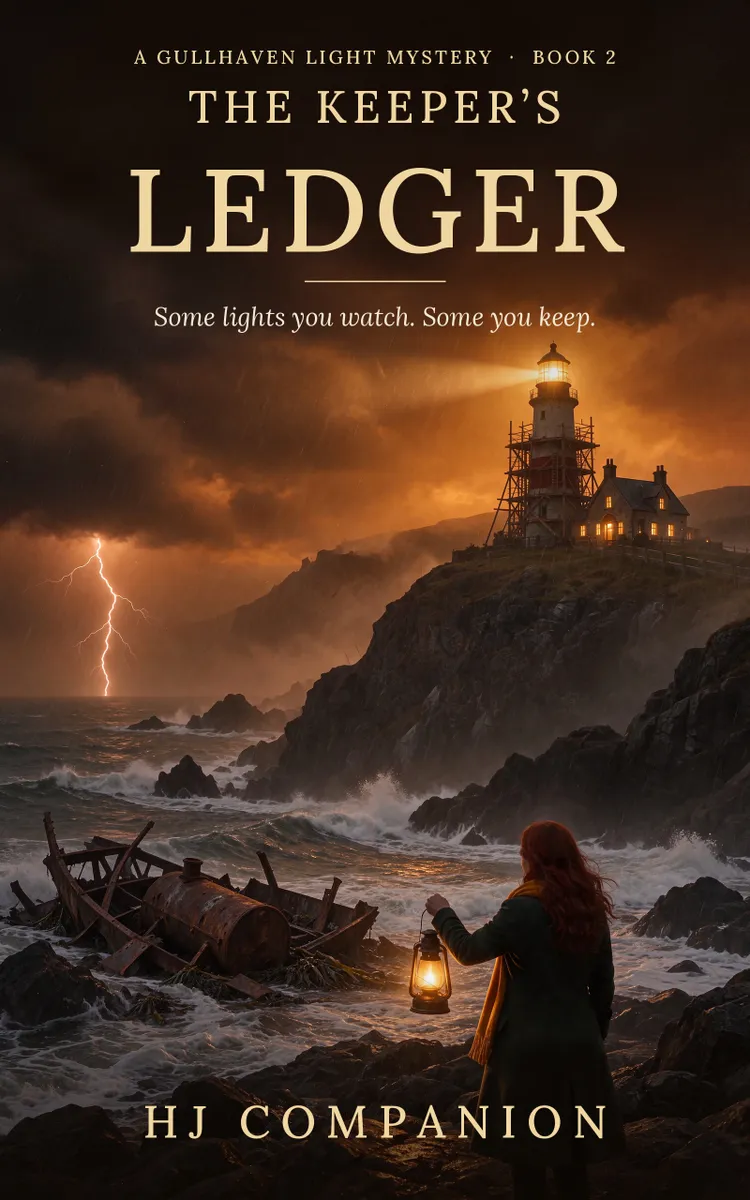
"The Keeper’s Ledger" is a fiction book by HJ Companion with 16 chapters and approximately 68,151 words. A sealed ledger, a sunken steamer and a great-grandmother no one believed. Book 2 of the Gullhaven Light Mysteries.
This book was created using Inkfluence AI, an AI-powered book generation platform that helps authors write, design, and publish complete books. It was made with the AI Novel Writer.
Frequently Asked Questions
What is "The Keeper’s Ledger" about?
A sealed ledger, a sunken steamer and a great-grandmother no one believed. Book 2 of the Gullhaven Light Mysteries.
How many chapters are in "The Keeper’s Ledger"?
The book contains 16 chapters and approximately 68,151 words. Topics covered include Prologue: The Keeper’s Daughter, The Drawer Beneath the Desk, Thirty-Seven Names, The Man Who Restores Things, and more.
Who wrote "The Keeper’s Ledger"?
This book was written by HJ Companion and created using Inkfluence AI, an AI book generation platform that helps authors write, design, and publish books.
How can I create a similar fiction book?
You can create your own fiction book using Inkfluence AI. Describe your idea, choose your style, and the AI writes the full book for you. It's free to start.
Write your own fiction book with AI
Describe your idea and Inkfluence writes the whole thing. Free to start.
Start writingCreated with Inkfluence AI


