
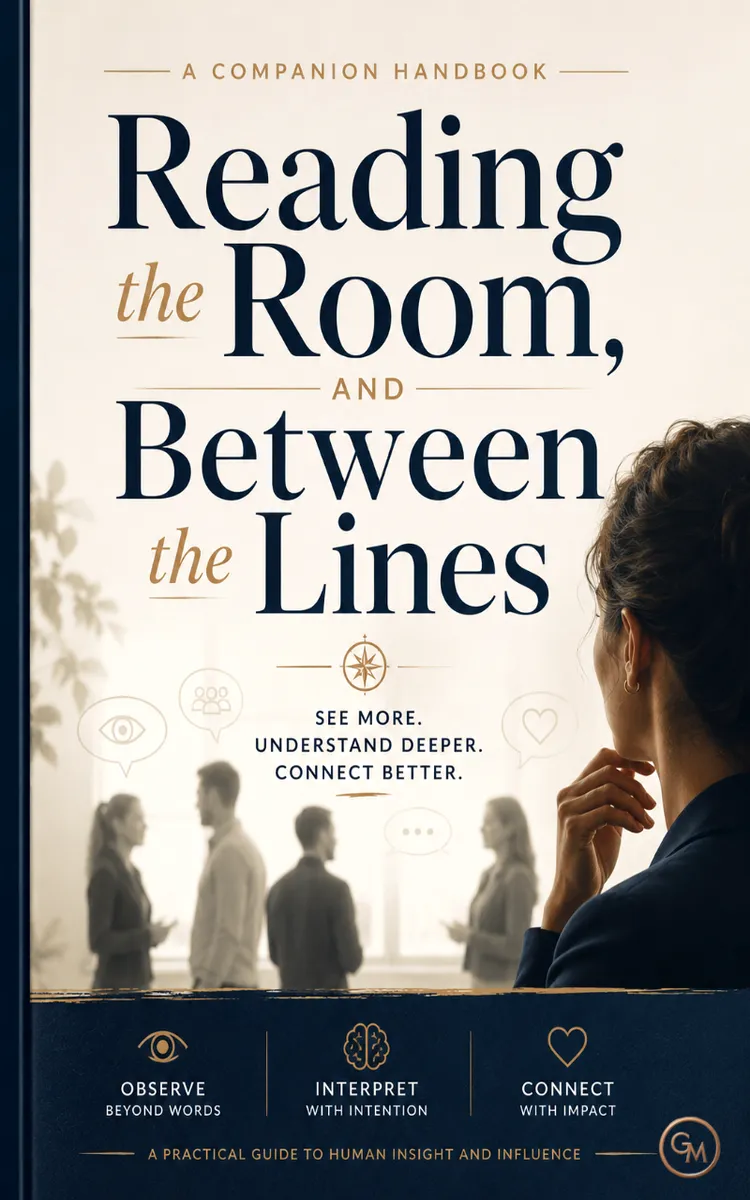

Your emotions are not mysterious, they are data. The problem is, your brain turns that data into stories you cannot easily question, and then you pay for it in relationships, conversations, and self-trust. In Emotional Intelligence, Rewired, you will learn how emotional patterns form, how trauma-shaped beliefs edit your meaning, and how to build emotional safety within so your first reaction becomes a useful signal instead of a verdict. You will practice practical, repeatable skills to name what is happening, label the loop, slow the rewrite, and respond from clarity. If you want relationships that feel steadier and clearer, start here.
Table of Contents
- 1. Naming Your Emotional Patterns
- 2. Rewriting the Stories Your Brain Tells
- 3. Building Emotional Safety Within
- 4. Turning Triggers Into Information
- 5. Decoding Subtext From Micro-Behaviors
- 6. Asking Better Questions for Clarity
- 7. Navigating Social Nuance Without People-Pleasing
- 8. Communicating Needs With Emotional Accuracy
- 9. Managing Conflict With Repair Moves
- 10. Decoding Attachment and Trauma Signals
- 11. Building Resilience After Emotional Hijacks
- 12. Designing a Personal Emotional IQ Plan
Preview: Naming Your Emotional Patterns
A short excerpt from “Naming Your Emotional Patterns”. The full book contains 12 chapters and 19,445 words.
Your emotions aren’t mysterious - you’re just missing the labels your body has been using all along.Last week, Talia (34, customer support lead) sat down after a long shift and realized she’d been “fine” all day - until one customer message hit her inbox. The tone was a little sharp, the request was a little vague, and suddenly her chest felt tight like someone had turned the volume up on her anxiety. Then she did what she always did: she reread the message like it was going to change. It didn’t. She rewrote a reply three times. Her manager praised her professionalism, but Talia stayed keyed up, like the interaction had followed her home.
That’s the thing about emotional patterns: they can look like “just how you are.” But there’s usually a repeatable trigger, a repeatable label, and a repeatable outcome. Once you name the loop, your feelings stop running the show - and start giving you usable information.
You’ll learn to spot the same trigger showing up in different outfits.
You’ll start mapping feelings to labels instead of guesses.
You’ll use a quick check-in so your reactions feel readable, not random.
You’ll practice a simple challenge that turns “I don’t know why I’m upset” into “Ah - there it is.”
The Pattern: How it shows up when you’re sure you “shouldn’t” feel this wayTalia’s pattern had a familiar shape. A customer would be frustrated, and the message would contain the same mix: a complaint + a vague demand + a hint that she (personally) was the problem. Her brain would jump straight to interpretation: They’re blaming me. Even if the customer never used the word “you,” Talia’s body acted as if it had. Her shoulders tightened. Her mind started scanning for what she might have missed. And then came the habit that looked like responsibility but felt like self-defense - she over-prepared the response, softened every sentence, and tried to “win” the interaction with extra clarity.
Afterward, she’d feel embarrassed that she’d reacted so hard. That’s where the “label fog” thickened. She didn’t say, “I’m feeling blamed.” She said, “I’m being dramatic.” Or, “I’m just stressed.” Those labels weren’t wrong - her stress was real - but they were too general. They didn’t explain the specific pull: the moment her system decided the message was about her worth. When you only use broad labels, your feelings stay slippery. When you use precise ones, they become trackable.
So - does your body do something similar, where a specific kind of moment flips you into a certain mode, and you later talk yourself out of it because it “doesn’t make sense”?
A New Perspective: The question that names the loop before it takes you overWhat if the feeling isn’t the problem - what if it’s your system’s label for a very old trigger?Try that on for size. Not as a philosophy thing. As a practical question. Because if you treat the feeling as a signal, you stop trying to argue with it. You start asking what it’s trying to protect. For Talia, the old trigger wasn’t “customer service.” It was the emotional meaning her nervous system attached to being evaluated or misunderstood. When she read a message that sounded unfair, her body didn’t just “get annoyed.” It treated the situation like a verdict. That’s why her reaction had urgency. That’s why she couldn’t just move on after hitting send.
Here’s a before-and-after example from her week. Before: she’d read the customer’s line - “I’ve been waiting” - and her stomach would drop. She’d immediately draft a long apology, add extra explanations, and double-check every detail like she was trying to prevent punishment. After: she paused at the first spike and asked herself, “What label is my system using right now?” In that moment, the label came clearly: “I feel blamed.” Not “I’m stressed.” Not “I’m tired.” Blamed. Once she named it, she could choose her next sentence like a person, not like a reflex. Her reply became shorter and steadier, and she stopped trying to prove she deserved good treatment.
That one shift - feeling as information - changes what you do next. It also changes what you call the moment after it’s over. Instead of “I overreacted,” you can say, “My label got activated.” That phrasing might sound small, but it gives you distance. Distance gives you choice.
So ask yourself again: when you feel intense, do you ever wonder whether you’re responding to the meaning of the moment more than the moment itself?
Breaking It Down: The Pattern-Label Map chain (and the alternative chain)When you can see the loop, you can interrupt it. The Pattern-Label Map is simple: you’re tracking trigger → label → action → outcome, and you’re doing it in the same order every time you notice yourself getting pulled.
When you receive a message that sounds like a verdict (vague complaint, tone shift, “you should’ve…” energy)
You feel tightness + urgency (your body decides you’re on trial)
So you over-correct - re-read, rewrite, add reassurance, try to pre-defend
...
About this book
"Reading the Room and Between the Lines" is a self-help book by Grant Mason with 12 chapters and approximately 19,445 words. Your emotions are not mysterious, they are data. The problem is, your brain turns that data into stories you cannot easily question, and then you pay for it in relationships, conversations, and self-trust.
This book was created using Inkfluence AI, an AI-powered book generation platform that helps authors write, design, and publish complete books. It was made with the AI Self-Help Book Writer.
Frequently Asked Questions
What is "Reading the Room and Between the Lines" about?
Your emotions are not mysterious, they are data. The problem is, your brain turns that data into stories you cannot easily question, and then you pay for it in relationships, conversations, and self-trust. In Emotional Intelligence, Rewired, you will learn how emotional patterns form, how trauma-shaped beliefs edit your meaning, and how to build emotional safety within so your first reaction becomes a useful signal instead of a verdict. You will practice practical, repeatable skills to name what is happening, label the loop, slow the rewrite, and respond from clarity. If you want relationships that feel steadier and clearer, start here.
How many chapters are in "Reading the Room and Between the Lines"?
The book contains 12 chapters and approximately 19,445 words. Topics covered include Naming Your Emotional Patterns, Rewriting the Stories Your Brain Tells, Building Emotional Safety Within, Turning Triggers Into Information, and more.
Who wrote "Reading the Room and Between the Lines"?
This book was written by Grant Mason and created using Inkfluence AI, an AI book generation platform that helps authors write, design, and publish books.
How can I create a similar self-help book?
You can create your own self-help book using Inkfluence AI. Describe your idea, choose your style, and the AI writes the full book for you. It's free to start.
Write your own self-help book with AI
Describe your idea and Inkfluence writes the whole thing. Free to start.
Start writingCreated with Inkfluence AI


