

Read the first chapter
The whole of chapter one, free. About 8 min. Turn the pages with the arrows, your keyboard, or a swipe.
Chapter 1
Rewriting Your Inner Story Scripts
Picture This: The Script You Don’t Know You’re Reading
Talia, 34, HR manager, is the kind of person who can read a room like it’s a calendar - quietly, accurately, and a little too fast. One Monday, a senior teammate snaps during a meeting. The words are sharp, but what hits Talia hardest is the moment right after: the silence, the tight smiles, the way everyone starts deciding what’s “safe” to say.
By lunchtime, she’s already built a whole story in her head. He’s stressed. It’s not about me. If I handle this right, nobody will be upset with me. She drafts an email that sounds “neutral” and “professional.” She smooths it with extra politeness. Then she waits - because if she waits long enough, the tension will somehow dissolve. It doesn’t. She goes home feeling like she did her job… and still failed at being okay.
Here’s the uncomfortable part: Talia isn’t just reacting to the meeting. She’s responding to a childhood-flavored inner narrator - one that learned early which version of her would keep things calm. And the narrator has been running the same loop so long that it feels like “her personality,” not a script that can be rewritten.
What if the real reason you keep feeling stuck isn’t your life - it’s the story your mind keeps insisting is true?
The Mindset Shift: From “That’s Just Who I Am” to “That’s a Script I Can Update”
Old Belief: “If I’m anxious, people-pleasing, or quick to apologize, that’s just my personality. I have to manage it, not change it.”
New Reality: “Those patterns often come from childhood narratives that protected me back then - and now they’re identity-shaped scripts I can replace with kinder, truer ones.”
When Talia’s email goes out, she feels relief for about ten minutes. Then her stomach tightens again. Not because the email was wrong - because her inner story is still bargaining: If I’m careful enough, I’ll prevent conflict. If I’m perfect enough, I’ll be safe. That’s not a personality trait. It’s a strategy that used to work.
Think about how childhood narratives become adult identity. When you’re young, you don’t have the luxury of “I wonder why.” You have to make sense fast. If a caregiver was unpredictable, you may have learned to read cues constantly. If you were praised for being easy, you may have learned that your needs are “extra.” If your feelings were dismissed, you may have learned to edit yourself before anyone else does. Over time, the mind turns those learned patterns into identity language: I’m responsible for everyone’s emotions. I’m too much. I’m not allowed to take up space.
Here’s why the mindset shift matters: when you label the pattern as “identity,” you try to fix it by forcing yourself to be different. When you label it as “script,” you can rewrite it - word by word, moment by moment.
Concrete example: after that meeting, Talia usually drafts a follow-up that sounds like she’s clearing debris off everyone else’s shoes. But instead, she tries a new inner script while she writes: My job is to address the issue, not to absorb the fallout. She removes two lines of over-explanation. She adds one clear sentence: “I’d like to align on expectations for how feedback is delivered.” Same professionalism - less self-erasure. And later, when someone misreads her tone, she doesn’t spiral into guilt as fast. She still feels it, but she can catch the script in real time: Oh, there it is - the old “make it safe” story.
That’s the shift. Not “be less anxious.” More like: “Stop confusing your old safety system with your current self.”
Going Deeper: How Childhood Narratives Become Identity (and How to Spot the Running Pattern)
Childhood narratives don’t just influence your choices - they shape your self-talk. They become the “common sense” your mind reaches for under stress. The reason it feels automatic is that your nervous system learned that script as a survival shortcut. When life gets tense, the brain doesn’t ask, “Is this true?” It asks, “Is this familiar?” Familiar usually means faster. Faster used to mean safer.
So when you feel yourself people-pleasing, minimizing, over-explaining, or volunteering for emotional labor, you’re often watching an old narrative defend you. It’s protecting something like belonging, approval, or peace. The cost is that you start living from the script instead of from your values.
Signs this pattern is running your life
• You treat discomfort like danger. If someone looks upset, your body reacts before your brain has time to think.
• You translate your feelings into logistics. You don’t just feel stressed - you immediately start managing outcomes: emails, schedules, tone, timing.
• You “edit” yourself before anyone asks. You soften statements, shrink opinions, or add disclaimers even when you’re right.
• You feel responsible for the emotional weather. If the room shifts, you assume you caused it - or you must fix it.
The core difference: scripts sound like facts, but they’re really learned meanings.
A script can feel like truth because it was built to keep you safe. But safety stories don’t always fit adult reality.
If you want a simple way to catch this, think about the language your mind uses in tense moments. Talia’s inner story didn’t say, “I’m anxious.” It said, This is on me. If I handle it right, I’ll prevent consequences. That’s an identity-level claim disguised as common sense. And identity-level claims are heavy - because they’re not just guiding behavior; they’re defining who you are.
Reflection & Self-Assessment: Reading Your Inner Story Scripts Without Blaming Yourself
Let’s make this practical. You don’t need to dig up every childhood memory to rewrite the script. You need to notice the pattern in your present life and trace what it’s trying to protect.
Here are thought-provoking questions that help you do exactly that:
• When you feel the urge to people-please, what are you afraid would happen if you didn’t?
Try answering with the emotional outcome, not the polite version. Example: “I’m afraid they’ll think I’m difficult,” or “I’m afraid I’ll be blamed.”
• What sentence does your mind say right before you act?
Write it down exactly as it appears. Even if it sounds dramatic. “Don’t make waves.” “Be grateful.” “Fix it fast.” Those are often script lines, not your true thoughts.
• Who taught you that sentence - directly or indirectly?
You’re not trying to “prove” anything. You’re looking for the vibe. Was it a caregiver who avoided conflict? A household where feelings were inconvenient? A school environment that rewarded compliance?
• If that script had a job title, what would it be?
For Talia, it might be: Conflict preventer. For someone else it might be: Needing-less manager. Naming the job helps you see the protection behind it.
• When you follow the script, what do you gain - and what do you lose?
Be honest. You might gain temporary peace, and lose authenticity, boundaries, or self-trust. Both can be true.
If you’re worried this turns into self-blame, slow down. Reflection here isn’t about hunting for a villain. It’s about honoring that your mind learned what it needed to survive. The rewrite comes later. First you get fluent in what you’ve been saying to yourself.
Growth Challenge: The Story-to-Self Script Audit (7 Days)
For the next week, you’re going to do a quick audit of your inner narratives - without turning it into a therapy marathon. This is about catching scripts while they’re still small enough to change.
Challenge: “Catch, Name, Rewrite” for 7 Days
• Day 1: Pick one recurring situation (work meetings, texting back, family calls, conflict conversations). Write the moment you feel the “pull” to shrink, explain, or fix.
• Day 2: Write the exact inner sentence you say during that moment. Keep it short - one line.
• Day 3: Name the script’s job. Ask: “What is this trying to protect?”
• Day 4: Write a kinder, truer replacement sentence that fits adult reality. (Example for Talia: My job is clarity, not emotional rescue. )
• Day 5: Use the replacement once in a low-stakes moment. Notice what changes in your body and your outcome.
• Day 6: Review what felt easier and what felt harder. Adjust the replacement sentence so it’s believable enough to use.
• Day 7: Choose one boundary or communication shift you’ll keep doing because it matches the new script.
Difficulty rating: Medium (not because it’s hard - because it asks you to be honest in real time)
You’ll know it’s working when…
• You catch the script sooner (even by a few minutes).
• Your body feels the pull, but you don’t automatically obey.
• The replacement line starts feeling less like “positive thinking” and more like “finally, that’s me.”
A quick note: you don’t need to “win” every interaction this week. You’re training recognition and choice. That’s the real muscle.
Key Takeaway: Your Identity Isn’t Fixed - Your Inner Story Is Edit-Ready
The biggest relief in all of this is realizing you’re not trapped inside your childhood. You’re carrying forward the meaning your mind attached to those experiences. And meaning can be rewritten.
Here’s what Talia eventually notices after a few weeks of auditing her scripts: she still cares about people. She still wants things to run smoothly. But she stops treating her nervous system’s old alarm as a command. When she feels the urge to over-explain, she can ask one question instead: Is this script helping me be the adult I’m becoming - or the kid I’m trying to protect?
Your inner story scripts don’t have to be true to run your life - so you can replace them even before you feel “ready.”
• Childhood narratives often turn into identity language - especially under stress.
• Scripts can sound like facts, but they’re learned meanings doing a protective job.
• You can audit your scripts by catching the moment, naming the job, and rewriting one sentence you can actually use.
• Change starts with recognition and choice, not with perfect behavior.
Next, we’ll take what you’ve found in this audit and build the next layer: how to respond to those scripts in real conversations - so your new self-talk doesn’t stay trapped in your journal, but shows up where it matters most.
End of chapter one. 9 more chapters in the full book.
Swipe or use the arrows to turn the page


What's inside: 10 chapters
- 1. Rewriting Your Inner Story Scripts
- 2. Breaking the Perfectionism Safety Loop
- 3. Building Secure Attachment in Adulthood
- 4. Calming Your Nervous System Under Stress
- 5. Reparenting Your Boundaries Without Guilt
- 6. Communicating Needs Like a Trauma-Smart Adult
- 7. Turning Triggers Into Choice Points
- 8. Designing a Purpose-Driven Recovery Plan
- 9. How These Habits Got Wired
- 10. What if everyone you judge is just following an old survival script?
About this book
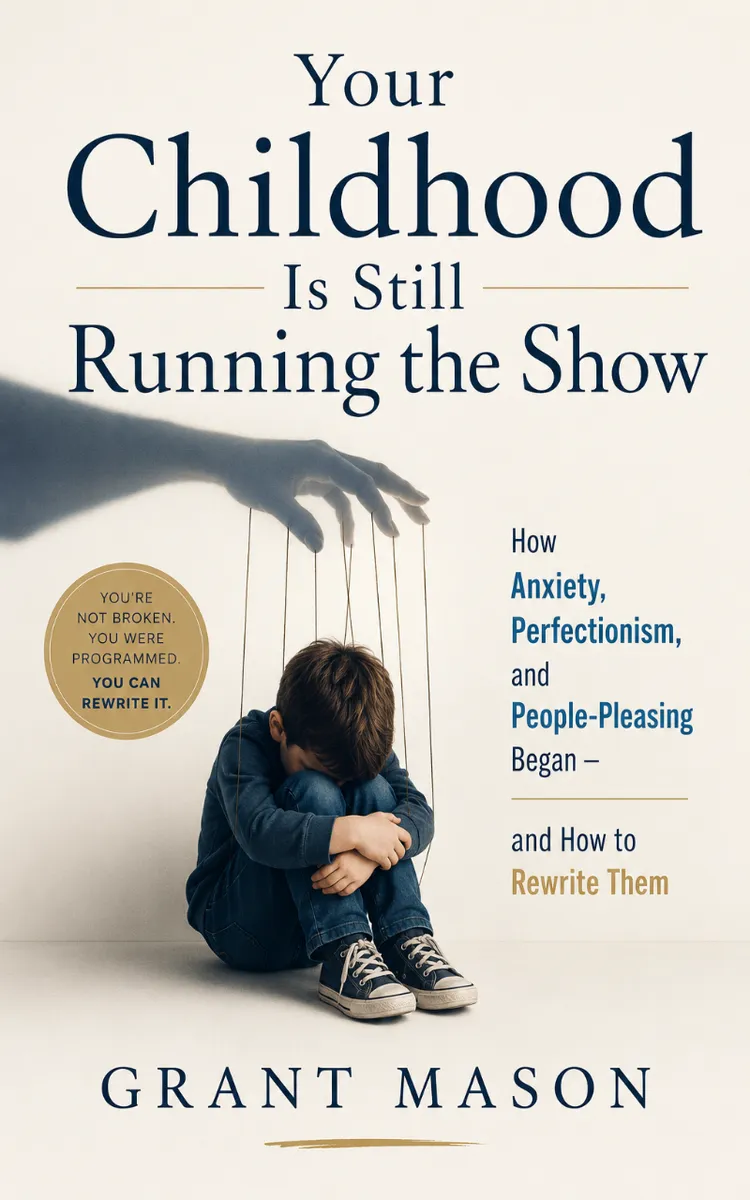
"Your Childhood Is Still Running the Show" is a self-help book by Grant Mason with 10 chapters and approximately 15,555 words. Stop treating your reactions like character flaws and start treating them like learned scripts you can update. This book shows you how childhood experiences shape adult behavior and wellbeing, so you can build the growth, confidence, and stability you keep trying to force.
This book was created using Inkfluence AI, an AI-powered book generation platform that helps authors write, design, and publish complete books. It was made with the AI Self-Help Book Writer.
Frequently Asked Questions
What is "Your Childhood Is Still Running the Show" about?
Stop treating your reactions like character flaws and start treating them like learned scripts you can update. This book shows you how childhood experiences shape adult behavior and wellbeing, so you can build the growth, confidence, and stability you keep trying to force. You will learn how to identify the perfectionism safety loop, recognize the attachment triggers that hijack your voice and timing, and rewrite the inner story your mind insists is true. Instead of trying to “be less emotional” or rely on willpower, you will practice interrupting the body-driven sequence that keeps you stuck. By the end, you will have a clear map for understanding your patterns and a set of practical ways to help clients or yourself move toward secure, grounded change.
How many chapters are in "Your Childhood Is Still Running the Show"?
The book contains 10 chapters and approximately 15,555 words. Topics covered include Rewriting Your Inner Story Scripts, Breaking the Perfectionism Safety Loop, Building Secure Attachment in Adulthood, Calming Your Nervous System Under Stress, and more.
Who wrote "Your Childhood Is Still Running the Show"?
This book was written by Grant Mason and created using Inkfluence AI, an AI book generation platform that helps authors write, design, and publish books.
How can I create a similar self-help book?
You can create your own self-help book using Inkfluence AI. Describe your idea, choose your style, and the AI writes the full book for you. It's free to start.
Write your own self-help book with AI
Describe your idea and Inkfluence writes the whole thing. Free to start.
Start writingCreated with Inkfluence AI


