
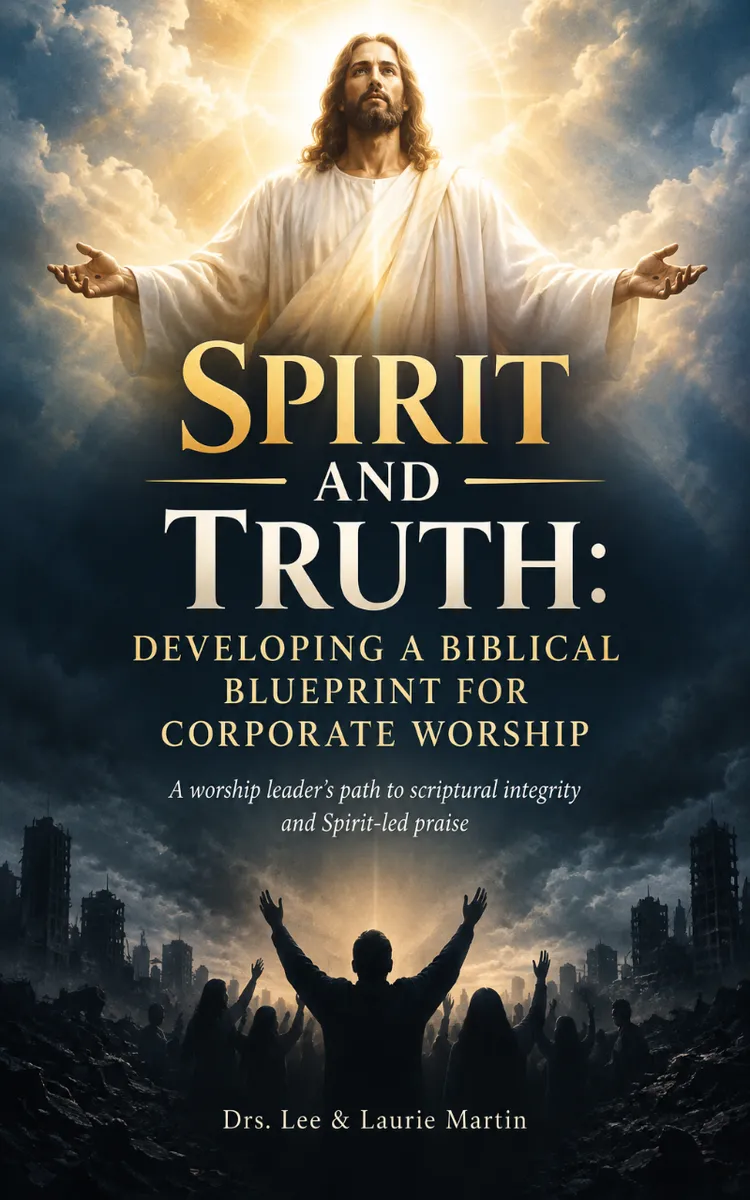

Read the first chapter
The whole of chapter one, free. About 7 min. Turn the pages with the arrows, your keyboard, or a swipe.
Chapter 1
The Holy Invitation to Worship
Scripture Focus
Isaiah 6:3
> “Holy, holy, holy is the LORD of hosts; the whole earth is full of his glory!”
Before worship is something we lead, it is a response to the holy God whose glory fills creation.
The first sound in Isaiah’s worship was not a song written for a service. It was the cry of heavenly beings who saw God as He is. Their repeated “holy” was not empty emphasis. It expressed the unmatched purity, majesty, and otherness of the Lord. He isn’t merely better than us. He is altogether set apart.
That vision gives worship leaders a needed starting point. We often begin with a set list, a key, a rehearsal plan, or a discussion about transitions. Those things matter. They help a gathered church sing together. But biblical worship begins earlier - with God’s holiness and our response to it. The question isn’t first, “What will create a strong moment?” It is, “Who is the God we are gathering to honor?”
Scripture traces this response from the opening pages of creation. “In the beginning, God created the heavens and the earth” (Genesis 1:1). Creation itself displays His glory. The heavens declare it, the skies proclaim it, and every living thing depends on His sustaining word (Psalm 19:1; Psalm 104:27-30). Worship doesn’t begin when a band plays the first chord. It begins because God is Creator, and all that exists belongs to Him.
The patriarchs learned to answer that reality with altars, obedience, and calling on the Lord’s name. Abraham built an altar after God appeared to him and promised the land (Genesis 12:7). He built another near Bethel and called on the name of the Lord (Genesis 12:8). Isaac built an altar at Beersheba and called on the Lord (Genesis 26:25). Jacob raised an altar after God met him and changed his understanding of home, promise, and presence (Genesis 35:1-7).
These moments weren’t detached religious customs. They joined worship to a life of trust. Abraham’s altar pointed to a promise he had not yet seen fulfilled. Jacob’s worship followed a hard season of conflict and return. Their worship declared that God was worthy before circumstances became easy.
That matters for us on a Sunday morning. We may arrive carrying fatigue, unresolved conflict, financial pressure, or disappointment from the previous week. The gathered church doesn’t worship because every person feels ready. We worship because the Lord remains holy and faithful. Worship is a response to God’s revealed worth, not a reward for a perfect week.
Israel’s story makes this even clearer. God delivered His people from Egypt, brought them through the sea, and then formed them into a covenant people. At Sinai, He called them to be “a kingdom of priests and a holy nation” (Exodus 19:6). Their worship included sacrifice, music, priestly service, feasts, silence, confession, and joyful celebration. It was never meant to be disconnected from how they lived.
The tabernacle taught Israel that God was near, yet holy. His presence was a gift, not a possession. The priests served according to His instructions, and the people approached with reverence. Later, when Solomon dedicated the temple, singers and musicians joined the priests in declaring, “For he is good, for his steadfast love endures forever” (2 Chronicles 5:13). The glory of the Lord filled the house so fully that the priests could not stand to minister.
The gathered people of God were learning a lasting truth: worship is both joyful and weighty. There is celebration, but there is also awe. There are instruments and voices, but there is also submission. The goal is not to make a room feel impressive. The goal is to honor the Lord in truth.
The New Testament gathers this story around Jesus. He tells the Samaritan woman that the Father is seeking worshipers who worship “in spirit and truth” (John 4:23-24). Through Christ, we draw near to God with confidence, because His blood cleanses us and His priesthood is sufficient (Hebrews 10:19-22). Yet grace doesn’t make holiness irrelevant. It brings us into holy fellowship and teaches us to offer our bodies as “a living sacrifice, holy and acceptable to God” (Romans 12:1).
So the church’s worship is not a performance placed before an audience. It is the response of a redeemed people to the Father, through the Son, by the Holy Spirit. The songs we sing, the prayers we lead, and the way we serve should agree with that reality.
Reflection
A worship leader can care deeply about God and still become distracted by the mechanics of a gathering. We count bars, watch the clock, check the monitor mix, and listen for the right vocal entrance. These responsibilities are real. They serve the church. But they can quietly become the center if we aren’t careful. The holy God we came to honor can fade behind the details of the service.
Isaiah’s vision corrects our focus. The seraphim weren’t impressed with Isaiah’s leadership ability. They weren’t evaluating the room’s atmosphere. They were overwhelmed by the Lord’s holiness. Their worship came before Isaiah had a ministry assignment. Once he encountered God, he recognized his own uncleanness: “Woe is me! For I am lost; for I am a man of unclean lips” (Isaiah 6:5). God then provided cleansing and called him to serve.
That order is important. We don’t cleanse ourselves so we can earn a place near God. God graciously cleanses and sends His people. Still, those who lead worship should welcome the Spirit’s searching work. A strong vocal, a polished arrangement, or a moving response cannot replace integrity. The Lord cares about the leader’s hidden life as well as the public song.
This doesn’t mean you must approach the platform with dread. It means you approach with honesty. If you’re irritated with a team member, bring that to the Lord before rehearsal. If you’re chasing approval, name it instead of dressing it up as excellence. If your private life contradicts the words you’re asking the church to sing, don’t ignore the tension. Receive the Father’s correction as an invitation to walk in the light.
The patriarchs also remind us that worship is built into ordinary obedience. Abraham worshiped by trusting God’s promise. Jacob worshiped by returning to Bethel and putting away foreign gods from his household (Genesis 35:2-4). Israel worshiped by remembering deliverance and keeping covenant. For us, preparation for corporate worship includes more than practicing notes. It includes forgiving, telling the truth, keeping commitments, and making room for prayer.
The holiness of God gives worship its center, and integrity gives our leadership its credibility. Not perfection - credibility. Your congregation doesn’t need a leader who pretends to have no weakness. It needs a leader who brings weakness into the light and keeps turning toward Christ.
This also shapes how we think about musical expression. Scripture gives the people of God a rich vocabulary: singing, shouting, kneeling, lifting hands, giving thanks, clapping, bowing, and being still (Psalm 46:10; Psalm 47:1; Psalm 95:6; Psalm 96:1-2; Psalm 134:2). These expressions aren’t tools for controlling a congregation. They are responses to God’s character and works. A lifted hand is not automatically sincere, and quietness is not automatically reverent. The Lord looks at the heart (1 Samuel 16:7).
That’s why technical structure and Spirit-led freedom belong together. A prepared arrangement can help the church participate. A responsive leader can notice when a lyric needs space, when a prayer should be extended, or when the congregation needs to sing a truth again. But neither structure nor spontaneity is the source of worship. God is.
When we begin with holiness, our leadership becomes less about producing a powerful atmosphere and more about serving the church faithfully. We can use skill without worshiping skill. We can welcome spiritual gifts without treating emotional intensity as proof of God’s presence. We can lead confidently while remembering that the Lord alone deserves the glory.
Practice for Today
1. Read and pray through Isaiah 6:1-8 for ten minutes. Read the passage slowly twice. On the second reading, notice what the heavenly beings say about God, what Isaiah says about himself, and what God does before Isaiah is sent. Ask, “Where have I treated worship as my performance rather than my response to God’s holiness?” Write one honest sentence, then answer it with a specific act of obedience.
2. Trace worship through three biblical scenes. Read Genesis 12:7-8, Genesis 35:1-7, and 2 Chronicles 5:11-14. In your journal, record what prompted worship in each passage. For example: Abraham responded to God’s promise; Jacob responded to God’s faithfulness and renewed calling; Israel responded to God’s steadfast love and presence. Then write one sentence about what should prompt your congregation’s worship this Sunday.
3. Bring one integrity question into rehearsal. Before the next team gathering, spend five quiet minutes asking the Lord to search your motives from Psalm 139:23-24. Choose one practical response: apologize to a musician, keep a promise, confess a hidden compromise to a trusted pastor, or pray for the congregation by name instead of focusing on how the set will feel. Let the response remain concrete. Holy worship reaches into the way we serve one another.
As you prepare songs, place Isaiah 6:3 at the top of your set list - not as decoration, but as a reminder: “Holy, holy, holy is the LORD of hosts.” Let that sentence shape your posture, your choices, and your care for the people entrusted to your leadership.
Closing Prayer
Holy God, You are worthy before I sing a note and faithful before I see the answer. Cleanse my heart, steady my motives, and teach me to lead from reverence rather than performance. Make my private life agree with the worship I invite others to offer. Through Jesus, draw us near, and by Your Spirit help us honor You in spirit and truth. Amen.
End of chapter one. 7 more chapters and about 9,797 words in the full book.
Swipe or use the arrows to turn the page


What's inside: 8 chapters
- 1. The Holy Invitation to Worship
- 2. In Spirit and Truth
- 3. A Life Set Apart
- 4. The Many Languages of Praise
- 5. Prayer, Scripture, and the Gathered Church
- 6. Order, Skill, and Faithful Preparation
- 7. Listening for the Spirit’s Leading
- 8. A People Sent in Hope
About this book
"Spirit And Truth: Developing A Biblical Blueprint For Corporate Worship" is a religious devotional book by Drs. Lee & Laurie Martin with 8 chapters and approximately 9,797 words. Biblical worship leading, praise vocabulary, holiness, and Spirit-led corporate worship.
This book was created using Inkfluence AI, an AI-powered book generation platform that helps authors write, design, and publish complete books.
Frequently Asked Questions
What is "Spirit And Truth: Developing A Biblical Blueprint For Corporate Worship" about?
Biblical worship leading, praise vocabulary, holiness, and Spirit-led corporate worship
How many chapters are in "Spirit And Truth: Developing A Biblical Blueprint For Corporate Worship"?
The book contains 8 chapters and approximately 9,797 words. Topics covered include The Holy Invitation to Worship, In Spirit and Truth, A Life Set Apart, The Many Languages of Praise, and more.
Who wrote "Spirit And Truth: Developing A Biblical Blueprint For Corporate Worship"?
This book was written by Drs. Lee & Laurie Martin and created using Inkfluence AI, an AI book generation platform that helps authors write, design, and publish books.
Write your own religious devotional book with AI
Describe your idea and Inkfluence writes the whole thing. Free to start.
Start writingCreated with Inkfluence AI


