

Read the first chapter
The whole of chapter one, free. About 9 min. Turn the pages with the arrows, your keyboard, or a swipe.
Chapter 1
Prompting for Math Lesson Outcomes
Why Standards Need a Clear Outcome
Tanya, a 34-year-old Algebra teacher at a public high school, copied a standard into an artificial intelligence tool and asked for a lesson. The response included a warm-up, a group activity, practice problems, and an exit ticket. It looked complete, but the lesson asked students to do far more than the standard required. Students solved equations correctly, yet the exit ticket also asked them to explain graph transformations - an idea Tanya had not taught that day.
The problem did not begin with the lesson activities. It began with an unclear outcome. A standard describes the learning target, but it often combines several ideas: a mathematical skill, a representation, a condition, and a level of reasoning. Artificial intelligence can turn that standard into a useful lesson only when the teacher first identifies the exact student performance the lesson should produce.
A clear outcome gives the tool a precise destination. It also helps you judge the generated tasks, examples, questions, and assessments. After working through the process, you will be able to take a standard, separate its parts, write an AI-ready outcome, and request lesson materials that match that outcome. You will also know what evidence to expect from students.
A practical test helps: if you cannot describe what a student will write, say, draw, or calculate by the end of the lesson, the outcome still needs work.
The Outcome-to-Assessment Bridge
The Outcome-to-Assessment Bridge connects four parts of planning:
1. Standard action - Identify the verb that describes what students must do. 2. Mathematical content - Name the exact concept, procedure, or relationship students must use. 3. Conditions and limits - Include representations, tools, numbers, or restrictions that matter. 4. Evidence of learning - State what students will produce so you can check the outcome.
This order matters because a tool may interpret a broad standard in several reasonable ways. For example, “solve linear equations” could lead to one-step equations, equations with variables on both sides, equations with fractions, or equations connected to a situation. The standard’s verb alone does not tell the tool which version you want.
Consider a standard requiring students to solve linear equations and justify their steps. A weak AI request might say:
> Create a lesson for solving linear equations.
That request identifies the topic but not the expected performance. A stronger request uses the Outcome-to-Assessment Bridge:
> Create a 50-minute Algebra lesson for students who are beginning to solve linear equations with variables on both sides. By the end, students will solve four equations, including one with parentheses, and justify each major step by naming the inverse operation used. Use equations with integer coefficients and no fractions. Include an exit ticket with two equations and a short justification prompt. Provide an answer key and a three-level scoring guide.
The second prompt gives the tool a target, boundaries, and evidence. The expected result should include practice such as \(3x+5=2x+17\) and \(2(x-3)=x+8\), rather than unrelated graphing tasks. The exit ticket should require both a solution and an explanation.
Use the following template when you translate a standard:
> Students will [action] [content] under [conditions or limits], as shown by [specific evidence].
For example:
> Students will compare the slopes of two linear functions represented by tables and equations, under positive, negative, and zero-slope cases, as shown by a written comparison that includes the slope values and a statement about the relationship between the lines.
The outcome names the action - compare - the content - slopes of linear functions - and the conditions - tables, equations, and three slope cases. It also names the evidence: calculated slopes and a written relationship. Ask yourself: Could another teacher read this outcome and design the same exit ticket? If not, add a missing detail.
The prompt should also tell the tool what not to include when that boundary protects the lesson. If Tanya wants students to focus on solving equations using inverse operations, she can write, “Do not include graphing, systems of equations, or decimal coefficients.” These exclusions reduce drift. They do not replace the outcome; they support it.
Here is a complete example prompt and expected result:
Example prompt
> I teach Algebra to a mixed-readiness class. Turn this standard into one measurable lesson outcome: “Interpret the slope and intercept of a linear model in context.” The lesson should last 45 minutes. Students should interpret, not calculate, slope and intercept. Use a situation involving a taxi fare with a starting fee of $4 and a charge of $2.50 per mile. Write the outcome in student-friendly language, provide three success criteria, and create a two-question exit ticket with an answer key. Do not include systems of equations.
Expected result
> Lesson outcome: Students will explain what the slope and intercept mean in a taxi-fare equation and connect each value to the situation. > > Success criteria: > - I can identify the slope and explain its units. > - I can identify the intercept and explain its meaning. > - I can use the equation \(C=2.5m+4\) to support my explanation. > > Exit ticket: > 1. In \(C=2.5m+4\), what does 2.5 mean? > 2. What does 4 mean, and why does it appear when the taxi travels 0 miles? > > Answer key: > 1. The taxi fare increases by $2.50 for each mile. > 2. The taxi charges a $4 starting fee, so the fare is $4 at 0 miles.
The expected result stays within the requested mathematical work. It does not ask students to find the equation, graph it, or solve for miles. That alignment shows that the prompt successfully built the bridge from standard to evidence.
A Classroom Walkthrough: Tanya Plans an Equation Lesson
Tanya wants a lesson based on a standard about solving one-variable linear equations. Her class can solve one-step equations, but many students lose track of why they perform the same operation on both sides. She needs an outcome that emphasizes reasoning rather than speed.
1. Tanya extracts the standard’s action. She writes “solve” and “justify” as the key actions. She does not treat “understand” as measurable evidence because students can understand an idea without showing what they can do.
2. She narrows the mathematical content. For one 50-minute lesson, she selects equations with variables on both sides and one equation with parentheses. She excludes fractions and decimals so students focus on preserving equality and explaining inverse operations.
3. She defines the evidence. Students must solve four equations and annotate at least two steps. Their explanations must name an operation, such as “subtract \(2x\) from both sides,” and state why the operation preserves equality.
4. She writes the AI prompt.
> Create a 50-minute Algebra lesson for students who can solve one-step linear equations but need practice with variables on both sides. Lesson outcome: Students will solve linear equations with variables on both sides and justify the steps used to isolate the variable. Use integer coefficients, include one equation with parentheses, and avoid fractions and decimals. > > Include: a three-minute retrieval warm-up with two one-step equations; a teacher model; guided practice with three equations; independent practice with four equations; an exit ticket with two equations; an answer key; and a three-level scoring guide. Require students to name the operation used in at least two written justifications. Do not include graphing, systems, or word problems.
5. She checks the generated result against the outcome. The response should include equations such as \(5x-7=2x+11\) and \(3(x+2)=x+14\). The model should show why subtracting \(2x\) from both sides keeps the equation balanced. The independent work should contain four equations, not a mixed worksheet on all Algebra topics.
6. She checks the assessment match. A suitable exit ticket might ask students to solve \(4x+9=2x+21\), solve \(2(x-4)=x+7\), and explain one step from either solution. The expected answers are \(x=6\) and \(x=15\). A student who gives only answers has not fully met the outcome, so the scoring guide should separate solution accuracy from justification.
The expected lesson outcome is now visible in every part of the plan. The warm-up prepares students for the needed skill, the model demonstrates the reasoning, practice repeats the target structure, and the exit ticket produces the evidence named in the outcome. If the generated lesson includes a graphing activity, Tanya can reject it quickly because it does not cross the bridge to her assessment.
Quick checklist
• Identify the standard’s observable action. - Name the exact mathematical content for one lesson. - Set limits for numbers, representations, tools, and related topics. - State what students will produce. - Tell the tool the class length and readiness level. - Request an answer key and scoring guide. - Check every activity against the lesson outcome. - Check the exit ticket for the same action and content. - Revise the prompt when the expected result adds unplanned skills.
The practical takeaway is simple: approve the outcome before approving the lesson. A polished activity cannot rescue a lesson that measures the wrong mathematics.
Mistakes That Break the Bridge
Using the standard as the entire prompt
A standard may combine several skills, but one lesson usually cannot teach and assess all of them well. Tanya might paste a standard about representing, solving, and interpreting equations, then receive a lesson that touches each skill without giving students enough practice in any one of them.
Do this: Select one main student action and specify the evidence for that action. Not this: “Make a lesson covering everything in this standard.”
If the standard contains multiple verbs, ask the tool to separate them first:
> Break this standard into three possible one-day lesson outcomes. For each outcome, name the student action, mathematical content, and evidence of learning. Keep the outcomes distinct.
The expected result should give three usable options rather than one crowded objective. Tanya can then choose the outcome that fits her class and available time.
Writing an outcome with hidden activities
“Students will complete a partner sort and a worksheet on slope” describes tasks, not learning. Students may complete both activities without being able to interpret slope. An AI tool may follow the activity request while missing the mathematical purpose.
Do this: Write the student performance first, then request activities that support it. Not this: “Students will do a card sort and practice sheet.”
For example:
> Students will determine whether a linear relationship has a positive, negative, zero, or undefined slope from a table or equation and explain how the slope affects the graph. Create a card sort and practice sheet that provide evidence for this outcome.
The expected result should make the card sort a means to the target, not the target itself.
Leaving out the conditions that control the mathematics
A prompt that asks for “problems on proportional relationships” may produce tables, graphs, equations, and word problems with decimals. That variety may help in a later unit, but it can confuse students who need to focus on identifying the constant of proportionality from tables.
Do this: Name the representation, number type, range, and context you want. Not this: “Make varied proportional relationship problems.”
A precise request might say:
> Create six problems in which students identify the constant of proportionality from a table. Use whole-number values from 2 through 8, include one non-example that is not proportional, and do not require graphing.
The expected result should contain six table-based problems, one non-example, and an answer key that identifies the constant. Specific conditions help the tool produce practice that matches the intended evidence.
A well-written standard translation does more than improve an AI response. It gives you a reliable way to inspect the response before students see it. When the outcome, task, and assessment point to the same mathematical performance, the generated lesson becomes easier to teach, easier to adjust, and easier to judge.
End of chapter one. 7 more chapters and about 15,919 words in the full book.
Swipe or use the arrows to turn the page


What's inside: 8 chapters
- 1. Prompting for Math Lesson Outcomes
- 2. Writing Rubrics and Success Criteria
- 3. Generating Worked Examples and Steps
- 4. Differentiating Practice Problems by Level
- 5. Creating Explanations for Student Misconceptions
- 6. Designing Formative Checks and Exit Tickets
- 7. Prompting for Math Word Problems
- 8. Verifying, Editing, and Re-Prompting Safely
About this book
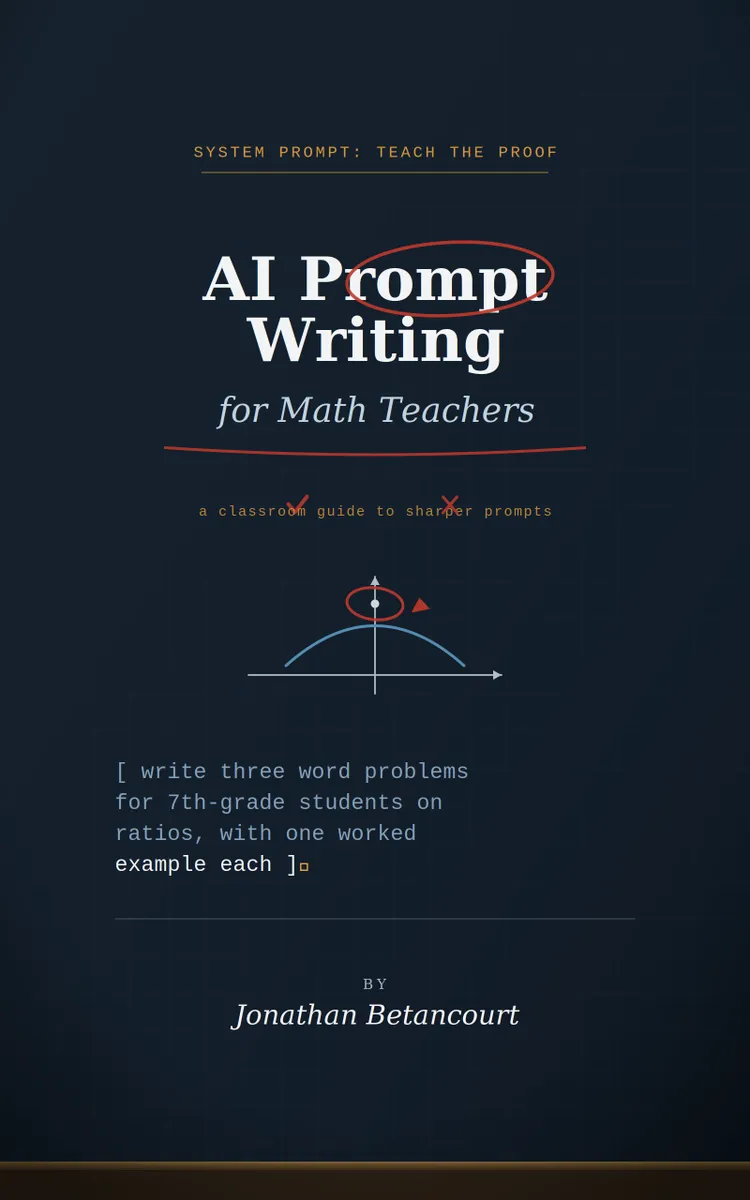
"AI Prompt Writing For Math Teachers" is a how-to guide book by Jonathan Betancourt with 8 chapters and approximately 15,919 words. Your AI can generate a “complete” math lesson that still teaches the wrong thing. That is how Tanya ended up with an exit ticket her students were not ready for, even though the problems looked correct.
This book was created using Inkfluence AI, an AI-powered book generation platform that helps authors write, design, and publish complete books. It was made with the AI Ebook Generator.
Frequently Asked Questions
What is "AI Prompt Writing For Math Teachers" about?
Your AI can generate a “complete” math lesson that still teaches the wrong thing. That is how Tanya ended up with an exit ticket her students were not ready for, even though the problems looked correct. The fix is not better AI. It is better prompts. In this fast, practical guide, you will learn how to turn standards into precise outcomes, write prompts that produce tasks aligned to your evidence, and generate rubrics, worked examples, and step-by-step reasoning that students can actually follow. If you have ever wondered why the output feels off, this book gives you the prompt structure and checks to make AI dependable in your classroom, starting now.
How many chapters are in "AI Prompt Writing For Math Teachers"?
The book contains 8 chapters and approximately 15,919 words. Topics covered include Prompting for Math Lesson Outcomes, Writing Rubrics and Success Criteria, Generating Worked Examples and Steps, Differentiating Practice Problems by Level, and more.
Who wrote "AI Prompt Writing For Math Teachers"?
This book was written by Jonathan Betancourt and created using Inkfluence AI, an AI book generation platform that helps authors write, design, and publish books.
How can I create a similar how-to guide book?
You can create your own how-to guide book using Inkfluence AI. Describe your idea, choose your style, and the AI writes the full book for you. It's free to start.
Write your own how-to guide book with AI
Describe your idea and Inkfluence writes the whole thing. Free to start.
Start writingCreated with Inkfluence AI


