
Read the first chapter
The whole of chapter one, free. About 8 min. Turn the pages with the arrows, your keyboard, or a swipe.
Chapter 1
Jack Mercer’s Halloween Money Panic
At 7:43 on Halloween night, Jack Mercer’s phone buzzed beside a bowl of sweets.
Payment unsuccessful. Please update your details.
The message was polite in the way a stranger is polite while pointing out that your trousers are on fire. Jack read it twice, then checked his bank balance, hoping the numbers might rearrange themselves out of embarrassment.
They did not.
His balance sat there, small and accusatory. Not evil, exactly. More like a tired witness who had been waiting all month to tell the truth.
Outside, children shouted for chocolate. A plastic skeleton swung from a neighbour’s porch. Somewhere nearby, a dog barked at a pumpkin. Jack’s stomach tightened as he mentally toured the next few days: food, transport, another payment he might have forgotten, and the awkward possibility of opening his banking app again.
The email had taken less than ten seconds to arrive. The panic arrived instantly, bringing several old friends: dread, shame, irritation, and the strong belief that checking the problem would somehow make it worse.
The Balance That Felt Like a Haunting
Jack had experienced this feeling before, although never with such theatrical timing. Money trouble rarely entered his life wearing a black cape. It slipped in through ordinary moments: a payment declined at a checkout, a reminder email, a card statement left unopened, a direct debit he didn’t recognise until the money had already vanished.
The frightening part wasn’t only the amount in the account. It was the uncertainty around it.
Had a bill already gone out? Was there enough for the next one? Which payment had failed? Would fixing it mean moving money from somewhere else? Every unanswered question grew claws. Soon, Jack wasn’t thinking about one missed payment. He was thinking about his entire financial life as a badly managed haunted house.
His phone buzzed again.
This time, it was a notification from a shopping app. A Halloween sale. Limited stock. A cheerful little pumpkin inviting him to buy something he had not wanted five minutes earlier.
Jack stared at the screen.
The timing was almost insulting. His account was limping, and the internet had sent a salesman dressed as a ghost.
He locked the phone and placed it face down. That was not a solution, but it was at least a temporary ceasefire.
Financial anxiety often behaves like a smoke alarm with a dying battery. It makes noise at the wrong moments, interrupts sleep, and leaves a person unsure whether there’s a real fire or merely another irritating beep. Sometimes the alarm points to an urgent problem. Sometimes it’s reacting to months of uncertainty. Either way, ignoring the sound rarely creates calm. It only leaves the smoke in the room.
Jack knew this, somewhere beneath the panic. He also knew that knowing it and acting on it were two different creatures.
Why Missed Payments Feel Bigger Than They Are
A missed payment can be a practical issue, but the mind often treats it as a verdict.
Jack’s thoughts moved quickly. He had messed up. He was behind. He couldn’t keep track of anything. If one payment had failed, perhaps the whole structure was collapsing. The email had not said any of that. It had simply reported a failed transaction. His brain supplied the thunder, bats, and dramatic organ music.
That leap is common because money carries more than numbers. It can touch safety, independence, family expectations, and a person’s sense of competence. A small financial error may feel like proof of a much larger personal failure. It isn’t proof. It’s information, usually inconvenient information, but still information.
The distinction matters. If Jack treated the email as a character judgment, he would want to hide from it. If he treated it as a problem to inspect, he could find out what had happened.
That was the first useful shift: a financial alarm is not the same thing as a financial catastrophe.
Of course, some missed payments can have serious consequences. Fees, service interruptions, interest, or damage to a person’s credit history may be possible, depending on the account, agreement, and local rules. That’s why the answer isn’t to shrug and call every problem harmless. The answer is to check the details promptly rather than letting fear write the story.
Jack opened the email again. He looked for the account name, the date, and the instructions. He didn’t click a suspicious link. He opened the provider’s official app instead and checked the payment status there. The charge had failed because the account balance was too low on the processing date.
There it was. Not a mysterious curse. Not a hidden enemy in the walls. A timing problem with consequences that needed attention.
His breathing loosened by one notch.
The Panic-Receipt Protocol
Jack had spent years trying to solve money panic by either staring at it for too long or refusing to look at it at all. Neither approach had served him brilliantly. So he reached for a scrap of paper from the kitchen counter and wrote a heading:
PANIC-RECEIPT PROTOCOL
The name came from the idea that panic should produce a receipt. Not a confession. Not a dramatic life review. A short record of what happened, what it meant, and what needed to happen next.
The first line was What actually happened?
Jack wrote: “A scheduled payment failed because there wasn’t enough money in the account on the processing date.”
That sentence was dull. Dull was good. Panic preferred fog, exaggeration, and phrases such as “everything is ruined.” Facts gave it fewer places to hide.
The second line was What does it affect?
He checked the payment details. It was a routine household bill. He needed to find out whether the provider would retry it, charge a fee, or require a new payment. He also needed to protect the money required for other essential payments due soon.
The third line was What’s the next smallest useful action?
Jack wrote: “Check the provider’s official payment instructions and confirm the amount needed.”
Not “fix my entire life.” Not “become financially organised by midnight.” One action. A manageable one.
The final line was When will it be checked again?
He chose the next morning, after reviewing his account balance and upcoming transactions. Giving the problem a time to be revisited stopped it from demanding his attention every thirty seconds.
The Panic-Receipt Protocol works because it separates emotion from action without pretending the emotion isn’t real. The fear gets acknowledged, but it doesn’t get to become the project manager.
For a money panic, the receipt can be as simple as:
• What actually happened? - What does it affect? - What’s the next smallest useful action? - When will it be checked again?
These aren’t magic questions. They’re a handrail. When the mind is racing, a handrail is surprisingly valuable.
Turning a Money Shock Into a Short List
Jack then made a second note, this time for the next few days. He wrote down only the payments and essentials he knew were approaching. He checked the dates, the amounts, and the account each payment would come from.
He didn’t attempt a grand financial reconstruction. That would have been like trying to repair a roof during a thunderstorm using a teaspoon. Tonight’s task was narrower: prevent one failed payment from becoming several surprises.
He marked anything that needed action. A provider might need to be contacted. A payment date might need confirmation. A transfer might be necessary, provided it wouldn’t cause another account to fall short. If he wasn’t sure about a fee, contract term, or consequence, he would ask the provider directly or seek qualified advice rather than guess.
That last part mattered. Money rules differ by country, account, lender, and agreement. Online certainty is often available in unlimited quantities, which is unfortunate because accuracy is not. General guidance can help someone prepare questions, but it can’t replace checking the actual terms of an account or getting professional advice where the stakes are high.
Jack’s list contained four lines. It looked almost offensively ordinary.
That was the point.
Anxiety had been presenting the problem as a giant creature with many heads. The list showed him a few specific tasks. He could work with tasks. He couldn’t negotiate with a monster made of vague dread.
Then he added one more note: “Do not shop while panicking.”
This was less a financial principle than a safety rule. Stress often reaches for quick relief. A purchase can offer a brief feeling of control, reward, or escape, even when the later consequences are unwelcome. Jack didn’t need to insult himself for having that impulse. He needed to put distance between the impulse and the checkout button.
He moved the shopping app off his home screen.
The pumpkin sale lost its powers.
A Small Reset Before the Night Gets Worse
Jack’s next move was not to promise a perfect future. It was to create a tiny reset he could repeat.
He placed the paper beside his phone. He set a reminder for the morning. He gathered the relevant account information, then stopped checking. Re-reading the same balance wouldn’t create money. It would only give the panic another performance.
Before bed, Jack wrote three sentences in a notebook:
“Tonight’s problem is specific.”
“I have an action to take.”
“I don’t need to solve every money question while frightened.”
The sentences didn’t make the failed payment disappear. They did something more useful: they returned the problem to its proper size.
That is the quiet power of a first response. A person doesn’t need perfect knowledge before taking a sensible next step. They need enough clarity to avoid making the situation harder. Checking the facts, protecting essential payments, contacting the relevant provider, and pausing panic-driven spending are modest actions. Modest actions are not weak actions. They are often how a person gets traction when confidence is unavailable.
Jack looked at the Halloween decorations outside. The skeleton still swung from the porch. The dog still distrusted the pumpkin. His bank balance remained unimpressed.
But the haunting had changed.
The email was no longer an omen floating in the dark. It was a receipt for one problem, with a next step written underneath. Jack still had financial work ahead of him. He still had habits to examine and decisions to make. Nothing had been magically repaired.
Yet the night had given him one useful discovery: money panic grew strongest when everything stayed unnamed.
Once the fear was written down, it had edges. Once it had edges, Jack could begin.
And somewhere beyond the glass, beneath the orange glow of a porch light, something with very long fingers quietly counted the days until payday.
End of chapter one. 29 more chapters and about 53,625 words in the full book.
Swipe or use the arrows to turn the page


What's inside: 30 chapters
- 1. Jack Mercer’s Halloween Money Panic
- 2. The House of Financial Fright Appears
- 3. Why Money Monsters Love Avoidance
- 4. Meet the Three Ghosts of Money
- 5. Your First Pay Packet Isn’t Neutral
- 6. The First Credit Card Spark
- 7. Lifestyle Inflation After Every Raise
- 8. The Subscription Graveyard Lesson
- 9. When Emergency Savings Went Missing
- 10. Ghost of Money Past: The Kind Truth
- 11. Jack’s Present Account Tells the Story
- 12. The Budget Vampire Strikes Before Payday
- 13. Minimum Payments Feed the Debt Demon
- 14. Subscriptions, Again-But This Time It’s Worse
- 15. Emotional Spending and the Reward Loop
- 16. Jack Talks Money with His Partner
- 17. The FOMO Goblin at the Checkout
- 18. The Emergency Fund Zombie Returns
- 19. Ghost of Money Present: The Real Budget
- 20. The Yet to Come Foggy Door
- 21. Future One: Keep the Same Habits
- 22. Future Two: Modest Improvements Work
- 23. Future Three: The Get-Rich-Quick Trap
- 24. The Property Phantom’s Promise
- 25. The Compound Interest Witch Appears
- 26. Wake Up: The Monsters Get Names
- 27. Budget Vampire Fix: Pay Bills on Purpose
- 28. Lifestyle Werewolf Tame: Keep Raises Boring
- 29. Debt Demon Strategy: Choose a Payoff Path
- 30. Your Escape Plan: One Tiny Win Today
About this book
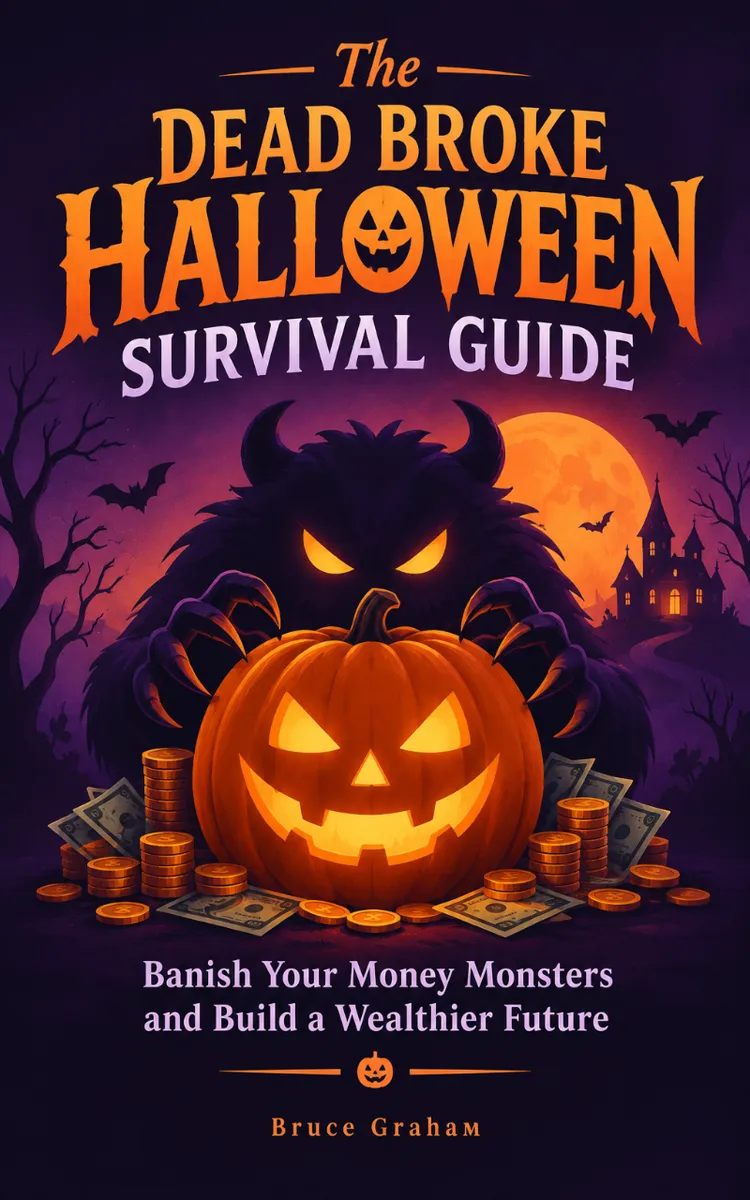
"The Dead Broke Halloween Survival Guide" is a self-help book by Bruce Graham with 30 chapters and approximately 53,625 words. Humorous supernatural fable teaching practical personal finance habits.
This book was created using Inkfluence AI, an AI-powered book generation platform that helps authors write, design, and publish complete books. It was made with the AI Self-Help Book Writer.
Frequently Asked Questions
What is "The Dead Broke Halloween Survival Guide" about?
Humorous supernatural fable teaching practical personal finance habits
How many chapters are in "The Dead Broke Halloween Survival Guide"?
The book contains 30 chapters and approximately 53,625 words. Topics covered include Jack Mercer’s Halloween Money Panic, The House of Financial Fright Appears, Why Money Monsters Love Avoidance, Meet the Three Ghosts of Money, and more.
Who wrote "The Dead Broke Halloween Survival Guide"?
This book was written by Bruce Graham and created using Inkfluence AI, an AI book generation platform that helps authors write, design, and publish books.
How can I create a similar self-help book?
You can create your own self-help book using Inkfluence AI. Describe your idea, choose your style, and the AI writes the full book for you. It's free to start.
Write your own self-help book with AI
Describe your idea and Inkfluence writes the whole thing. Free to start.
Start writingCreated with Inkfluence AI


