

Read the first chapter
The whole of chapter one, free. About 12 min. Turn the pages with the arrows, your keyboard, or a swipe.
Chapter 1
Stop Performing Your Life
Picture This
When you wake up, do you feel like you’re starting your day… or clocking into a role? Like your body is there, but your mind is already writing the caption. You’re not just getting ready-you’re getting approved. Matching the right shoes to the right mood. Answering texts in a tone that won’t make you seem “too much.” Showing up with the exact level of enthusiasm that makes people relax around you.
Talia, 26, brand strategist, could name the exact shade of “confident” she’s supposed to wear at work. She’s good at her job. She’s polished. She’s the friend people call when they need a plan. And lately, she’s been snapping at tiny things: a delayed reply, a meeting that runs long, someone asking for “just a quick opinion.” Not because she’s mean. Because she’s tired of running a second life inside her first one-one made of impressions, not choices.
What if “having it all together” isn’t a life… it’s a job you keep doing even when your soul is off the clock?
The Mindset Shift
Old Belief: If I look like I’ve got it handled, I’ll stay safe.
New Reality: If you manage impressions all day, you won’t have a “together” life-you’ll have a performance that eventually breaks.
Here’s the hidden contract: you’ve probably convinced yourself that people will like you, trust you, and keep you close if you keep the surface clean. So you practice. You rehearse. You smooth the edges. You don’t just do things-you curate the proof that you’re doing them right. The problem isn’t ambition. The problem is turning your worth into a deliverable.
Talia didn’t wake up one day and decide to become fake. She became skilled at being “easy.” She learned that if she was calm, competent, and responsive, nobody had to worry about her. And for a while, it worked. Then burnout showed up like this: she started to feel numb after social events, like she’d been acting and couldn’t shut it off. Even when she “won” (a promotion, a good client pitch, a clean weekend), she didn’t feel proud. She felt… relieved. Like the audience exhaled and she could finally stop holding her breath.
When you switch from “I manage impressions” to “I’m performing,” everything gets clearer. You stop asking, “Why am I tired?” and start asking, “What am I protecting?” Because performing isn’t free. It costs your attention, your honesty, your appetite for risk, and eventually your nervous system. That’s why the burnout signals don’t feel like regular stress. They feel like shutdown with a smile.
Going Deeper
“The Performance Mirror” is the thing you look into without realizing you’re looking at it. It’s the inner lens that asks: How will I look if I say no? How will I sound if I don’t have an answer? What will it mean if I’m not glowing right now? You don’t necessarily lie. You just curate. You edit your needs. You translate your real life into something that plays well.
This is how you end up managing impressions instead of living: your decisions start serving the mirror, not your actual values. You over-explain because you’re trying to prevent confusion. You people-please because you’re trying to prevent rejection. You stay “together” because you’re afraid that if you don’t, you’ll become a problem people step around.
Here are the signs this pattern is running your life:
• You feel more responsible for the vibe than for your own truth.
If you’re constantly adjusting your tone, timing, or wording to keep the peace, your life is being run by prevention.
• You can’t tell the difference between “I’m busy” and “I’m performing.”
You’re tired, but it’s not from work you chose. It’s from work you did to look acceptable.
• Your body gives you away before your brain does.
You get headaches after social plans. You feel heavy after you “did great.” You feel keyed up after doing the right thing-like relief is the only emotion that still gets access.
• You keep choosing the version of you that requires less friction.
The real you asks for clarity, rest, boundaries, or honesty. The performing you asks for permission to exist quietly.
Le verdict: If you’re always managing how you’re perceived, you’re not building a life-you’re maintaining a mask.
Reflection & Self-Assessment
• When you imagine telling someone the truth (a real boundary, a real opinion), what do you fear will happen?
Write the fear as a sentence, not a vibe. Example: “If I say no, they’ll think I’m difficult.” That’s the performance contract talking.
• What do you do “well” that you don’t actually want to keep doing?
Talia realized she was excellent at being the reliable one. But reliability wasn’t her value-it was her strategy for belonging.
• Where do you feel the most drained: after work, after socializing, or after alone time where you still feel “on”?
If you’re drained after alone time too, that usually means the mirror never actually shuts off.
• What do you over-explain about most-your capability, your schedule, your emotions, your choices?
Notice the pattern. Over-explaining often isn’t about clarity. It’s about control: “If I explain enough, you won’t leave.”
• If you stopped performing for one week, what would you do differently-without asking permission?
Don’t make it big. Just name one small action you’d allow yourself: declining a plan, asking for what you want, saying “I don’t know.”
Growth Challenge
The Mirror-Off Week (7 days)
• For 7 days, before every text, meeting response, or “friendly” interaction, pause for 10 seconds and ask: “Am I doing this to be understood… or to be approved?”
• When you catch yourself performing, do one replacement action:
• If you over-explain, try one sentence less than you want.
• If you people-please, offer one honest boundary instead (“I can’t do that, but I can do ___.”).
• If you’re “fine” when you’re not, replace “I’m good!” with a simpler truth (“I’m tired,” “I need more time,” “I’m not feeling it.”).
• Track only one thing each day: What did the mirror cost me today? (Time, energy, honesty, calm-pick one.)
Difficulty Rating: Medium
You’ll know it’s working when…
• You feel slightly more irritated at first (because you’re breaking a habit), but then you notice more calm after your conversations.
• You stop “earning” your own life. Your choices start matching your values more often than your audience.
• You catch the performance earlier-before it becomes a whole day of edited living.
Key Takeaway
You can’t burn out from a life you aren’t living-you burn out from maintaining the version of yourself that keeps people comfortable.
• “Having it all together” often means managing impressions, not building a real day.
• The Performance Mirror runs in the background through tone, timing, and over-explaining.
• Burnout here isn’t random-it’s the cost of staying approved.
• The first move isn’t motivation. It’s noticing the contract in real time.
Next, we’re going to get more specific about the mirror’s favorite trick: how you over-handle your words and emotions so nobody has to deal with the mess of being human. Because once you see the mechanism, you can stop feeding it.
Picture This
You walk into a coffee shop and someone asks, “How are you?” Your thumb hovers over your phone before you answer, because the version of you that’s allowed in public has an approved script: upbeat, brief, vaguely competent. You say, “Good! Busy, but good.” Inside, your muscles are tight and your brain is humming with a to-do list you didn’t plan to share. You didn’t lie exactly - you just gave the performance a line that keeps the peace.
What if the small, everyday edits are the thing that adds up to the longest kind of exhaustion: the slow, steady wearing-away of who you actually are?
The Mindset Shift
Old Belief: Small edits and polite white lies keep everything smooth, so I should keep doing them.
New Reality: Every little self-edit is rental space you pay for with your energy; stop signing new leases.
This matters because those tiny edits are cumulative. Saying “I’m good” instead of “I’m exhausted” saves an awkward moment now, but it trains your whole life to run on autopilot approval. Talia realized that when she always softened her answers, people stopped asking the hard things - and she stopped needing to answer them. Her exhaustion wasn’t dramatic; it was the accumulation of every softened sentence, every withheld request, every “fine” that wasn’t.
Start seeing each micro-decision - the text you don’t send, the truth you water down - as either an investment in your life or a withdrawal. Small withdrawals add up fast.
Going Deeper
Performing isn’t only loud gestures. It’s the tiny negotiations you do every hour to prevent discomfort. That’s why this shift is less about one big reveal and more about permission-granting: giving yourself permission to be smaller, messier, or more honest in ways that feel safe to you.
Signs this pattern is running your life:
• You rehearse short responses before saying them out loud.
• You edit yourself more in private than you do in public.
• You apologize reflexively for needs that don’t harm anyone.
• You avoid small reveals (like saying you need a day off) because you imagine a disproportionate fallout.
Le verdict: The little compromises are the ones that steal most.
Reflection & Self-Assessment
• When did you last say “I’m fine” and mean something different? Write the last three times and what you really felt - honesty is the practice here.
• What tiny concession do you make daily to avoid one awkward moment? Name it and imagine saying the honest version once. How does your stomach respond?
• Which people get the unedited you and which ones always get the edited version? What’s one safe test you could run with someone in the edited group?
Growth Challenge
The Unedited Sentence (3 days)
• For the next 3 days, pick one interaction each day where you replace your automatic edit with one honest sentence.
• Keep it small: “I’m tired,” “I can’t right now,” or “I don’t know.”
• Rate the difficulty: Easy-Medium.
You’ll know it’s working when you notice relief after the sentence, someone responds without catastrophe, or you feel a tiny energy return.
Key Takeaway
Small edits feel harmless - until they become the foundation of your life.
• Micro-edits accumulate into deep exhaustion.
• Honesty can be practiced in tiny, safe steps.
• Testing one unedited sentence rebuilds your permission to be real.
You’ve started noticing the fine print of the Performance Mirror - next, we’ll pull it apart: how over-explaining became the mirror’s favorite tool and what to say instead when your instinct is to explain everything. You’ve got this.
A single scene that feels too familiar
You straighten your shirt in the bathroom mirror, breathe, and rehearse the small version of yourself you’ll wear today: competent, composed, unruffled. You swipe through three DMs, delete one honest reply because “it’s not the right time,” and copy-paste a safe emoji to a group chat because it reads like you’re present. At lunch you laugh at the exact spot you practiced. That night you scroll through your own photos and stash the ones where you weren’t smiling “right.” Your phone buzzes with a friend asking if you can cover a shift, and you type out the polite yes before your chest can say no.
How long have you been onstage, and when did you stop being allowed to take off the costume?
Are you living your life or performing it for an audience that never asked for the real you?
Old vs. New - the flip that frees you
Old Belief: Small edits, quick lies, and softened truths are harmless; they keep relationships and days running smoothly.
New Reality: Each tiny edit is a transaction where you spend your energy to avoid discomfort - and those transactions bankrupt you over time.
This matters because the cost is gradual and invisible. That polite “I’m fine” isn’t a neutral line; it’s a withdrawal from the bank of your attention and honesty. When you habitually trade a truthful moment for a smooth one, you train your brain to hide, and people learn to expect the curated version. The result? You get late-night relief instead of real rest, and milestones feel hollow because they were earned by performance, not by fuller engagement.
Picture telling your roommate you’re exhausted instead of defaulting to “I’m good.” It might feel risky for a day, but it recalibrates expectations. They stop asking “Are you okay?” like it’s a test and start offering help because they actually have accurate information. That one small transaction - honest sentence instead of edited script - shifts where your energy goes.
Why this shift actually works (and how to spot it)
Performing minimizes immediate friction. It’s shorter, safer, and often socially rewarded. But the brain learns patterns. If you keep choosing safe edits, your nervous system assumes the edit equals survival. Undoing it feels like danger at first because your body expects applause for the performance. The trick is not to overthrow everything at once; it’s to choose targeted small reversals that prove truth is survivable.
Signs this pattern is running your life:
• You draft replies in your head and rehearse tone before sending anything casual.
• You apologize for needs that are reasonable (needing rest, needing space).
• Alone time still leaves you exhausted because your inner editor never clocks out.
• You choose convenience over authenticity in relationships.
Le verdict: Tiny compromises are not harmless - they’re the slow leak sinking your sense of self.
Questions that pull at the seams
• When was the last time you said “I’m fine” but were not? Name the moment and the truth you skipped. (Honest example: “Told my boss I was fine after a long day; I actually wanted to request fewer meetings.”)
• What small script do you use to smooth things over most often? How would one honest version sound? (Example: Replace “I’m busy!” with “I can’t do that this week.”)
• Who hears the unedited you? Who never does? Pick one person to test a small truth with. (Try telling a friendly co-worker you need a deadline extension.)
• What’s one micro-edit you can stop making for seven days? (Stop downplaying your tiredness; say “I’m drained.”)
• What costs did that edit save you today - and what did it cost you? (Saved awkwardness; cost: extra night of rumination.)
A tiny, practical thing to try today
Challenge: The Unedited Text (3 days)
• Before replying to any non-urgent message, pause 8 seconds and replace your automatic softened line with one honest sentence.
• Keep it tiny: “I can’t tonight,” “I’m tired,” or “I don’t have the bandwidth.”
• Note one immediate reaction and how you felt afterward.
Difficulty: Easy-Medium
You’ll know it’s working when you feel a little less hollow after conversations, or when someone responds without blowing up - that’s proof your truth is survivable.
One bold truth to hold and the bridge forward
Bold truth: Small edits are not harmless; they’re habit-forming withdrawals from your own life.
• Tiny white lies compound into deep exhaustion.
• Honesty is practice, not perfection.
• You can start reclaiming energy with one unedited sentence.
• Testing truth in small doses rewires expectations.
You’ve started noticing the quiet theft - next we’ll confront the mirror’s favorite trick: the urge to over-explain everything so nobody has to sit with an uncomfortable pause. You’ve got this.
End of chapter one. 12 more chapters and about 18,190 words in the full book.
Swipe or use the arrows to turn the page
What's inside: 13 chapters
- 1. Stop Performing Your Life
- 2. Kill Comparison Scrolling for Good
- 3. Unlearn Over-Explaining Instantly
- 4. Build Boundaries Without Guilt
- 5. End the People-Pleasing Loop
- 6. Choose Identity Over Approval
- 7. Design a Life That Fits
- 8. Recover After the Unfollow
- 9. The late-night draft you never send
- 10. The Starting Point
- 11. The Pattern
- 12. A Moment of Truth
- 13. A late-night scroll that ends with your chest tight and your drafts app open
About this book
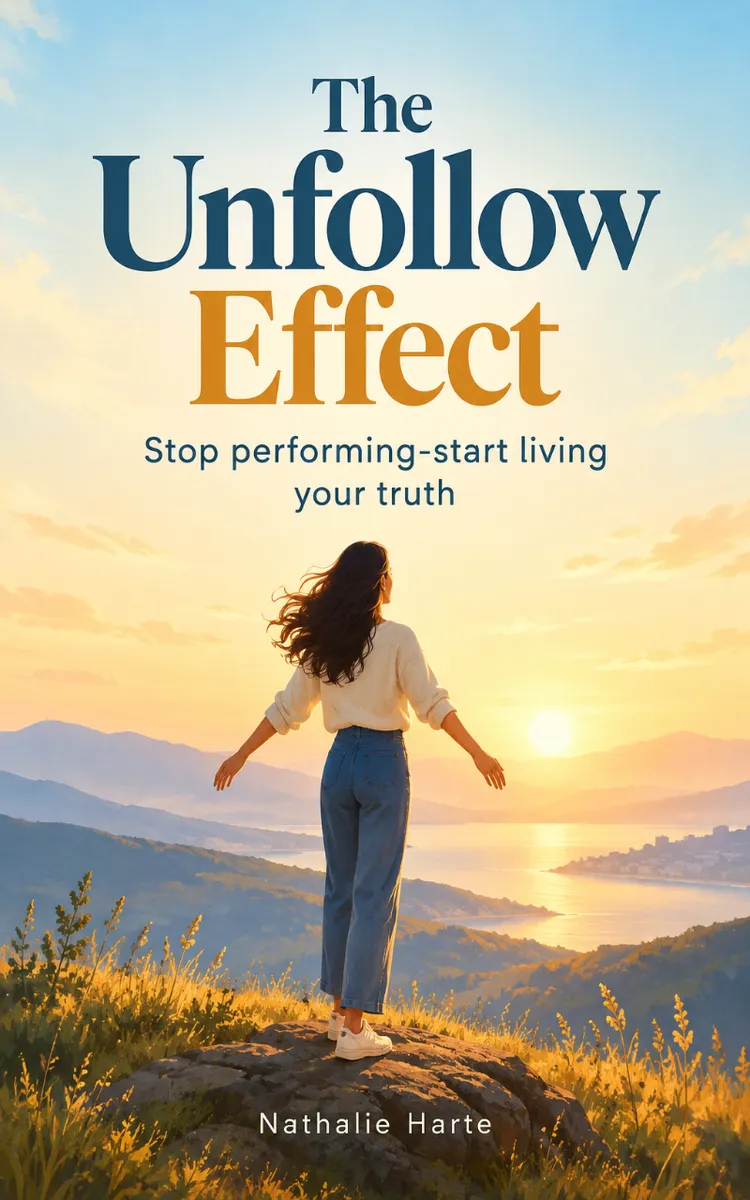
"The Unfollow Effect" is a self-help book by Nathalie Harte with 13 chapters and approximately 18,190 words. Breaking comparison, over-explaining, and people-pleasing.
This book was created using Inkfluence AI, an AI-powered book generation platform that helps authors write, design, and publish complete books. It was made with the AI Self-Help Book Writer.
Frequently Asked Questions
What is "The Unfollow Effect" about?
Breaking comparison, over-explaining, and people-pleasing
How many chapters are in "The Unfollow Effect"?
The book contains 13 chapters and approximately 18,190 words. Topics covered include Stop Performing Your Life, Kill Comparison Scrolling for Good, Unlearn Over-Explaining Instantly, Build Boundaries Without Guilt, and more.
Who wrote "The Unfollow Effect"?
This book was written by Nathalie Harte and created using Inkfluence AI, an AI book generation platform that helps authors write, design, and publish books.
How can I create a similar self-help book?
You can create your own self-help book using Inkfluence AI. Describe your idea, choose your style, and the AI writes the full book for you. It's free to start.
Write your own self-help book with AI
Describe your idea and Inkfluence writes the whole thing. Free to start.
Start writingCreated with Inkfluence AI


