
Read the first chapter
The whole of chapter one, free. About 6 min. Turn the pages with the arrows, your keyboard, or a swipe.
Chapter 1
Days 1-4: Rewriting Your Confidence Story
You don’t build confidence by thinking “positive thoughts.” You build it by changing what your brain treats as evidence. Think of confidence like a file your brain keeps updating - quietly - every day.
Nadia, 41, Director of Operations, told me something that sounded small but was actually huge: “I don’t doubt my skills. I doubt whether I’m allowed to be the one who decides.” That belief showed up every time she led a meeting - she’d talk faster, anticipate pushback, and leave space for other voices to take over. No wonder her confidence felt fragile. Her brain wasn’t protecting her performance; it was protecting an old story.
Days 1-4 are where you start rewriting your Confidence Story. We’ll build a neuroscience-backed baseline by finding the exact limiting belief, then replacing it with evidence-based self-talk your brain can actually use.
Day 1: Find the Sentence Your Brain Keeps Repeating
Tip of the Day:
Here’s the sneaky part: most limiting beliefs don’t sound dramatic. They sound like “just the way it is.” Your brain repeats a short sentence over and over, and it uses that sentence to predict danger - so it tries to keep you safe by shrinking your confidence.
Nadia’s repeating sentence was something like, “If I push, people will think I’m overstepping.” Notice what it does. It doesn’t attack her competence. It attacks her permission. We’re going to catch your version of that sentence today - because if you can name it, you can rewrite it.
Your Turn
Take 3 minutes and finish these prompts in plain language. Don’t polish it. Just write what’s true.
• When I feel my confidence drop, I usually think:
“________________________________________”
• What I’m afraid would happen if I fully show up is:
“________________________________________”
• The “permission” part (who am I to…?) looks like:
“________________________________________”
Now pick the single shortest sentence that captures the belief underneath. Write it again, clearly:
• My Confidence Story sentence is:
“________________________________________”
Today’s Action:
Write that sentence at the top of a page (title it “My Confidence Story”). Circle the fear word in it (like “rejected,” “overstepping,” “fail,” “not enough”). Keep this page somewhere you’ll see it again tomorrow.
Day 2: Pull the Evidence - Not the Vibes
Tip of the Day:
Neuroscience translation: your brain trusts patterns. When you only use feelings (“I feel like I’m not good enough”), you’re basically asking your brain to build a decision from fog. Today we’re going to give your brain real inputs - evidence it can’t ignore.
This is also where people get tripped up. They try to “argue” with the limiting belief using empty optimism. Don’t. We’re going to do evidence-based self-talk. That means you’ll collect proof that your belief is incomplete.
Nadia didn’t need a pep talk. She needed data. When she listed outcomes she’d already delivered - projects shipped, teams aligned, decisions made - her brain had something solid to update.
Your Turn
Make two columns on a single page.
On the left, write your limiting sentence again. On the right, answer the questions below with specific examples from your work life.
Left (Limiting belief): “________________________________________”
Right (Evidence):
• A time I handled pressure better than my belief predicted:
“________________________________________”
• A time I made a strong decision and it worked (even if it wasn’t perfect):
“________________________________________”
• What people said or did that counts as proof:
“________________________________________”
• What I did that was skill-based (not luck-based):
“________________________________________”
If you can’t think of a big example, use a small one. Confidence updates from small wins too.
Now write one evidence-based statement that directly challenges the limiting sentence. Keep it factual.
• My updated sentence (evidence-based) is:
“________________________________________”
Today’s Action:
Send one message to yourself in your notes app (or email draft to nobody) titled “Evidence.” Paste your updated sentence and add two bullet points with the most concrete proof you wrote today. You’ll use it when confidence dips.
Day 3: Replace the Auto-Thought in Real Time
Tip of the Day:
Most confidence problems aren’t constant. They spike at predictable moments - meetings, deadlines, walking into a room where you feel judged, presenting an idea that matters. Your brain runs the limiting sentence automatically, then your body follows: tighter voice, smaller gestures, less eye contact.
Today you’ll interrupt that loop while it’s happening. Not someday. Not when you “feel ready.” Right in the moment your brain starts to play the old recording.
Nadia told me she noticed her pattern after she started watching for it: the moment she sensed disagreement, her Confidence Story sentence kicked in and she’d start negotiating her own authority. Once she caught the trigger, she could choose a different response.
Your Turn
Choose one “trigger moment” for today. Pick something you can realistically face:
• a meeting
• a 1:1 check-in
• sending a proposal
• answering a tough question
• asking for budget/resources
Write your trigger and your replacement.
• My trigger moment today:
“________________________________________”
• When it hits, I will say (out loud or in my head):
“________________________________________” (use your updated sentence from Day 2)
Now add a body cue. Your brain doesn’t just listen to words; it listens to signals.
• My body cue (choose one):
I will sit taller / take one slow breath / unclench my jaw / keep my hands visible
Apply It (the script for the moment):
When you feel the confidence dip, do this sequence once:
• Notice the drop (“My Confidence Story is running.”)
• Take one slow breath
• Use your replacement sentence
• Continue with the next step you planned (don’t freeze)
Today’s Action:
During one planned trigger moment today, use your 4-step sequence once. Afterward, write 3 lines:
• What triggered me:
“________________________________________”
• What I said instead:
“________________________________________”
• What I did next (even if it was small):
“________________________________________”
Day 4: Make It Stick With a Micro-Reset
Tip of the Day:
Rewriting confidence isn’t a one-time rewrite. It’s repetition with feedback. Neuroscience loves “practice + correction.” Your brain gets better at the new story when you reinforce it right after you use it - while the moment is still fresh.
Also - let’s be honest - some days your old sentence will win. That doesn’t mean you’re back to zero. It means you’ve identified where your brain defaulted. That’s useful information.
Nadia started doing a quick reset after meetings. Not a long journaling session. Just a short close-out that told her brain, “We updated the file today.”
Your Turn
Do this micro-reset at the end of your day (2-5 minutes). Copy the prompts and fill them in.
• Moment I noticed my Confidence Story running:
“________________________________________”
• What I did to interrupt it:
“________________________________________”
• Evidence I proved today (one line):
“________________________________________”
• Updated sentence I want to reinforce tomorrow:
“________________________________________”
• One tweak for next time (make it practical):
“________________________________________”
If you want a simple option, choose one of these micro-tweaks:
• “Next time I’ll breathe before I speak.”
• “Next time I’ll state the decision first, then explain.”
• “Next time I’ll ask one clarifying question instead of assuming pushback.”
Now write a “confidence boundary” statement. This is the part that stops the old story from hijacking you tomorrow.
• My confidence boundary is:
“I won’t let ________ decide what I do next. I will ________.”
Today’s Action:
Set a reminder for tomorrow at the same time you’ll face your trigger. When it pops up, read your updated sentence once, then add your body cue once (like “slow breath” or “shoulders back”). You’re training your brain to switch faster.
You’re not trying to become a different person overnight - you’re teaching your brain to track different evidence. By the end of Day 4, you’ve done something most people never do: you named the limiting sentence, matched it with real proof, and practiced the replacement under pressure. That’s how confidence stops being a mood and starts being a skill.
Tomorrow, we’ll refine how your brain responds when the stakes feel high - so your Confidence Story rewrite holds up when you really need it.
End of chapter one. 7 more chapters in the full book.
Swipe or use the arrows to turn the page


What's inside: 8 chapters
- 1. Days 1-4: Rewriting Your Confidence Story
- 2. Days 5-8: Building Self-Trust Through Micro-Wins
- 3. Days 9-12: Training Your Brain for Calm
- 4. Days 13-16: Owning Presence with Evidence-Based Posture
- 5. Days 17-20: Speaking with Clarity Under Pressure
- 6. Days 21-24: Resilience After Setbacks
- 7. Days 25-28: Confidence in Social Influence
- 8. Days 29-30: Locking In Lasting Confidence
About this book
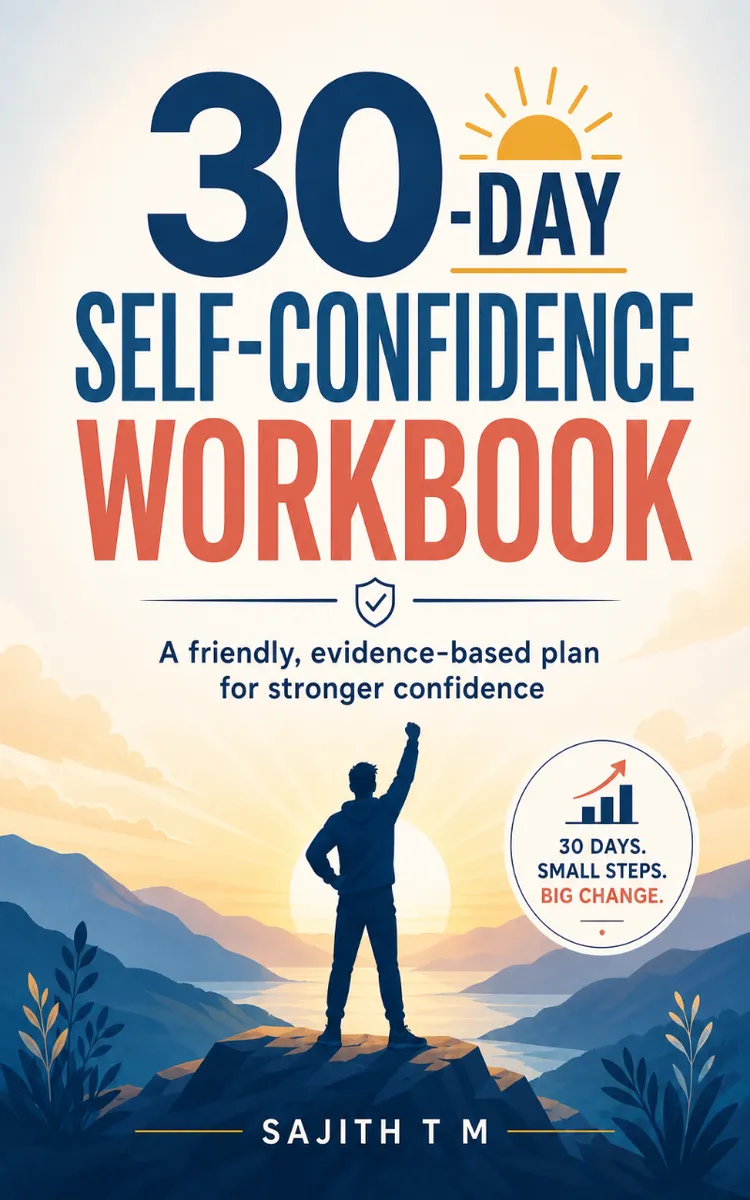
"30-Day Self-Confidence Workbook" is a day challenge book by Sajith T M with 8 chapters and approximately 8,541 words. Your confidence is not missing. It is being protected by an old brain story that keeps rewriting your decisions at work.
This book was created using Inkfluence AI, an AI-powered book generation platform that helps authors write, design, and publish complete books.
Frequently Asked Questions
What is "30-Day Self-Confidence Workbook" about?
Your confidence is not missing. It is being protected by an old brain story that keeps rewriting your decisions at work. In 30 days, you will identify the exact limiting sentence your mind uses as “evidence,” then replace it with self-talk that your brain can actually accept. You will build self-trust with micro-wins that fit inside real workdays, and train your nervous system to downshift fast so pressure stops hijacking your choices. If you are a mid- to senior-level employee who needs confidence you can use in meetings, deadlines, and tough calls, this workbook gives you a clear daily practice based on psychology and neuroscience, starting today.
How many chapters are in "30-Day Self-Confidence Workbook"?
The book contains 8 chapters and approximately 8,541 words. Topics covered include Days 1-4: Rewriting Your Confidence Story, Days 5-8: Building Self-Trust Through Micro-Wins, Days 9-12: Training Your Brain for Calm, Days 13-16: Owning Presence with Evidence-Based Posture, and more.
Who wrote "30-Day Self-Confidence Workbook"?
This book was written by Sajith T M and created using Inkfluence AI, an AI book generation platform that helps authors write, design, and publish books.
Write your own day challenge book with AI
Describe your idea and Inkfluence writes the whole thing. Free to start.
Start writingCreated with Inkfluence AI


