
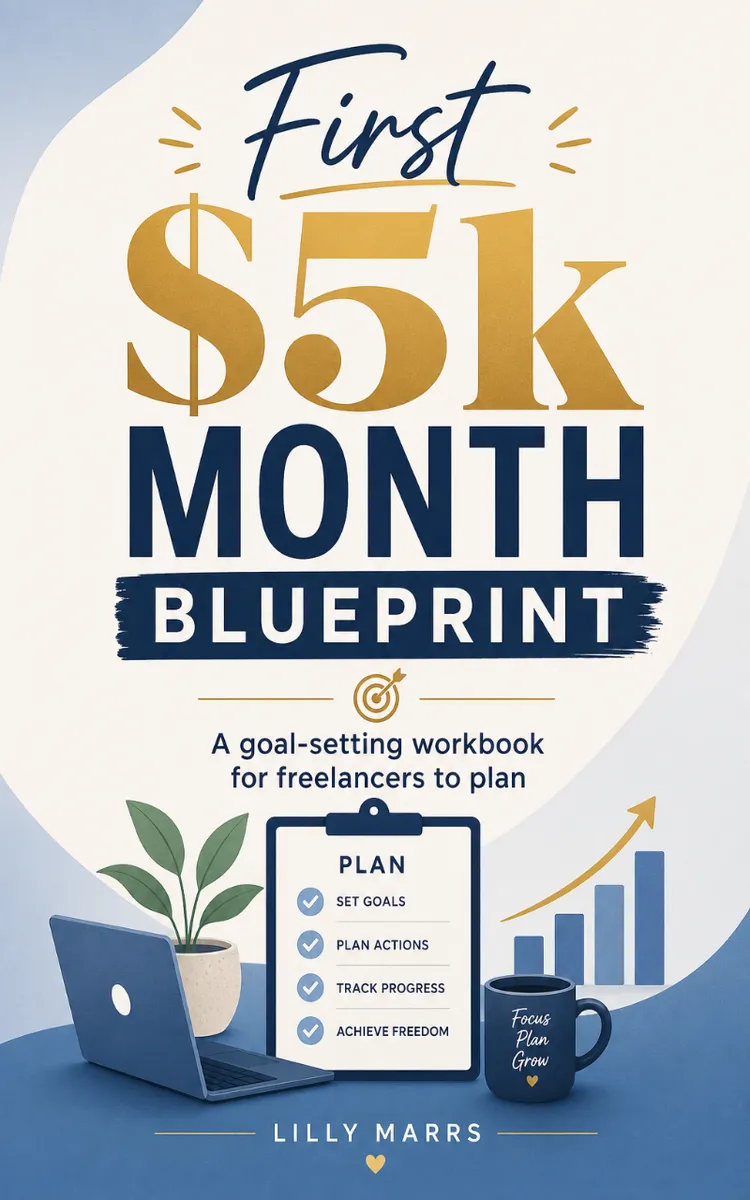

Read the first chapter
The whole of chapter one, free. About 6 min. Turn the pages with the arrows, your keyboard, or a swipe.
Chapter 1
Defining Your $5k Month Target
A $5k month becomes useful when it stops being a nice idea and turns into a number you can track every week. “I want to make more” won’t tell you what to sell, how many clients you need, or whether you’re on pace. A clear target will.
You’ll define three things: the exact income number, the deadline, and the weekly proof that you’re moving toward it. Keep the target simple enough to check in under five minutes. Your number should guide your decisions, not sit in a notebook looking impressive.
Key takeaway: Your $5k target needs a deadline and weekly success criteria, or it isn’t a working goal yet.
Use this three-part target:
1. Monthly income target: $5,000 collected during one calendar month. 2. Timeline: The specific month when you intend to reach it. 3. Weekly success criteria: The amount of income booked or collected each week, plus the client or project milestones that support it.
The distinction between “booked” and “collected” matters. Booked means a client has agreed to pay. Collected means the money has actually reached your account. For this target, use collected income as the final measure. You can track booked work as an early warning signal, but it doesn’t count toward the $5k month until payment arrives.
Set the Number, Deadline, and Weekly Finish Line
Before you plan offers, outreach, or your calendar, choose the month you’re aiming for. Pick a real month, not “sometime soon.” A deadline forces the target to fit your current workload, available hours, and sales cycle.
Then split $5,000 across the weeks of that month. A simple starting point is $1,250 per week. Some months won’t divide neatly, and your payment schedule may be uneven. That’s fine. The point isn’t to collect the same amount every Monday. The point is to know what pace keeps you on track.
Your weekly success criteria should include more than revenue. A payment can arrive late even when you did the work correctly. Track the actions and milestones that make the payment likely: proposals sent, deposits received, projects delivered, invoices followed up, or retainers renewed. Choose measures you can verify with a number or a yes/no answer.
For example, your target could look like this: “I will collect $5,000 in September. By the end of each week, I’ll track collected income, booked income, proposals sent, and invoices due.” That statement gives you something to review instead of relying on a feeling.
Your Turn: Build Your $5k Target Sheet
Materials needed: A notebook or spreadsheet, your calendar, and your last three months of income records. Time required: 25 minutes. Expected outcome: One dated $5k target and four weekly scorecards.
1. Write the exact calendar month when you want to collect $5,000. If you’re choosing between two months, select the first month that gives you enough time to prepare without ignoring your current commitments.
Target month: _______________________________________________
2. Write your income target. Keep it at $5,000. If you also need to cover taxes, business costs, or personal income, record those separately. Don’t quietly change the target by adding several different numbers together.
Collected income target: $5,000
3. Divide the target across the weeks of your target month. Start with $1,250 per week. If your month has an unusual payment schedule, adjust the weekly amounts so the four weekly targets still total $5,000.
Week 1 target: $______________ Week 2 target: $____________ Week 3 target: $____________ Week 4 target: $____________ Total: $______________
4. Choose three weekly measures that show whether you’re building toward collected income. Use measures you can count. Good options include proposals sent, deposits received, invoices paid, projects delivered, or follow-ups completed.
Weekly measure 1: ________________________________________ Weekly measure 2: ______________________________________ Weekly measure 3: ________________________________________
5. Set a weekly review time. Make it the same day and time each week. During the review, record your collected income, booked income, and the three measures you chose. A 15-minute review is enough.
Review day: __________________ Review time: _______________ Where you’ll record it: _______________________________
6. Write your completed target as one sentence. Include the month, the $5,000 amount, and the weekly review method.
> Completed example: “I will collect $5,000 in September. My weekly targets are $1,250, $1,250, $1,250, and $1,250. Every Friday at 4:00 p.m., I’ll record collected income, booked income, proposals sent, deposits received, and invoices paid.”
7. Create four scorecard rows. Copy this format into your notebook or spreadsheet and complete one row at each weekly review.
Week ending: __________________ Collected income: $__________ Booked income: $_____________ Measure 1: __________________ Measure 2: __________________ Measure 3: ____________________ On pace for $5k? Yes / No
You’re finished when you have one target month, four weekly income amounts totaling $5,000, three measurable weekly criteria, and a scheduled review time. If any of those are blank, the target isn’t ready to use.
Use the Target in Your Real Workweek
Your target should change what you do with an ordinary Tuesday. Suppose you’re halfway through the month and you’ve collected $1,600 against a $2,500 pace. That gap is useful information. You may need to follow up on unpaid invoices, move a ready-to-buy prospect toward a decision, or schedule work that can be delivered and paid before month-end.
Now consider a different result. You’ve collected $2,600, but you have no booked work for the final week. You’re temporarily ahead, but the pipeline is thin. Your weekly measures show the risk before the revenue report does. The next move might be sending two proposals or confirming a deposit, rather than spending the week polishing your website.
Use the scorecard during client conversations, too. If a project is nearly complete but the final payment hasn’t been scheduled, confirm the delivery date and payment date. If a client asks for work that would push payment into the next month, record that timing instead of counting it toward the current target. Your numbers stay honest, and you avoid the classic freelancer trick of celebrating money that hasn’t arrived yet.
At the end of each week, mark the result without judging it. If you’re below target, write one correction for the next seven days. If you’re above target, check whether the extra income came from a repeatable source or a one-off rush job. The expected outcome is a clear next action, not a dramatic life assessment.
Apply It
Complete this short weekly check after each scorecard:
Collected this week: $______________ Weekly target: $_________________ Difference: $____________________ One action before the next review: ___________________________ Payment or milestone I must confirm: ____________________________
You’re done when the final line names a specific person, project, invoice, or milestone. “Do more marketing” is too vague. “Follow up with Sam about the $900 proposal by Wednesday” is trackable.
Lock In Your Definition of Success
A useful $5k month target gives you a clean answer to three questions: How much must arrive? By when? What will I check every week to stay on pace? If you can answer those questions from your scorecard, you’ve turned an income wish into a working operating number.
Keep your weekly review short and consistent. Record the money collected, compare it with the weekly target, and identify the next payment-related action. Don’t rewrite the target every time a week goes badly. Adjust the plan, not the definition of success. The month is successful when $5,000 has been collected during the target month.
Reflect
1. Which calendar month gives you enough time to reach $5,000 without relying on work you haven’t realistically scheduled?
__________________________________________________
__________________________________________________
__________________________________________________
2. Which weekly measure will warn you earliest that your collected income is falling behind?
__________________________________________________
__________________________________________________
__________________________________________________
3. What payment, proposal, or project milestone needs a specific date on your calendar this week?
__________________________________________________
__________________________________________________
__________________________________________________
Your target is now concrete: $5,000 collected, in a named month, reviewed every week. That clarity gives every upcoming work decision a simple test: does it help move the number toward the finish line?
End of chapter one. 7 more chapters in the full book.
Swipe or use the arrows to turn the page

Substitute Teacher Packet Grades 1 2

Sub Binder and Sub Plans Bundle

Ready Made Sub Plans Grades 3 4
What's inside: 8 chapters
- 1. Defining Your $5k Month Target
- 2. Choosing Services People Will Buy
- 3. Pricing with the 3-Option Ladder
- 4. Building a Weekly Lead System
- 5. Writing Proposals That Close
- 6. Managing Scope with a Simple Contract
- 7. Delivering Faster with a 5-Step Workflow
- 8. Reviewing Metrics to Hit $5k
About this book
"First $5k Month Blueprint" is a workbook by Lilly Marrs with 8 chapters and approximately 12,359 words. Goal-setting workbook for freelancers to plan a $5k month.
This book was created using Inkfluence AI, an AI-powered book generation platform that helps authors write, design, and publish complete books. It was made with the Workbook Generator.
Frequently Asked Questions
What is "First $5k Month Blueprint" about?
Goal-setting workbook for freelancers to plan a $5k month
How many chapters are in "First $5k Month Blueprint"?
The book contains 8 chapters and approximately 12,359 words. Topics covered include Defining Your $5k Month Target, Choosing Services People Will Buy, Pricing with the 3-Option Ladder, Building a Weekly Lead System, and more.
Who wrote "First $5k Month Blueprint"?
This book was written by Lilly Marrs and created using Inkfluence AI, an AI book generation platform that helps authors write, design, and publish books.
How can I create a similar workbook?
You can create your own workbook using Inkfluence AI. Describe your idea, choose your style, and the AI writes the full book for you. It's free to start.
Write your own workbook with AI
Describe your idea and Inkfluence writes the whole thing. Free to start.
Start writingCreated with Inkfluence AI


