
Read the first chapter
The whole of chapter one, free. About 7 min. Turn the pages with the arrows, your keyboard, or a swipe.
Chapter 1
Recognizing the Returning Soul
When Beginning Again Is the Evidence
A woman once told me she had started over so many times that the phrase had lost its shine. New work after a layoff. A home after a difficult move. Trust after a relationship ended. Each beginning felt less like courage and more like proof that she couldn’t make anything last.
That judgment is easy to understand. We’re often taught to measure life by continuity: one path, one plan, steady progress. But some lives don’t move in a straight line. They bend, pause, break open, and begin again. The return itself can reveal something important - not failure, but a spirit still willing to grow.
Repeated beginnings don’t automatically mean every choice was wise or every ending was unavoidable. They do mean you’re still responding to life. You’re still capable of learning, repairing, choosing, and caring. That matters. A closed heart doesn’t usually bother rebuilding.
This Chapter Is For You If...
• You’ve had to restart work, love, health, home, or purpose more than once, and you’re tired of treating that history as evidence against you. - You keep comparing your timeline with people who seem to have followed one uninterrupted path. - You want a practical way to tell the difference between repeating an old pattern and returning with new understanding. - You’re ready to make one careful beginning without demanding that it become permanent immediately.
The shift here is simple but not small: instead of asking, “Why am I always back at the beginning?” you’ll begin asking, “What am I bringing back with me this time?”
That question doesn’t erase disappointment. It gives disappointment a place in the work. Your past attempts become information. The skills you gained, the boundaries you missed, the needs you ignored, and the truths you finally accepted can all travel with you.
The Returner’s Compass
A repeated beginning is not proof that you failed; it is evidence that some part of you remains willing to grow.
The Returner’s Compass helps you read that willingness without romanticizing every restart. A compass doesn’t choose the destination for you. It tells you where you are facing. When you return to something - a creative practice, a healthier routine, a relationship with yourself - you can check four directions: what you learned, what you’re leaving, what you need now, and what small step is honest today.
Take a person who has tried to exercise several times and stopped. The old story says, “I never follow through.” The compass asks better questions. Did the plan require an hour at the gym after a twelve-hour workday? Was there an injury that never received proper care? Did the person mistake an ambitious burst of effort for a sustainable routine?
A return with new information is not the same as starting from zero. Maybe this time the person begins with a twenty-minute walk three mornings a week, keeps shoes by the door, and measures consistency over four weeks rather than judging one missed day. The beginning looks modest. Its wisdom is not.
This principle also changes how you speak about your history. “I’m back here again” can become “I know more about what this requires.” That wording isn’t a trick. It’s accurate when your next choice reflects what you’ve learned.
In Practice, This Means...
• You review the last attempt before designing the next one. - You name one pattern you’re leaving behind, rather than blaming your whole character. - You choose a smaller first step that can survive an ordinary difficult day. - You measure return by honest participation, not by instant results.
Turning the Compass Into Daily Practice
The Returner’s Compass becomes useful when it leaves your thoughts and enters your calendar. A beginning needs a shape. Otherwise, it remains a beautiful idea that gets crowded out by laundry, work, messages, and the thousand small demands of being alive.
Use these practices for the first fourteen days of a return. Fourteen days is long enough to gather real information and short enough to avoid turning the effort into a lifelong contract.
1. Morning: name the return. Write one sentence before checking your phone: “Today I’m returning to ____ because ____.” Keep the reason concrete. “Because I want to feel more steady at work” gives you something to hold. “Because I should be better” only adds pressure.
2. Morning: choose the minimum honest action. Set a version so small you can complete it on a busy day. Read two pages, send one application, walk for ten minutes, or spend fifteen minutes clearing the table where you want to work. The point is not to impress yourself. It’s to create contact with the life you’re rebuilding.
3. Midday: check your direction, not your mood. Ask, “Am I still facing the thing I said mattered?” You may feel tired, doubtful, or distracted. Those feelings don’t automatically mean the return is wrong. A compass check keeps one hard afternoon from making the decision for you.
4. Evening: record evidence. Write three brief notes: what I did, what made it easier, and what got in the way. Avoid dramatic labels such as “disciplined” or “hopeless.” Record facts. “I walked after lunch and felt less restless” teaches you more than “I’m finally becoming a new person.”
5. At the end of each week: adjust one condition. Don’t redesign your entire life because Tuesday went badly. Change one thing. Move the task earlier, shorten it, ask for help, remove an obstacle, or make the next step visible. Growth often depends less on stronger willpower than on kinder, clearer conditions.
There’s a useful rule here: don’t make a permanent judgment from temporary evidence. Give the return fourteen days of honest attention before deciding whether the plan needs changing. You’re not promising never to stop. You’re learning how to return without abandoning what you’ve learned.
A Return That Becomes Different
Before
A small business owner had closed one venture and later left a second role after burnout. When a new opportunity appeared, she wanted to try again, but she carried a private conclusion: “I’m the common denominator, so I must be the problem.”
Her previous attempts had included working seven days a week, answering messages late at night, and saying yes to customers she couldn’t serve well. Each time, the work grew faster than her boundaries. She called the endings failures because the businesses hadn’t matched the picture she had hoped to create.
Action
Before beginning again, she used the Returner’s Compass. She wrote down three lessons from the earlier attempts:
• She needed a clear closing time. - She needed to price work according to the time it actually took. - She needed a way to decline jobs without treating every “no” as lost security.
For the first month, she accepted only a set number of projects and reviewed her hours every Friday. She kept a visible note beside her desk: “A full calendar is not the same as a healthy business.” When a request fell outside her limits, she waited until the next morning before answering. That pause gave her room to choose instead of react.
Result
The new beginning still involved uncertainty. It wasn’t magically easy, and she still had difficult weeks. But the return was no longer a repeat of the old pattern. She had brought evidence with her. She could see earlier warning signs, make adjustments sooner, and separate a disappointing outcome from a verdict on her worth.
That’s the difference worth noticing. Returning doesn’t require you to prove that the next attempt will last forever. It asks you to begin with more truth than you had before.
Questions for the Road Back
1. What have I called a failure that may actually be unfinished learning? Choose one specific beginning, not your entire life. You might discover that the lesson wasn’t “I can’t do this,” but “I need support, limits, training, or a slower pace.”
2. What did my last attempt teach me about the conditions I need? Look beyond effort. Consider sleep, money, time, tools, relationships, health, and the people who influenced your decisions. Honest reflection may show that your plan depended on conditions you never had.
3. What pattern am I willing to stop carrying into the next beginning? Name a behavior rather than attacking your identity. “I will stop agreeing immediately” gives you a decision rule. “I ruin everything” gives you nowhere useful to stand.
4. What is the smallest action that would make this return real today? Make it measurable and time-bound. Ten minutes of research, one truthful conversation, or placing an appointment on the calendar can count. A beginning becomes trustworthy when it enters your actual day.
5. How will I recognize progress before the final result arrives? Choose two signs, such as keeping a promise to yourself three times this week or recovering from a missed day without quitting. These measures help you notice growth while the larger outcome is still forming.
Make One Return Today
Choose one beginning you’ve been carrying as evidence against yourself. Write down what it taught you, what you’re leaving behind, and one minimum honest action you can complete before the day ends. Then put that action on your calendar for a specific time.
Time needed: 15 minutes.
You will know it worked when... you can describe your next step without using the words “I have to fix myself.” You’re not going back empty-handed. You’re returning with knowledge, limits, and a willingness that has survived the ending.
That willingness is not a minor thing. It is the quiet part of you still facing life - and still willing to meet what comes next.
End of chapter one. 39 more chapters and about 60,329 words in the full book.
Swipe or use the arrows to turn the page


What's inside: 40 chapters
- 1. Recognizing the Returning Soul
- 2. Releasing the Myth of Starting Over
- 3. Listening to Inner Knowing
- 4. Making Peace with Your Pace
- 5. Honoring What You Have Survived
- 6. Beginning Before You Feel Ready
- 7. Choosing Hope Without Guarantees
- 8. Letting Grief Change You
- 9. Forgiving Your Former Self
- 10. Separating Shame from Responsibility
- 11. Building Trust Through Small Promises
- 12. Resting Without Earning It
- 13. Setting Boundaries Without Guilt
- 14. Asking for Help with Courage
- 15. Finding Belonging After Change
- 16. Choosing Relationships That Let You Grow
- 17. Leaving What No Longer Fits
- 18. Meeting Uncertainty with Curiosity
- 19. Turning Setbacks into Information
- 20. Practicing Resilience in Ordinary Days
- 21. Keeping Promises to Your Future
- 22. Making Room for Joy Again
- 23. Finding Meaning in Repetition
- 24. Changing the Story You Tell
- 25. Choosing Values Over Applause
- 26. Staying Soft Without Surrendering
- 27. Welcoming Change in Your Identity
- 28. Making Peace with Unfinished Things
- 29. Creating Rituals for Renewal
- 30. Returning to the Body
- 31. Trusting Slow, Invisible Progress
- 32. Beginning Again After Burnout
- 33. Choosing Courage Over Familiarity
- 34. Offering Yourself Unconditional Compassion
- 35. Making Amends Without Self-Erasure
- 36. Becoming a Safe Place for Others
- 37. Living Beyond the Old Wound
- 38. Choosing Renewal as a Way of Life
- 39. Carrying Wisdom into the Next Beginning
- 40. Returning to Life with an Open Heart
About this book
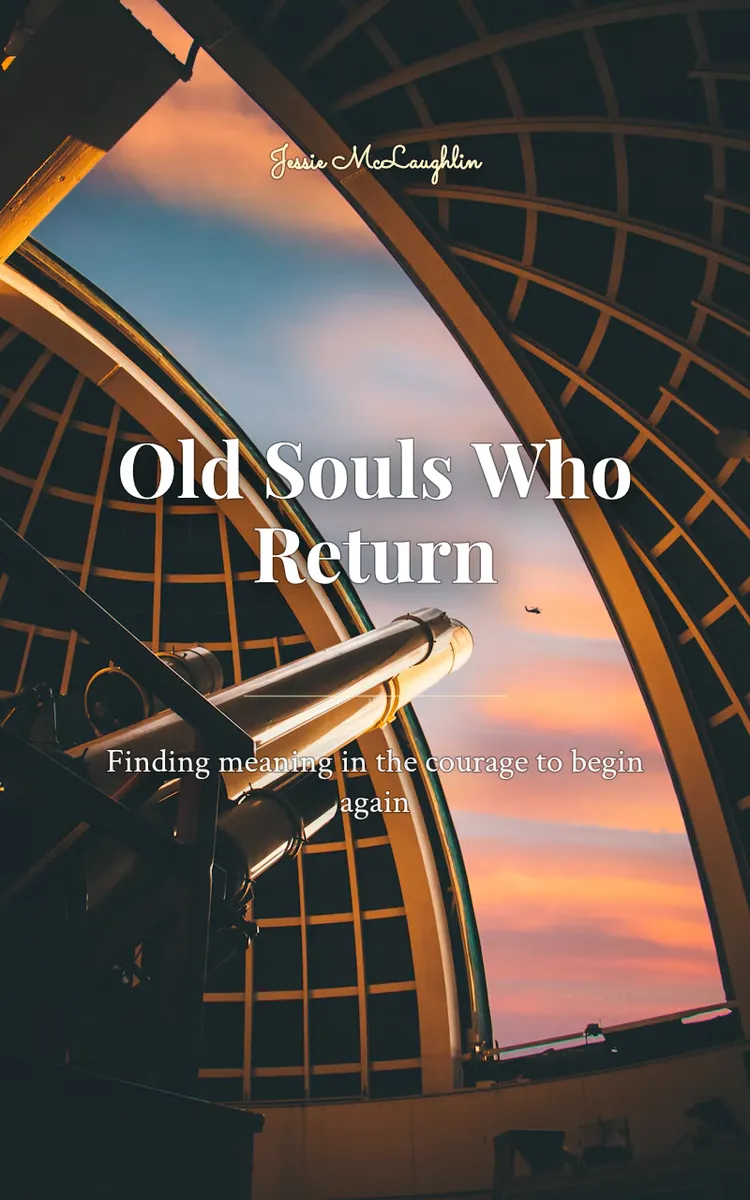
"Old Souls Who Return" is a inspirational book by Jessie McLaughlin with 40 chapters and approximately 60,329 words. Old souls and the willingness to return to life, love, and possibility.
This book was created using Inkfluence AI, an AI-powered book generation platform that helps authors write, design, and publish complete books. It was made with the AI Inspirational Book Writer.
Frequently Asked Questions
What is "Old Souls Who Return" about?
Old souls and the willingness to return to life, love, and possibility
How many chapters are in "Old Souls Who Return"?
The book contains 40 chapters and approximately 60,329 words. Topics covered include Recognizing the Returning Soul, Releasing the Myth of Starting Over, Listening to Inner Knowing, Making Peace with Your Pace, and more.
Who wrote "Old Souls Who Return"?
This book was written by Jessie McLaughlin and created using Inkfluence AI, an AI book generation platform that helps authors write, design, and publish books.
How can I create a similar inspirational book?
You can create your own inspirational book using Inkfluence AI. Describe your idea, choose your style, and the AI writes the full book for you. It's free to start.
Write your own inspirational book with AI
Describe your idea and Inkfluence writes the whole thing. Free to start.
Start writingCreated with Inkfluence AI


