
Read the first chapter
The whole of chapter one, free. About 8 min. Turn the pages with the arrows, your keyboard, or a swipe.
Chapter 1
How a Viral Claim Becomes a Plot
The Headline That Outgrew Its Evidence
In 2017, a video circulated online claiming that the Rothschild family controlled central banks, governments, and wars. Its images moved quickly: old portraits, bank buildings, maps, and newspaper headlines about Israel, migration, terrorism, and financial crises. The material looked varied, but the video gave it one invisible thread. A collection of unrelated facts became a plot.
That transformation is the subject here. The claim is not merely that a particular story is false or exaggerated. The more revealing question is how scattered events acquire the shape of a single explanation - especially when the explanation joins Zionism, Israel, Islamist movements, Western decline, and the idea of a future world government. Such narratives often borrow the appearance of investigation while relying on association, repetition, and emotional timing.
The distinction between evidence and narrative momentum is easy to state and difficult to maintain. Evidence asks what a source actually demonstrates. Narrative momentum asks what the next headline seems to confirm.
When does a chain of associations begin to feel like proof?
The Headline-to-Hypothesis Ladder
A useful way to observe this process is the Headline-to-Hypothesis Ladder. It begins with a headline, rises through a selected pattern, and ends with a theory broad enough to absorb almost anything. The ladder is not a formal scientific model; it is a way of noticing how a claim changes as it travels.
At the first rung sits a genuine event: a military operation, a banking decision, a terrorist attack, a speech by a political leader, or a vote at the United Nations. The event may be documented in official records and reported by several news organizations. At this stage, the information is narrow. It answers a limited question: what happened, when, and who was involved?
The second rung is selection. From thousands of available headlines, a narrator chooses those that appear connected. A report about American military aid to Israel may sit beside an article about Islamist violence in Europe, followed by a story about economic instability. The items are real, but their proximity is manufactured by the presentation. The reader is encouraged to treat sequence as relationship.
At the third rung, the selected events are given a common actor. “Zionist Jews,” “globalists,” Western intelligence agencies, or Islamist networks may be described as parts of one coordinated system. Distinct groups with competing interests are compressed into a single noun. The compression is rhetorically powerful because it removes the untidy details that would otherwise interrupt the story.
The fourth rung turns coordination into intention. A policy that produces disorder is recast as a policy designed to produce disorder. A government’s alliance becomes proof of control. A terrorist group’s actions become evidence that it is secretly serving the state it claims to oppose. The final rung is the hypothesis of global management: the apparent chaos is said to be useful because it clears the way for one world government, with Israel at its center and religious law enforced through a transformed political order.
Each rise makes the story more sweeping and less testable. A claim about a specific payment can be checked against financial records. A claim that “chaos benefits the same hidden network” can absorb almost any outcome, including events that appear to contradict it.
A conspiracy narrative does not need every detail to be invented. It often works by placing true details inside an unsupported architecture.
Why Contradictions Can Strengthen the Story
The modern political conspiracy story has older ancestors. In medieval Europe, Jews were falsely accused of causing disease, poisoning wells, or conducting secret rituals. During the nineteenth century, antisemitic pamphlets portrayed Jewish financiers as a hidden international power. The most influential forgery in this tradition, The Protocols of the Elders of Zion, presented an imaginary meeting in which Jewish leaders supposedly planned world domination. It was exposed as fraudulent, yet it continued to circulate because it offered a ready-made explanation for social change.
The language changes with the period, but the structure remains familiar. Economic uncertainty, military defeat, cultural change, and political conflict are gathered into a story about concealed agency. Modern versions may replace “secret Jewish council” with “Zionist control,” attach Israel to American foreign policy, and add Islamist movements as either collaborators or useful enemies. The result can appear politically sophisticated while preserving the old habit of assigning collective blame to Jews.
A striking feature of these narratives is their ability to treat contradiction as confirmation. If Israel and an Islamist organization fight, the conflict is described as staged or mutually useful. If they negotiate, the negotiation becomes proof of collusion. If Western governments condemn Israel, that may be interpreted as theater; if they support Israel, it is treated as evidence of capture. The theory survives because no possible event is allowed to count against it.
This resembles a trap in scientific reasoning. A useful explanation makes predictions that could fail. A closed conspiracy story instead rearranges the evidence after every event. Its strength comes not from precision but from elasticity.
The Headline-to-Hypothesis Ladder shows where that elasticity enters. The headline supplies a fact. Selection supplies a pattern. The pattern is assigned an actor. The actor is assigned an intention. Finally, the intention is expanded into a master plan. At each rung, the language becomes more certain while the direct evidence usually becomes thinner.
The Surprising Power of Repetition
The counterintuitive finding is that repeated exposure can make a claim feel more familiar even when it does not make the claim more credible. Familiarity is often experienced as recognition, and recognition can be mistaken for verification.
That matters because viral conspiracy material rarely depends on one persuasive document. It depends on recurrence. The same photograph of a political leader, the same quotation attributed to a financier, and the same map of alleged influence appear across videos, posts, podcasts, and comment threads. Each appearance seems independent, but many copies may trace back to one unverified source.
Digital platforms intensify this effect by rewarding material that creates reaction. A headline suggesting that Israel secretly directs both Western governments and Islamist groups is more likely to provoke anger, fear, or astonishment than a careful account of competing institutions and incomplete evidence. The platform does not need to endorse the claim. It only needs to circulate it.
Images add another layer. A photograph of a Jewish philanthropist meeting a prime minister may be presented beside an image of a protest or a military strike. The visual arrangement implies a relationship without stating one. The viewer performs the final connection. Because the conclusion feels self-generated, it can seem more convincing than a sentence supplied by someone else.
One sentence captures the problem: A repeated association can become psychologically stronger while remaining evidentially empty.
The same mechanism explains why unrelated crises are often bundled together. Financial instability, immigration, terrorism, pandemic restrictions, and war generate genuine anxiety, but they do not automatically share a cause. A narrative that links them offers relief from uncertainty by converting many difficult questions into one answer. The answer may be wrong, yet its simplicity gives it staying power.
A Story in a London Algorithm
The 2017 video about the Rothschild family was not an isolated curiosity. It belonged to a broad online ecosystem in which antisemitic claims were repackaged as political analysis. Old images were paired with modern references to Zionism, central banking, Israel, and the decline of Western nations. The presentation borrowed the visual grammar of documentary film: ominous music, archival photographs, maps, quotations, and a steady accumulation of “coincidences.”
Its persuasive force came from the arrangement. A viewer did not need to accept every claim. The video only needed to establish a mood in which each new connection seemed plausible. Historical Jewish persecution could be recast as evidence of hidden power rather than evidence of prejudice. Israeli state policy could be treated as the expression of all Jews. Islamist violence could be described either as an enemy of Israel or as an instrument secretly permitted by Israel. Western political failures could then be presented as the intended result.
The human consequences of this process are visible in communities that have confronted online radicalization. In the United Kingdom, the Community Security Trust, which monitors antisemitic incidents, has repeatedly documented how conspiracy claims migrate from fringe websites into mainstream social media. The content often arrives disguised as criticism of governments or banks, but its vocabulary reveals an older target: Jews as a collective force manipulating finance, war, media, and migration.
Picture the route of one such claim. A post begins with a real photograph of a Jewish public figure. A caption adds a claim about funding. A second account copies the image and attaches a headline about Israel. A video maker places it beside footage of Islamist militants and a speech about Western decline. By the time the material reaches a large audience, the original photograph has become a symbol inside a much larger story. Its factual content has not expanded, but its narrative role has.
That is how a headline becomes a hypothesis. The event remains small; the explanation grows around it.
What the Ladder Reveals
The most important distinction is not between people who believe conspiracy stories and people who do not. It is between forms of reasoning. A person can be suspicious of governments, critical of Israeli policy, opposed to Islamist violence, and concerned about Western political weakness without placing all four subjects inside a single hidden command structure.
Evidence preserves boundaries. It distinguishes the Israeli government from Jewish people worldwide, Zionist political movements from Judaism, Islamist organizations from Muslims generally, and Western policy failures from a centrally directed plan. Conspiracy narratives erase those boundaries because their power depends on making separate categories appear interchangeable.
The ladder also explains why debunking can fail when it addresses only one rung. Correcting a false quotation may leave the larger pattern untouched. Showing that one image was miscaptioned may not weaken the emotional conclusion already formed. The narrative has moved beyond its original materials and now feeds on its own repetition.
Human beings are pattern-seeking creatures, but patterns are not all of the same kind. Some reveal causes; others are produced by the storyteller’s choice of what to place together. The difference is often invisible in the finished video, where a dozen headlines march in the same direction.
A conspiracy story becomes persuasive not when every fact supports it, but when the gaps between facts disappear. What looks like a map of hidden control may be the outline of a story assembled from fragments - and the most unsettling part is how easily the eye mistakes the outline for the territory.
End of chapter one. 39 more chapters and about 65,978 words in the full book.
Swipe or use the arrows to turn the page


What's inside: 40 chapters
- 1. How a Viral Claim Becomes a Plot
- 2. Following the Money Without Guessing
- 3. What “Zionist” Means in Context
- 4. The Old Blueprint Behind New Plots
- 5. Reading Donation Records Carefully
- 6. Lobbying Is Not a Remote Control
- 7. Who Benefits From Western Collapse?
- 8. Chaos as a Political Explanation
- 9. The Missing Link in Secret-Plan Claims
- 10. When Coincidence Looks Coordinated
- 11. Israel’s Real Political Institutions
- 12. How Alliances Shape U.S. Policy
- 13. Arms Deals, Aid, and Accountability
- 14. The Media Ownership Shortcut
- 15. Algorithms That Reward Outrage
- 16. Screenshots Without Provenance
- 17. The Secret-Meeting Fallacy
- 18. What the UN Can Actually Enforce
- 19. World Government: Metaphor or Institution?
- 20. Noahide Laws Beyond the Rumor
- 21. Who Enforces Religious Law?
- 22. Christian Zionism Has Its Own Agenda
- 23. Islamist Politics Is Not One Bloc
- 24. Why Some States Normalize Ties
- 25. The Abraham Accords Under Scrutiny
- 26. Palestinian Politics Beyond the Slogan
- 27. War Footage and False Certainty
- 28. The Intelligence-Agency Magnet
- 29. Crisis Timelines That Don’t Add Up
- 30. The Expert Who Knows Everything
- 31. How Prophecy Enters Political Analysis
- 32. The Psychology of Hidden-Hand Stories
- 33. When Every Denial Becomes Proof
- 34. The Cost of Collective Blame
- 35. How to Challenge a Claim Fairly
- 36. A Better Map of Political Influence
- 37. What Would Change Your Mind?
- 38. Building a Reliable Source Trail
- 39. Living With Unresolved Geopolitics
- 40. The World Is More Than One Plot
About this book
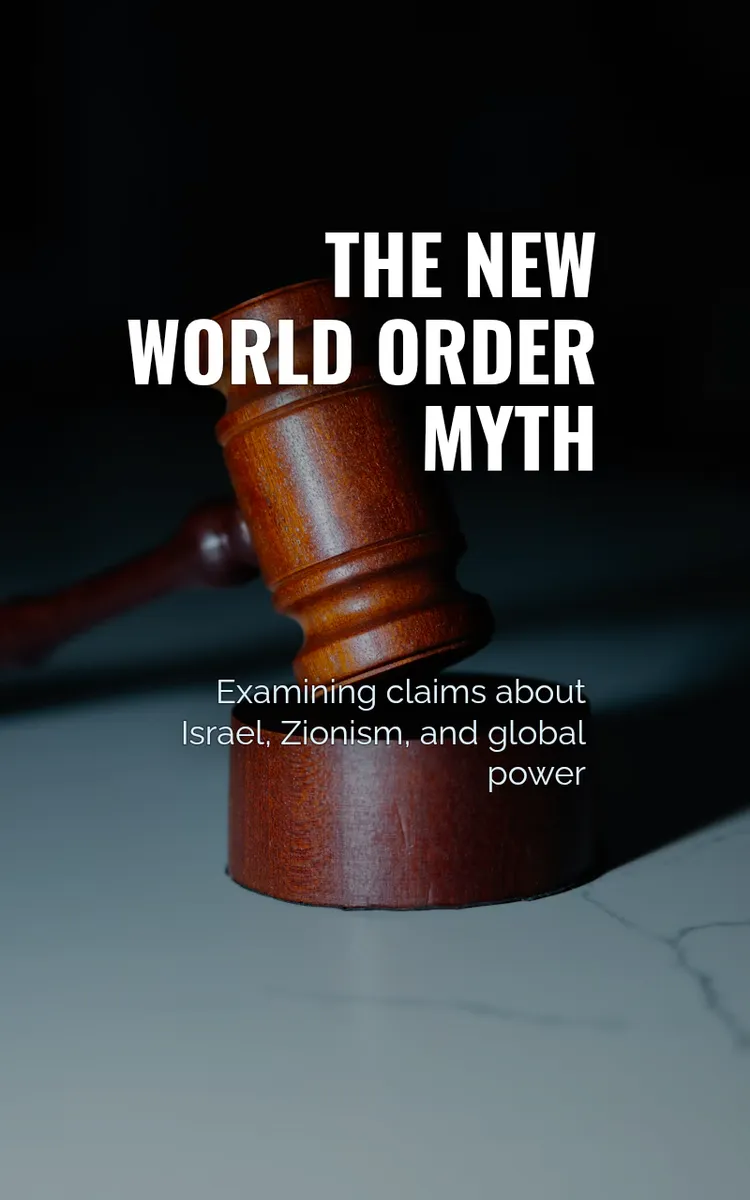
"The New World Order Myth" is a nonfiction book by Jessie McLaughlin with 40 chapters and approximately 65,978 words. Conspiracy claims linking Zionism, Israel, Islamism, and Western collapse.
This book was created using Inkfluence AI, an AI-powered book generation platform that helps authors write, design, and publish complete books.
Frequently Asked Questions
What is "The New World Order Myth" about?
Conspiracy claims linking Zionism, Israel, Islamism, and Western collapse
How many chapters are in "The New World Order Myth"?
The book contains 40 chapters and approximately 65,978 words. Topics covered include How a Viral Claim Becomes a Plot, Following the Money Without Guessing, What “Zionist” Means in Context, The Old Blueprint Behind New Plots, and more.
Who wrote "The New World Order Myth"?
This book was written by Jessie McLaughlin and created using Inkfluence AI, an AI book generation platform that helps authors write, design, and publish books.
Write your own nonfiction book with AI
Describe your idea and Inkfluence writes the whole thing. Free to start.
Start writingCreated with Inkfluence AI


