

Read the first chapter
The whole of chapter one, free. About 4 min. Turn the pages with the arrows, your keyboard, or a swipe.
Chapter 1
Hinterkaifeck Farm, 1922
The farm known today as Hinterkaifeck stood alone in the Bavarian countryside, roughly seventy kilometres north of Munich, between the towns of Ingolstadt and Schrobenhausen. It took its name from its position relative to a small hamlet nearby — Hinterkaifeck meant, quite literally, "behind Kaifeck" — and that was about as much notice as the outside world had ever taken of it. The nearest neighbours lived the better part of a kilometre away. The house itself had stood since around 1863, a solid two-storey farmhouse with a barn attached, surrounded by fields and forest, reachable only by an unpaved track that turned to mud in the wet.
The land had come into the family through Cäzilia Gruber, born Cäzilia Sanhüter in 1849 in the nearby village of Gerolsbach. Her first marriage, to a man named Josef Asam, had produced three children — Martin, Cäzilia and Andreas — before ending in divorce, with ownership of the Hinterkaifeck property awarded to her as part of the settlement in 1877. Nine years later, in 1886, she married a local man named Andreas Gruber, and the two of them settled into farming the land together. Their marriage produced two more daughters, Viktoria, born in 1887, and Sophie, born in 1889.
It was Viktoria who would remain at Hinterkaifeck into adulthood. In March 1914, she married a young man from the nearby village of Waidhofen named Karl Gabriel, and on the same day, her parents formally transferred ownership of the farm to the newly married couple. Whatever future they might have imagined for themselves didn't get the chance to unfold. Within months, war had broken out across Europe, and Karl was called up. By December of that year, he had been reported killed in France. His body was never returned home, a detail that meant little to anyone at the time, though it would go on to fuel speculation in the years that followed.
The following January, Viktoria gave birth to a daughter, whom she named Cäzilia after her grandmother. It should have been a straightforward matter of a young widow raising her husband's child. It wasn't. Later that same year, Andreas Gruber and his daughter Viktoria were convicted in a Bavarian district court of having carried on an incestuous relationship, one the court determined had taken place between 1907 and 1910 — years before Viktoria's marriage, and well before her daughter's birth. Andreas was sentenced to a year in prison. Viktoria's sentence, by most accounts, ran to a single month. The conviction covered a period that had already passed, but it left a mark on how the family was seen locally, one that never really faded. And it wasn't the last question raised about who fathered a child in that house. Some years after Karl's reported death, Viktoria gave birth to a son, Josef. By 1922, the boy was two years old, and his parentage had never been settled to anyone's satisfaction. Suspicion fell in more than one direction. Some believed Andreas was responsible a second time. Others pointed to a neighbouring farmer named Lorenz Schlittenbauer, a widower who lived only a short distance away and who would later say he had been involved with Viktoria since 1918, and who at various points publicly acknowledged Josef as his own son. Whether he was, whether Andreas was, or whether the answer lay somewhere else entirely, nobody outside that house ever knew for certain.
By the start of 1922, then, the household at Hinterkaifeck consisted of five people. Andreas Gruber, sixty-three, still the head of the farm in practice if no longer on paper. His wife Cäzilia, seventy-two. Their daughter Viktoria, thirty-five, a widow raising two children under the same roof as her parents. And Viktoria's children: Cäzilia, seven, and Josef, two. It was, on the surface, an ordinary rural Bavarian household of the kind found across the countryside that year, in a Germany still reeling from a war it had lost and an economy that was beginning to slide toward the runaway inflation that would define the years just ahead. Whatever hardship the wider country was facing, life at Hinterkaifeck carried on in its own isolated rhythm — the fields worked, the animals fed, the same handful of people going about the same days, mostly unseen by anyone beyond their own small stretch of land.
That isolation, though, had started to unsettle at least one person who knew the house well. Around six months earlier, in the latter part of 1921, the family's maid, a woman named Kreszenz Rieger, had abruptly quit her position. She told people afterward that she had heard footsteps moving through the attic above her room, sounds she couldn't explain and didn't want to spend another night listening to. Whether she believed the house was genuinely haunted, or simply wanted an excuse to leave a household already trailing an uncomfortable local reputation, nobody pressed her on it much at the time. The Grubers needed a replacement, and eventually found one: a forty-four-year-old woman named Maria Baumgartner, who agreed to start work at the farm on the thirty-first of March, 1922.
That Friday began, as far as anyone would later be able to tell, like any other day at Hinterkaifeck. Maria arrived to begin her new position. The household went about its usual work. Nothing that morning gave any sign of what the day would end with, or of how long it would be before anyone outside that isolated stretch of Bavarian farmland realised that something had gone terribly wrong.
End of chapter one. 11 more chapters in the full book.
Swipe or use the arrows to turn the page

THE KILLER WHO TURNED CABIN 28 INTO A SLAUGHTERHOUSE

THE KILLER WHO WORE A WHITE MASK

Color My Little Pooch
What's inside: 12 chapters
- 1. Hinterkaifeck Farm, 1922
- 2. The Warnings
- 3. The New Maid
- 4. The Night of the Murders
- 5. Days of Silence
- 6. The Discovery
- 7. A Crime Scene Destroyed
- 8. Secrets of the Gruber Family
- 9. The Suspects
- 10. Legend and the Press
- 11. The Modern Investigation
- 12. The Farm That Was Never Rebuilt
About this book
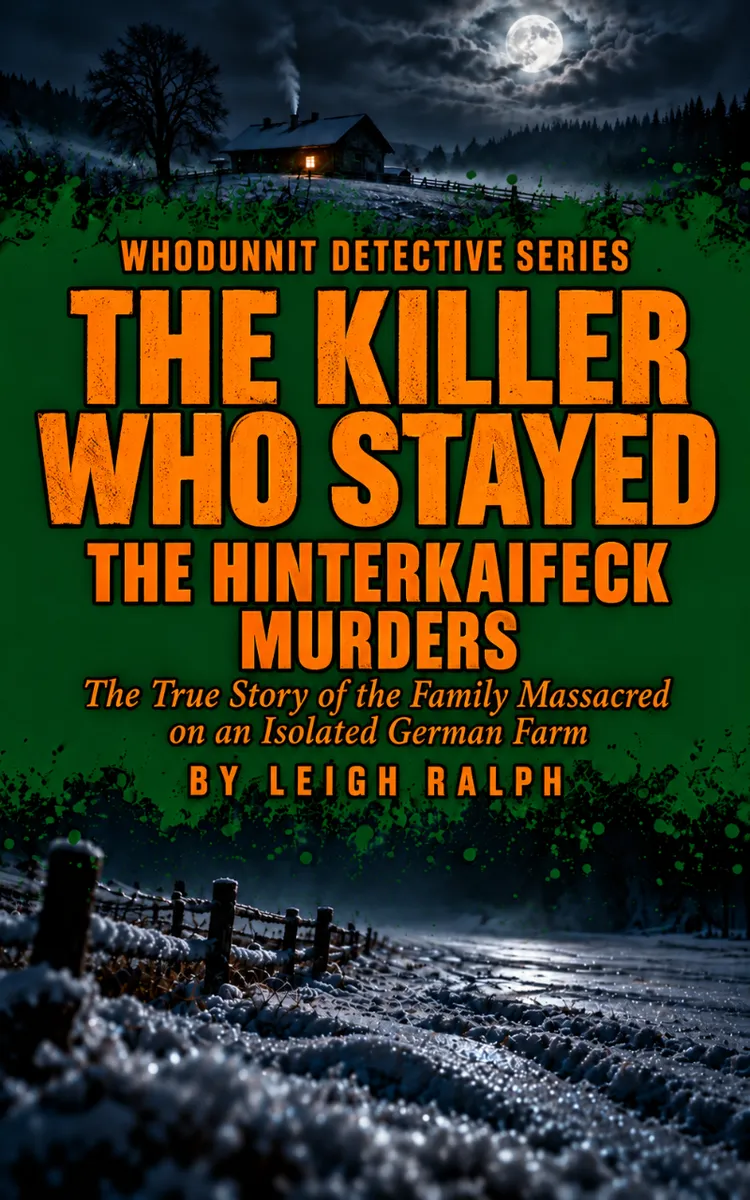
"THE KILLER WHO STAYED" is a general book by Leigh Ralph with 12 chapters and approximately 7,977 words. It covers key insights and practical takeaways on the topic.
This book was created using Inkfluence AI, an AI-powered book generation platform that helps authors write, design, and publish complete books.
Frequently Asked Questions
What is "THE KILLER WHO STAYED" about?
"THE KILLER WHO STAYED" is a general book by Leigh Ralph covering key insights and practical takeaways on the topic.
How many chapters are in "THE KILLER WHO STAYED"?
The book contains 12 chapters and approximately 7,977 words. Topics covered include Hinterkaifeck Farm, 1922, The Warnings, The New Maid, The Night of the Murders, and more.
Who wrote "THE KILLER WHO STAYED"?
This book was written by Leigh Ralph and created using Inkfluence AI, an AI book generation platform that helps authors write, design, and publish books.
Write your own book with AI
Describe your idea and Inkfluence writes the whole thing. Free to start.
Start writingCreated with Inkfluence AI


