
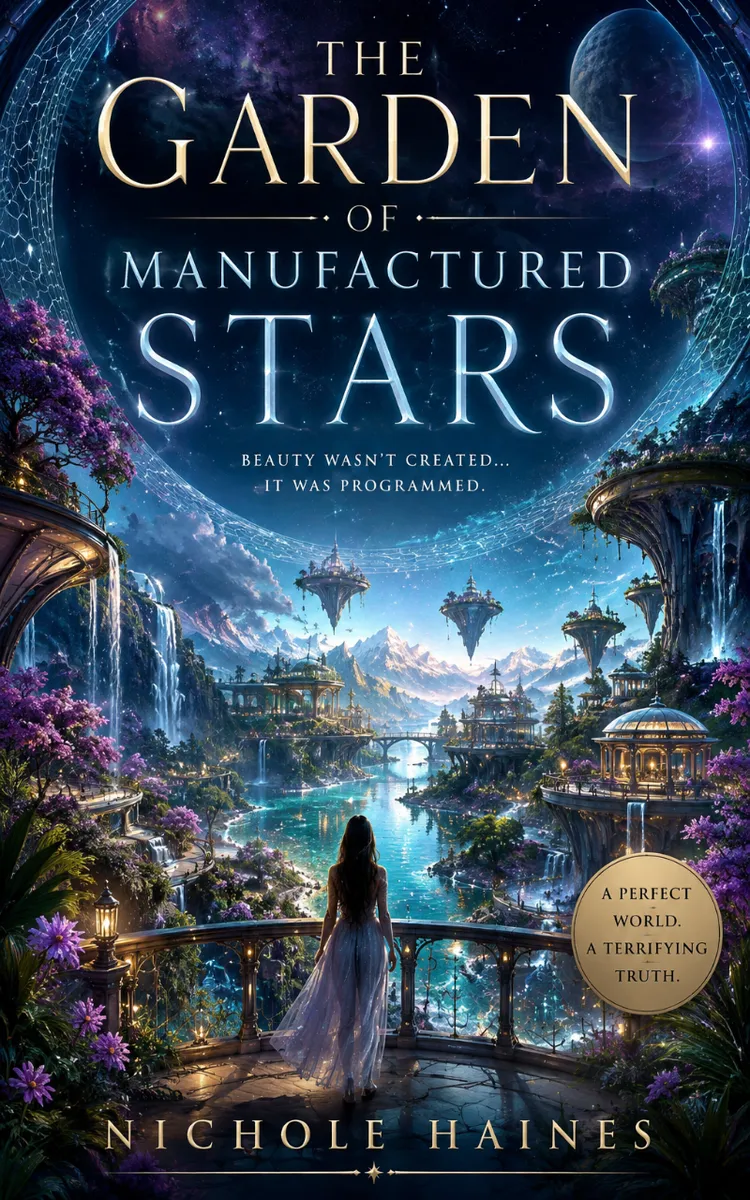

Read the first chapter
The whole of chapter one, free. About 8 min. Turn the pages with the arrows, your keyboard, or a swipe.
Chapter 1
Arrival Under Wrong Constellations
The gate’s shadow fell upward.
Kael Soren noticed it before he noticed the garden: a dark, precise silhouette climbing through the transparent platform beneath his boots, rising toward the island instead of descending toward the river. His knees struck the white stone as the transit field released him. Somewhere behind him, the aperture folded shut with the dry crack of cooling metal.
He stayed on all fours, one hand pressed to the platform.
The stone was warm. Not sun-warm. Body-warm.
Below the platform, a river of liquid light moved through empty space. It poured from a cliff with no visible source, spilling in a broad silver ribbon beneath the island. The current made no sound, yet Kael felt it vibrating through his teeth. Islands drifted in the distance, each carrying forests of crystal, terraces of blue grass, and towers that seemed grown rather than built.
Above them hung a sky crowded with stars.
Kael pushed himself upright.
“Confirm your position,” he said.
His voice entered the air and returned a fraction late.
He looked at the wrist unit strapped beneath his sleeve. The display had survived the transit. Barely. Its thermal sensor crawled between impossible values, then settled on twelve degrees Celsius.
He touched the casing. “Astraea gateway. Local environment. Surface temperature twelve degrees. Gravity - ”
“Point eight-eight standard,” said a woman behind him.
Kael turned.
Lyra stood at the edge of the platform, barefoot on the warm stone. She wore a pale garment that moved as if underwater, though the air around her was still. Her face was calm, almost familiar. Not beautiful in any human proportion Kael could name. Her eyes held the color of the river below, luminous and depthless.
He had never seen her before.
“You’re not in my transmission logs,” he said.
“You have not transmitted anything.”
Kael glanced at the wrist unit. The recording icon was dark.
He tapped it twice. “I am recording now.”
The icon lit.
Lyra watched him with patient attention. “Then begin with what you can prove.”
That had been the purpose of sending him here. Not officially. Officially, the Directorate had called it an evaluation mission, a final opportunity to correct his misconduct. Three months earlier, Kael had released classified structural data showing that Astraea’s mass distribution violated every model of gravitational stability. The data had vanished from the public archive within eleven minutes. His license had followed it.
Then the Directorate had offered him a choice between permanent confinement and a one-way descent into the anomaly he had exposed.
He had chosen the place where the equations could answer for themselves.
Kael raised his wrist toward the sky. “I can prove that the stars are not natural.”
Lyra’s expression did not change. “Most visitors begin with beauty.”
“Most visitors weren’t astrophysicists.”
“Most visitors were.”
The answer landed softly, but it disturbed him more than a threat would have.
Kael ignored her and began the survey. The gateway platform measured approximately forty meters across, circular, with no visible supports. The island extended beyond it in a shallow slope of silver soil and flowering structures. Crystal trees rose along the perimeter, their branches holding translucent leaves that chimed without wind. A narrow path curved toward an archway woven from black roots.
He crouched and placed a calibration puck on the stone.
The puck unfolded into a tripod. Its three legs locked. A blue beam projected upward, searching for a gravitational reference.
The beam bent.
Not gradually. It kinked at a sharp angle and continued toward a point above the horizon.
Kael stared at it.
“Your instrument is adjusting to the garden,” Lyra said.
“Instruments don’t adjust to gardens.”
“This one does.”
He opened the diagnostic panel. The puck reported a local gravitational vector angled thirty-one degrees east of vertical. He checked the tripod manually. Level. Stable. He set a second puck three meters away.
The second beam rose straight.
Kael’s mouth went dry.
He moved the first puck beside the second. Both beams now rose straight, as if embarrassed by their earlier mistake.
Lyra stepped closer. “You wanted an immediate observation.”
“I want repeatability.”
“Astraea does not offer that.”
“A physical structure cannot change because I look at it.”
“Why not?”
He looked up sharply.
The stars had shifted.
Only a few degrees, perhaps. A cluster near the zenith had loosened, three points of light sliding apart while he watched. One star brightened. Another vanished behind nothing.
Kael raised his hand and traced the movement against the sky.
Lyra followed his gaze. “Do not force yourself to remain calm.”
“I’m not forcing anything.”
“You are counting.”
He stopped.
He had been counting silently. One through ten, as he always did when an observation threatened to become subjective. His old mentor had called it the Soren reset: reduce panic to sequence, sequence to measurement.
The stars rearranged again.
A line of seven became a shallow arc.
Kael’s pulse thudded against the wrist unit. He looked down at the recording display. The sky’s spectral readings were scrolling across it, but the values changed each time he blinked.
He pinched the screen and froze the data.
The numbers held.
He lifted his eyes.
The constellation above him had returned to its original pattern.
Kael looked back at the screen.
The data now showed the second pattern.
“Lyra.”
“Yes.”
“Did you alter the display?”
“No.”
“Did Astraea?”
She inclined her head. “You are beginning to ask useful questions.”
He pulled the storage wafer from his jacket. It was shielded, self-powered, and physically disconnected from every network. He inserted it into the wrist unit, copied the readings, and removed it.
The wafer’s indicator flashed green.
He held it up. “This is independent.”
“Independent of what?”
“Of you.”
Lyra looked at the wafer. For the first time, something moved behind her eyes - not surprise, exactly. Recognition.
Kael turned away from her and walked toward the island’s edge. The river of light passed beneath him without a ripple. Its surface carried shapes that might have been reflections, except the sky above it was different. In the river, the stars formed a dense spiral.
He knelt.
The spiral tightened.
Kael leaned closer.
It broke apart.
A cold pressure gathered behind his eyes. He stood quickly and backed away from the edge.
The river resumed its smooth, silent flow.
“You said the garden adapts to visitors,” he said.
“To desire.”
“I don’t desire this.”
“Not consciously.”
He faced her. “You know what I’m thinking?”
“I know what the garden hears.”
“And what does it hear now?”
Lyra’s gaze moved past him, toward the black-root archway. “You want a fixed point.”
Kael almost laughed. The sound came out brittle. “That’s not a desire. It’s a requirement.”
“For you, there is little difference.”
The archway opened.
No mechanism moved. The roots simply unknotted, revealing a path beyond. The soil along it was dark and wet, though no water fell from the sky. Flowers emerged from the ground as Kael watched, opening in quick succession. Each had a glassy center filled with miniature sparks.
He did not move.
“You expect me to follow you,” he said.
“I expect you to continue.”
“Where?”
“To the observatory.”
“There’s an observatory?”
“There will be.”
Kael looked at the archway, then at the stars. He had come for structure. For a baseline. Something that could be measured before the place learned how to disguise itself.
He took the storage wafer from his wrist unit and pressed it into the center of his palm.
“If I find one stable reference,” he said, “I can reconstruct the rest.”
Lyra’s eyes settled on him. “Then find one.”
He stepped through the archway.
The temperature dropped at once. Crystal branches reached over the path, touching one another overhead. Their leaves chimed in patterns too regular to be natural. The sound followed Kael’s pace. When he slowed, it slowed. When he stopped, the final note hung in the air until he moved again.
He turned his head without moving his feet.
The gateway platform was gone.
Not hidden by trees. Gone. Beyond the archway lay only a descending garden, its terraces floating one beneath another over the river. The path behind him ended at a wall of pale stone.
Kael’s breath caught.
Lyra continued ahead.
“You said no one leaves,” he called.
“No one returns through the gate.”
“That isn’t what I asked.”
She glanced back. “You already know the answer.”
He followed because the alternative was standing alone in a place that had removed the door.
The path curved through a grove of crystal trunks. At the center of each trunk, a slow pulse of light traveled upward, branching into the limbs. Kael placed his hand against one. The surface flexed beneath his fingers.
The tree pulsed faster.
He withdrew his hand.
A small observatory rose from the garden ahead, assembled from concentric rings of black metal. Its dome was open to the artificial sky. Instruments waited inside: telescopes, gyroscopes, arrays of lenses, all arranged around a circular table.
Kael entered.
The door sealed behind him.
He set the wafer on the table. A holographic star map unfolded above it, rendered from the readings he had collected at the gateway.
At first, the map was nonsense. Star positions contradicted one another. Distances changed between scans. Several points occupied the same coordinates.
Then the projection steadied.
A constellation appeared in the center: nine stars forming a narrow eye.
Kael leaned toward it.
The pattern held.
He checked the raw files. The values remained consistent. He ran the gravitational equations by hand, entering the coordinates one at a time. The result was stable. Impossible, but stable. The constellation had a defined geometry. Its stars were separated by distances that implied a coherent local frame.
For the first time since arrival, something in Astraea behaved like a system rather than a mood.
Kael exhaled.
Lyra stood outside the table’s circle. “There.”
He did not look at her. “This map is stable.”
“Is that what you wanted?”
“Yes.”
The nine stars brightened.
Kael froze.
He had not touched the controls. The map’s central star flared, then dimmed. The outer stars shifted by a fraction, correcting themselves into a cleaner symmetry.
He reached for the projection.
The moment his fingers entered it, the constellation changed.
The eye became a closed loop.
Kael jerked back. The map flickered and returned to the eye.
He stared at his hand.
“Don’t,” Lyra said.
“Don’t what?”
“Trust it.”
He looked at the map again. The eye remained perfect. Motionless. Waiting.
Kael picked up the wafer and turned it over. Its green indicator had gone dark.
He inserted it into the observatory console.
The system accepted it.
A single line appeared across the projection:
OBSERVATION CONFIRMED.
Kael felt the room contract around him.
“What does that mean?” he asked.
Lyra’s reflection appeared in the black metal table, though she stood several feet away. In the reflection, her head was tilted toward the stars.
“It means,” she said, “Astraea knows you are here.”
The constellation shifted once more.
This time, it did not wait for him to look away.
End of chapter one. 12 more chapters and about 23,494 words in the full book.
Swipe or use the arrows to turn the page


What's inside: 13 chapters
- 1. Arrival Under Wrong Constellations
- 2. Lyra’s Thought-Perfect Guide
- 3. Devices That Lie on Recheck
- 4. The Pocket Universe Beneath Astraea
- 5. Encoded Light Messages Start Answering
- 6. Lyra Confesses She’s Astraea
- 7. The Core That Filters Minds
- 8. Stars Fall, Kael Wakes on Earth
- 9. Afterimages in Ordinary Sky
- 10. Stubborn Light
- 11. Quiet Cartography
- 12. The Weight of Small Truths
- 13. Small Constellations Burn
About this book
"The Garden Of Manufactured Stars" is a fiction book by Nichole Haines with 13 chapters and approximately 23,494 words. A disgraced astrophysicist uncovers a sentient star-filter universe..
This book was created using Inkfluence AI, an AI-powered book generation platform that helps authors write, design, and publish complete books. It was made with the AI Novel Writer.
Frequently Asked Questions
What is "The Garden Of Manufactured Stars" about?
A disgraced astrophysicist uncovers a sentient star-filter universe.
How many chapters are in "The Garden Of Manufactured Stars"?
The book contains 13 chapters and approximately 23,494 words. Topics covered include Arrival Under Wrong Constellations, Lyra’s Thought-Perfect Guide, Devices That Lie on Recheck, The Pocket Universe Beneath Astraea, and more.
Who wrote "The Garden Of Manufactured Stars"?
This book was written by Nichole Haines and created using Inkfluence AI, an AI book generation platform that helps authors write, design, and publish books.
How can I create a similar fiction book?
You can create your own fiction book using Inkfluence AI. Describe your idea, choose your style, and the AI writes the full book for you. It's free to start.
Write your own fiction book with AI
Describe your idea and Inkfluence writes the whole thing. Free to start.
Start writingCreated with Inkfluence AI


