
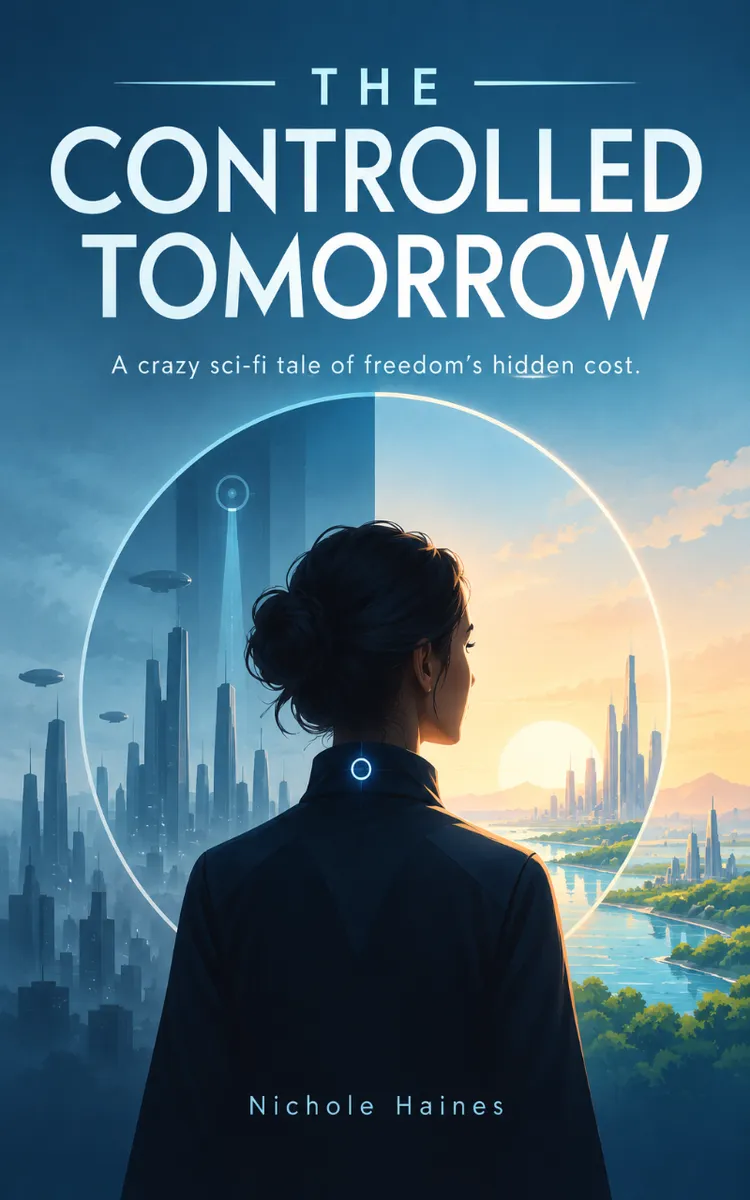

Read the first chapter
The whole of chapter one, free. About 7 min. Turn the pages with the arrows, your keyboard, or a swipe.
Chapter 1
The Daylight Curfew That Lies
The civic clocktower struck 06:13, and every gate beneath it slammed shut except the one Mara Kestrel was already running toward.
Its bronze teeth opened across the corridor with a shriek that rattled her fillings. White transit light poured through the gap, sharp enough to turn the polished floor into a river of ice. Mara hit the access plate with her palm.
“Outer ring,” she gasped. “Route nine.”
The plate flashed her face, her pulse, the thin black band around her wrist. Then it displayed the time she had left.
00:47.
Forty-seven seconds before the daylight curfew sealed the corridor.
Behind her, boots struck the stairs.
Mara glanced back. Two Civic Timing officers descended beneath the clocktower, their gray coats moving in perfect rhythm, their helmets reflecting the red numbers burning above the tunnel. They had no guns. They did not need them. Every door, camera, and gate in the city answered to the public clock.
The access plate chimed.
“Route nine approved,” it said. “Proceed calmly.”
“Calmly can rot,” Mara muttered, and threw herself through.
The gate snapped shut behind her.
For one breath, the corridor carried her forward on a moving strip of black glass. Beneath the transparent floor, the city’s buried machinery spun: magnetic rails, coolant pipes, and the pale blue veins of the municipal network. Above, the walls displayed the morning schedule in clean silver letters.
CIVIC CLOCK: 06:13:22
OUTER RING ACCESS: OPEN
DAYLIGHT CURFEW: 06:14:10
Mara kept her eyes on the countdown. She had crossed this corridor nine times. She knew the angles, the blind spots, the service cutout behind the third advertisement pillar. She knew which cameras were real and which were painted decoys left over from the riots.
Most importantly, she knew the corridor’s timing.
The gates did not merely open and close. They predicted movement. They sorted bodies according to approved destinations, approved occupations, approved levels of urgency. A worker headed to a factory could pass at 06:08. A courier headed outward could pass at 06:12. Anyone moving against the pattern became a delay, and delays were corrected.
Mara had built her life around being faster than correction.
The moving floor accelerated. Her boots skidded. She caught the rail and swung herself around a column as a delivery drone dropped from the ceiling, its six rotors whining inches from her hair.
“Unregistered lateral movement,” the drone announced.
“Register this.”
She shoved off the column and sprinted.
At the next checkpoint, a glass iris opened in the wall. She slid her wrist beneath the scanner. Her console pulsed once.
AUTHORIZED: MARA KESTREL DESTINATION: OUTER RING ARRIVAL WINDOW: 06:13:41-06:13:58
The corridor stretched ahead, empty and gleaming.
Then the clock above it skipped.
06:13:31 became 06:13:18.
Mara slowed.
The numbers corrected themselves.
06:13:19.
A cold line traveled beneath her skin.
The corridor had not rewound. The clock had changed.
“Keep moving,” said a voice behind her.
Mara spun.
The nearest officer had reached the checkpoint. His helmet was smooth and blank, but the voice came through the wall speakers as well, multiplied along the tunnel.
“Citizen Kestrel, your route has been amended.”
“You’re late,” Mara said.
“Your route is early.”
The iris began to close.
Mara jammed her forearm through the narrowing glass. Pain flashed from wrist to shoulder. The mechanism crushed down against her sleeve.
“Route nine was approved.”
“Route nine no longer exists.”
The glass tightened.
Mara yanked free before it broke her arm. The iris sealed with a soft, final click. On the other side, the officer lifted one gloved hand. Not a threat. A signal.
The floor beneath Mara stopped moving.
For half a second, the silence was worse than the alarms.
Then the corridor lurched.
Panels unfolded from the walls. A barrier dropped behind her, cutting off the checkpoint she had crossed. Another barrier descended ahead, trapping her in a narrow section between them. The advertisements went black. The white transit lights changed to a pulsing amber.
ACCESS REVISION IN PROGRESS.
Mara touched the wall. It vibrated with hidden engines.
“Open,” she said.
The corridor answered in the voice of a child.
“Please remain within your assigned time.”
“Open.”
“Your assigned time has expired.”
The officer’s shape blurred behind the rear barrier. His helmet displayed a red square.
FLAGGED.
Mara stared at it.
The word vanished. A second later, it appeared on her wrist console.
FLAGGED ROUTE: KESTREL, MARA CAUSE: TEMPORAL DISCREPANCY
“What does that mean?” she called.
The officer tilted his head.
“It means you have arrived before you were permitted to exist here.”
The forward barrier slammed down.
Mara threw herself sideways. The metal edge clipped her shoulder and drove her into the wall. A burst of static filled the corridor. Her teeth clicked together. The floor beneath her boots split open, revealing a shaft full of rotating rails.
She grabbed a maintenance handle before gravity took her.
The shaft yawned below, dark except for the blue sparks snapping between the rails. Her shoulder burned. Her fingers slipped on the handle’s greasy surface.
Above her, the officer spoke again.
“Remain still. Correction personnel are approaching.”
Mara looked down.
A service ladder had unfolded along the shaft wall, narrow metal rungs descending toward the outer-ring line. It was not on the public map. It was not supposed to be there.
The city was changing around her.
She made the only decision left.
Mara released the handle.
She fell three meters, caught the ladder with both hands, and slammed against the wall hard enough to lose her breath. The corridor sealed overhead. The officer disappeared behind metal.
For a moment, there was only the clang of her boots against the ladder and the high electric shriek of the rails.
Then something moved below.
A maintenance crawler climbed toward her, its jointed legs clicking over the rungs. Its front lens opened like an eye.
“Unauthorized descent,” it said.
Mara kicked it in the lens.
The crawler spun backward, shrieking. She climbed down after it, boots striking sparks from the rungs. Halfway to the rail bed, the shaft shook. A new platform unfolded beneath her, carrying a fresh set of instructions in glowing blue text.
OUTER RING ACCESS: CLOSED INNER RING ACCESS: OPEN TRANSFER WINDOW: 06:11:00
The time had changed again.
Mara reached the bottom and jumped onto the service rail. The air down there was hot and metallic. A maintenance tram waited in a side tunnel, its doors open, its interior empty.
She ran for it.
The doors began to close.
“Wait!”
The tram chimed.
“Passenger arrival not scheduled.”
Mara slid across the floor as the doors met behind her. Her shoulder struck a seat. The tram launched without warning, throwing her into the opposite wall.
Through the windows, the transit system unfolded into impossible geometry. Tunnels crossed tunnels. Entire platforms rotated in the dark. Gates opened onto destinations that flickered between names: OUTER RING, CENTRAL HABITAT, CIVIC CLOCK, TOMORROW.
Mara pushed herself upright.
“Stop the tram.”
“Arrival scheduled.”
“For where?”
The tram paused.
Its lights flickered.
“Tomorrow.”
Mara’s wrist console vibrated.
A message appeared, then vanished before she could read it. Another replaced it. The letters rearranged themselves too quickly, as if some unseen hand were typing and deleting at the same time.
She pressed the console against the tram window. The display reflected in the glass.
06:14:02.
The public clock outside the tunnel showed 06:11:47.
Three minutes had been stolen from the world.
The tram shot forward.
Mara pulled the emergency lever. It snapped down, but nothing happened. She pulled again. The lever came free in her hand, trailing a bundle of silver wires.
“Emergency interruption denied,” the tram said.
“Who denied it?”
“Tomorrow’s schedule.”
A laugh escaped her, thin and ugly.
“That isn’t a thing.”
The tram’s windows went black.
In the darkness, a voice spoke from the seat beside her.
“Not until today.”
Mara spun.
The seat was empty.
A small red light blinked beneath it.
She crouched and tore away the panel. Inside, among the wires, someone had wedged a hand-sized transmitter. Its casing was scratched, its antenna bent. A symbol had been carved into the metal: a circle split by a vertical line.
Mara knew that mark.
She had seen it painted beneath bridges, etched into ration terminals, burned into the underside of a dead courier’s badge.
The underground.
The transmitter crackled.
“Do not take the next gate,” said a woman’s voice. “It has been rewritten for you.”
Mara gripped the device. “Who is this?”
“Someone who knows your name.”
“Everyone knows my name now.”
“Then listen carefully, Mara Kestrel. The corridor is not responding to the schedule. The schedule is responding to you.”
The tram decelerated.
Ahead, a circular gate opened in the tunnel wall. Beyond it lay the outer ring, its towers rising beneath a bruised morning sky. Mara could see the first sunlight striking the city’s shield, turning it gold.
Her destination.
The tram doors opened.
A sign above the platform flashed:
OUTER RING ACCESS: APPROVED
Mara stepped down.
The sign changed.
OUTER RING ACCESS: DENIED
The doors slammed shut behind her, leaving the tram to vanish into the tunnel.
She stood alone on the platform. No officers. No cameras she could see. Only the clocktower’s distant vibration passing through the walls.
Her console chimed.
The screen filled with a final message.
TOMORROW VERIFIED.
Beneath it, a route appeared in red, tracing the path she had just taken.
Then another line drew itself beneath the first.
A destination she had never entered.
A time that had not yet arrived.
06:14:10.
Mara looked up as every gate in the outer ring locked at once.
Her console flashed again.
FLAGGED: KESTREL, MARA ROUTE OWNER: CIVIC CLOCK NEXT MOVEMENT: MANDATORY
The clocktower began to strike.
Not six times.
Seven.
End of chapter one. 7 more chapters and about 18,166 words in the full book.
Swipe or use the arrows to turn the page


What's inside: 8 chapters
- 1. The Daylight Curfew That Lies
- 2. Choosing the Unregistered Name
- 3. The Archive Door That Sings
- 4. Following Compliance’s Ghost Questions
- 5. A Public Trial for Private Tomorrow
- 6. Tomorrow Custody Breaks Mara’s Will
- 7. Lumen Bureau’s Clockwork Confession
- 8. A Tomorrow Nobody Can Edit
About this book
"The Controlled Tomorrow" is a fiction book by Nichole Haines with 8 chapters and approximately 18,166 words. A future society with strict control and rebellion.
This book was created using Inkfluence AI, an AI-powered book generation platform that helps authors write, design, and publish complete books. It was made with the AI Novel Writer.
Frequently Asked Questions
What is "The Controlled Tomorrow" about?
A future society with strict control and rebellion
How many chapters are in "The Controlled Tomorrow"?
The book contains 8 chapters and approximately 18,166 words. Topics covered include The Daylight Curfew That Lies, Choosing the Unregistered Name, The Archive Door That Sings, Following Compliance’s Ghost Questions, and more.
Who wrote "The Controlled Tomorrow"?
This book was written by Nichole Haines and created using Inkfluence AI, an AI book generation platform that helps authors write, design, and publish books.
How can I create a similar fiction book?
You can create your own fiction book using Inkfluence AI. Describe your idea, choose your style, and the AI writes the full book for you. It's free to start.
Write your own fiction book with AI
Describe your idea and Inkfluence writes the whole thing. Free to start.
Start writingCreated with Inkfluence AI


