
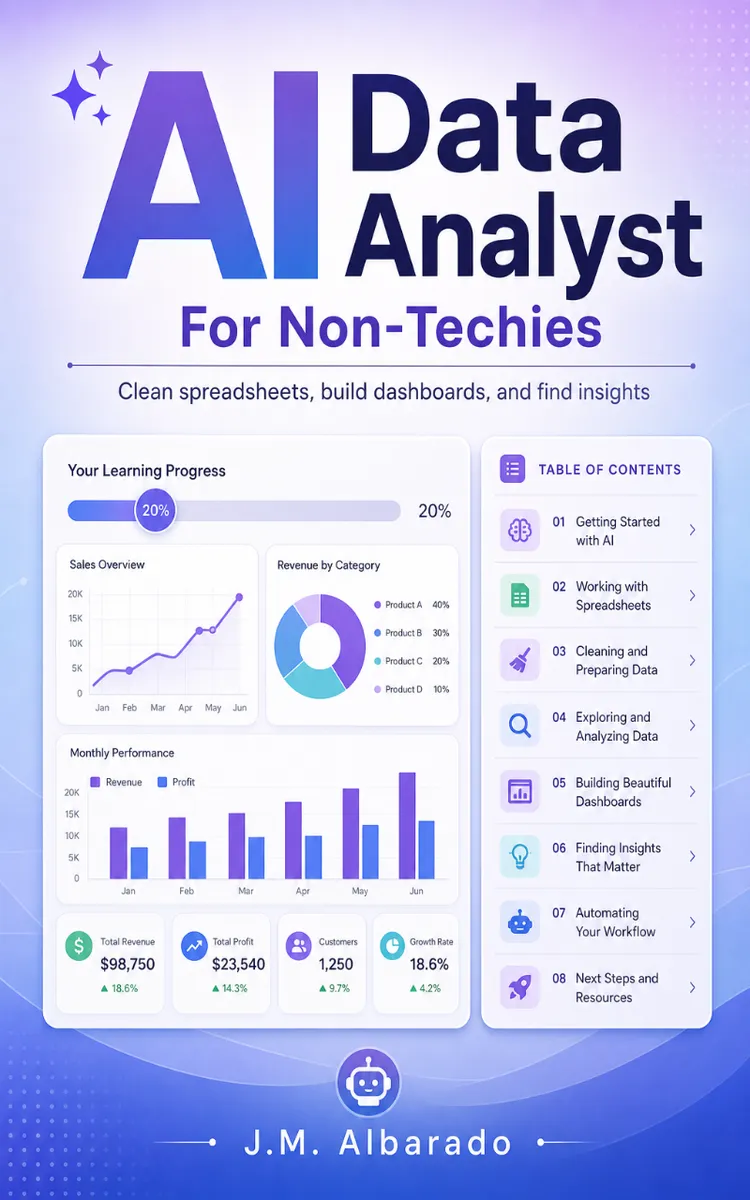
AI Data Analyst For Non-Techies
Created with Inkfluence AI
Using conversational AI to clean data, analyze spreadsheets, and build dashboards
Table of Contents
- 1. From Data-Blind to AI Analyst
- 2. Sanitize Excel for AI Reading
- 3. Spreadsheet Cleanup Prompt Framework
- 4. Descriptive Analytics for Hidden Gold
- 5. Build Dashboards with AI Tables
- 6. Next-Quarter Forecasting Without Coding
- 7. Verify AI Answers Before Acting
- 8. Plug-and-Play Prompt Library
- 9. 60-Minute Weekly Data Pulse Routine
Preview: From Data-Blind to AI Analyst
A short excerpt from “From Data-Blind to AI Analyst”. The full book contains 9 chapters and 16,866 words.
Your sales report says “we did well,” but your inventory spreadsheet says you still have too much sitting on shelves. Your promotion file says customers bought more, but your refund log says you’re losing money on the same items. When you can’t connect those dots, you end up guessing - then you pay for it with cash tied up in slow stock and discounts you didn’t need to run.
This chapter teaches you how conversational AI removes that intimidation and turns messy business questions into actionable analysis - without you writing SQL or Python. You’ll learn how to ask messy questions in plain English, how to clean the data enough for AI to work with it, and how to get back results you can actually use in your weekly decisions. You’ll also learn a simple framework you’ll use throughout the book: The Bridge-to-Answers Map.
If you run a small business (boutique, local service, e-commerce, studio, agency), you already have the data - you just don’t have the time, the comfort, or the technical help to turn it into answers. Conversational AI closes that gap by letting you talk to your spreadsheet and ask for the next step: “What’s wrong?” “What changed?” “What should I do this week?”
The Bridge-to-Answers Map: turning messy questions into usable answers
Here’s the problem you feel when you look at a spreadsheet: the rows look correct, but the meaning doesn’t. Dates come in mixed formats. Product names don’t match across sheets. Some values are blank. Some totals don’t add up. And you don’t know whether the data is wrong, the question is wrong, or you’re just missing the pattern.
Conversational AI helps because it can follow your instructions in plain language - then it can produce a cleaned table, a calculation, or a summary you can paste into a dashboard. But you still need a way to steer it. The Bridge-to-Answers Map gives you that steering wheel. It turns “messy business questions” into a sequence of prompts that lead to concrete outputs.
Use it like this: you build a bridge from your business goal to the exact output you need. You do that by mapping (1) what you’re trying to decide, (2) what data you have, (3) what you want AI to produce, and (4) how you’ll verify it so you don’t get fooled by a confident wrong answer.
To make this practical, you’ll use this exact “How-To Guide” playbook as the overall structure for your work across the book: The AI Data Analyst for Non-Techies: Using conversational AI tools to clean messy spreadsheets, build data dashboards, and extract business insights without knowing a single line of SQL or Python. You’ll apply the same idea in each task - ask for the right output, then verify before you act.
How conversational AI removes intimidation (and what you do with it)
Conversational AI doesn’t “read your mind.” You remove intimidation by giving it a clear job and a clear format to return. When you do that, you stop wrestling with technical tools and start directing the work like you would a trusted assistant: you provide the inputs, you set the rules, and you check the result.
Start by preparing your question in business language. Then add the constraints that protect you from bad output. Finally, request a structured result you can plug into your workflow.
Follow these steps, in order:
1. State the decision you need.
Say the outcome in one line: “I need to decide which products to discount next week” or “I need to know why sales dropped in February.” This matters because AI will pick a different analysis path depending on whether you want causes, comparisons, or recommendations.
2. Name the fields you have and the fields you need.
Example: “My sheet has Order Date, Product Name, Quantity, Sale Price, Cost, Channel, and Refund Amount. I need Profit by product and refund rate by product.” This matters because AI can’t calculate what you don’t define.
3. Force the output format.
Ask for a table, not a paragraph. For example: “Return a markdown table with columns: Product Name, Units Sold, Revenue, Cost, Profit, Profit Margin.” This matters because you paste tables into Looker Studio or your own charts and you avoid copy-paste cleanup.
4. Add a verification request.
Tell AI to show the math checks: “Recompute totals and show a row for Grand Totals.” This matters because it gives you a way to catch errors quickly - especially when data has missing dates, extra spaces, or duplicate products.
When you run these steps, you stop thinking “How do I use AI?” and start thinking “What exact result do I need, and what should the output look like?” That shift is what removes intimidation.
Putting Tanya’s boutique inventory and promotions into AI-ready answers
Let’s make this real with Tanya, 41, who runs a boutique and manages inventory and promotions using Excel. She tracks purchases, sales, and markdowns across a few sheets. Some product names include extra spaces, and the date format changes between exports....
About this book
"AI Data Analyst For Non-Techies" is a how-to guide book by J.M. Albarado with 9 chapters and approximately 16,866 words. Using conversational AI to clean data, analyze spreadsheets, and build dashboards.
This book was created using Inkfluence AI, an AI-powered book generation platform that helps authors write, design, and publish complete books. It was made with the AI Ebook Generator.
Frequently Asked Questions
What is "AI Data Analyst For Non-Techies" about?
Using conversational AI to clean data, analyze spreadsheets, and build dashboards
How many chapters are in "AI Data Analyst For Non-Techies"?
The book contains 9 chapters and approximately 16,866 words. Topics covered include From Data-Blind to AI Analyst, Sanitize Excel for AI Reading, Spreadsheet Cleanup Prompt Framework, Descriptive Analytics for Hidden Gold, and more.
Who wrote "AI Data Analyst For Non-Techies"?
This book was written by J.M. Albarado and created using Inkfluence AI, an AI book generation platform that helps authors write, design, and publish books.
How can I create a similar how-to guide book?
You can create your own how-to guide book using Inkfluence AI. Describe your idea, choose your style, and the AI writes the full book for you. It's free to start.
Write your own how-to guide book with AI
Describe your idea and Inkfluence writes the whole thing. Free to start.
Start writingCreated with Inkfluence AI


