
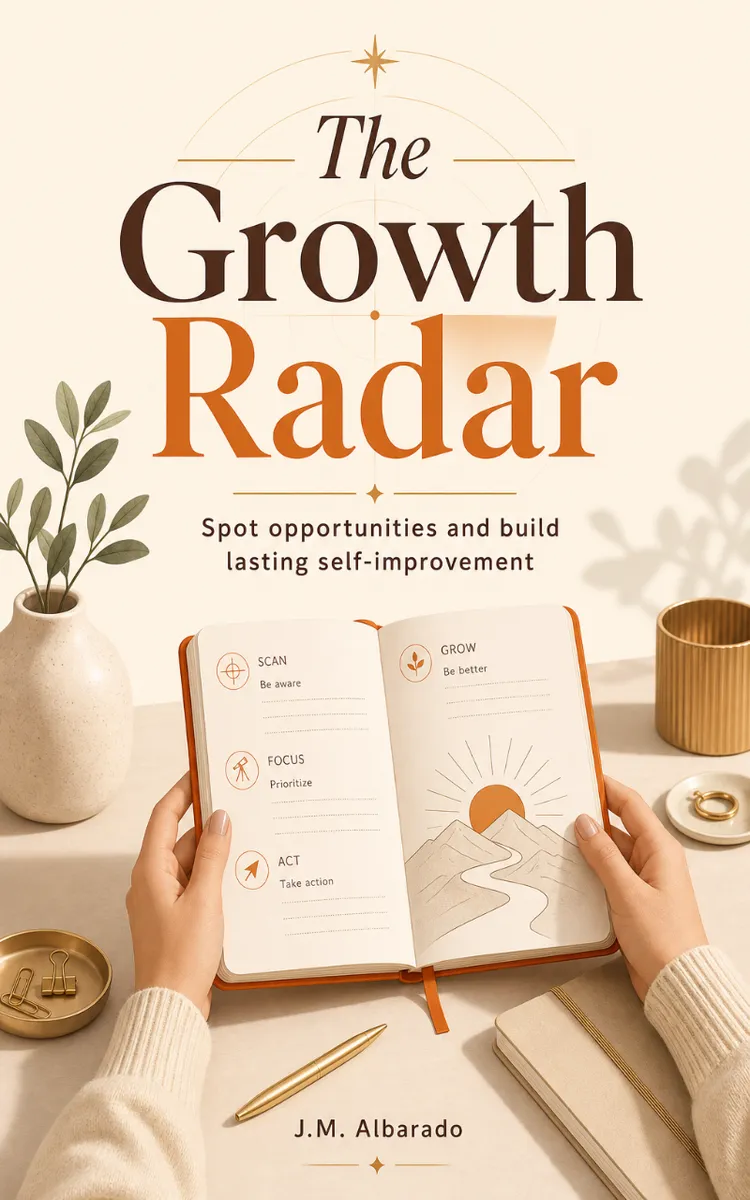
The Growth Radar
Created with Inkfluence AI
Practical framework for identifying and acting on growth opportunities
Table of Contents
- 1. The Growth Radar Lens
- 2. Self-Audit: Blind Spots Map
- 3. Mining Daily Friction Loops
- 4. Curating Your Growth Environment
- 5. 30-Day Micro-Habits Experiments
- 6. Action Paralysis Breakers
- 7. Feedback Translation Playbook
- 8. Measuring Progress That Compounds
- 9. Your Next 30-Day Growth Plan
Preview: The Growth Radar Lens
A short excerpt from “The Growth Radar Lens”. The full book contains 9 chapters and 17,414 words.
Your inbox tells you something is wrong before you even open it. Your phone buzzes. A customer message lands with a tone you don’t like. You feel your body tighten, and your brain races to label it: “complaint,” “mistake,” “I’m failing.” That reflex costs you more than time. It steals your ability to learn from the moment.
This chapter installs a simple noticing habit: when friction shows up, you don’t treat it like a threat - you treat it like a signal. You’ll learn how to catch the moment your mind flips from “protect myself” to “collect data,” and you’ll turn everyday pushback, delays, confusion, and negative feedback into clear next steps you can actually take.
By the end, you’ll have a repeatable way to run “The Growth Radar Lens” on your day: a short script, a quick logging system, and a way to separate what you feel from what you can measure. You’ll also get a realistic workflow using a customer success manager’s real-world pressure: Nina, 34, who handles onboarding, renewals, and support escalations - where friction happens constantly.
The Growth Radar Lens: Turning Friction Into Signal
Most people think growth starts when life gets easier. Your brain thinks the opposite. When friction hits, it tries to shut you down: avoid, argue, explain too much, or freeze. That reaction feels protective, but it blocks the only thing you need - useful information.
The fix isn’t “think positive.” The fix is build a noticing habit that forces your attention into the right lane. You train your mind to ask better questions at the exact moment your body wants to panic.
Here’s the core idea of The Growth Radar Lens: you scan every moment of friction for three things - what happened, what pattern it matches, and what experiment you can run next. You don’t need perfect insight. You just need a consistent way to collect signal while you still have momentum.
Ask yourself this one question when friction appears: “What data did I just get?”
Not “Who’s to blame?” Not “How do I fix it forever?” Data. Small, specific, usable.
The 3 passes of The Growth Radar Lens
Use this as a mental checklist you can run in under 60 seconds. You’ll repeat it often, so it must stay simple.
1. Name the friction (what I’m feeling and what just happened).
Say it out loud or write it: “I feel tense. A customer replied angrily / a task took longer than expected / I got stuck in a meeting.”
Why this works: naming reduces the brain’s urge to spiral. It turns a foggy threat into a concrete event.
2. Extract the signal (what this friction is trying to tell me).
Use one of these signal prompts:
- “This means they didn’t get X.”
- “This means my process failed at Y.”
- “This means the timing or expectation is off.”
- “This means I need a better example, template, or handoff.”
Why this works: you stop treating feedback as judgment and start treating it as a clue about gaps.
3. Choose the next micro-action (an experiment, not a verdict).
Pick one action you can finish in 10-30 minutes. Examples: rewrite a message, add a one-page checklist, ask two clarifying questions, update a call agenda, or test a new onboarding step for the next customer.
Why this works: you replace “I must fix my whole approach” with “I can test one small change.”
A quick comprehension check: when friction hits, do you usually jump to blame or to problem-solving? The Growth Radar Lens trains you to do both, in order: name → signal → micro-action.
Practical takeaway: Your job isn’t to feel calm. Your job is to collect signal fast enough that you can act before the moment passes.
The Noticing Habit Setup: Your Script, Log, and Trigger
A habit needs a trigger and a script. Without those, you rely on motivation - which disappears the first time someone pushes back.
You’ll set up three pieces: a trigger, a script, and a log spot. Keep them boring. Boring beats complicated every time.
Your trigger: “The first sign of friction”
Pick one obvious moment you already notice. Choose only one to start:
- the moment your chest tightens,
- the moment you reread a message twice,
- the moment you hit a task that stalls for more than 10 minutes,
- the moment a customer says “This isn’t working.”
Why one trigger? Because your brain needs a clear “when,” not a vague “someday.”
Your script: the 20-second inner monologue
Use this exact wording (change nothing for a week):
- “Name it: what happened?”
- “Signal it: what gap does this point to?”
- “Action it: what’s one next experiment I can finish today?”
Why this works: it forces you through the three passes of the lens without thinking about what to do next.
Your log spot: a single note called “Radar”
Open one note on your phone or computer named Radar. Every time friction hits and you run the lens, you save one short entry with this format:
...
About this book
"The Growth Radar" is a how-to guide book by J.M. Albarado with 9 chapters and approximately 17,414 words. Practical framework for identifying and acting on growth opportunities.
This book was created using Inkfluence AI, an AI-powered book generation platform that helps authors write, design, and publish complete books. It was made with the AI Ebook Generator.
Frequently Asked Questions
What is "The Growth Radar" about?
Practical framework for identifying and acting on growth opportunities
How many chapters are in "The Growth Radar"?
The book contains 9 chapters and approximately 17,414 words. Topics covered include The Growth Radar Lens, Self-Audit: Blind Spots Map, Mining Daily Friction Loops, Curating Your Growth Environment, and more.
Who wrote "The Growth Radar"?
This book was written by J.M. Albarado and created using Inkfluence AI, an AI book generation platform that helps authors write, design, and publish books.
How can I create a similar how-to guide book?
You can create your own how-to guide book using Inkfluence AI. Describe your idea, choose your style, and the AI writes the full book for you. It's free to start.
Write your own how-to guide book with AI
Describe your idea and Inkfluence writes the whole thing. Free to start.
Start writingCreated with Inkfluence AI


