
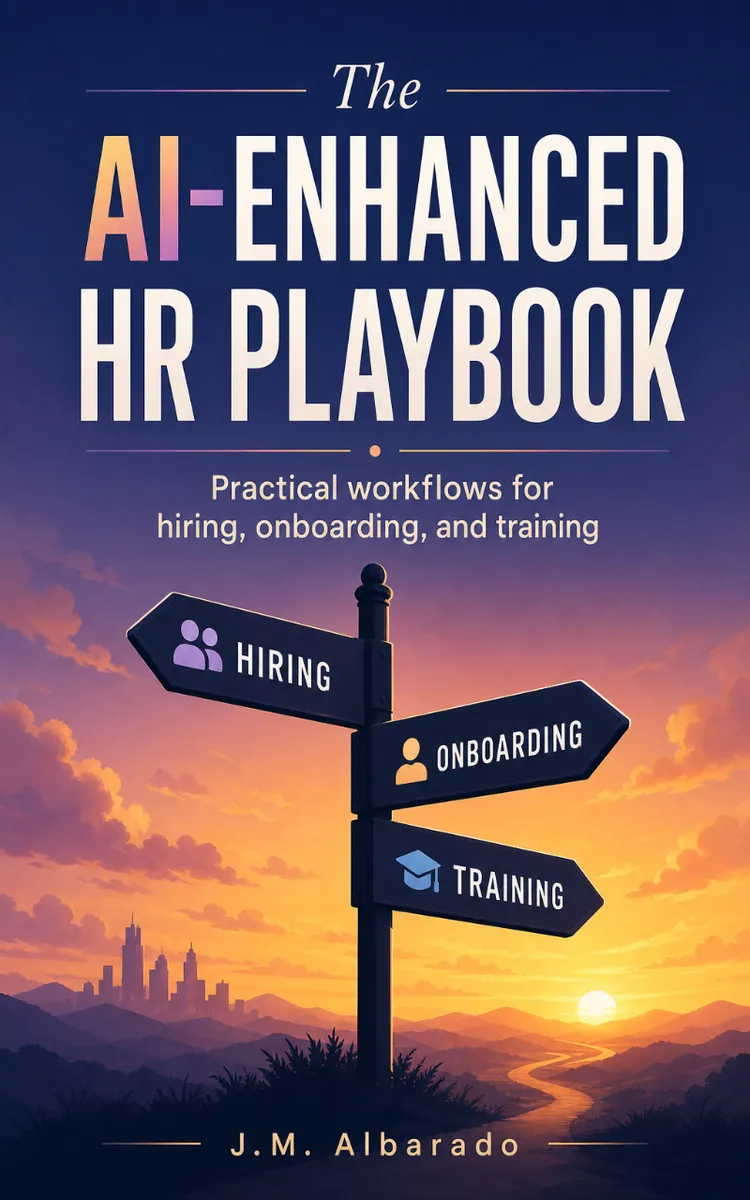
The AI-Enhanced HR Playbook
Created with Inkfluence AI
Using enterprise AI to streamline HR hiring and onboarding
Table of Contents
- 1. From HR Backlog to Talent Engine
- 2. Role Blueprint Prompts for Job Ads
- 3. ATS-Safe Resume Triage Workflow
- 4. Onboarding Engine 30-60-90 Plans
- 5. Micro-Learning Training Modules From Docs
- 6. Enterprise AI Guardrails Checklist
- 7. Catching AI Blind Spots Before Decisions
- 8. Plug-and-Play HR Prompt Library
- 9. 90-Minute Weekly People Pulse Routine
Preview: From HR Backlog to Talent Engine
A short excerpt from “From HR Backlog to Talent Engine”. The full book contains 9 chapters and 18,399 words.
1) Stop Feeding the Backlog: Turn Hiring Admin Into a Talent Flywheel (and Watch It Run)
An inbox full of resumes doesn’t just slow you down - it quietly trains your team to accept delays. Every week you spend sorting unqualified applications manually, you also delay the one thing your business actually needs: the next qualified hire. That’s the real cost of the HR backlog in small-to-midsize businesses - work piles up, decision-making gets sloppier, and onboarding tasks stack behind recruiting.
This chapter tackles a specific shift: moving from administrative overload to strategic talent management using enterprise AI as a force multiplier for SMB recruiting. You will leave with a practical way to redesign your hiring workflow so it doesn’t depend on one person’s time. You’ll also learn how to structure your process around an operating loop - so “recruiting work” turns into an ongoing system that improves every cycle.
We’ll use one consistent blueprint: The Talent Flywheel Model. It focuses your work on four connected parts - signal, selection, onboarding, and feedback - so your team stops treating recruiting like a one-off scramble and starts running it like a repeatable engine. You’ll also see how to use enterprise AI safely, with guardrails for privacy and bias, so your improvements don’t create new risks.
Book context you can anchor to: The AI-Enhanced HR Playbook: Streamlining applicant tracking, generating hyper-accurate job descriptions, and building internal training modules safely using enterprise AI tools. This chapter sets the workflow foundation that the later chapters plug into - resume triage, job description generation, onboarding plans, and training modules all work better when your process already runs as a flywheel.
---
2) The Talent Flywheel Model: How Enterprise AI Turns Admin Into Talent Flow
The Talent Flywheel Model works because it treats hiring as a loop, not a queue. Most teams run recruiting like this: post job → collect resumes → manually screen → schedule interviews → hire → forget what happened. That “forgetting” wastes learning. Enterprise AI helps you capture and apply learning faster - but only if you wire it into your workflow.
Here are the four parts of the flywheel, written as actions your team can run:
1) Signal (Bring the right data in fast)
Start by turning job requirements into clear screening signals. You do this before you ever look at resumes. The “signal” part also includes setting up your intake so you collect consistent applicant details (for example: required work authorization question, required location, and a structured set of experience fields you can compare across candidates).
Why this matters: AI can only help with what you feed it. If your intake data stays messy, you’ll get messy outputs and you’ll keep doing manual cleanup.
2) Selection (Choose with consistency, not exhaustion)
Use enterprise AI to draft consistent first-pass evaluations against the job’s requirements. You still make final decisions, but AI reduces the “read every resume slowly” burden. You can ask the tool to summarize each candidate’s fit and generate a recommended next step (interview, keep for later, or reject).
Why this matters: selection is where time disappears. AI gives you a short, repeatable view of each candidate so your team spends time on decisions, not sorting.
3) Onboarding (Convert hiring wins into performance-ready plans)
When you hire, you generate a role-specific onboarding plan from the same job blueprint you used for selection. This includes a 30-60-90 day structure and practical milestones tied to what the role actually needs.
Why this matters: onboarding delays create “hidden backlog.” If new hires don’t ramp fast, you lose productivity and you start recruiting again because the role still isn’t working.
4) Feedback (Close the loop so the next cycle gets better)
Track what happened: which interview notes led to hires, where candidates struggled in onboarding, and which resume signals predicted success. Feed that back into your job blueprint and your screening prompts.
Why this matters: without feedback, you repeat the same mistakes. With feedback, your next hiring cycle gets faster and more accurate.
Concrete SMB example (assigned persona): Rosa, 41, HR Manager at a 120-person logistics firm. Rosa runs recruiting for multiple driver-adjacent roles plus office support. She doesn’t have a full HRIS team or a big ops department to build complex systems. What she does have is a real problem: her team spends mornings reading resumes that don’t match basic requirements (license availability, schedule constraints, warehouse experience depth). Rosa uses the flywheel to stop repeating that manual pass every week....
About this book
"The AI-Enhanced HR Playbook" is a how-to guide book by J.M. Albarado with 9 chapters and approximately 18,399 words. Using enterprise AI to streamline HR hiring and onboarding.
This book was created using Inkfluence AI, an AI-powered book generation platform that helps authors write, design, and publish complete books. It was made with the AI Ebook Generator.
Frequently Asked Questions
What is "The AI-Enhanced HR Playbook" about?
Using enterprise AI to streamline HR hiring and onboarding
How many chapters are in "The AI-Enhanced HR Playbook"?
The book contains 9 chapters and approximately 18,399 words. Topics covered include From HR Backlog to Talent Engine, Role Blueprint Prompts for Job Ads, ATS-Safe Resume Triage Workflow, Onboarding Engine 30-60-90 Plans, and more.
Who wrote "The AI-Enhanced HR Playbook"?
This book was written by J.M. Albarado and created using Inkfluence AI, an AI book generation platform that helps authors write, design, and publish books.
How can I create a similar how-to guide book?
You can create your own how-to guide book using Inkfluence AI. Describe your idea, choose your style, and the AI writes the full book for you. It's free to start.
Write your own how-to guide book with AI
Describe your idea and Inkfluence writes the whole thing. Free to start.
Start writingCreated with Inkfluence AI


