
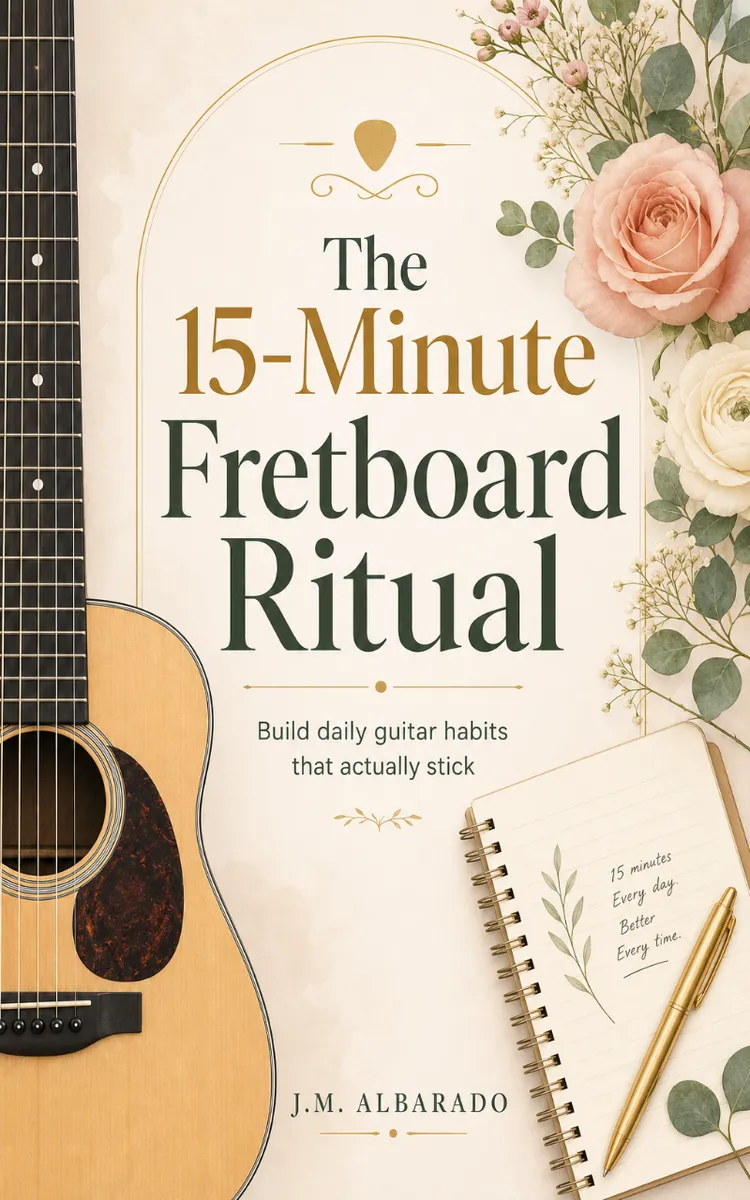
The 15-Minute Fretboard Ritual
Created with Inkfluence AI
15-minute daily routine for intermediate guitar habit formation
Table of Contents
- 1. The Noodle Trap vs. Deliberate Practice
- 2. The Anatomy of a 15-Minute Habit
- 3. Designing Your Micro-Routine
- 4. Overcoming the 'No Time' Myth
- 5. Tracking Compound Gains
Preview: The Noodle Trap vs. Deliberate Practice
A short excerpt from “The Noodle Trap vs. Deliberate Practice”. The full book contains 5 chapters and 6,672 words.
The Noodle Trap: Why “Just Playing” Stops Your Progress Cold
If your practice feels like you’re shredding, but your hands don’t get noticeably better week to week, you’re probably stuck in the noodle trap. The trap isn’t “playing too much.” It’s playing without a target that forces your fretting hand to adapt. You run your fingers through familiar shapes, your brain labels it “practice,” and then you walk away with the same tone, the same timing, and the same gaps - just with more noise in the room.
A plateau usually shows up right when you feel comfortable. Your licks sound fine in your head, your fingers cooperate, and you can play through a song without falling apart. That comfort is exactly what makes mindless playing dangerous: you stop asking your hands to do new work. Think of it like doing warmup sets forever at the gym. You feel busy, you sweat a little, but you never add the weight that actually changes your body.
Quick tone profile + target audience analysis (so you know I’m aiming at you)
I’m writing for intermediate guitarists who can already play real music, but they feel “stuck” because their daily routine doesn’t create visible upgrades. You don’t need more inspiration - you need a practice method that hits your weak links on purpose. That means no fluffy advice, no vague “focus on improvement,” and no time-wasting sessions that only feel productive. Gym-style analogies help here because your body understands training load. Your fretting hand needs the same kind of load: specific, repeatable, and measurable by what changes after you practice.
Ask yourself a blunt question: when you finish a session, can you point to one thing you can do now that you couldn’t do before? If you can’t, you’re probably noodling.
Practical takeaway: After your next practice, write one sentence: “Today I improved _ by _.” If you can’t fill it in, you didn’t train - you just performed.
Deliberate Practice: The Training Load Your Hands Actually Need
Deliberate practice means you aim at a specific weakness, then you repeat a small piece until it improves, then you adjust. You don’t wander. You don’t “run it again” to feel good. You bring one problem into focus and you give your fingers a reason to grow.
Here’s the gym translation that clicks: your plateau is like your workouts staying at the same weight. If you always do the same easy reps, you keep building the same comfort. Deliberate practice forces a tiny bump in difficulty - just enough that your hand has to learn, but not so much that you spend the session fighting chaos.
So what counts as “specific weakness” on guitar? Not “my lead playing.” That’s too wide. Pick something concrete like:
- your ability to hit a certain string-crossing cleanly at a specific tempo,
- your timing on one tricky rhythmic subdivision,
- your accuracy when you move from one position to another without guessing.
Then you build reps around that. You can’t train a ghost. You train a measurable moment: a note that lands late, a transition that stumbles, a chord shape that turns into mush under pressure.
Quick comprehension check: If you asked a friend to watch you practice for five minutes, could they tell exactly what part you’re working on? If they’d just see you playing licks, you’re not doing deliberate practice - you’re doing “guitar time.”
Practical takeaway: Choose one target for improvement before you play. Then repeat only the section that directly trains that target.
The Noodle Trap vs. Deliberate Practice: A Fast Diagnosis You Can Use Today
You can diagnose the noodle trap in about a minute by watching what happens during your session. Mindless playing has a pattern. Deliberate practice has a different pattern. The difference shows up in your attention and your feedback loop - how you correct yourself.
Noodle trap behavior looks like this: you play, you listen for “overall vibes,” and you move on when it feels passable. You might even repeat the same lick several times, but you don’t change the way you play it. Your corrections stay emotional (“that sounded sloppy”) instead of technical (“my ring finger lifts too early on the upstroke”).
Deliberate practice behavior looks like this: you play a short fragment, you catch one specific failure, you change one thing, and you repeat. You build your reps like a builder laying bricks - same structure, tighter fit each round.
A simple “spotter” rule helps: if you can’t name the correction you made on your last rep, you didn’t practice deliberately. You practiced browsing.
Here’s an example using a common plateau moment: you try to play faster lead lines, but your fingers scramble when you shift positions. In the noodle trap, you just speed up and hope. In deliberate practice, you isolate the shift itself. You practice the shift slowly with clean landings, then you repeat at a slightly faster tempo while keeping the same landing accuracy....
About this book
"The 15-Minute Fretboard Ritual" is a how-to guide book by J.M. Albarado with 5 chapters and approximately 6,672 words. 15-minute daily routine for intermediate guitar habit formation.
This book was created using Inkfluence AI, an AI-powered book generation platform that helps authors write, design, and publish complete books. It was made with the AI Ebook Generator.
Frequently Asked Questions
What is "The 15-Minute Fretboard Ritual" about?
15-minute daily routine for intermediate guitar habit formation
How many chapters are in "The 15-Minute Fretboard Ritual"?
The book contains 5 chapters and approximately 6,672 words. Topics covered include The Noodle Trap vs. Deliberate Practice, The Anatomy of a 15-Minute Habit, Designing Your Micro-Routine, Overcoming the 'No Time' Myth, and more.
Who wrote "The 15-Minute Fretboard Ritual"?
This book was written by J.M. Albarado and created using Inkfluence AI, an AI book generation platform that helps authors write, design, and publish books.
How can I create a similar how-to guide book?
You can create your own how-to guide book using Inkfluence AI. Describe your idea, choose your style, and the AI writes the full book for you. It's free to start.
Write your own how-to guide book with AI
Describe your idea and Inkfluence writes the whole thing. Free to start.
Start writingCreated with Inkfluence AI


