
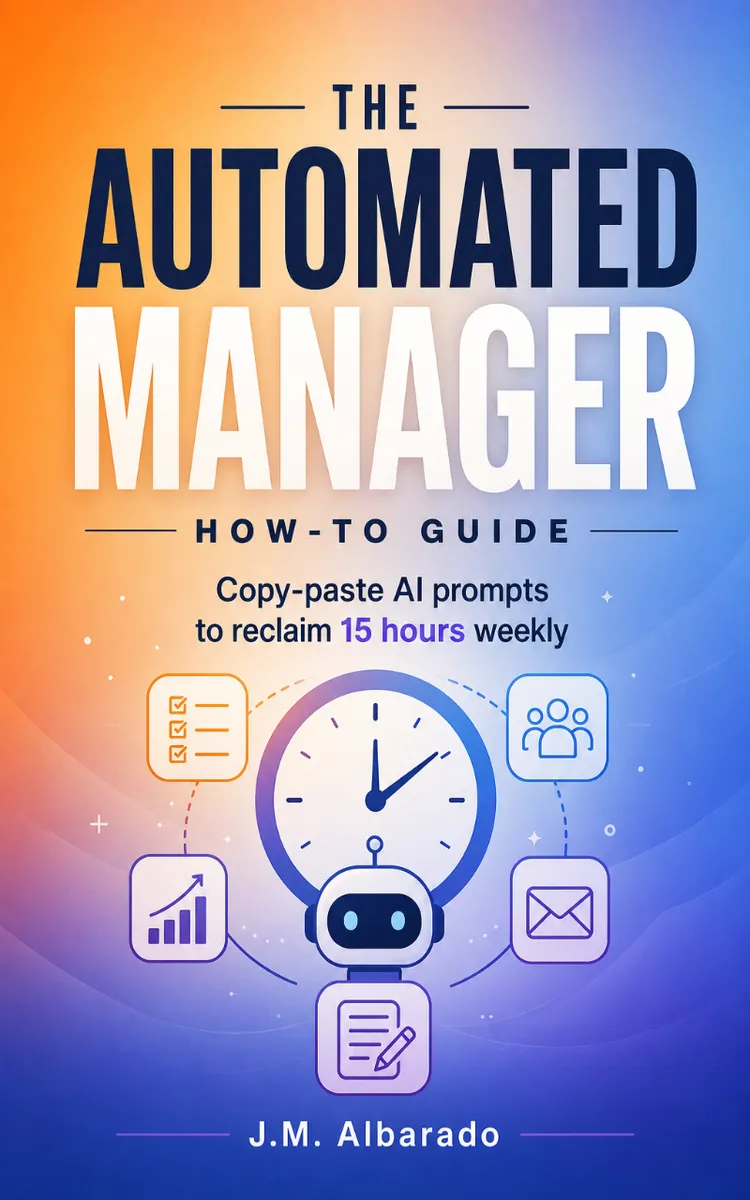
The Automated Manager
Created with Inkfluence AI
AI prompt frameworks for managers to automate writing tasks
Table of Contents
- 1. Editor-in-Chief Manager Workflow
- 2. Anatomy of Corporate Prompts
- 3. Email Deluge Summaries That Work
- 4. Diplomatic Conflict Resolution Drafts
- 5. Bulletproof Report Generator System
- 6. Presentation Outlines in Minutes
- 7. Sensitive Data & Compliance Prompts
- 8. Plug-and-Play Prompt Library Index
- 9. 15-Hour Reclaim Weekly Workflow
Preview: Editor-in-Chief Manager Workflow
A short excerpt from “Editor-in-Chief Manager Workflow”. The full book contains 9 chapters and 16,813 words.
At 4:45 p.m. on a Thursday, you’re still editing a deck you already sent. The slide titles got rewritten three times. Someone added a compliance note that changes the whole story. Now legal wants “one more pass,” and your calendar already has tomorrow’s status meeting blocked. That’s the moment you realize the problem isn’t effort - it’s the workflow. You keep drafting from scratch, then you keep re-drafting when the input changes.
This chapter fixes that by shifting you from “writer mode” to an Editor-in-Chief operating rhythm. You’ll use The Automated Manager: Copy-Paste AI Prompt Frameworks to Reclaim 15 Hours a Week. workflow idea - specifically the EIC Loop (Draft→Edit→Approve) - so you produce cleaner corporate writing faster, without creating extra back-and-forth in strict environments. You’ll learn how to cut friction with role assignment, constraints, and output formatting so the first draft looks like something a reviewer can approve.
You’ll also walk out with literal prompt templates you can paste into your AI tool the same day - prompts that force the model to draft, then stop, then let you edit like an Editor-in-Chief. The goal is simple: reduce the time you spend fixing structure, tone, and policy gaps, not just “speed up writing.”
The EIC Loop: Draft→Edit→Approve in a strict corporate environment
Your job as a middle manager isn’t to write the perfect email. Your job is to get decisions made with minimum risk and minimum mess. In regulated companies (or any place where people forward messages to legal, risk, and compliance), writing gets slow because every draft has to survive scrutiny. If you draft “open-ended,” you create more edits. If you draft “loosely,” you force reviewers to guess what you meant. If you draft “too polished,” you force reviewers to dig for what changed and why.
The EIC Loop (Draft→Edit→Approve) solves this by making AI output something you can safely edit. You don’t ask the AI to be smart and guess policy. You ask it to draft to your rules, then stop. Then you run a repeatable edit pass that checks structure, risk, and clarity in the same order every time.
Here’s the core idea: AI should produce a workable first draft that matches corporate constraints - tone, length, formatting, and what not to include. You should own the final accuracy and the “editor decisions” (what stays, what moves, what gets deleted). That reduces friction because reviewers see consistent formatting and consistent risk handling, so they don’t burn time re-parsing your message.
Tanya (39, Operations Manager at a regulated fintech) runs into this every week. She’s not short on content - she’s short on time. She spends her mornings chasing thread updates and her afternoons rewriting decks after feedback. When she switches to EIC Loop (Draft→Edit→Approve), she stops treating AI like a writer and starts using it like a draft engine she can reliably edit.
Practical takeaway: You don’t need “better writing.” You need a workflow that makes each draft reviewable faster and makes your edits repeatable.
How to run the EIC Loop without triggering rework
You’ll use the EIC Loop (Draft→Edit→Approve) every time you need a corporate document: an email, an executive update, a compliance note, or a slide narrative. The loop keeps AI output predictable, which matters in strict environments.
1. Draft (AI writes to your rules)
Use a prompt that locks the role, scope, constraints, and formatting. Then force the AI to generate a draft that is “review-ready,” not “final-final.”
Copy-paste prompt template:
> Role: You are my Draft Assistant for internal corporate communication.
> Task: Draft ONLY the requested document based on the inputs I provide.
> Constraints:
> - Use professional, neutral tone.
> - Do not invent facts or claim approvals.
> - If any required detail is missing, add a section titled “Missing Info” with bullet points.
> Output format:
> - Subject line (if email)
> - 3-6 short paragraphs max
> - Bullets only when listing items
> - End with “Proposed next step:” and one sentence
> Inputs: [paste thread notes / meeting bullets / facts]
> Draft now.
2. Edit (You run a checklist in a fixed order)
You don’t “read it and react.” You edit in passes. First pass fixes structure. Second pass fixes risk language. Third pass fixes clarity and length. This reduces the chance you’ll miss something and cause another review cycle.
Editor-in-Chief edit checklist (run in this order):
- Structure: Do the first 3 lines answer “what changed” and “what you need”?
- Claims: Did the draft avoid “we confirmed” unless you truly have confirmation?
- Compliance-safe language: Did it avoid absolute promises (like “will comply”) when you only have “we plan to” or “we are reviewing”?
- Missing Info: Did you fill the gaps or remove the parts that depend on them?
3....
About this book
"The Automated Manager" is a how-to guide book by J.M. Albarado with 9 chapters and approximately 16,813 words. AI prompt frameworks for managers to automate writing tasks.
This book was created using Inkfluence AI, an AI-powered book generation platform that helps authors write, design, and publish complete books. It was made with the AI Ebook Generator.
Frequently Asked Questions
What is "The Automated Manager" about?
AI prompt frameworks for managers to automate writing tasks
How many chapters are in "The Automated Manager"?
The book contains 9 chapters and approximately 16,813 words. Topics covered include Editor-in-Chief Manager Workflow, Anatomy of Corporate Prompts, Email Deluge Summaries That Work, Diplomatic Conflict Resolution Drafts, and more.
Who wrote "The Automated Manager"?
This book was written by J.M. Albarado and created using Inkfluence AI, an AI book generation platform that helps authors write, design, and publish books.
How can I create a similar how-to guide book?
You can create your own how-to guide book using Inkfluence AI. Describe your idea, choose your style, and the AI writes the full book for you. It's free to start.
Write your own how-to guide book with AI
Describe your idea and Inkfluence writes the whole thing. Free to start.
Start writingCreated with Inkfluence AI


