
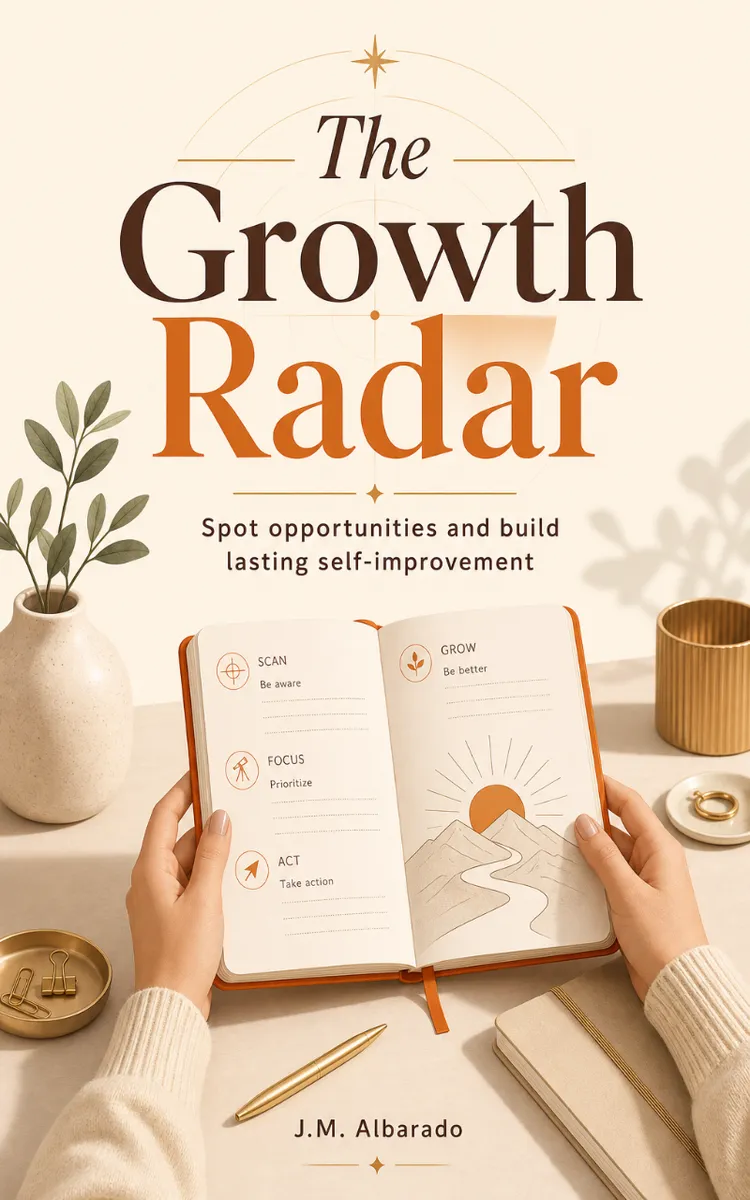
Read the first chapter
The whole of chapter one, free. About 8 min. Turn the pages with the arrows, your keyboard, or a swipe.
Chapter 1
The Growth Radar Lens
Your inbox tells you something is wrong before you even open it. Your phone buzzes. A customer message lands with a tone you don’t like. You feel your body tighten, and your brain races to label it: “complaint,” “mistake,” “I’m failing.” That reflex costs you more than time. It steals your ability to learn from the moment.
This chapter installs a simple noticing habit: when friction shows up, you don’t treat it like a threat - you treat it like a signal. You’ll learn how to catch the moment your mind flips from “protect myself” to “collect data,” and you’ll turn everyday pushback, delays, confusion, and negative feedback into clear next steps you can actually take.
By the end, you’ll have a repeatable way to run “The Growth Radar Lens” on your day: a short script, a quick logging system, and a way to separate what you feel from what you can measure. You’ll also get a realistic workflow using a customer success manager’s real-world pressure: Nina, 34, who handles onboarding, renewals, and support escalations - where friction happens constantly.
The Growth Radar Lens: Turning Friction Into Signal
Most people think growth starts when life gets easier. Your brain thinks the opposite. When friction hits, it tries to shut you down: avoid, argue, explain too much, or freeze. That reaction feels protective, but it blocks the only thing you need - useful information.
The fix isn’t “think positive.” The fix is build a noticing habit that forces your attention into the right lane. You train your mind to ask better questions at the exact moment your body wants to panic.
Here’s the core idea of The Growth Radar Lens: you scan every moment of friction for three things - what happened, what pattern it matches, and what experiment you can run next. You don’t need perfect insight. You just need a consistent way to collect signal while you still have momentum.
Ask yourself this one question when friction appears: “What data did I just get?”
Not “Who’s to blame?” Not “How do I fix it forever?” Data. Small, specific, usable.
The 3 passes of The Growth Radar Lens
Use this as a mental checklist you can run in under 60 seconds. You’ll repeat it often, so it must stay simple.
• Name the friction (what I’m feeling and what just happened).
Say it out loud or write it: “I feel tense. A customer replied angrily / a task took longer than expected / I got stuck in a meeting.”
Why this works: naming reduces the brain’s urge to spiral. It turns a foggy threat into a concrete event.
• Extract the signal (what this friction is trying to tell me).
Use one of these signal prompts:
• “This means they didn’t get X.”
• “This means my process failed at Y.”
• “This means the timing or expectation is off.”
• “This means I need a better example, template, or handoff.”
Why this works: you stop treating feedback as judgment and start treating it as a clue about gaps.
• Choose the next micro-action (an experiment, not a verdict).
Pick one action you can finish in 10-30 minutes. Examples: rewrite a message, add a one-page checklist, ask two clarifying questions, update a call agenda, or test a new onboarding step for the next customer.
Why this works: you replace “I must fix my whole approach” with “I can test one small change.”
A quick comprehension check: when friction hits, do you usually jump to blame or to problem-solving? The Growth Radar Lens trains you to do both, in order: name → signal → micro-action.
Practical takeaway: Your job isn’t to feel calm. Your job is to collect signal fast enough that you can act before the moment passes.
The Noticing Habit Setup: Your Script, Log, and Trigger
A habit needs a trigger and a script. Without those, you rely on motivation - which disappears the first time someone pushes back.
You’ll set up three pieces: a trigger, a script, and a log spot. Keep them boring. Boring beats complicated every time.
Your trigger: “The first sign of friction”
Pick one obvious moment you already notice. Choose only one to start:
• the moment your chest tightens,
• the moment you reread a message twice,
• the moment you hit a task that stalls for more than 10 minutes,
• the moment a customer says “This isn’t working.”
Why one trigger? Because your brain needs a clear “when,” not a vague “someday.”
Your script: the 20-second inner monologue
Use this exact wording (change nothing for a week):
• “Name it: what happened?”
• “Signal it: what gap does this point to?”
• “Action it: what’s one next experiment I can finish today?”
Why this works: it forces you through the three passes of the lens without thinking about what to do next.
Your log spot: a single note called “Radar”
Open one note on your phone or computer named Radar. Every time friction hits and you run the lens, you save one short entry with this format:
• Friction: (one sentence)
• Signal: (one sentence)
• Micro-action: (one sentence + when you’ll do it)
Why this works: you stop relying on memory. You build evidence that your noticing habit is producing real changes.
A concrete example with Nina (customer success manager)
Nina handles onboarding and support escalations. One day she gets a customer email that reads, “We’re still waiting. This is ridiculous.” Her first instinct: defend her team or offer a long apology. Instead, she runs the lens:
• Name the friction: “Customer is angry. They waited longer than promised.”
• Signal: “We missed an expectation and the handoff wasn’t clear.”
• Micro-action: “Send a short status update with the exact next step and a time window, then adjust the onboarding checklist for future handoffs.”
She doesn’t debate the tone. She collects the signal: expectation gap + handoff clarity. Then she runs a micro-action that reduces harm today and prevents repeats tomorrow.
Practical takeaway: You install the habit by making it unavoidable (trigger), automatic (script), and trackable (Radar log).
Applying the Lens in Real Life: Nina’s 15-Minute Radar Routine
Here’s a realistic workflow you can copy on a busy day. Nina uses this when her calendar stacks up and messages pile into her inbox.
You’ll run it in two parts: instant pass (when friction hits) and batch pass (once later that day).
Step-by-step routine (with expected outcomes)
• Run the instant pass within 60 seconds of friction.
When you feel the tightening or see the message, stop and do the three passes:
• Name the friction
• Extract the signal
• Choose a micro-action you can finish in 10-30 minutes
Expected outcome: you reduce panic and you leave the moment with a next step.
• Create your micro-action draft immediately (even if you won’t send it yet).
Write the first version in your Radar log entry. Keep it short:
• one sentence acknowledging the issue,
• one sentence stating what will happen next,
• one sentence with a time window or next deadline.
Expected outcome: you don’t lose the thread while you’re busy.
• Do the batch pass at a set time (Nina picks 4:30 PM).
Nina opens Radar and reads only the last 10 entries. She asks:
• “What pattern keeps showing up?”
• “Which micro-action would prevent the most repeat friction?”
Then she picks one improvement to implement for the next day.
Expected outcome: you stop treating each friction event as isolated and start turning them into a roadmap.
• Close the loop after you act (one line).
When you finish your micro-action, add a final line to the Radar entry:
• “Sent update to customer at 3:10 PM; customer replied with next-step confirmation.”
Expected outcome: you train your brain that action changes outcomes, which keeps the habit alive.
Quick checklist (use this as your on-screen reminder)
• Pick one trigger you already notice.
• Use the exact script: Name it → Signal it → Action it.
• Log each friction event in Radar with three fields.
• Draft the micro-action right away.
• Batch-review Radar once daily (choose a time).
• Implement one repeat-prevention change per day.
• Add a one-line outcome after you act.
Practical takeaway: Friction stops feeling personal when you treat it like a daily data feed - instant pass to act, batch pass to improve.
What to Watch For: Common Mistakes That Break the Habit
The Growth Radar Lens works best when you avoid a few predictable failure modes. These don’t mean you’re “bad at this.” They mean your brain will try to protect you in familiar ways.
Over-fixing too fast
Do this: Choose a micro-action you can finish in 10-30 minutes, even if you feel the “real solution” requires a bigger rewrite.
Not this: Spend two hours building a perfect explanation, then wonder why you still feel stuck and anxious.
Why it breaks: perfection delays action. Your brain gets more time to label the moment as danger.
Treating “signal” like mind-reading
Do this: Turn the signal into a gap you can test, like “They didn’t get the handoff step” or “My timeline wasn’t clear.”
Not this: Decide the customer “is unreasonable” or assume their intent without checking what happened.
Why it breaks: mind-reading turns friction into a personality problem. The lens needs behavior and process clues, not character judgments.
Logging vague entries
Do this: Write friction in one sentence and signal in one sentence. Keep micro-action specific.
Not this: Write “Customer upset” and “Need better service” with no next experiment.
Why it breaks: vague logs don’t create momentum. You can’t batch-review patterns if your entries don’t contain usable information.
Practical takeaway: If your Radar entries feel fuzzy, shorten them. If you feel blocked, reduce the micro-action until it becomes easy to start.
The Payoff: How You’ll Know the Lens Is Working
You’ll know it’s working when friction no longer hijacks your attention for hours. You’ll see three changes:
• You act faster. You choose a micro-action before you overthink.
• You repeat less. Your daily batch pass turns repeated friction into a simple improvement you can roll forward.
• You feel less threatened. Even when the message is harsh, you respond with data and next steps.
Run this for one week. Keep Radar entries consistent. When you finish, look back and count how many times your micro-action was specific enough to complete. That number matters more than how “good” you felt while doing it.
If you want a simple next step right now: pick your trigger for the next 24 hours and create the Radar note. Then wait for the first piece of friction. Name it, signal it, act on it - small, fast, and logged. That’s how the lens turns everyday friction into signal you can build on, day after day.
End of chapter one. 8 more chapters in the full book.
Swipe or use the arrows to turn the page


What's inside: 9 chapters
- 1. The Growth Radar Lens
- 2. Self-Audit: Blind Spots Map
- 3. Mining Daily Friction Loops
- 4. Curating Your Growth Environment
- 5. 30-Day Micro-Habits Experiments
- 6. Action Paralysis Breakers
- 7. Feedback Translation Playbook
- 8. Measuring Progress That Compounds
- 9. Your Next 30-Day Growth Plan
About this book
"The Growth Radar" is a how-to guide book by J.M. Albarado with 9 chapters and approximately 17,414 words. Practical framework for identifying and acting on growth opportunities.
This book was created using Inkfluence AI, an AI-powered book generation platform that helps authors write, design, and publish complete books. It was made with the AI Ebook Generator.
Frequently Asked Questions
What is "The Growth Radar" about?
Practical framework for identifying and acting on growth opportunities
How many chapters are in "The Growth Radar"?
The book contains 9 chapters and approximately 17,414 words. Topics covered include The Growth Radar Lens, Self-Audit: Blind Spots Map, Mining Daily Friction Loops, Curating Your Growth Environment, and more.
Who wrote "The Growth Radar"?
This book was written by J.M. Albarado and created using Inkfluence AI, an AI book generation platform that helps authors write, design, and publish books.
How can I create a similar how-to guide book?
You can create your own how-to guide book using Inkfluence AI. Describe your idea, choose your style, and the AI writes the full book for you. It's free to start.
Write your own how-to guide book with AI
Describe your idea and Inkfluence writes the whole thing. Free to start.
Start writingCreated with Inkfluence AI


