
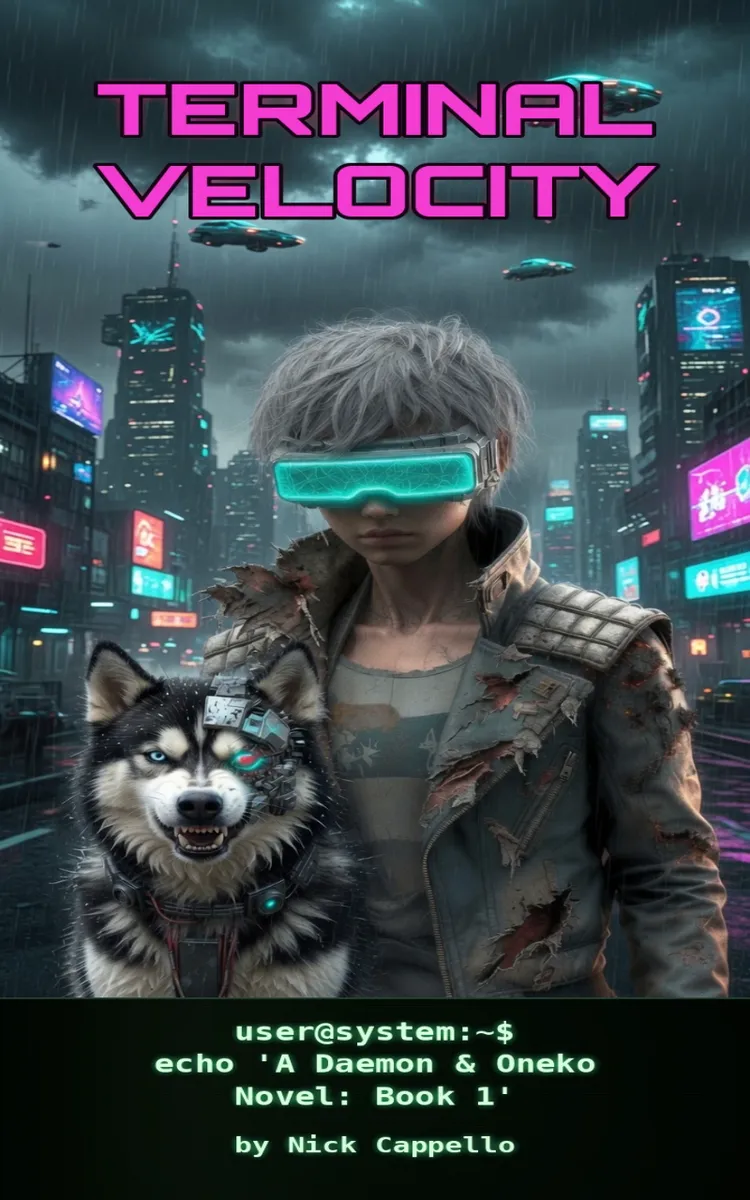
Terminal Velocity
Created with Inkfluence AI
Table of Contents
- 1. What the Dog Knew
- 2. Static and Kibble
- 3. Neon and Teeth
- 4. The Proxy's Offer
- 5. A Failing Grade
- 6. Steel on Rails
- 7. Off the Grid
- 8. The Gimlorok Fingerprint
- 9. Lockdown by Acheron
- 10. Hunters in the Dark
- 11. Grid Node
- 12. Underpass
- 13. The Meat-Rig Doctor
- 14. Static in the Wire
- 15. Parking Structure Trap
- 16. The Upper Grid
- 17. Ghost in the Collar
- 18. What Ally Knows
- 19. Three Years on File
- 20. Decoding Gimlorok
- 21. The Low-Seams Run
- 22. What the Storm Brought Down
- 23. Severed
- 24. Finding the Dark
- 25. Two Sets of Boots
- 26. What the Body Remembers
- 27. The Canine Protocol
- 28. What They Had Left
- 29. The Search Grid
- 30. Between Signals
- 31. The Channel Again
- 32. The Long Approach
- 33. The Substation Siege
- 34. Broadcast Catalyst
- 35. Face to Face with Vane
- 36. Neither of Them Done Yet
- 37. What the Squad Found
- 38. What's Left Standing
- 39. What Vance Did With the Rest of the Night
- 40. The Glitch in the Eye
- 41. What the Voice Remembers
- 42. Three Days
- 43. Two Old Liars
- 44. What Was Left of Her
- 45. Beyond Neo-Kyoto
Preview: What the Dog Knew
A short excerpt from “What the Dog Knew”. The full book contains 45 chapters and 64,893 words.
Oneko had been awake before Daemon for eleven minutes, and had spent all eleven of them doing nothing but listening to him breathe.
No engineer had trained this into him. Nothing about lying still in the dark, cataloguing the rise and fall of another creature's chest, matching the rhythm of it until his own systems settled into something close to peace, had ever shown up on a diagnostic checklist or a corporate spec sheet. He had simply started doing it, sometime in the first months after the scrap yard, and never once stopped. Three years later it remained the single function of his entire architecture that no protocol had ever demanded of him.
Habit more than necessity kept him cataloguing the room the way he catalogued every room: the drip of water into the rusted tin in the corner, the faint electromagnetic pulse leaking up from the pachinko solenoids below, the specific, familiar smell of burnt copper and wet wool that had come, somewhere along the way, to mean something closer to home than any word his vocalizer could currently afford to spend on it. He didn't have a word yet for what this room was to him. Feelings arrived faster than the language built to hold them, and this was one of the oldest ones, worn soft and comfortable through three years of repetition.
Not for the first time, he found himself turning over the difference between what he had been built to do and what he actually did.
A key. A weapon disguised as an animal, engineered in a white room by men who had measured his worth entirely in bandwidth and neural capacity, and who had never once, in all their careful measuring, bothered to ask what he might choose to do with a body once it was his own to direct.
That was what he'd been built to carry. They had built a container. They had not built the thing that filled it, the part of him that had looked up through iron bars at a shivering, broke seventeen-year-old and made a decision no schematic had accounted for.
He did not resent them for the container. It was, after all, load-bearing. Without the graft, without the cybernetic architecture layered over aging canine bone, he would not have survived long enough to make the choice that actually mattered. Lying in the dark listening to Daemon breathe, though, he understood something they never had: the container and the choice were not the same thing, and everyone who had ever looked at him, Acheron included, kept mistaking one for the other.
How many more mornings he had left to keep proving that distinction, he couldn't say. In the vague, unspoken way a body sometimes understands things a mind hasn't gotten around to articulating yet, he suspected the number was smaller than either of them wanted it to be. Smaller simply meant each one mattered more, he decided, listening to Daemon's steady breath, and found, somewhat to his own surprise, that the decision cost him nothing at all to make.
Mornings like this one, he wanted to say some small piece of it out loud. Not the whole shape of it; he didn't have the words built for the whole shape of it yet. Just some plain, ordinary fragment. Good morning. I am glad you are still breathing. Something even smaller than that. He knew what it would cost him to try, the heat, the strain, the risk of waking Daemon over nothing more urgent than a feeling that could wait. So he let it wait, the way he let most things wait, and told himself there would be another morning for it eventually, a cheaper one, though he had no evidence such a morning was coming and no real way to know how long he'd have to keep waiting for it.
Daemon stirred, not quite awake, and his hand found Oneko's shoulder in his sleep the way it always did, an old, unconscious reflex that required no thought at all anymore. Oneko held still and let it happen, cataloguing the small warmth of it the same careful way he catalogued everything.
Whatever Acheron had built him to be, he thought, he'd spent three years quietly building something else on top of it, one ordinary morning at a time, and he intended to keep doing exactly that for as long as either of them still had a morning left to spend.
Eleven minutes became twelve. Somewhere above the transom window, the first grey edge of dawn began working its way through forty years of grime, and Oneko closed his organic eye, content, for a little while longer, to simply listen.
About this book
"Terminal Velocity" is a general book by Nick Cappello with 45 chapters and approximately 64,893 words. It covers key insights and practical takeaways on the topic.
This book was created using Inkfluence AI, an AI-powered book generation platform that helps authors write, design, and publish complete books.
Frequently Asked Questions
What is "Terminal Velocity" about?
"Terminal Velocity" is a general book by Nick Cappello covering key insights and practical takeaways on the topic.
How many chapters are in "Terminal Velocity"?
The book contains 45 chapters and approximately 64,893 words. Topics covered include What the Dog Knew, Static and Kibble, Neon and Teeth, The Proxy's Offer, and more.
Who wrote "Terminal Velocity"?
This book was written by Nick Cappello and created using Inkfluence AI, an AI book generation platform that helps authors write, design, and publish books.
Write your own book with AI
Describe your idea and Inkfluence writes the whole thing. Free to start.
Start writingCreated with Inkfluence AI


