
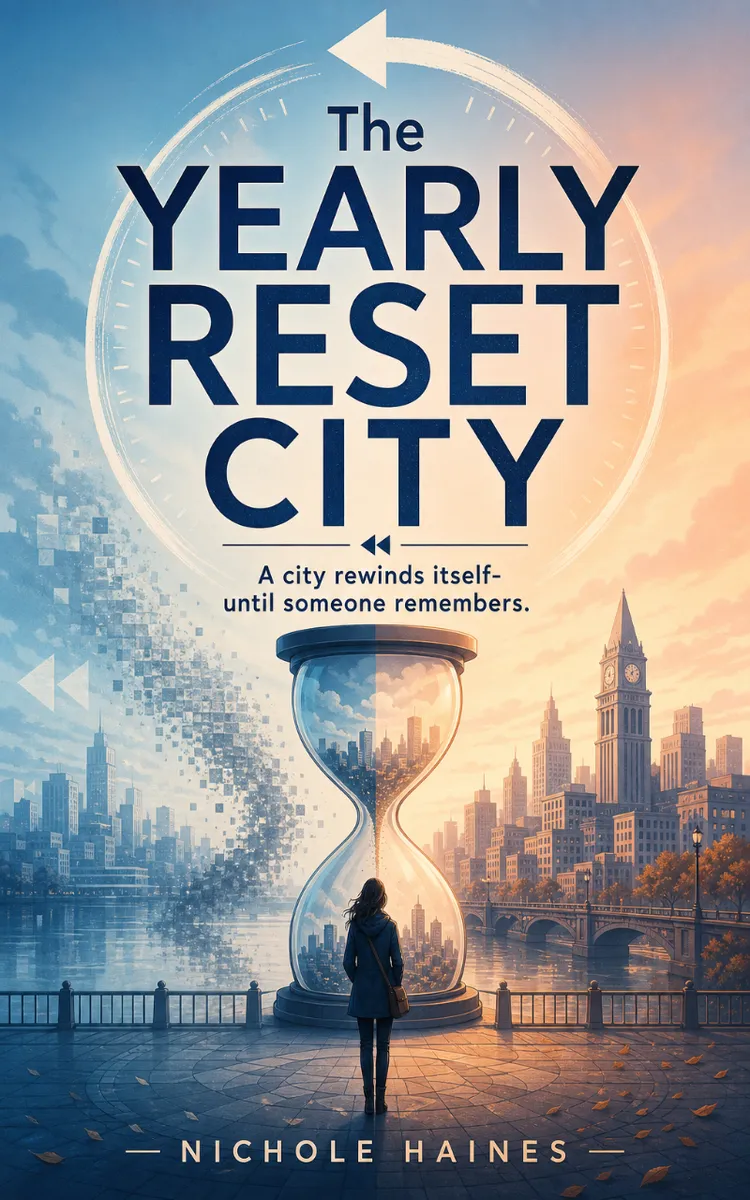

Read the first chapter
The whole of chapter one, free. About 15 min. Turn the pages with the arrows, your keyboard, or a swipe.
Chapter 1
Midnight Bell and the Reset
The midnight bell didn’t ring like a bell. It punched through Old Harbor Square in a hard, metallic thrum that seemed to vibrate the bones in Mara Ellison’s throat. One moment it was the last minute of the year - streetlamps already dimmed for the ritual, the harbor water black as ink beyond the piers - and the next the sound sharpened into a countdown she could feel behind her eyes.
Mara sat up too fast on the cold stone bench outside the pawn shop, palm still wrapped around the hand warmer she’d stolen from her own coat pocket last season. The air was salt and damp concrete, but the temperature dropped so suddenly it raised gooseflesh along her forearms. She stared at the shop window across the square.
The glass should have reflected the same crooked sign she’d watched all week: a bell icon with a crack through its clapper, painted over and repainted until the damage looked intentional. Instead, the reflection showed a different crack - new paint lines, a fresh smear where someone had tried to scrub history away. The bell icon still hung in the frame, but the crack ran in the wrong place.
The bell struck again.
Mara’s breath fogged. The square lurched - not physically, not like a quake, but like the world had been cut and rejoined out of sync. Sound snapped. The distant gulls stopped mid-cry. Somewhere down by the docks a cart wheel squealed once, then went silent like it had never happened.
Her stomach dropped with the kind of certainty she hated. She’d been awake for this before. She’d watched the Yearly Reset from the same spot, counting seconds the way some people counted prayers, because she’d learned the only way to survive the first shock was to meet it with eyes open.
She hadn’t expected the second shock.
The bell faded into a quiet that felt manufactured. When Mara blinked, her bench was still there, but the stone beneath her had a different pattern of pitting. The pawn shop’s door no longer had the dent she could have traced with a blind finger. The street cobbles leading toward the harbor were rearranged - same curve, different stones - like someone had taken a map and redrawn it with a rough hand.
Mara swung her legs off the bench and stood. Her knees protested. The cold bit through her socks. She looked down at her hands, willing herself to find blood, bruises, anything that proved she’d been thrown through time like a rag.
No injuries. No new marks. Her skin was the same, her nails still split from prying a lock last week. Her pulse hammered anyway, because memory didn’t obey the city’s rules the way her body did.
She moved toward the pawn shop, fast enough to make the air sting. The bell icon sign above the doorway now had a different crack. Beneath it, a brass notice board held a flier with a smiling woman and the words - her tongue snagged on them - WELCOME TO HARBOR SQUARE. The letterforms were too crisp, too clean, as if the paper had been printed five minutes ago.
Mara shoved the door open.
A bell chimed inside - one small note, not the midnight bell. The shop smelled of old wood and oil, but the shelves had shifted. The row of cheap pocket watches she’d sold to pay off her last month’s rent was gone. In its place sat a display of keys on hooks, each tagged with a neat little paper label.
Her throat went dry. Her attention snagged on the labels the way a magnet snags filings.
She’d hidden a key last year - an ugly little thing with a notch on the side, wrapped in cloth and tucked inside the hollow of a loose brick behind the counter in her mind, because she’d never trusted herself to remember exact coordinates. She remembered the brick. She remembered the cold grit of it under her nails. She remembered the way her own pulse had steadied when the key clicked free.
Keys hung in this shop like they’d always been there, but the one she was hunting didn’t hang anywhere.
Mara crossed the floor, boots slipping a fraction on smooth boards worn by different feet. She grabbed the nearest hook and turned it to read the tag.
“LOCKS - MUNICIPAL STORAGE 12,” the label said, stamped in black ink.
She let it go. Her hand trembled.
A man behind the counter looked up from a ledger. He was older than she remembered, with a gray mustache and eyes too bright for the hour. His apron was freshly tied. His expression didn’t shift into recognition when he saw her. It didn’t shift into fear, either. It was worse than either.
It was blank.
“Close to midnight,” he said, voice rough like paper. “You’re late for the year.”
Mara stared at him, forcing her lungs to work. “I - ” She stopped herself from saying the wrong thing. Saying the wrong thing in this city could get you swallowed by the reset like a pebble in deep water.
She tried again. “Where’s the loose brick behind the counter?”
The man blinked once. “What?”
“The one with the crack on the left,” Mara said, and hated how her voice sped up as if truth was a race. “The one I - ”
His gaze flicked past her shoulder, not to a customer, not to the door. To something else in the shop - something she couldn’t see. His mouth tightened. “We don’t have a brick like that.”
“I do,” she snapped, then immediately regretted the sharpness. Her heart thudded. “I’ve been here.”
The man’s eyes narrowed. “Everyone’s been here. You’re talking about the Harbor Square pawn shop. It’s been here longer than your… year.”
Mara swallowed. The cold in the shop had teeth. “Then you’ll know this,” she said, and reached into her coat.
The cloth-wrapped key wasn’t there.
Her fingers found only the lining, empty fabric, a missing weight that should have anchored her. She yanked the coat open, frantic. The pocket where she’d kept the hand warmer was wrong - she’d stuffed it into the wrong place during the reset shock, she told herself, and the lie came too easily. She could feel the absence like a phantom limb.
The man behind the counter didn’t move, but the air around him felt different, as if he’d stepped into a prepared stance. “Are you looking for something?” he asked.
Mara forced her hands still. “I hid it.”
His eyes slid to her hands again. “You can hide things in a place that resets?”
Mara’s chest tightened. “You’re pretending you don’t know.”
“I’m pretending you’re not breaking policy,” he said. “The reset is done. People who wake up confused usually don’t last the hour.”
Mara’s mind stuttered. The sentence was too close to something she’d heard a year ago, spoken by someone else in this same shop - or maybe it was just the city reusing old scripts.
She backed toward the counter. Her boots scraped across the wood, loud in the small room. “Show me the back wall.”
The man’s jaw flexed. “No.”
Mara leaned in, lowering her voice. “I’m telling you I’m not new here. The midnight bell - ” Her words caught. She didn’t want to say it. She didn’t want to confirm, out loud, that she’d heard the bell the way everyone else pretended not to.
The man’s expression changed at last. Not recognition. Not surprise.
Recognition was too human.
He looked relieved, like the fear had finally found a shape he could act on. “You heard it,” he said.
Mara froze. “What?”
“You heard the bell,” he repeated, and the roughness of his voice sharpened into something like authority. “That means you didn’t reset like the rest of us.”
Mara’s mouth went numb. “No,” she said, because she needed denial to be a life preserver. “I reset. I - ”
The man didn’t let her finish. He slid a brass instrument across the counter. It looked like a small desk bell with a handle, but the metal was engraved with the same bell icon that hung outside. A crack ran through its clapper in the exact wrong place Mara had noticed in the window.
“Ring it,” he said.
Mara stared at the instrument. “Why?”
“Because you’re in the wrong year,” he said. “And the city corrects mistakes.”
Mara’s pulse slammed against her ribs. Her mind tried to sprint ahead, mapping escape routes even as the shop’s silence pressed in. She’d come here because she believed the key would be where she left it, because she believed her memory would persist.
Now the key was gone, and the man behind the counter knew the truth before she could force it into her own mouth.
Mara grabbed the instrument anyway. The metal was cold and slick under her fingertips. She lifted it, feeling the weight of a decision in her hand.
The man’s eyes sharpened. “Don’t hesitate.”
Outside, the harbor wind moaned around the shutters like something alive testing seams.
Mara rang the instrument once.
The sound was thin, nothing like the midnight bell. But the shop’s air reacted. The hairs on her arms rose as if electricity had brushed them. The walls seemed to tighten. The ledger on the counter fluttered open by itself, pages flipping to a section Mara couldn’t read from where she stood.
The man exhaled through his nose. “Now they’ll come.”
Mara’s stomach turned. “Who?”
“Reset officers,” he said, like it was a normal job title. “Harbor Square doesn’t tolerate anomalies. Not after the bell.”
Mara’s mind raced. If officers came, she couldn’t run blind. She needed to move fast, but not into a dead end. She needed to confirm one thing - one anchor of reality that would prove to herself she wasn’t hallucinating her own persistence.
She turned her attention back to the shop floor, to the way the shelves had shifted, to the keys on hooks. Her gaze caught on a single tag, crookedly attached, as if someone had slapped it on in a hurry.
MUNICIPAL STORAGE 12.
Her key last year had been for a storage unit. She remembered that much. She remembered the cloth wrap and the notch and the way the lock had resisted before it finally yielded.
But the notch she’d carved into her memory didn’t match any key on the hooks.
Unless - Mara’s eyes tracked the tag to the key itself. It was there, hanging among the others. The metal had a dull sheen, the kind you got from handling. The notch on the side was wrong, slightly deeper, like a mirror version of the one she remembered.
She reached up and pulled it free.
The hook squealed. The man behind the counter flinched, then steadied. “Don’t,” he warned.
Mara ignored him. She shoved the key into her palm, feeling its ridges. Not her key.
Her heart sank.
Then she noticed the cloth wrap.
It wasn’t on the hook. It was tucked behind the tag, wedged between paper and metal, as if someone had stuffed it there and forgotten. The cloth was gray-blue with a frayed edge, and the fray was exactly where she’d bitten it last year when her teeth were raw from fear.
Mara’s breath hitched.
The reset didn’t just persist her memory. It had persisted her hiding place, or it had moved it into a different shape - like the city was rearranging reality while keeping the important scars.
She clutched the cloth wrap and key together, then shoved both into her coat pocket without thinking. Her fingers were too fast, too desperate.
The shop door rattled.
Not from outside wind. From impact. Someone hit it hard enough to make the frame sing.
The man behind the counter stood. “You shouldn’t have rung it,” he said, voice low.
Mara backed toward the back hallway, already hearing the rhythm of footsteps that didn’t belong to customers. “You made me,” she hissed.
“I gave you a chance,” he snapped. “Now you’re marked.”
The door banged again. A voice barked from the other side, metallic with practiced command. “Harbor Square pawn shop! Open immediately!”
Mara’s mind flashed to the back wall she’d demanded - bricks, loose, crack-left. She didn’t have time to argue. She lunged toward the hallway, hands out, and the moment her shoulder hit the corridor’s dim light, the world tightened again.
The hallway was longer than it should have been.
It wasn’t a little longer. It stretched like a throat swallowing light. The air grew colder with every step, and the sound of the city outside - bells and carts and people pretending nothing happened - fell away, leaving only her breathing and the scrape of her boots on unfamiliar boards.
She turned her head, trying to orient by memory. The back room should have been two turns from where she stood. Instead, she saw only one.
A wall of bricks, pale and smooth, no crack, no loose stone - just an uninterrupted surface that looked like it had never held a secret.
Mara slammed her palm against it. The bricks were dry. No grit. No hollow.
Her throat tightened. She pressed harder, fingers searching for give. Nothing.
Behind her, the shop door exploded open with a sound like wood splintering under a hammer. Footsteps thundered down the hallway toward her, fast and coordinated.
Mara yanked her hand away and stared at the bricks, then at the key in her coat pocket, then at the tag she’d seen, then at the cloth wrap that had somehow survived.
The reset had moved things. It hadn’t erased them.
If the loose brick was gone, it meant the city had relocated the cavity. Maybe it wasn’t behind the counter anymore. Maybe the counter had shifted. Maybe the brick’s position had been translated into a new geometry.
Mara’s eyes burned with the effort of thinking under pressure. She reached into her pocket and pulled out the gray-blue cloth wrap, unfolding it with shaking fingers.
Inside it was not just the key.
There was a smear of black ash on the cloth, faint but distinct - like soot pressed into fabric. She remembered smearing ash on the wall last year to mark a route she’d sworn she’d never forget. Only she hadn’t been in this hallway. She’d been in the square, following a direction she shouldn’t have been able to find.
The ash pattern on the cloth wasn’t random.
It formed a line.
Mara touched the bricks again, slower this time, and moved her hand along them, feeling for the seam where ash had been pressed into reality. Her fingertips found it - thin, almost invisible, a hairline join between stones that looked like nothing until you were desperate enough to read the city like a code.
She scraped at it with her nail.
The seam widened. A panel shifted inward with a reluctant scrape, exposing darkness behind it.
Mara’s lungs seized. A narrow space opened where there hadn’t been one.
She didn’t waste breath. She shoved her shoulder into the opening and wriggled through, grimacing as the edge scraped her skin. The air inside smelled like dust and old metal, warmer than the hallway, like a pocket of time that hadn’t been fully adjusted.
Her coat snagged on something. She yanked free and heard a sharp shout behind the wall - voices muffled by brick, angry and impatient.
“Intruder! She went - ”
Mara crawled forward on elbows and knees, the panel sealing behind her with a soft click that felt like the city closing its eyes.
She pushed out into a space that should have been impossible: a service corridor that ran under Old Harbor Square, lit by thin strips of emergency glow. The light made everything look underwater. Her skin prickled at the quiet.
In front of her, on the corridor wall, black ash marks traced a route. Not just one line. A sequence - arrows and small breaks - like someone had been mapping an escape path that only existed when you were looking for it.
Mara stared until her vision steadied.
It was her handwriting. Her ash. Her route.
The city hadn’t reset her memories. It had reset the physical world around them, and it had left her breadcrumbs like a dare.
Footsteps echoed above, closer now, scraping the hallway boards. A door somewhere clanged. Metal rang.
Mara stood, careful not to make a sound. Her knee popped with the strain of adrenaline. She turned down the ash route, following it by touch and glance, counting turns the way she used to count seconds before the bell.
The corridor ended at a hatch. Beyond it, she could hear the muffled roar of voices and the sharper click of something mechanical - keys, bolts, the sound of people with authority trying to make the world behave.
Mara pressed her ear to the hatch.
A voice spoke, calm and cold. “She used municipal access.”
Another answered, irritated. “That’s not possible. Access gets wiped every reset.”
Mara’s fingers tightened around the key and cloth wrap in her pocket. She understood with sick clarity what “access wiped” meant.
Not her.
The reset wiped the city’s records, not her. It wiped locks, not intentions. It wiped the context that made her actions make sense.
If she used the wrong key now, if she opened the wrong hatch, if she walked into a door that led to someone else’s storage unit - someone else’s life - then she wouldn’t just be an anomaly.
She’d be a thief in a world that didn’t remember giving her permission.
She pulled the hatch handle.
It moved too easily.
The city had left the door open just enough to lure her into a trap.
Mara slipped through into a small maintenance room and froze.
A familiar landmark sat in the corner - something she’d stared at last year when she’d first realized the city kept secrets in plain sight. A chipped stone arch with the bell icon carved into it, cracked through the clapper.
Only the arch wasn’t cracked in the same place.
It had been moved.
Not far. Not across town. Just across the room, as if the reset had nudged it by a few inches and dared her to notice. As if the city wanted her to see the proof and then punish her for it.
A red light blinked on the wall beside the arch. A small speaker crackled.
“Mara Ellison,” it said, like the city had been waiting for her name to catch up to the present. “Unauthorized access detected at Harbor Square.”
Her blood turned to ice.
She hadn’t given her name to anyone today. She hadn’t spoken it out loud. The last time she’d heard anyone say it like that was a year ago - during the first investigation, when she’d still thought she could talk her way out of the impossible.
The maintenance room door slammed shut behind her with a finality that didn’t belong to ordinary locks.
Mara spun, hand reaching for the latch, but the seam was smooth now. The city’s geometry had changed. The exit was a memory.
Footsteps gathered in the hallway outside, louder than before, with the unmistakable confidence of people who believed the reset had put everything back in its place.
Mara stared at the moved arch, at the bell icon’s shifted crack, and felt her survival instincts snap into a new shape.
She’d confirmed her memory persisted.
She’d also confirmed the city remembered her too - only not the way she did.
The bell icon on the arch clicked once, mechanical, like a signal finishing its thought.
Then the room speaker hissed and the voice returned, sharper. “Suspect located.”
End of chapter one. 40 more chapters and about 107,579 words in the full book.
Swipe or use the arrows to turn the page


What's inside: 41 chapters
- 1. Midnight Bell and the Reset
- 2. The Stolen Key That Reappears
- 3. A Map Drawn in Ash
- 4. The Watchman Who Forgets Her
- 5. Her Name in a Different Mouth
- 6. The Cell Door That Won’t Open
- 7. The Courier’s Wrong Receipt
- 8. The Bell Tower Locked From Inside
- 9. A Tomorrow Note With Today Ink
- 10. The Archivist’s List of Exceptions
- 11. Juno Kestrel’s Year-Old Apology
- 12. The River That Rewrites Footprints
- 13. The Watch That Counts Wrong Years
- 14. Drone Nets and a Broken Escape
- 15. The Locked Chamber’s Secret Slot
- 16. Year 0 Broadcast on Broken Radio
- 17. Closed District Doors Remember Her
- 18. The Empty Streets and the Living Echo
- 19. Nora’s Journal Skips Every Answer
- 20. The Market’s Anchor Under Glass
- 21. Time-Sand That Stains Her Thoughts
- 22. The Token’s Owner Is Arrested
- 23. A Witness Who Changes Sides
- 24. Kestrel Station Platform Without Trains
- 25. Confessing to a Machine That Judges
- 26. The Hatch Releases a Year-Old Lie
- 27. Following the Anchor Wire’s Pulse
- 28. Sub-Basement Doors That Swap Places
- 29. Lockdown Sirens and the Missing Year
- 30. Mara’s Choice: Save or Remember
- 31. The Reset Chain’s Human Operator
- 32. Elias Varr’s Empty Control Booth
- 33. Her Voice Summons the Reset Hunters
- 34. The Core Under the Festival Stage
- 35. Three Choices, One Citywide Break
- 36. A New Year Without a Bell
- 37. Juno’s Map to the First Reset
- 38. The Engine That Learned Her
- 39. The Backup Calls Mara by Name
- 40. A Promise That Survives Resets
- 41. The Promise That Remembers
About this book
"The Yearly Reset City" is a fiction book by Nichole Haines with 41 chapters and approximately 107,579 words. A city secretly resets yearly, driving a twisty thriller plot.
This book was created using Inkfluence AI, an AI-powered book generation platform that helps authors write, design, and publish complete books. It was made with the AI Novel Writer.
Frequently Asked Questions
What is "The Yearly Reset City" about?
A city secretly resets yearly, driving a twisty thriller plot
How many chapters are in "The Yearly Reset City"?
The book contains 41 chapters and approximately 107,579 words. Topics covered include Midnight Bell and the Reset, The Stolen Key That Reappears, A Map Drawn in Ash, The Watchman Who Forgets Her, and more.
Who wrote "The Yearly Reset City"?
This book was written by Nichole Haines and created using Inkfluence AI, an AI book generation platform that helps authors write, design, and publish books.
How can I create a similar fiction book?
You can create your own fiction book using Inkfluence AI. Describe your idea, choose your style, and the AI writes the full book for you. It's free to start.
Write your own fiction book with AI
Describe your idea and Inkfluence writes the whole thing. Free to start.
Start writingCreated with Inkfluence AI


