
Read the first chapter
The whole of chapter one, free. About 10 min. Turn the pages with the arrows, your keyboard, or a swipe.
Chapter 1
AI Se Earning ka Sach - kya possible hai, kya nahi
A client will not pay you because you used AI. They will pay when your work solves a clear problem, looks reliable, and arrives on time. This simple truth separates real AI earning from social-media hype.
AI can help a beginner work faster, create better drafts, and offer useful services without spending years mastering every traditional tool. But AI is not an automatic income button. It cannot replace judgment, communication, checking, and responsibility. If you copy an AI output and send it without review, one wrong fact or poor design can cost you a client.
This chapter gives you a realistic way to judge AI earning opportunities before wasting time or money. Each point focuses on one truth you can apply immediately.
What Clients Actually Pay For
#1: AI Is a Work Assistant, Not a Business
Problem: Many beginners think opening an AI tool is enough to start earning. They create a few outputs, post “AI expert” online, and wait for clients. Nothing happens because clients buy a finished result, not access to a tool.
Solution: Choose one business problem you can solve, such as writing ten product descriptions, preparing a job application, or creating a weekly content plan. Use AI to speed up research and drafting, then add your own editing and checking. Describe your service by its result, not by the software you use.
Result: Your offer becomes easier to understand and easier to sell. A client can see what they will receive, how much work it saves, and why your service has value.
#2: Speed Alone Does Not Create Value
Problem: AI may produce a first draft in two minutes, but a client may still need accuracy, brand style, formatting, and revisions. Sending an unedited draft creates extra work for the client and makes your service look cheap.
Solution: Build a simple quality process: understand the request, generate a draft, check facts, improve the language, format the final file, and review it once more before delivery. Keep a checklist for every project. Fast work is useful only when the final work is ready to use.
Result: You can complete suitable projects faster without lowering quality. This increases your earning capacity while protecting your reputation.
#3: Clients Pay for Responsibility
Problem: When a mistake appears in your work, saying “the AI made it” does not protect you. A wrong phone number, false product claim, or copied sentence can cause lost sales or embarrassment for the client.
Solution: Treat every AI output as a draft. Verify names, numbers, dates, prices, links, and claims. Ask the client for missing information before starting, and clearly confirm what you will deliver. You remain responsible for the work you submit.
Result: Clients trust you with more important tasks. Reliability often matters more than producing the fastest draft.
Quick check: If a client asks, “Did you check this yourself?” can you answer yes with confidence? If not, your process needs improvement.
Where AI Earning Is Realistic
#4: Small, Clear Services Are Easier to Sell
Problem: “I provide all AI services” sounds broad but gives a client no clear reason to contact you. Beginners often spend weeks learning many tools without creating one service they can deliver properly.
Solution: Start with a narrow package. For example, offer ten polished product descriptions, five short video scripts, or a cleaned-up resume with a cover letter. Define the number of deliverables, turnaround time, revision limit, and price before approaching clients.
Result: A focused service is easier to practise, explain, price, and improve. You also learn what clients actually request instead of guessing.
#5: Local Businesses Can Be a Practical Starting Point
Problem: Beginners often compete globally before learning how to communicate with a real customer. They send generic messages to hundreds of online accounts and receive very few replies.
Solution: Look for nearby businesses with visible problems: outdated social posts, unclear menus, weak service descriptions, or missing customer replies. Contact them with one specific observation and one useful sample. Do not promise guaranteed growth; offer a defined piece of work.
Result: A local business may respond because your message is relevant and easy to understand. You also gain practical experience with feedback, deadlines, and payment discussions.
#6: AI Can Reduce Work Time, Not Remove All Work
Problem: A task that takes one hour with AI may still require fifteen minutes of questions, checking, edits, and delivery. Beginners sometimes accept too many orders because they calculate only the generation time.
Solution: Track the complete project time for your first five jobs. Include messaging, research, revisions, file preparation, and follow-up. Use that total when deciding your price and daily workload.
Result: Your schedule becomes realistic. You avoid accepting a project that looks profitable at first but pays very little after all the hidden work.
What AI Cannot Do for You
#7: AI Cannot Understand an Unclear Client Brief
Problem: A client may say, “Make it professional,” without explaining the audience, purpose, tone, size, or deadline. If you start generating immediately, you may deliver something unusable and face several revisions.
Solution: Ask focused questions before beginning:
• Who will read or use this? - What action should they take? - Which examples or competitors should guide the style? - What format and deadline are required? - What must be included or avoided?
Write the answers in a short project brief and confirm them with the client.
Result: You reduce misunderstandings and produce a first draft that is closer to the client’s expectation. Good questions often save more time than better prompts.
#8: AI Cannot Guarantee Correct Facts
Problem: AI systems can produce confident but incorrect information. This is especially risky for health, legal, financial, academic, and technical work. A polished answer can still be wrong.
Solution: Use reliable sources for verification and mention uncertainty when information is not confirmed. For high-risk topics, do not present yourself as a qualified professional unless you have the required training. Offer support work, such as formatting or research organization, within your actual skill level.
Result: You protect the client and yourself from avoidable errors. Honest limits make your service safer and more professional.
#9: AI Cannot Replace Human Taste
Problem: AI can generate ten headlines or design ideas, but many may sound ordinary, repetitive, or unsuitable for the audience. A client needs someone to choose the strongest option and explain why it fits.
Solution: Compare outputs against clear standards: clarity, relevance, originality, audience fit, and ease of use. Remove unnecessary words and test the result with someone who represents the target audience. Keep the best version, not simply the first version.
Result: Your work feels edited rather than automatically produced. Your judgment becomes part of the service clients are paying for.
Practical takeaway: Use AI for options and speed; use human judgment for selection and final decisions.
The Numbers Behind a Realistic Start
#10: Your First Income May Be Small
Problem: Online posts often show large monthly earnings but hide the time spent building skills, finding clients, revising work, and handling unpaid conversations. Expecting a high income in the first week can lead to poor pricing or scams.
Solution: Set a first milestone based on proof, not fantasy: complete three sample projects, contact twenty relevant prospects, and earn from one small paid assignment. Record the hours and feedback. Increase your target after you understand your delivery process.
Result: You build evidence step by step. A small paid project teaches more about the market than a month of watching earning videos.
#11: Low Prices Can Become a Trap
Problem: Charging extremely little may attract clients who demand unlimited revisions or urgent work. If a project takes eight hours and you receive ₹400, your effective earning is only ₹50 per hour before other costs.
Solution: Calculate your working time and set a minimum project price. State the number of revisions and delivery time in writing. You may offer a beginner rate for the first few projects, but do not promise unlimited work at that rate.
Result: You learn pricing without training clients to expect free or exhausting work. Clear boundaries also make serious clients more comfortable.
#12: Consistent Work Matters More Than One Viral Post
Problem: A viral post can bring attention but not necessarily paying clients. Many beginners spend their time chasing views instead of showing samples, contacting suitable prospects, and improving delivery.
Solution: Use a weekly routine: improve one sample, send a small number of personalized messages, follow up once, and review any response. Measure conversations, proposals, paid orders, and repeat work - not only likes.
Result: You build a repeatable path from skill to client. Consistency gives you useful information even when one post receives little attention.
Avoiding Fake AI Earning Promises
#13: Guaranteed Income Is a Warning Sign
Problem: No honest person can guarantee a fixed income from a new AI skill. Results depend on your service, quality, market, communication, and effort. Claims such as “earn ₹10,000 daily without skills” usually sell hope rather than a workable method.
Solution: Before paying for a course, tool, or membership, ask what exact skill you will learn, what practice is included, what the total cost is, and how the earning claim was measured. Search for independent reviews and do not borrow money for an untested promise.
Result: You keep your budget for useful learning and necessary tools. You judge opportunities by evidence instead of excitement.
#14: Never Pay to Receive a Freelance Job
Problem: A fake client may ask for a registration fee, security deposit, document charge, or payment to unlock a project. After receiving money, the person disappears or asks for another fee.
Solution: Do not pay a client to get work. Verify the person and company, keep project terms in writing, and use a safe payment method. Avoid sharing passwords, one-time passwords (OTPs), or unnecessary identity documents.
Result: You reduce the risk of losing money and personal information. A genuine client pays for completed work; they do not charge you for permission to work.
#15: Free Work Must Have a Clear Limit
Problem: Some people request a “small test” that is actually a complete project. If you spend two days creating unpaid work, you may lose time and still receive no order.
Solution: Offer a short sample or use your own practice project. If a test is necessary, limit it by time and scope - for example, one short draft or one sample page. Ask what happens after approval and confirm whether the test is paid.
Result: You can demonstrate ability without giving away a full project. Your time remains available for learning and paid work.
Ask yourself: Does this opportunity explain the work, payment, deadline, and client identity clearly? If several answers are missing, step back.
A Practical Reality Check Before You Start
#16: Choose Skills You Can Check Yourself
Problem: If you cannot judge whether your own output is good, you cannot reliably sell it. Beginners sometimes offer services they have never practised, depending completely on AI to decide what is correct.
Solution: Select a service where you can compare your work with clear examples. Practise on three real-world formats, ask for feedback, and create a checklist for quality. Learn the basic rules of the service before adding AI to your process.
Result: You become less dependent on automatic output. Your confidence comes from proof and practice, not from the tool’s confident wording.
#17: Build Proof Before Making Big Promises
Problem: Saying “I can grow your business” or “I can guarantee job interviews” creates expectations you may not control. One poor result can damage trust before your freelancing journey has started.
Solution: Promise only the deliverable you control: a set number of edited posts, a formatted resume, or a researched list. Create samples using public information or your own project, clearly label them as samples, and show the process where useful.
Result: Clients understand exactly what they are buying. You can improve your offer based on real feedback without defending unrealistic claims.
#18: Protect Your Time and Learning Budget
Problem: Beginners may subscribe to several tools, buy expensive courses, and spend hours testing features before earning anything. These costs create pressure to accept bad projects or scams.
Solution: Start with available free options where possible and purchase a tool only when a real task requires it. Maintain a simple monthly record of tool costs, income, and hours worked. Cancel subscriptions that do not support a current service.
Result: You keep your experiment affordable. Your decisions are based on actual use and income, not on fear of missing the next popular tool.
The central truth is straightforward: AI makes useful work faster, but it does not make weak work valuable. Real earning begins when you combine one practical service, careful checking, clear communication, and honest expectations.
Before chasing a new tool or income claim, ask three questions: What problem will I solve? What part of the work will I personally verify? Why should a client trust me with it? Strong answers to these questions are a better starting point than any promise of instant money.
End of chapter one. 4 more chapters and about 8,290 words in the full book.
Swipe or use the arrows to turn the page
What's inside: 5 chapters
- 1. AI Se Earning ka Sach - kya possible hai, kya nahi
- 2. AI Tools Se Paise Kaise Kamayein
- 3. 30 Best AI Tools for Beginners
- 4. AI Se Content Writing
- 5. AI Se Graphic Design
About this book
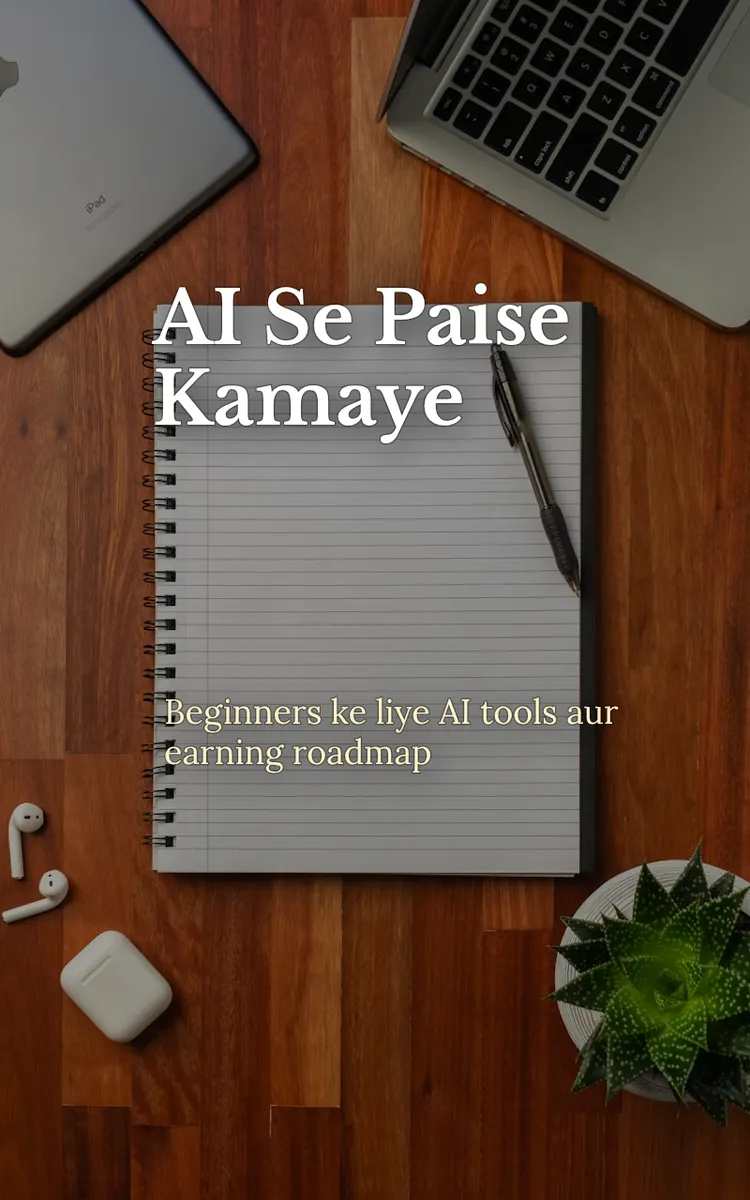
"AI Se Paise Kamaye" is a list book by Anonymous with 5 chapters and approximately 8,290 words. Beginners ke liye 30 AI tools se online earning roadmap.
This book was created using Inkfluence AI, an AI-powered book generation platform that helps authors write, design, and publish complete books.
Frequently Asked Questions
What is "AI Se Paise Kamaye" about?
Beginners ke liye 30 AI tools se online earning roadmap
How many chapters are in "AI Se Paise Kamaye"?
The book contains 5 chapters and approximately 8,290 words. Topics covered include AI Se Earning ka Sach - kya possible hai, kya nahi, AI Tools Se Paise Kaise Kamayein, 30 Best AI Tools for Beginners, AI Se Content Writing, and more.
Who wrote "AI Se Paise Kamaye"?
This book was written by Anonymous and created using Inkfluence AI, an AI book generation platform that helps authors write, design, and publish books.
Write your own list book with AI
Describe your idea and Inkfluence writes the whole thing. Free to start.
Start writingCreated with Inkfluence AI


