
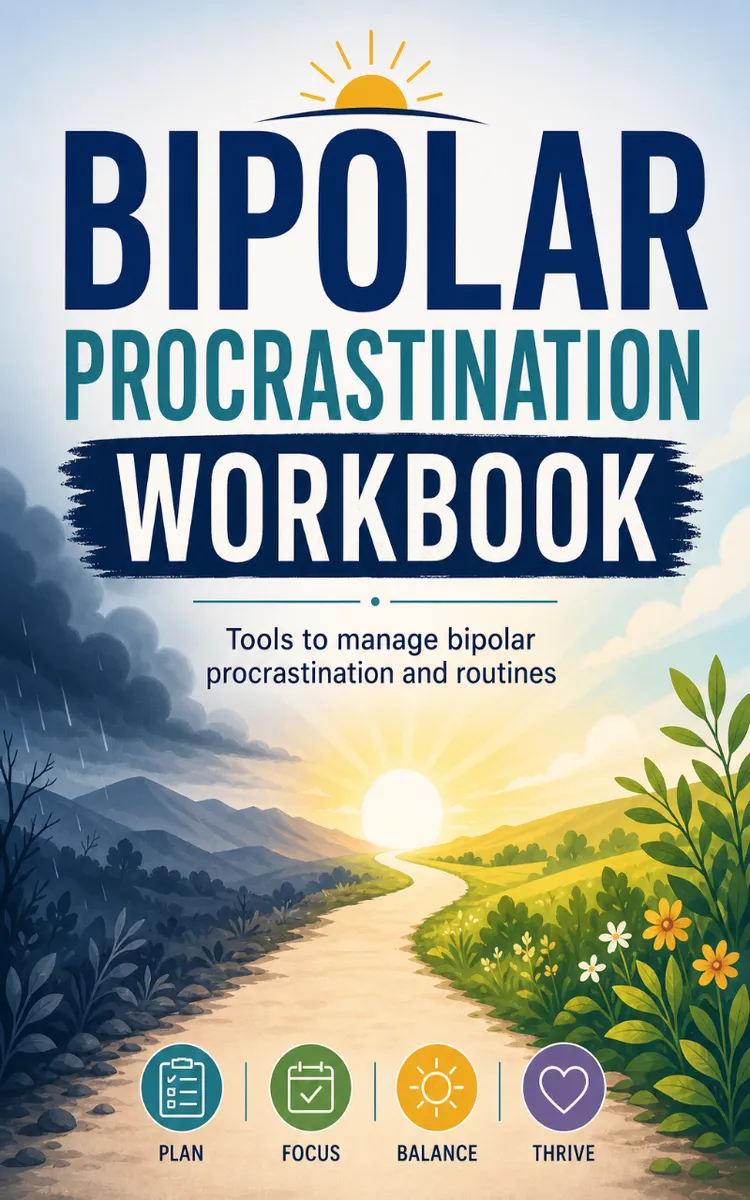

Read the first chapter
The whole of chapter one, free. About 6 min. Turn the pages with the arrows, your keyboard, or a swipe.
Chapter 1
Spotting Bipolar Procrastination Triggers
A missed task isn’t always a time-management problem. With bipolar disorder, procrastination can show up when your mood, energy, sleep, stress, or confidence shifts. Your first job isn’t to force yourself to work. It’s to notice the signal early enough to choose a safer response.
Use the pages below to track what happens before you put something off. You’re looking for patterns, not proof that you’re lazy or failing. A signal might be obvious, such as sleeping four hours and starting ten new projects. It might also be quiet, such as rereading one email for twenty minutes because your brain feels stuck.
Reading Your Procrastination Signals
Procrastination often has a sequence. Something changes in your body, mood, thoughts, or surroundings. Then a task feels harder, more urgent, or strangely unimportant. Finally, you avoid it, switch tasks, overplan, or wait for the “right” mood. Spotting the sequence gives you a chance to interrupt it.
Mood shifts can create different kinds of delay. During a depressive period, low energy, hopelessness, shame, or slowed thinking may make a simple task feel enormous. During a hypomanic or manic period, you may feel capable of everything, start several tasks, underestimate the time involved, or chase a more exciting idea. Mixed states can be especially confusing: your mind may race while your body feels exhausted. Stress and poor sleep can intensify any of these patterns.
Track four parts of each episode:
1. Signal: What did you notice first - sleep change, racing thoughts, heaviness, irritability, fear, or another clue? 2. Task reaction: What happened when you approached the task? 3. Delay behavior: What did you do instead? 4. Mood and stress context: What was your mood, sleep, and stress level?
Key takeaway: Your procrastination signal is the earliest noticeable change before the delay, not the delay itself.
A signal isn’t a diagnosis, and one bad day doesn’t identify a mood episode. Treat your notes as information to discuss with your treatment team, especially if you notice major sleep changes, risky behavior, severe depression, or thoughts of harming yourself. If you’re in immediate danger, contact emergency services or a crisis service in your area.
Your Turn: Signal Sort
Use one recent postponed task. Choose something specific, such as “send the invoice to Sam,” not “fix my business.”
Mapping the Moment Before Delay
Materials needed: This workbook, a pen, and a recent task you postponed. Time required: 15 minutes.
1. Write the task you delayed: Task: ___________________________________________________________
2. Write when you first noticed you were avoiding it: Date and approximate time: _______________________________________
3. Rate your mood at that moment. Use one number for each scale: Low or depressed mood, 0-10: ____ Irritability or agitation, 0-10: __ Racing thoughts, 0-10: __ Stress, 0-10: __ Physical energy, 0-10: ____
4. Record your sleep from the previous night: Hours slept: ____ Sleep quality, 0-10: ____
5. Circle or copy the first signal you noticed: - I felt heavy, slowed down, or numb. - I felt anxious or afraid of doing it wrong. - I became irritated by the task or by someone connected to it. - My thoughts sped up or jumped between ideas. - I felt unusually confident and decided it could wait. - I felt overwhelmed by the number of steps. - I felt physically tired despite wanting to work. - Another signal: _________________________________________________
6. Describe what happened in the next ten minutes. Include the exact delay behavior. I was going to: _______________________________________________ Instead, I: _________________________________________________ I delayed for approximately: ___________________________________
7. Identify the mood or stress pattern that may have shaped the delay. Complete one sentence: “When I notice ______________________________, I’m more likely to postpone ______________________________.”
8. Give this pattern a short name you’ll recognize later. Keep it practical, such as “four-hour-sleep overcommitment” or “shame-and-email freeze.” Pattern name: ___________________________________________________
9. Choose one early warning signal to watch for during the next seven days: My signal: ______________________________________________________
> Completed example > Task: Send a $450 invoice to a regular customer. > Mood: Low mood 7/10; irritability 2/10; racing thoughts 1/10; stress 8/10; energy 3/10. > Sleep: 6 hours, quality 3/10. > First signal: My chest felt tight, and I thought, “They’ll question the price.” > Delay behavior: I reorganized my desktop and watched short videos for 35 minutes. > Pattern: When stress is high and my confidence is low, I avoid money-related emails. > Signal to watch: Tight chest plus the thought “They’ll judge me.”
You’re done when you have named one signal, one delay behavior, one mood or stress pattern, and one signal to monitor. Don’t try to explain your whole life on one page. One clear pattern is enough.
Using Signals in Everyday Situations
Suppose you run a small business and notice you slept five hours, feel unusually charged, and have opened six new project ideas before breakfast. The task is to finish one estimate. Your signal isn’t “I’m procrastinating.” It’s the combination of reduced sleep, fast ideas, and repeated switching. The useful response is to pause new commitments, write the ideas in one list, and return to the estimate for a short, defined period. The expected outcome is not perfect focus. It’s fewer new promises and a clearer view of what still needs doing.
Now imagine a depressive stretch. You need to call a supplier, but the phone feels impossibly heavy. You notice low energy, shame, and the thought, “I’ve already messed everything up.” That thought is part of the signal. Write down the call’s smallest visible action, such as “find the supplier’s number.” Set a ten-minute timer, and stop when it ends if you need to. The expected outcome is a completed first step, not a magically finished phone call.
Stress can blur mood signals, so use a simple three-day check. Once each evening, record sleep hours, stress from 0-10, and the strongest procrastination signal you noticed. After three days, look for a repeated pairing. For example, “stress above 7 plus irritability leads to avoiding paperwork,” or “less than six hours of sleep leads to starting too many tasks.” If you see a sharp mood change, several nights of reduced sleep, or behavior that feels unsafe or out of character, contact your clinician rather than treating it as an ordinary productivity problem.
Apply It: Make a Signal Response Card
Write three lines you can keep beside your phone or work area:
• When I notice: _______________________________________________ - I will pause and check: sleep, mood, stress, and the task I’m avoiding. - My next safe step is: _________________________________________
For the next seven days, use the card once whenever your named signal appears. Mark the result:
Signal noticed: yes / no I paused before switching tasks: yes / no I completed one defined step: yes / no I contacted support if the mood shift felt unsafe: yes / no / not needed
The card is working if it helps you notice the pattern before at least one delay, even if the task still takes time. Awareness comes first. Speed can come later.
Making Your Personal Signal Map
Use these questions to turn observations into a plan. Answer with specific examples from the last two weeks when possible. If a question doesn’t fit, write “not noticed” rather than guessing.
Reflect
1. Which signal appears earliest for you: a sleep change, body sensation, mood shift, racing thoughts, low energy, or a stressful event? What exact clue would another person be able to notice? ________________________________________________ ______________________________________________ ________________________________________________
2. Which tasks are most likely to be postponed during low mood, high energy, or high stress? Name one task for each pattern, and include the delay behavior that usually follows. ________________________________________________ ______________________________________________ ________________________________________________
3. What will you do when your signal appears again? Name one task pause, one small next step, and one person or professional you can contact if the mood shift becomes concerning. ________________________________________________ ______________________________________________ ________________________________________________
Keep your signal map somewhere visible for one week. You don’t need to catch every delay. Catch one early signal, record what followed, and use that information to make the next choice a little safer.
End of chapter one. 9 more chapters in the full book.
Swipe or use the arrows to turn the page
What's inside: 10 chapters
- 1. Spotting Bipolar Procrastination Triggers
- 2. Using Micro-Starts for Stuck Tasks
- 3. Building a Mood-Aware Daily Routine
- 4. Setting Energy-Based Task Priorities
- 5. Creating a One-Page Weekly Plan
- 6. Designing Anti-Procrastination Friction
- 7. Managing Urges with the 5-Minute Reset
- 8. Using Implementation Intention Scripts
- 9. Planning Safe Accountability with Boundaries
- 10. Reviewing Progress with the Recovery Loop
About this book
"Bipolar Procrastination Workbook" is a workbook by Anonymous with 10 chapters and approximately 14,543 words. Workbook for managing bipolar procrastination behaviors and routines.
This book was created using Inkfluence AI, an AI-powered book generation platform that helps authors write, design, and publish complete books. It was made with the Workbook Generator.
Frequently Asked Questions
What is "Bipolar Procrastination Workbook" about?
Workbook for managing bipolar procrastination behaviors and routines
How many chapters are in "Bipolar Procrastination Workbook"?
The book contains 10 chapters and approximately 14,543 words. Topics covered include Spotting Bipolar Procrastination Triggers, Using Micro-Starts for Stuck Tasks, Building a Mood-Aware Daily Routine, Setting Energy-Based Task Priorities, and more.
Who wrote "Bipolar Procrastination Workbook"?
This book was written by Anonymous and created using Inkfluence AI, an AI book generation platform that helps authors write, design, and publish books.
How can I create a similar workbook?
You can create your own workbook using Inkfluence AI. Describe your idea, choose your style, and the AI writes the full book for you. It's free to start.
Write your own workbook with AI
Describe your idea and Inkfluence writes the whole thing. Free to start.
Start writingCreated with Inkfluence AI


