
Read the first chapter
The whole of chapter one, free. About 6 min. Turn the pages with the arrows, your keyboard, or a swipe.
Chapter 1
The Farm and the War in Poland
The newspaper ink stained Stefano’s fingers before he finished the first line: Germany had invaded Poland. He stood by the kitchen table on the Clemente farm, sixteen and still in the work clothes he’d worn in the pigpen, the smell of manure on his sleeves. Outside, pigs shifted and grunted in the muddy yard, the wind pressing the screen door with the dry, restless sound of late summer. His mother moved between stove and sink. His father sat beneath the window, head lowered, listening to the radio. It spoke of armies, borders, cities Stefano had known only from maps. Poland seemed impossibly far, separated from the farm by an ocean, by languages he did not speak, by the ordinary duties waiting before supper. Yet the words on the paper made that distance feel fragile. His father reached for the sheet. “Give it here.” Stefano passed it across the table. “They invaded Poland.” “I heard.” “What happens now?” His father folded the paper once, carefully. “The governments will decide what happens now.” The answer settled over the room without satisfying him. His mother set a plate near the stove. The radio continued in a low crackle, describing a war that had begun beyond the fields. Stefano looked out at the farm: the barn roof needing repair, a fence leaning toward the road, land running flat beneath a pale sky with no hill or town to break the view. He had been born there in 1924, raised among Italian relatives, feed sacks, winter chores, and the steady heat of the pigs. He knew how to mend a gate and lift a struggling animal; he knew the smell of wet straw and the feel of frozen metal against his palms. He did not know how to become the person he imagined beyond that place. That evening, after work, he returned to the paper. The kitchen had grown quiet: his father in bed, his mother drying dishes. Stefano flattened the page with both hands and read the report again, though the words were the same. “Why do you keep looking at it?” his mother asked. “I want to understand.” “It is across the ocean.” “That doesn’t mean it isn’t real.” She draped the dishcloth over the sink. “No one here can do anything about it.” Stefano lowered his eyes. “Maybe someone can.” His mother studied him; for a momentthe seat of his pants. “You’ve been somewhere else for a week.” Stefano wiped his hands on his trousers. “I’m thinking.” “Thinking won’t keep the roof from leaking.” His father’s voice was practical, patient. Stefano wanted to tell him about the faces beneath the headlines, the mothers clutching children, the men whose plans were shattered, but the words felt too large for the kitchen. Instead he said, “I want to see.” His father’s jaw tightened. “See what? Trouble?” “I want to see what’s happening. To understand it.” His father went back to his tasks without answering, and the silence pressed like the summer heat. In the following weeks, Stefano stole moments wherever he could: lingering by the grocery window to catch the paper’s headlines, eavesdropping on radio broadcasts at the feed mill, piecing together reports that were often vague or contradictory. Each fragment made the world beyond the farm more present: soldiers moving, towns emptied, families fleeing. The images settled in him, as if settling into a different, growing shape he had not expected. Friends joked that he listened to the news like a lover waiting for a letter. His mother fretted that the talk would make him restless. His father said nothing, but his shoulders seemed heavier. Work continued: fences mended, troughs filled, pigs fed. The farm’s demands were relentless and immediate. Still, Stefano’s mind kept traveling farther, mapping routes and names, imagining how to go. One evening, as dusk thinned the light, a neighbor passing through stopped to speak with his father about recruits leaving for the city, and someone mentioned enlistment, travel, papers. A name was given of a man organizing transport for those heading to join causes beyond the province. Stefano listened, heart tightening and loosening at once. After the neighbor left, he waited until his parents were occupied with supper and quietly asked for the name. They exchanged looks: his mother’s concern, his father’s reluctant resignation. “If you go,” his father said finally, “you must be sure. There’s no turning back without a cost.” Stefano understood the warning: not only the danger of travel and war, but the cost of leaving family and the only life he had known. Yet the thought of remaining felt like a slow surrender to a life planned by habit rather than choice. That night
that night I lay awake on the loft boards above the pigpen, the straw pricking my shoulders, and tried to measure how much of myself I could carry out the door without my parents noticing. The paper’s ink still smudged the pads of my fingers when I closed my fists. Names and dates spun in my head like the feed grinder in the barn - mechanical, inevitable. Poland had been the first clear line; after that the map folded toward me. I imagined the sea as a dark road that might take me somewhere I could answer the questions that hummed behind my ribs.
I told myself I wanted to see, to understand, that it was curiosity - an honest hunger for knowledge. That was part of it. But beneath the neat reasoning there was a feeling I could not explain then: an itch of unrest that had nothing to do with headlines, an awareness that the small world of hogs and fences could not hold every part of me. When I pictured Paris in my mind, it was not merely lights or a crowd; it was a place where I might be someone apart from the son who scrubbed troughs and patched roofs. I imagined other names, other faces, and the possibility that those private pieces inside me - those furtive inclinations I had learned to smother - might be less cramped there, or at least better hidden among strangers.
Fear slid through that vision like cold water. I thought of my father’s jaw tightening every time I pushed the topic, of my mother’s hands, always busy with work that showed how small decisions bent a whole household. Leaving meant more than travel; it meant carving away a part of them and of myself. The cost he warned about was not only danger on the road but the slow unmooring from what had made me Stefano Clemente: the cadence of chores, the names called at dinner, the rough touch of my brother’s shoulder. To go would be to become two people - the boy who left and the one who remained.
Still, the maps in my head drew themselves bolder. I pictured the boat’s rail under my hands, the smell of salt and coal, the low murmur of men who had chosen to move. I thought of the men on the papers - ordinary bodies set against extraordinary things - and told myself I could be like them in a way that did not require a uniform or a letter of enlistment. I could choose my own place in the fight, or at least I could begin to choose.
In the dark I measured the weight of what I would have to hide. There were small, private truths that meant more than any headline: where my eyes lingered, the way warmth at another man’s shoulder made my chest lift. On the farm those truths had no name that fit; they were a danger and a hush. If I went, I would have to learn when to be silent and when to hold close what I dared not reveal. That knowledge felt like armor and a sentence at once.
By morning the decision had a shape. Not a plan fully formed - only a stubborn clarity that I could not keep waiting for permission to become myself. The farm would still stand when I left, but leaving would be the moment I stopped letting other people define the measure of my days.
End of chapter one. 29 more chapters and about 62,604 words in the full book.
Swipe or use the arrows to turn the page


What's inside: 30 chapters
- 1. The Farm and the War in Poland
- 2. Stowing Away for Europe
- 3. Paris, October 10, 1939
- 4. A Barback in Paris Nightlife
- 5. Choosing Paris Over Home
- 6. Germany Invades France
- 7. Taking Up Arms Independently
- 8. The Fall of France
- 9. Finding the Resistance
- 10. First Sabotage Mission
- 11. Tracing the Leaked Route
- 12. A Safehouse Under Search
- 13. The Cost of Resistance
- 14. Disrupting German Supply Lines
- 15. Two Years in the Resistance
- 16. Crossing Toward Calabria
- 17. Choosing the American Front
- 18. Joining U.S. Forces in Calabria
- 19. The Unofficial Fighter’s Place
- 20. The Road North Through Italy
- 21. Rejoining the Campaign
- 22. Meeting Harold Draper in Turin
- 23. The Kiss in the Dark
- 24. A Love Kept Secret
- 25. The Last Night Outside Reims
- 26. Harold’s Death at Reims
- 27. Three Weeks to the MP-40 Wounds
- 28. The Croix de Guerre
- 29. Returning Home in Grief
- 30. John Durant and Akron, 1959
About this book
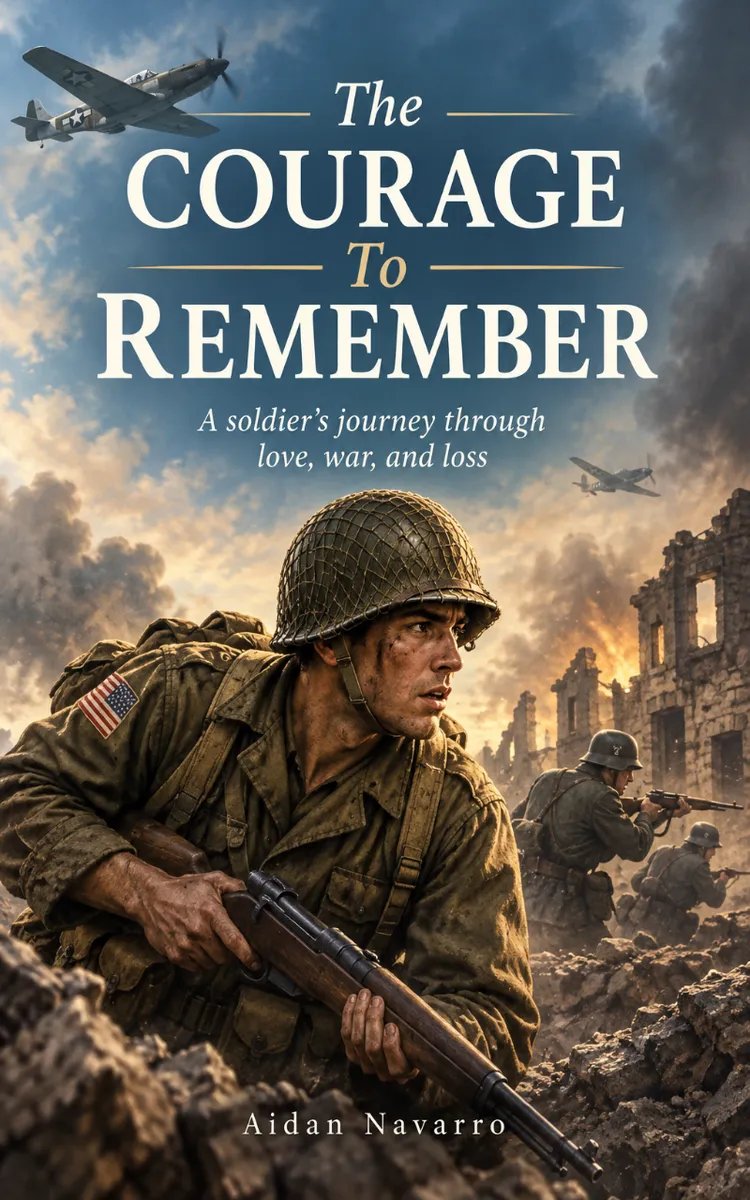
"The Courage To Remember" is a fiction book by Aidan Navarro with 30 chapters and approximately 62,604 words. At sixteen, Stefano Clemente read that Germany had invaded Poland, then left his family’s farm with a canvas bag and no passport. He rode freight trains, hid among cargo, and crossed the Atlantic in search of a place in a war already reshaping Europe.
This book was created using Inkfluence AI, an AI-powered book generation platform that helps authors write, design, and publish complete books. It was made with the AI Novel Writer.
Frequently Asked Questions
What is "The Courage To Remember" about?
At sixteen, Stefano Clemente read that Germany had invaded Poland, then left his family’s farm with a canvas bag and no passport. He rode freight trains, hid among cargo, and crossed the Atlantic in search of a place in a war already reshaping Europe. The boy who watched his father fold the newspaper would become a gay Italian American whose life was marked by resistance, love, and loss. The Courage To Remember follows Stefano from the muddy yard of the Clemente farm to wartime Europe, tracing a life lived against the dangers of its time. His story brings LGBTQ+ history close: a freight car climbed in secret, a ship crossed in hiding, and a future he could not yet see.
How many chapters are in "The Courage To Remember"?
The book contains 30 chapters and approximately 62,604 words. Topics covered include The Farm and the War in Poland, Stowing Away for Europe, Paris, October 10, 1939, A Barback in Paris Nightlife, and more.
Who wrote "The Courage To Remember"?
This book was written by Aidan Navarro and created using Inkfluence AI, an AI book generation platform that helps authors write, design, and publish books.
How can I create a similar fiction book?
You can create your own fiction book using Inkfluence AI. Describe your idea, choose your style, and the AI writes the full book for you. It's free to start.
Write your own fiction book with AI
Describe your idea and Inkfluence writes the whole thing. Free to start.
Start writingCreated with Inkfluence AI


