

Read the first chapter
The whole of chapter one, free. About 9 min. Turn the pages with the arrows, your keyboard, or a swipe.
Chapter 1
The Disturbance That Reveals You
The Opening
In the field, a disturbance is often treated as noise - something to filter out so the “real” ecology can be measured. But in many transitional environments, the disturbance is the only reason the system becomes legible at all: it rearranges what counts as a boundary, what counts as an entity, and what counts as evidence.
Leila, 34, doesn’t have the luxury of ignoring that logic. As a field ecologist logging “symptom signatures” in disturbed habitats, she learned that the same patch of ground can look like ecological silence until a particular kind of disturbance arrives - then suddenly you can see it: which organisms are actually present, which interactions are active, and which identities the habitat is willing to sustain. The paradox is that the disturbance does not merely reveal a pre-existing state; it helps constitute what is being revealed.
This chapter follows that paradox with cross-lab evidence about mutual manifestation: the idea that environments and entities become distinguishable through reciprocal responsiveness. Instead of asking how an object moves from one condition to another, we ask how the architecture of possible continuations reorganizes when disturbance forces both the environment and the observer to renegotiate what they are looking at. When the system is disturbed, what exactly is being disclosed - an underlying reality, or the conditions under which reality can be distinguished?
The Deep Dive
Leila’s field notes have a distinctive rhythm. She records symptoms - patterns of persistence, sudden absences, the sudden appearance of certain textures of life - without assuming those symptoms correspond neatly to stable “before” and “after” categories. In practice, she treats disturbance as a generator of observability. A burn scar, a flood margin, a windthrow gap: these are not just events that change biomass. They also change the coordinates of observation - what is readable, what is comparable, what can be tracked across time without collapsing into interpretation.
That stance maps cleanly onto a comparative synthesis emerging across independent lines of work in ecology of environment. The convergence point is not a single mechanism but a repeated morphogenetic pattern: transitions repeatedly show up as transformations affecting environments, entities, observers, identities, routes, rhythms, memory, and even future possibilities. Mutual manifestation sits at the center. An entity becomes distinguishable not by being “found,” but by being made salient through the disturbance it induces - and by the environment’s response that makes the entity persist as an identifiable continuation.
Historically, ecology has cycled through ways of treating disturbance. Early ecological thinking often framed disturbance as a perturbation to recovery, a kind of outside push that interrupts an otherwise orderly succession. Later perspectives emphasized that disturbance regimes are not incidental; they structure landscapes over time. What is easy to miss in that historical arc is how often “structure” is smuggled in as if it were already carved into the world before the disturbance. Mutual manifestation asks a sharper question: what if structure is produced by the encounter between an entity and an environment that can newly recognize one another?
A useful cultural analogy comes from microscopy and photography. Many imaging techniques do not simply “show” what was there; they change the visibility of features by altering contrast - sometimes by using the sample’s own behavior against the instrument’s assumptions. In the same way, disturbance can act like an imaging protocol without being designed as one. It imposes constraints (waterlogging, thermal stress, abrasion, altered light) that reorganize which traits remain interpretable and which interactions remain stable enough to count as evidence. The system becomes, in a literal observational sense, more or less “distinguishable.”
One reason this matters for a systems ecology audience is that distinguishability is not a minor epistemic detail. It is an ecological variable. Disturbance can “activate” certain feedbacks while silencing others, and those feedbacks are what stabilize identities long enough for observers to track them. In that sense, the disturbance-disclosure relation is not merely cognitive; it is ecological. The environment responds, the entity responds, and the observer’s categories become entangled with what the joint response makes stable.
Cross-lab evidence reinforces that the disturbance-disclosure relation is rarely a one-way arrow. Mutual manifestation is not a metaphor for “co-evolution” in the broad sense; it is a specific morphogenetic pattern: environments and entities reveal one another through distributed changes that include membranes, residual geometries of memory, and reconstructed coordinates of observation. When disturbance reorganizes membranes - literal biological boundaries, but also functional ones like resource gradients and dispersal corridors - it changes which entities can maintain continuity. When continuity changes, so does what an observer can reliably distinguish without turning the observation into post hoc story.
A single-sentence fact can clarify why this is not just about disturbance as a cause. In many ecological contexts, the same disturbance intensity can yield different community trajectories because the disturbance changes the identity of the niches that remain available, not just the population sizes. That reframing matters because it pushes distinguishability from a passive property of the world into an emergent property of the disturbance-mediated architecture of continuation.
What You Did Not Expect
The surprise that keeps showing up across laboratories is counterintuitive at the level of intuition: disturbance can increase distinguishability even when it reduces apparent stability. People often expect that “more chaos” means “less signal.” Mutual manifestation flips that expectation by treating disturbance as a generator of persistent differences - differences that survive long enough to become measurable, comparable, and shareable between observers.
This matters because it changes what we treat as evidence. If disturbance makes identities more distinguishable, then the observer’s task is not only to infer the underlying state, but to track how the disturbance reorganizes the observability conditions themselves. In other words, the disturbance is not simply revealing an already-formed entity; it is helping to create the conditions under which that entity maintains a recognizable continuity. That shifts theory-building away from a static picture of “states” and toward an architectural picture of possible continuations.
The deeper implication is that the disturbance-disclosure relation can look like “recognition” in cognition while being rooted in ecological mutuality. Observers often talk as if they are matching patterns to categories. Mutual manifestation suggests a co-production: categories become viable because the disturbance makes certain contrasts persist. The entity, the environment, and the observer are mutually constrained into a shared readability regime.
Leila’s field practice makes the point concrete. She does not treat symptom signatures as labels stuck onto a stable substrate. Instead, she treats them as residual geometries - patterns that remain after the disturbance has done its constitutive work. A disturbed habitat becomes a kind of record, but not a passive one. The record is shaped by what the disturbance permits to persist and what it prevents from persisting. That is why the same site can become “legible” only after certain disturbances: without them, the system’s continuation options may be too underdetermined to hold stable identities long enough for reliable distinction.
If this sounds like a subtle epistemic twist, it is - but it is also ecological. Distinguishability is a constraint on which ecological routes can be followed without collapsing into noise. Mutual manifestation therefore suggests that disturbance regimes are not just landscape-level forces; they are part of the machinery that makes ecological identities dynamically accessible.
The Human Story
Leila’s work centers on disturbed habitats that are close enough to infrastructure to be repeatedly encountered, but far enough that “control” is limited. Her site logs often begin with a familiar baseline: a mosaic of vegetation patches, small soil differences, and the usual background variability that makes ecological recording feel more like listening than counting. Then a disturbance arrives - one of those events that local land managers would describe in practical terms (clearing, flooding, fire, storm damage), but that in ecological terms acts like a reconfiguration of the environment’s coordination architecture.
What changes first, in Leila’s observations, is not merely abundance. It is the sudden emergence of consistent contrasts. After a flood margin event, for example, waterlogged zones stop behaving like “just wet ground” and start behaving like a different observational regime: different species persist, different interactions become detectable, and the spatial organization of continued possibility becomes sharper. The habitat stops being a continuum and starts being a set of distinguishable regions - regions that can be revisited and re-identified across time.
She records these changes as symptom signatures: patterns of persistence that function like a diagnosis of ongoing mutual manifestation. The signatures are not “diagnoses” in a clinical sense; they are observational commitments. They represent what the disturbance has made stable enough to be tracked. When the signatures are consistent across repeat visits, Leila treats that consistency as evidence that the disturbance has created a recognizable ecological identity - an entity-environment configuration that continues to unfold in a way observers can reliably point to.
The community angle matters here. Leila is not working in isolation; she shares her symptom signatures with other field ecologists who use different instruments and different taxonomic instincts. Disagreement happens - sometimes about what counts as the “same” entity, sometimes about whether a signature is truly persistent or merely coincidental with timing. But those disagreements are not noise to eliminate. They are the cross-lab analogue of mutual manifestation’s central claim: if observers disagree, it can reveal where disturbance reorganizes observability more strongly than it reorganizes underlying continuity. In that sense, cross-lab disagreement becomes part of the evidence policy: it marks where identities are still negotiating their distinguishability.
One concrete detail helps ground the abstraction. Leila’s logs emphasize transitions that appear to be “instantaneous” from a coarse viewpoint - an abrupt shift in what the site looks like over a short interval. Yet when she compares symptom signatures across time, those abrupt shifts often correspond to distributed changes: altered soil structure, altered moisture regimes, changed dispersal opportunities, and changed persistence of microhabitats. The disturbance does not simply flip a switch; it reorganizes the conditions under which certain entities can reveal themselves to both the environment and the observer.
Leila’s human story, then, is not a motivational arc. It is a methodological one. She learned to treat disturbance as a disclosure operator - an ecological process that changes what can be distinguished. Her daily practice of logging symptom signatures is, in effect, a local implementation of a broader theoretical stance: mutual manifestation is not an add-on to ecology; it is what makes transitions observable as anything other than narrative blur.
What This Tells Us
The disturbance-disclosure loop leaves a residue in how we think about human cognition and social coordination. People often assume that observation is a window onto a world that is already structured. Mutual manifestation suggests something more entangled: observation becomes part of a feedback web in which entities and environments co-produce the conditions for distinguishability. Disturbance intensifies that entanglement by forcing the system into regimes where only certain continuations remain viable - and therefore only certain identities remain trackable.
There is also a political and social implication, though it shows up indirectly. When different observers interpret the same disturbed landscape differently, those differences are not merely interpretive style. They can reflect genuine architectural differences in what the disturbance has made visible. Shared understanding in ecology therefore depends on shared disturbance contexts as much as shared language. A community’s “common sense” about a site may lag behind the disturbance-mediated reorganization of what counts as an entity.
Finally, the most enduring lesson is that distinguishability is a dynamic achievement, not a passive property. Disturbance can reduce the comfort of stable categories while increasing the sharpness of emergent identities. It makes the world less like a static map and more like a set of negotiated continuations - negotiations in which entities, environments, and observers each contribute constraints.
The mystery that lingers is not whether disturbance reveals the world, but how it decides what can be revealed: what, in a disturbed system, sets the threshold at which an entity becomes distinguishable enough to persist as an identity for anyone at all?
End of chapter one. 7 more chapters and about 16,018 words in the full book.
Swipe or use the arrows to turn the page


What's inside: 8 chapters
- 1. The Disturbance That Reveals You
- 2. When the Boundary Becomes a Habitat
- 3. Membranes You Can’t Always Point To
- 4. Movement, Correction, and Coordinate Drift
- 5. Interphases That Compete Like Ecosystems
- 6. Identity Survives Only as a Pattern
- 7. Invariants That Rebuild Themselves
- 8. Residual Geometry as Memory’s Form
About this book
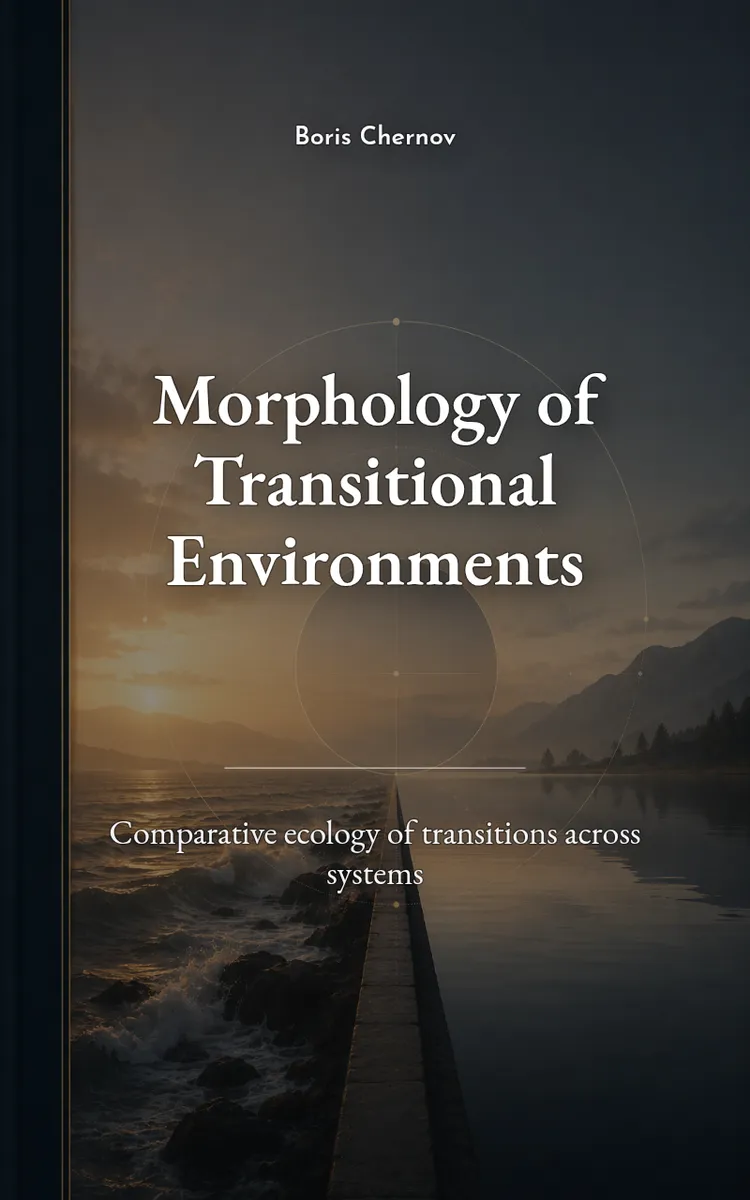
"Morphology Of Transitional Environments" is a curiosity book by Boris Chernov with 8 chapters and approximately 16,018 words. Comparative research on transitional environments, observers, and identities.
This book was created using Inkfluence AI, an AI-powered book generation platform that helps authors write, design, and publish complete books.
Frequently Asked Questions
What is "Morphology Of Transitional Environments" about?
Comparative research on transitional environments, observers, and identities
How many chapters are in "Morphology Of Transitional Environments"?
The book contains 8 chapters and approximately 16,018 words. Topics covered include The Disturbance That Reveals You, When the Boundary Becomes a Habitat, Membranes You Can’t Always Point To, Movement, Correction, and Coordinate Drift, and more.
Who wrote "Morphology Of Transitional Environments"?
This book was written by Boris Chernov and created using Inkfluence AI, an AI book generation platform that helps authors write, design, and publish books.
Write your own curiosity book with AI
Describe your idea and Inkfluence writes the whole thing. Free to start.
Start writingCreated with Inkfluence AI


