

Read the first chapter
The whole of chapter one, free. About 6 min. Turn the pages with the arrows, your keyboard, or a swipe.
Chapter 1
When the Project Enters the Place
At 6:40 on a wet Tuesday morning, the old bus stop still has three people under its shallow metal roof. The timetable is faded. Someone has wedged a folded supermarket bag into the cracked side panel to keep the rain out. Behind them, a surveyor’s orange peg marks the edge of a future access road.
The field beyond the stop is not empty, though the planning drawings call it undeveloped land. A woman walks her dog along its muddy edge. A builder stores lengths of pipe beside the hedge. Children cut across it on their way to school when the pavement floods. Under the grass runs a water main, and beneath the road sits a drain installed when the village was much smaller. The proposed district will bring 1,200 homes, a primary school, shops, a new junction, and a pumping station. On paper, it is a territorial transformation. At the bus stop, it is a peg in the ground and a question nobody has answered yet.
The same transformation travels under several descriptions. For the developer, it begins as a difficult parcel with planning risk, land options, construction costs, sales rates, and a programme that must hold together long enough for the first homes to become financeable. The project is not simply a collection of buildings. It is a sequence of permissions, contracts, roads, utility connections, and releases of capital. A delay to the junction can hold back the whole scheme. A disagreement over drainage can turn a promising quarter into an expensive holding pattern.
For the bank, the place appears through a different window. The lender sees debt service, collateral, drawdown conditions, presales, interest exposure, and the point at which infrastructure spending begins to support an asset rather than merely consume cash. The bank may believe in the long-term demand for the homes and still worry about the eighteen months before the first occupation certificate. Its concern is not imaginary. It is carrying the risk that the project’s future value will fail to arrive on schedule.
An insurer watches the same ground for other signs. How will surface water move after the fields are paved? Will the new retaining wall be maintained? Is the pumping station protected against power failure? What happens when a hundred-year rainfall event meets a road built to yesterday’s assumptions? Insurance turns often invisible conditions into prices, exclusions, and requirements. A drainage design that looks like a technical appendix to one observer may become the difference between cover and no cover to another.
The public authority has its own clock. It must secure affordable homes, school places, transport capacity, and a reliable water system. It must answer residents’ objections without pretending that every objection can stop the scheme. It must spend public money carefully, sometimes years before the benefits become visible. The new junction may be an item in a capital programme, but it is also a promise that emergency vehicles will reach the new streets, that buses will not be trapped in the old bottleneck, and that the existing village will not be asked to absorb every consequence of growth.
Then there are the people who already live there. The resident at the bus stop may not oppose new homes. She may know someone who needs an affordable flat nearby. She may also know that the current bus arrives late, that the corner floods twice each winter, and that the local surgery has stopped taking new patients. Her view is not a verdict on development in the abstract. It is a reading of whether this particular change can enter the place without making ordinary life less workable.
A family sees more again. A parent measures the route to school, the cost of commuting, the safety of a crossing, and whether a grandparent can still reach the house without a car. A teenager notices that the field where football happens will become a construction compound. A shopkeeper counts the months of dust before counting the future customers. For a family, the project is not only what will exist when complete. It is the long interval between the last familiar season and the first stable version of what follows.
That interval is easy to lose in official language. “Temporary disruption” sounds modest when printed beside a programme bar. But temporary can mean three school years, a closed footpath, a moved bus stop, and a small business surviving on reduced trade. The word does not tell us who has savings, who can work from home, who depends on the old route, or who has no spare time for another consultation meeting at six o’clock on a weekday.
Future residents enter the picture as a quieter presence. They are not yet available to object, negotiate, or describe the life they will lead. Their interests are carried by standards, forecasts, design codes, and the judgement of people working now. A future resident may inherit a well-connected neighbourhood with a school and a shaded street. They may also inherit a maintenance problem, a housing estate built around a road that never gained bus service, or public space that looked generous in the brochure and feels exposed in winter.
None of these observations cancels the others. The developer’s return is not a moral failure. Without capital, land often remains land, and without a viable scheme there may be no homes, school, or drainage works at all. The bank’s caution is not greed in disguise. A lender that ignores risk can endanger depositors, borrowers, and the wider financial system. The insurer’s questions can seem fussy until a flooded basement closes a row of businesses. The authority’s conditions may frustrate delivery, yet weak conditions can leave residents paying for private decisions through public repair bills.
The unease begins when one description becomes the only description that counts. A project can be financially viable and socially exhausting. It can meet its planning obligations while making a familiar route unusable for years. It can produce an attractive completed neighbourhood while weakening the village that had to carry the construction period. It can also fail, leaving a half-built road and a set of promises that no longer have a clear owner.
This is why the project enters the environment rather than the environment entering the project. The phrase is easy to misunderstand. It does not mean that an existing place must be preserved exactly as it is, or that every local preference should control every investment decision. It means that the incoming scheme meets supporting arrangements already in motion: habits, businesses, care networks, maintenance practices, memories, debts, school admissions, bus timetables, and the physical limits of pipes laid decades earlier.
Those arrangements are not background scenery. They are part of the project’s operating conditions. A road is not merely a line connecting two points if people use it to reach a dialysis appointment. A vacant plot is not merely available land if its informal path is the only level route to the station. A construction delay is not merely a cost if a family has already sold its home and is paying rent while waiting for completion.
The practical difficulty is that each institution has learned to wait for a different future. The developer waits for completion and sales. The bank waits for repayment. The insurer waits for claims that may never come. The authority waits for infrastructure capacity and political accountability. Residents wait for the noise to stop, the bus to return, or a promise to become something they can touch. Families cannot always wait in the same way. They have leases ending, children growing, wages changing, and bodies that need care now.
At the bus stop, the orange peg remains visible after the rain. Months later, the timetable may be moved, the hedge cut back, and the field fenced. The scheme will be described in units, hectares, junction capacity, and investment value. All those measures will be true. So will the memory of the old route, the extra twenty minutes to school, the first shop that closes, and the first family that moves in wondering why the pavement ends before the crossing.
The harder question is not whether change should arrive. Places have always changed, and many people need the homes and services that development can provide. The harder question is how an institution can enter an already living environment and help conduct large-scale change without requiring the people within that environment to surrender the continuity of their lives to a future that only the institution has learned to wait for.
End of chapter one. 7 more chapters in the full book.
Swipe or use the arrows to turn the page


What's inside: 8 chapters
- 1. When the Project Enters the Place
- 2. Value Created, Value Captured
- 3. The Years a Project Takes
- 4. What Waiting Takes Away
- 5. A Good Ending Is Not Enough
- 6. When Governments Change Midstream
- 7. Who Carries the Transition Cost
- 8. Co-Tuning a Living Environment
About this book
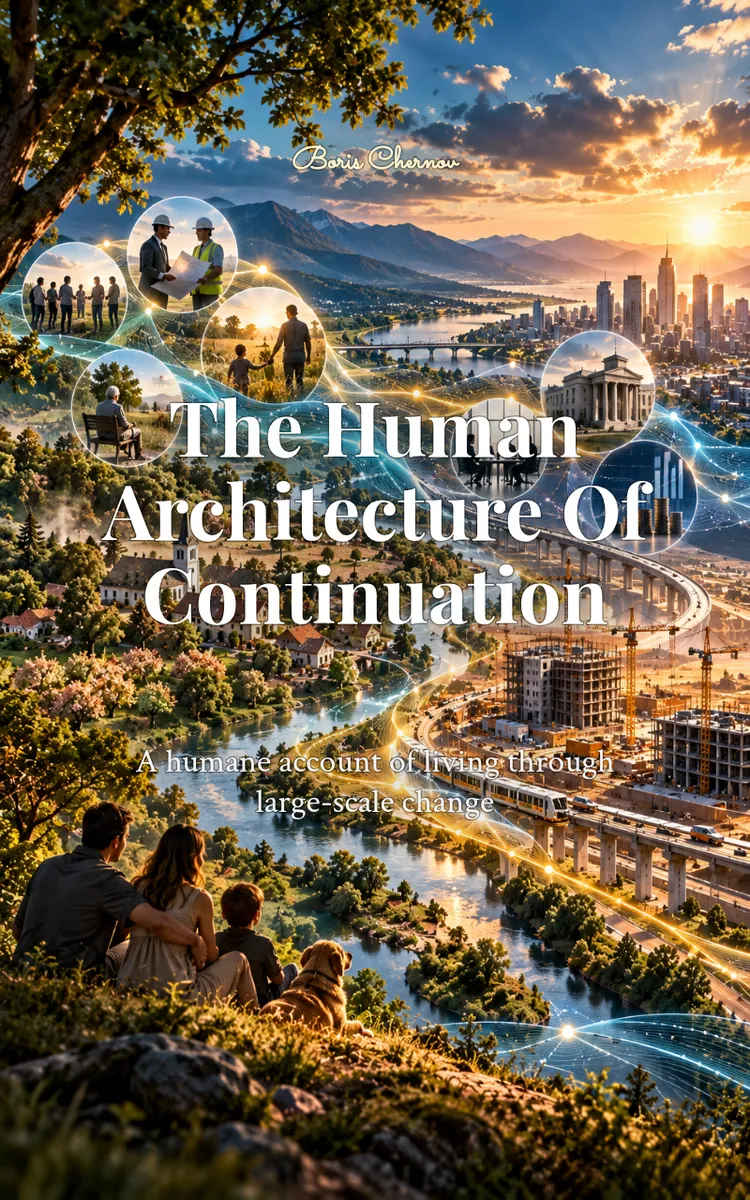
"The Human Architecture Of Continuation" is a essay collection book by Boris Chernov with 8 chapters and approximately 12,474 words. How infrastructure development shapes human continuity, institutional time, and lived transition.
This book was created using Inkfluence AI, an AI-powered book generation platform that helps authors write, design, and publish complete books.
Frequently Asked Questions
What is "The Human Architecture Of Continuation" about?
How infrastructure development shapes human continuity, institutional time, and lived transition
How many chapters are in "The Human Architecture Of Continuation"?
The book contains 8 chapters and approximately 12,474 words. Topics covered include When the Project Enters the Place, Value Created, Value Captured, The Years a Project Takes, What Waiting Takes Away, and more.
Who wrote "The Human Architecture Of Continuation"?
This book was written by Boris Chernov and created using Inkfluence AI, an AI book generation platform that helps authors write, design, and publish books.
Write your own essay collection book with AI
Describe your idea and Inkfluence writes the whole thing. Free to start.
Start writingCreated with Inkfluence AI


