
Read the first chapter
The whole of chapter one, free. About 9 min. Turn the pages with the arrows, your keyboard, or a swipe.
Chapter 1
The Plus-One Is Missing
The first thing my aunt did when I arrived was look past me.
Not rudely, exactly. She checked the driveway through the open front door, then glanced at the street, as if my date might be hiding behind the recycling bin. I stood there holding a bottle of wine and a pie I had bought from the bakery because I had run out of time, patience, and the desire to make pastry from scratch. Behind me, my car was empty.
“Oh,” she said. “It’s just you.”
Merry Christmas to me.
The house smelled like cinnamon, roasted onions, and the faint electrical heat of too many strands of decorative lights plugged into one outlet. Coats were heaped on the bed in the spare room. Someone’s toddler was wearing one sock. The television was showing a holiday movie nobody was watching, though three people were emotionally invested in the plot and one person kept announcing that the actor had “really let himself go.”
I stepped inside and became a category.
Single daughter. No children. Available adult. Safe person to seat beside Grandma because I could “keep an eye on her.” Potential helper. Possible disappointment. The cousin who had not brought a partner, a baby, or even a compelling explanation.
There is a particular silence that follows a single woman into a family gathering. It isn’t quite awkwardness. Awkwardness would give you the dignity of being a person in an uncomfortable moment. This is more like the room recalibrating around missing furniture. A chair has been left empty, and everybody knows what was supposed to be sitting in it.
My mother hugged me and immediately asked whether I had remembered to bring the serving spoon. I had not. She sighed in the way mothers sigh when they are trying to communicate both disappointment and their entire medical history. Then she took the pie from my hands.
“Did you come alone?” she asked.
I looked around the entryway. “No, I brought the pie.”
She did not laugh. The pie, apparently, had not met the minimum requirements for a holiday plus-one.
By the time I reached the kitchen, I had already received three versions of the same inquiry. Was I seeing anyone? Was there someone “special”? Had work been keeping me busy? These questions arrive dressed as conversation but carry the energy of an audit. They are not really asking what my life feels like. They are checking whether the family spreadsheet has been updated.
My cousin’s husband was introduced to a neighbor as “the one who works in finance.” My brother’s girlfriend was “the new teacher.” My sister was “Mom’s favorite because she gave her grandchildren.” I was “still living in the city,” which was not an occupation, a relationship status, or a personality, but had somehow become my official label.
The city was the thing I had in place of a family.
This is how holiday gatherings turn people into decorative categories. The married ones form a unit. The parents are assigned their children, their schedules, and a heroic level of snack management. The teenagers are allowed to be rude because they are teenagers. The babies are treated like visiting royalty, even when they are screaming directly into a bowl of mashed potatoes.
And then there is the single, childless woman, hovering near the kitchen island with a glass of wine and no one legally required to text her back.
I have become excellent at arriving with evidence of usefulness. I bring wine, dessert, batteries, extra phone chargers, and the exact brand of sparkling water my father likes but refuses to buy for himself. I can set a table without asking where anything goes. I know which relatives need to be seated far apart and which ones need to be separated only after the second glass of red.
I have mastered the art of making myself easy to have around.
This is partly survival and partly habit. If I arrive carrying something, I am not merely the woman who arrived alone. I am the woman who brought the good bread. If I take responsibility for the coffee, I become indispensable for at least eleven minutes. If I offer to drive Grandma home, I am no longer the person whose life everyone is quietly assessing. I am transportation.
There are worse things to be. Transportation gets thanked.
Still, the category follows me. It sits beside my plate. It gets asked whether I have “met anyone.” It gets told, with a soft and tragic smile, that there is “still plenty of time.” Plenty of time for what, exactly? A husband? A baby? A personality transplant? The phrase is always delivered as if I have misplaced a package and the courier might yet find it.
One Christmas, my uncle asked me whether I was “open to dating.” He was standing beside the dessert table, holding a paper plate with a slice of pie balanced on it. He had been married for thirty-eight years and had spent most of dinner complaining about his wife’s choice of wrapping paper.
“I’m open to dating,” I said. “I’m less open to being interviewed about it while you eat whipped cream.”
He nodded thoughtfully, as if I had presented a complex business proposal. Then he suggested online dating.
Of course he did.
The family gathering has a way of flattening time. I can be thirty-nine, forty-one, forty-four, and still be treated like the version of myself who once came home from college with a laundry bag and a vague plan. My relatives remember me before the apartment, before the promotion, before the years of paying my own bills and learning how to assemble furniture without calling my father.
They remember my childhood body, my teenage moods, my first terrible haircut. They remember me as someone who was supposed to move through a sequence of events. School, job, partner, house, children. A neat little parade with matching hats.
When I arrive without the next float, the parade pauses.
Nobody says this directly. That would be rude, and families prefer their cruelty wrapped in concern. Instead, they ask whether I’m happy. Not how work is going, or what I’m watching, or whether the apartment radiator is still making that banging noise. They ask if I’m happy, with the careful expression of someone checking a smoke alarm.
I usually say yes.
This answer creates its own problem. If I say yes too quickly, I sound defensive. If I pause, everyone hears a confession. If I make a joke, someone says I use humor to avoid vulnerability, which is true but not helpful. If I explain that my life is full of friends, projects, travel, books, and the kind of quiet I once thought only monks could afford, the room listens politely and then asks whether I have tried a dating app.
The question isn’t whether I am happy. The question is whether my happiness looks sufficiently temporary.
That is the part that catches in my throat.
Being single at a family gathering is not always lonely. Sometimes it is peaceful. Sometimes it is deeply funny. I have watched partnered relatives negotiate bathroom time, nap schedules, in-law diplomacy, and the shocking discovery that nobody packed enough diapers. I have eaten dinner while it was still hot. I have slept past seven. I have left a party without coordinating with a second adult or locating a missing mitten.
My life is not a waiting room. It has furniture.
But the family gathering doesn’t always recognize furniture unless it can be used by someone else. A spare bedroom is useful. A folding chair is useful. A single woman with a flexible schedule is useful. Her inner life, less so. Her choices are treated as temporary weather, something that may change if everyone keeps mentioning it.
The complication is that sometimes I’ve helped build the category myself.
I have laughed along when relatives called me the “fun aunt,” even though I am not an aunt and the title often means I will buy expensive gifts while receiving no authority. I have accepted the seat at the children’s table because it was quieter there. I have volunteered for errands because driving to the store felt better than answering questions in the living room. I have made myself so competent, agreeable, and mobile that people forgot to ask what I wanted.
Or perhaps they asked, and I answered with logistics.
I’ll bring dessert. I can pick her up. I don’t mind sleeping on the sofa. I’m fine. I’m free. I can stay late.
There is a strange bargain in being the unattached adult. You are given freedom, but it is often the freedom to absorb everyone else’s inconvenience. You are treated as lucky until someone needs a ride, then lucky becomes available. You are praised for being independent until independence makes people uncomfortable. Then it becomes a problem to solve over coffee.
At one gathering, my mother introduced me to a distant relative as “our single one.” Not my name. Not my work. Not the fact that I had just finished renovating a bathroom myself, which involved a drill, three trips to the hardware store, and a level of rage I had previously reserved for airline customer service.
“Our single one,” she said.
The relative looked at me with immediate interest, like I was a rare bird or a clearance item.
I smiled because the alternative was explaining that I was not a family condition. I was not lactose intolerant. I was not the person who had failed to arrive with a man attached. I was standing there in boots I had paid for myself, holding a glass of wine I had chosen myself, having driven myself two hours through freezing rain.
Still, I felt the label settle over me.
Later, I found the pie in the kitchen, untouched and slightly damp beneath its plastic lid. The bakery had decorated it with a little sugar wreath that had collapsed on one side during the drive. It looked tired. It looked like it had made an effort and then regretted it.
I cut myself a slice and ate it standing beside the sink while my relatives argued over who had the right to take home the leftover stuffing. Nobody asked whether I liked the pie. Nobody asked what I had been thinking about on the drive. Nobody asked why I had been quiet.
They only noticed when I left.
“Already?” my aunt said, looking toward the empty doorway.
I told her I had an early morning. This was technically true. My morning contained coffee, laundry, and no children demanding to know where the batteries were.
Outside, the cold had sharpened. My breath appeared in front of me and vanished. The driveway was crowded with cars carrying couples, children, parents, and the full administrative burden of belonging to a unit. Mine sat at the end, clean enough, empty except for the pie knife I had forgotten to return.
For a moment, I stood with my hand on the door and looked back at the house glowing with holiday light. Inside, I was a category. Out here, I was simply the person who had arrived, stayed as long as she wanted, and brought home the knife.
End of chapter one. 11 more chapters and about 20,377 words in the full book.
Swipe or use the arrows to turn the page
What's inside: 12 chapters
- 1. The Plus-One Is Missing
- 2. The Annual Relationship Audit
- 3. Assigned to the Children’s Table
- 4. The Gift Budget Nobody Sees
- 5. When Your Calendar Is Empty
- 6. The Family Photo Formation
- 7. Hosting Without a Household
- 8. The Ex Who Gets Invited
- 9. Explaining Your Life Again
- 10. The Secret Joy of Leaving Early
- 11. Traditions You Get to Keep
- 12. A Life Outside the Template
About this book
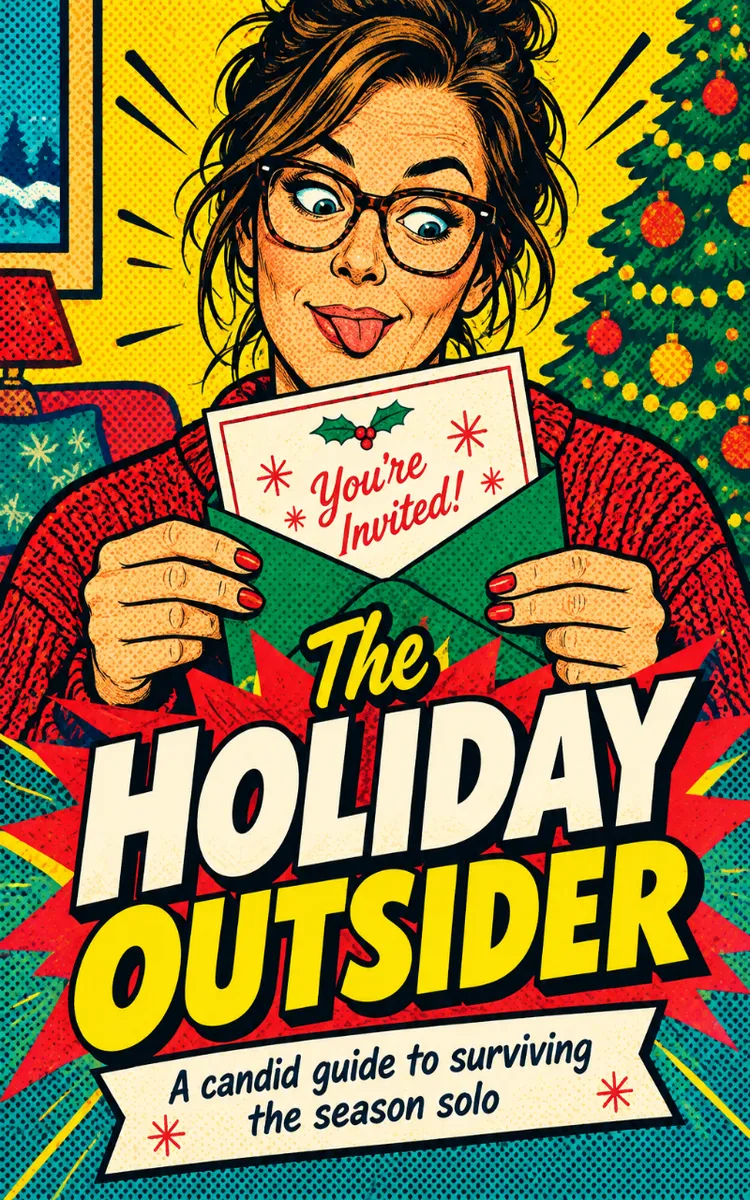
"The Holiday Outsider" is a essay collection book by Anonymous with 12 chapters and approximately 20,377 words. Humorous reflections on holiday season pressures for single, childless middle-aged millennial women.
This book was created using Inkfluence AI, an AI-powered book generation platform that helps authors write, design, and publish complete books.
Frequently Asked Questions
What is "The Holiday Outsider" about?
Humorous reflections on holiday season pressures for single, childless middle-aged millennial women
How many chapters are in "The Holiday Outsider"?
The book contains 12 chapters and approximately 20,377 words. Topics covered include The Plus-One Is Missing, The Annual Relationship Audit, Assigned to the Children’s Table, The Gift Budget Nobody Sees, and more.
Who wrote "The Holiday Outsider"?
This book was written by Anonymous and created using Inkfluence AI, an AI book generation platform that helps authors write, design, and publish books.
Write your own essay collection book with AI
Describe your idea and Inkfluence writes the whole thing. Free to start.
Start writingCreated with Inkfluence AI


