

Read the first chapter
The whole of chapter one, free. About 8 min. Turn the pages with the arrows, your keyboard, or a swipe.
Chapter 1
From Money to a Working Asset
A bridge can be physically empty and financially crowded long before its first vehicle crosses it. Banks have approved loans, a public authority has committed funds, insurers have accepted defined exposures, contractors have signed agreements, and investors may hold claims on future revenue. None of these claims is yet a bridge. They are promises arranged around the possibility of one.
The transformation begins when those promises meet drawings, permits, land, materials, labor, and time. Money leaves accounts in separate streams, but construction gradually gathers those streams into one object: a road, port, water system, power plant, rail line, or communications network. Once the asset opens, the direction changes. The completed structure begins to produce services, savings, fees, taxes, or wider commercial activity. The original financial architecture is tested by what the asset can actually do.
The Claims-to-Cash Sequence
The movement from finance to infrastructure is not a single transaction. It is a sequence in which one form of value becomes another. The Claims-to-Cash Sequence describes that movement without assuming that every project follows the same legal or financial pattern.
At the beginning are distributed financial claims. A public institution may commit budgetary resources. A lending group may provide debt. A project company may issue equity or enter into a concession agreement. Guarantees can support repayment obligations, while insurance and reinsurance can address defined losses. Contractors hold claims for completed work; operators may receive payments for making the asset available or running it. Each claim carries conditions, dates, and limits. Together, they create the financial capacity to begin construction.
During construction, these claims are converted into physical work. Loan proceeds pay for excavation, steel, machinery, design services, and labor. Public funds may cover land acquisition or supporting facilities. Contractors turn contractual rights into foundations, tunnels, pipes, tracks, or transmission lines. The project company coordinates payments and performance, while lenders monitor whether funds are being used for the agreed purpose. What had been dispersed across contracts and balance sheets becomes concentrated in a site and a growing structure.
Completion does not erase the earlier claims. It changes their setting. Debt remains payable. Equity still depends on the asset’s performance. Guarantees and insurance may remain contingent rather than visible in daily operations. The operator now has obligations measured in reliability, capacity, maintenance, and service quality. Revenue, availability payments, public subsidies, or indirect economic returns must support the commitments assembled before opening.
This is why a completed asset cannot be understood simply by looking at its construction cost. The physical object is the result of a longer conversion process. Its price may be recorded in accounts, but its existence depends on the alignment of finance, contracts, regulation, engineering, and operations. The asset is working only when these elements continue to hold together.
How Financial Claims Become Concrete Work
Construction makes financial architecture visible, but not always in the way financial documents describe it. A loan agreement may refer to milestones, covenants, and drawdown conditions. On site, those conditions become surveys completed, foundations inspected, equipment delivered, or sections certified. The distance between the document and the work is managed through verification.
Consider a regional water-treatment facility. Before construction, its financing may involve a public contribution, long-term borrowing, a contractor’s performance obligations, insurance against specified events, and an operating agreement. The money does not arrive as one undifferentiated pool. It is released against approved uses and stages. Design must be sufficiently advanced for procurement. Procurement must be sufficiently reliable for construction. Construction must meet tests before the facility can be accepted.
The sequence matters because infrastructure is unusually difficult to reverse. A defective commercial building may be sold, redesigned, or abandoned with losses concentrated in a smaller area. A water plant, rail corridor, or transmission line is tied to land, networks, permits, and public service requirements. Errors made early can become embedded in later work. Financial controls therefore do more than protect repayment. They help determine whether the project is still capable of becoming the asset originally intended.
Yet control has limits. A lender can verify expenditure, but cannot make a difficult site simple. An insurer can define covered events, but cannot remove every operational uncertainty. A contractor can meet a specification, while the completed facility still proves poorly matched to demand. The Claims-to-Cash Sequence is therefore not a smooth pipeline. It is a chain of conversions in which each stage can preserve, narrow, or alter the possibilities available to the next.
The asset’s supporting geometry begins to emerge here. This term refers to the surrounding arrangements that allow the physical structure to function: access roads, connections to existing networks, maintenance systems, permits, trained staff, payment mechanisms, and operating rules. A pumping station without power connections is not a functioning water system. A rail line without stations, signaling, rolling stock, and a workable service plan is not yet useful transport. Construction creates the central object, but supporting geometry determines whether that object can enter ordinary economic life.
The Handover From Construction to Operation
The most important financial moment may occur after the visible construction work is nearly finished. Handover converts a project from a temporary production effort into a continuing service. The contractor’s role changes, the operator assumes responsibility, lenders begin to assess operating performance, and users encounter the asset as part of their daily environment.
At this point, “complete” has several meanings. The structure may be physically built but awaiting testing. It may pass technical tests but lack final permits. It may open with reduced capacity while unresolved defects are corrected. It may operate as designed but produce less revenue than forecast because demand has changed. These distinctions affect when payments begin, when debt service becomes fully supported, and who carries the cost of delay or underperformance.
Cash flows are the practical test of the conversion. Some assets collect direct charges: tolls, fares, connection fees, or utility bills. Others receive payments for availability or service standards. Public facilities may generate value through avoided costs, improved access, or higher reliability rather than through a single revenue stream. In each case, the operating asset must produce something that can support its continuing obligations.
The passage from construction to cash is rarely immediate. Early operations often involve ramp-up periods, maintenance corrections, staff training, and adjustments to demand. A port may open before all berths are used. A power facility may face commissioning constraints. A water network may need time to reach its intended customer base. During this period, the financing structure remains exposed to the difference between an asset that exists and an asset that performs.
That difference also explains why ownership and operation cannot be treated as afterthoughts. A public owner may retain responsibility for service access while a private operator manages daily performance. A project company may collect revenue but depend on public regulation. A contractor may remain liable for defects after opening. These arrangements determine who has authority to correct problems and who has an economic reason to do so.
From Asset Performance to Economic Environment
Once an infrastructure asset operates, its effects extend beyond its own accounts. A functioning road reduces travel time between suppliers and markets. A reliable electricity connection allows machinery to run with fewer interruptions. A wastewater system supports denser settlement and protects downstream uses. These effects are not identical to the asset’s direct cash flow, but they shape the environment in which other activities become possible.
This broader effect can be described through conductance: the ease with which people, goods, energy, information, or payments move through an economic system. The term is useful because infrastructure does not merely add capacity at one location. It changes the resistance encountered by subsequent activity. A new connection may lower the cost of reaching a market, coordinating production, or serving customers. It may also redirect movement away from older routes or make some locations less attractive.
The resulting continuation space is the range of developments that remain possible after the asset is built. Some possibilities become easier because the infrastructure supplies a missing connection. Others become harder because land is committed, debt service limits future spending, or the asset requires a particular operating pattern. Continuation space is therefore not simply a list of benefits. It includes paths made available, paths made expensive, and paths that become difficult to recover if early assumptions prove wrong.
For example, a water network can support housing, manufacturing, public health, and commercial services. But its design may also favor particular settlement patterns, require long-term maintenance commitments, or make expansion costly in one direction and simple in another. The physical asset creates a platform for later activity, while its technical and financial design influences the shape of that activity.
This is where recoverability becomes relevant. Recoverability is the extent to which a system can correct, adapt, or redirect itself without disproportionate loss when conditions change. A project with modular capacity, accessible maintenance, flexible contracts, and manageable obligations may offer more recoverability than one that depends on a narrow demand forecast and highly specialized components. No design can preserve every option. The question is how much correction remains possible after capital has been committed.
What the Sequence Leaves Behind
The Claims-to-Cash Sequence ends neither with the final construction certificate nor with the first operating payment. It leaves behind an arrangement that must continue producing service while supporting obligations created at the beginning. Financial claims have become a physical asset, but the physical asset has also become a new set of conditions for future finance, production, settlement, and public decisions.
That legacy is partly visible in revenue and maintenance records. It is also present in less obvious forms: the skills developed to operate the system, the suppliers able to serve it, the land tied to its corridors, the contracts that limit change, and the connections that make new activity feasible. A project can therefore succeed as construction while leaving a weak operating base, or meet its financial obligations while narrowing later choices. Conversely, an asset with modest direct revenue may strengthen the surrounding economy by making many other activities more reliable.
The Flow Systems Lab distinctions used here - conductance, continuation space, supporting geometry, and recoverability - are working concepts for observing these transitions, not an established theory or a final classification. They draw attention to what ordinary project accounts can miss: the way a financing structure becomes a physical arrangement, and the way that arrangement influences what can follow.
The central fact remains concrete. Money does not become infrastructure at the moment it is committed, borrowed, or insured. It becomes infrastructure through construction, verification, connection, and operation. Then infrastructure becomes an economic environment through the services it makes possible and the constraints it leaves in place. The most consequential question is not only whether the asset opens, but what kind of future its continued operation makes easier to build.
End of chapter one. 7 more chapters in the full book.
Swipe or use the arrows to turn the page


What's inside: 8 chapters
- 1. From Money to a Working Asset
- 2. The Costs Beyond Interest
- 3. Where Project Risk Goes
- 4. When Infrastructure Changes the Map
- 5. The Price Built Into the Asset
- 6. When Finance Becomes Friction
- 7. Who Watches Beyond Completion?
- 8. Financing Futures Without Choosing Them
About this book
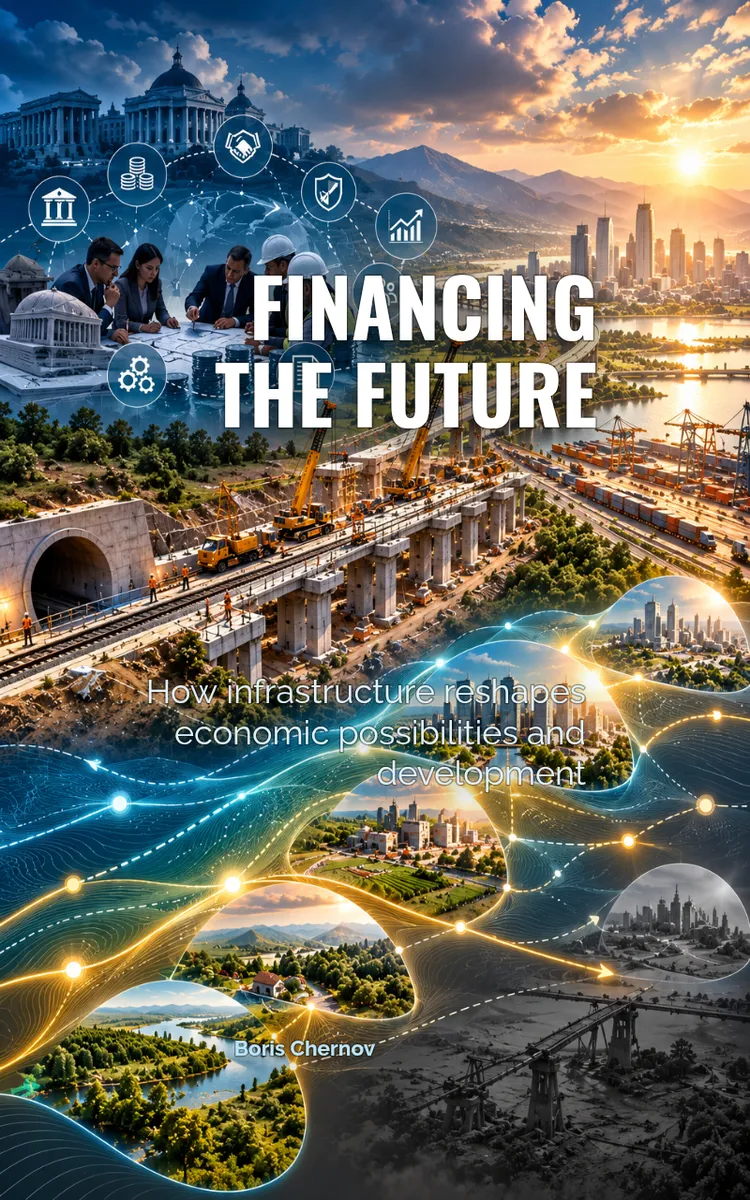
"Financing The Future" is a curiosity book by Boris Chernov with 8 chapters and approximately 14,691 words. How infrastructure finance reshapes economic activity, risk, and future development possibilities.
This book was created using Inkfluence AI, an AI-powered book generation platform that helps authors write, design, and publish complete books.
Frequently Asked Questions
What is "Financing The Future" about?
How infrastructure finance reshapes economic activity, risk, and future development possibilities
How many chapters are in "Financing The Future"?
The book contains 8 chapters and approximately 14,691 words. Topics covered include From Money to a Working Asset, The Costs Beyond Interest, Where Project Risk Goes, When Infrastructure Changes the Map, and more.
Who wrote "Financing The Future"?
This book was written by Boris Chernov and created using Inkfluence AI, an AI book generation platform that helps authors write, design, and publish books.
Write your own curiosity book with AI
Describe your idea and Inkfluence writes the whole thing. Free to start.
Start writingCreated with Inkfluence AI


