

Read the first chapter
The whole of chapter one, free. About 10 min. Turn the pages with the arrows, your keyboard, or a swipe.
Chapter 1
The Boat Key That Doesn’t Fit
The harbor crane swung a pallet of crab pots over Nancy’s head, its cables whining in the gray morning, while the tide slapped against the pilings below. Beyond the breakwater, Resurrection Bay narrowed between dark mountains still patched with snow. Seward looked exactly as it had in her father’s photographs and nothing like the place she had left.
“Don’t stand there,” a man shouted. “Unless you want a pot through the roof.”
Nancy stepped back against the charter office window. The glass was cold through her coat. A pallet descended where she had been, chains clattering, the pots knocking together like iron bones.
She tightened her grip on the folder under her arm. Inside were the probate papers, the death certificate, the transfer from her father’s estate, and the key he had left taped beneath a drawer in his kitchen. The key was brass, long and narrow, with a chipped blue tag marked ALTAIR.
She had come to claim the boat.
Now. Not tomorrow, not after she found a lawyer who understood fishing licenses or a man willing to tell her where the fuel account stood. The next halibut charter season was close enough that every day mattered. She needed to get aboard the Altair, check the engine, find the logbooks, and open the office window before the first clients began calling.
The crane operator lowered the load onto the dock. A man in orange bibs watched her from beside a stack of bait tubs. He was broad through the shoulders, his beard silver at the chin, his cap bearing the name of a vessel Nancy did not recognize.
“You Nancy?” he asked.
“Yes.”
He looked past her toward the harbor. “Thought you’d be older.”
“I’m thirty-four.”
“That’s not what I meant.”
The office door stood three feet away, swollen in its frame. Nancy put the folder beneath her arm and tried the knob. It turned without resistance, but the door opened only an inch before striking something inside.
The man’s mouth twitched.
“Office hasn’t been used much,” he said.
“My father ran charters out of it.”
“Your father ran a lot of things.”
Nancy pushed harder. Something scraped across the floor on the other side. A chair, perhaps. The door stopped.
“What’s your name?”
“Rusk.”
He offered no first name. His gaze moved to the key in her hand.
“That for the Altair?”
“Yes.”
“Boat’s not ready.”
“I’ll decide that after I see it.”
Rusk gave a short laugh. “You’ll need someone to start her.”
“I can start her.”
“Can you?”
The question landed softly, almost politely. That made it worse.
Nancy slid the key into the office lock instead. It went in, but it would not turn. She withdrew it and looked at the chipped blue tag. ALTAIR. Her father’s handwriting, blocky and impatient.
Rusk leaned against the bait tubs. “That key’s for the old padlock.”
“Where’s the lock?”
“Changed it.”
“Who changed it?”
“Your father, probably.”
Her father had been dead eleven days. The phrase your father still arrived in other people’s mouths as if he might come around the corner and settle the matter. Nancy had spent the funeral hearing it from relatives who had not spoken to him in years. Now it came from a stranger who seemed to believe death had left her with less authority than a living man.
She held out the probate papers. “The boat and the business are mine.”
Rusk glanced at the first page without taking it.
“Paper says a lot.”
“Then read it.”
“I don’t need to read it.”
“Why not?”
“Because the harbor knows who runs what.”
A forklift groaned behind them. A gull dropped a strip of bait onto the dock and tore at it, wings spread against the wind. Nancy could feel the folder softening at the corners from the damp.
Rusk nodded toward the row of slips. “Altair’s down at C-float. You can look at her.”
“Good.”
“But you can’t take her out.”
“I didn’t say I was taking her out.”
“You said you wanted to get operational.”
Nancy stared at him. She had said that to the probate attorney, to the bank, to herself in the motel room before dawn. Not to Rusk.
He shrugged. “Small town.”
She walked toward C-float.
The dock shifted under her boots, each plank slick with rain and fish scales. Men moved around her without making room. One dragged a hose across her path and let it snap against her ankle. Another watched her pass, then called to someone behind a windshield.
“That the new owner?”
“Looks temporary.”
Nancy kept walking.
The Altair lay at the end of the float, white hull streaked with rust, her name painted in blue along the stern. She was smaller than Nancy remembered from childhood, though the memory of her had always been enormous: her father’s boots on the deck, the wheel turning beneath his hands, the cabin windows glowing after dark as the boat came back through the bay.
A padlock hung from the gate.
Nancy took out the brass key. It fit the lock but refused to turn.
She tried again, pressing her thumb against the bow. Nothing.
Behind her, a pair of boots stopped on the planks.
“Like I said,” Rusk called. “Old key.”
Nancy turned. “Where’s the new one?”
“Office.”
“Then open the office.”
Rusk came closer, hands in his jacket pockets. “You’ll need to talk to dispatch.”
“I’m talking to you.”
“I don’t handle keys.”
“You just told me the lock was changed.”
“I know who handles them.”
“Who?”
He looked toward the harbor office. Its blinds were pulled down, though a thin bar of yellow showed at the bottom.
“Best not to make a production out of your first morning,” he said.
Nancy felt something inside her settle, not calm but weight. Grief had made her slow since the hospital called. She had moved through the last eleven days as though the world were behind glass: the funeral home, the attorney’s conference room, her father’s empty kitchen with the kettle still on the stove. She had mistaken that slowness for helplessness.
She turned back to the padlock.
“Move,” she said.
Rusk blinked. “What?”
“Move away from the gate.”
He did not. Nancy set down her folder, unzipped her tool bag, and removed the compact bolt cutter she had bought at the hardware store in Anchorage. Her father had taught her to carry tools before he taught her to drive. She positioned the jaws around the lock.
Rusk’s expression hardened. “You damage that, you’ll be paying for it.”
“It belongs to me.”
“The lock does not.”
“Then send me the bill.”
She squeezed. The metal resisted. Her gloves slipped once, and the cold handle bit into her palm. She adjusted her grip and leaned her weight into it. The lock snapped with a sharp report that carried down the float.
A man on a nearby seiner looked over. Another stepped out of a cabin doorway.
Nancy picked up the broken lock and placed it on the dock beside her folder.
Rusk stared at the open gate. “You’re going to need a replacement.”
“I’ll buy one.”
“You’ll need a mechanic, too.”
“I know where to find one.”
“Do you?”
Nancy met his eyes. “No. But I know how to ask.”
She boarded the Altair.
The deck dipped under her weight. Water hissed along the hull. The cabin door was secured with a second lock, newer than the first. Nancy tried the brass key. It failed there, too.
Rusk remained on the float. “That one’s controlled access.”
“Controlled by whom?”
“Dispatch.”
“Who is dispatch?”
He smiled without warmth. “You’re asking the wrong question.”
Nancy looked through the cabin window. The wheelhouse was dark. A clipboard hung beside the helm, its pages turned backward, the last sheet blank. On the dash lay a ring of keys.
Her father’s boat. His keys. Someone else’s lock.
She walked back to the dock and collected her folder. “I’m going to the office.”
Rusk’s voice followed her. “Nancy.”
She stopped.
“Your father had arrangements.”
“My father had a business.”
“Same thing, sometimes.”
“Not anymore.”
The office door opened when she tried it again. The chair had been moved. Inside, the room was narrow and overheated, carrying the stale scents of coffee, diesel, and wet wool. A desk filled most of the space. The walls were crowded with tide tables, framed photographs of charter groups, and a faded map of Resurrection Bay marked with red grease pencil.
The blinds trembled in the wind leaking through the window frame.
A man sat behind the desk with his back to the harbor. He was younger than Rusk, maybe forty, with a clean-shaven face and a gray sweater stretched over his stomach. The key ring from the Altair lay beside his right hand.
Nancy closed the door.
“Are you dispatch?”
“Depends who’s asking.”
“Nancy.”
“I know.”
She set the folder on the desk and opened it to the transfer papers. “I need the boat keys, the charter records, the fuel account information, and the licensing documents.”
The man glanced at the papers as if they were an advertisement.
“Your father kept things informal.”
“He kept enough records to operate.”
“Not all of them.”
“Where are they?”
He lifted the key ring and rolled it between his fingers. “You’ll want to sit down.”
“I’m fine standing.”
“That’s going to make this harder than it needs to be.”
“It already is.”
His eyes moved over her coat, her wet boots, the tool bag at her side. “You came in from Anchorage this morning?”
“Yes.”
“By yourself?”
“Yes.”
He nodded, as though she had confirmed something. “Look, nobody’s trying to take anything from you. But the harbor has systems. Your father understood that.”
“Then give me the system.”
“Dispatch manages the bookings, crew assignments, and operational paperwork. The boat owners handle the boat.”
“I own the business.”
“On paper.”
Nancy placed one hand on the desk. “What’s your name?”
He did not answer.
Outside, a forklift beeped in reverse. The sound came through the walls in steady intervals.
She looked at the key ring. There were six keys, each tagged with a strip of white tape. One read ALT. Another read OFFICE. The third had no tag at all.
“Give me the keys,” she said.
The man leaned back. “You don’t want to rush into decisions while you’re grieving.”
The room seemed to contract around the word.
Nancy saw her father’s kitchen again: his mug beside the sink, the dish towel folded over the oven handle, the silence where his boots should have been. Then she saw the Altair’s locked cabin and the yellow line beneath this office’s blinds.
“I’m not grieving at the moment,” she said. “I’m working.”
His expression changed, only slightly.
He selected the key tagged ALT and held it out. Nancy reached for it. Before she could take it, he withdrew his hand.
“The operational file stays here.”
“Why?”
“Because that’s how it’s always been.”
“Since when?”
“Since your father agreed to it.”
“My father is dead.”
The words struck the room clean. Even the forklift seemed to pause.
The man set the key on the desk. “That doesn’t erase an agreement.”
“Show me the agreement.”
He covered the key with his palm.
Nancy looked at the desk drawers. One was locked. The filing cabinet beside the window had a new brass latch. On the wall, beneath the tide tables, a rectangle of unfaded paint showed where something had been removed.
“Where are the charter records?” she asked.
“Somewhere safe.”
“From me?”
“From confusion.”
She laughed once. It came out flat. “You’ve changed the locks on my boat and hidden the records, but I’m the confusion?”
His jaw tightened. “You don’t know how this place works.”
“No,” Nancy said. “I know how it’s being used.”
For a moment neither of them moved.
Then he pushed the ALT key across the desk.
Nancy took it.
“You can access the boat today,” he said. “But no bookings go out under your name until the paperwork is sorted.”
“Who decided that?”
“Your father’s dispatch arrangement.”
“Show me.”
His hand covered the locked drawer.
Nancy slipped the key into her pocket. “I’ll be back for the rest.”
“With what?”
“The locksmith.”
She gathered the folder and walked to the door.
Behind her, he said, “You’ll make enemies.”
Nancy looked out through the harbor window. The Altair rocked against her lines, the broken padlock still lying on the dock like a small piece of evidence.
“I arrived with some already,” she said.
Outside, Rusk stood beside the gate. His eyes dropped to the key in Nancy’s hand, then rose to her face.
“Got what you came for?” he asked.
Nancy closed her fingers around the metal. “Enough to board.”
“That’s not the same as having a business.”
“No,” she said. “It isn’t.”
She stepped onto the float, the harbor shifting beneath her, and headed back toward the Altair. Behind her, the office blinds lifted a fraction. Someone watched her go, guarding papers that belonged to her and a history she had not yet learned how to read.
End of chapter one. 14 more chapters in the full book.
Swipe or use the arrows to turn the page


What's inside: 15 chapters
- 1. The Boat Key That Doesn’t Fit
- 2. A Charter Contract Signed Under Protest
- 3. The Missing Ledger on the Office Shelf
- 4. When the Crew Won’t Stand Down
- 5. Her Voice in the Wheelhouse
- 6. The Coast Radio Cuts Out
- 7. The Dockside Rumor That Spreads
- 8. A Quota Map With a Hidden Mark
- 9. The Broker Who Won’t Look at Her
- 10. The Crew’s Strike Over Safety Rules
- 11. Quotas Sold While She’s Still Grieving
- 12. The Evidence Bag That Won’t Open
- 13. The Wheelhouse Deposition
- 14. Building a Crew Who Chooses Her
- 15. The Seward Folly Comes Due
About this book
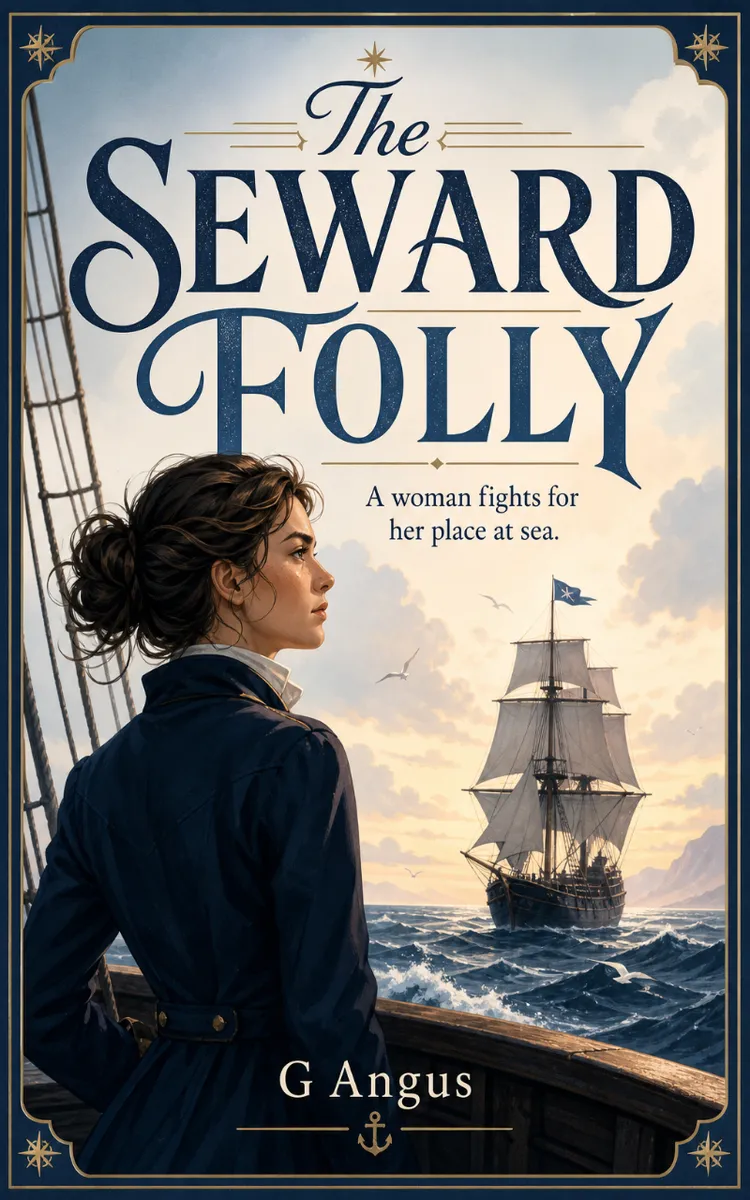
"The Seward Folly" is a fiction book by G Angus with 15 chapters and approximately 32,344 words. A woman inherits a fishing business in Seward, Alaska.
This book was created using Inkfluence AI, an AI-powered book generation platform that helps authors write, design, and publish complete books. It was made with the AI Novel Writer.
Frequently Asked Questions
What is "The Seward Folly" about?
A woman inherits a fishing business in Seward, Alaska
How many chapters are in "The Seward Folly"?
The book contains 15 chapters and approximately 32,344 words. Topics covered include The Boat Key That Doesn’t Fit, A Charter Contract Signed Under Protest, The Missing Ledger on the Office Shelf, When the Crew Won’t Stand Down, and more.
Who wrote "The Seward Folly"?
This book was written by G Angus and created using Inkfluence AI, an AI book generation platform that helps authors write, design, and publish books.
How can I create a similar fiction book?
You can create your own fiction book using Inkfluence AI. Describe your idea, choose your style, and the AI writes the full book for you. It's free to start.
Write your own fiction book with AI
Describe your idea and Inkfluence writes the whole thing. Free to start.
Start writingCreated with Inkfluence AI


