
Read the first chapter
The whole of chapter one, free. About 5 min. Turn the pages with the arrows, your keyboard, or a swipe.
Chapter 1
Cover Page and Workbook Promise
A Respectful Starting Point for This Workbook
Use these pages as a place to slow down, notice relationships, and choose responsible action. The prompts are inspired by themes found in the Thanksgiving Address, including gratitude, connection, respect, and reciprocity. They are not the Thanksgiving Address itself.
The ceremonial Thanksgiving Address belongs to a living cultural context among Kanien’kehá:ka and Haudenosaunee peoples. It carries teachings, language, responsibilities, and protocols that cannot be reproduced by a workbook. This companion offers personal journaling only. It does not replace, reproduce, perform, or reinterpret the ceremonial Address, and it is not a traditional Mohawk ritual text.
Every activity here is labeled either a Daily Wisdom Practice or a Personal Reflection Practice. A Daily Wisdom Practice is a simple, everyday act of noticing or choosing. A Personal Reflection Practice is private journaling that helps you examine your own relationship with the living world. Neither should be treated as ceremony.
Key takeaway: These pages are for respectful personal reflection inspired by the Address, not for recreating the Address.
Keep these three boundaries in view:
1. Name the source carefully. You may write that a prompt is inspired by themes of the Thanksgiving Address. Don’t claim that your journal entry is the Address. 2. Stay with your own life. Write about your choices, relationships, habits, and responsibilities. Don’t speak for Kanien’kehá:ka or Haudenosaunee communities. 3. Turn gratitude toward responsibility. A thankful thought can be a beginning. The work is deciding what respectful action belongs to you.
If a prompt feels too close to ceremonial language, pause. You can skip it, rewrite it in your own plain words, or simply record what you noticed. Respect sometimes looks like leaving something alone.
Your Respectful Use Agreement
Materials needed: This workbook, a pen or pencil, and a quiet space. Time required: 10-15 minutes. Practice type: Personal Reflection Practice. Expected outcome: A completed personal agreement with five clear boundaries for using these pages.
Before moving into later exercises, write a short agreement with yourself. This gives your journaling a steady frame. You’re not signing up to perform anything. You’re deciding how you’ll use the workbook with care.
Your Turn
1. Read the five statements below. 2. For each statement, mark one box: Yes, Not yet, or Needs my own wording. 3. Rewrite any statement that doesn’t sound like you. 4. Finish the five sentence prompts. 5. Read your agreement once aloud or silently. You’re done when all five statements have a mark and all five sentences are complete.
My respectful use checklist
• [ ] I understand that this workbook is not the ceremonial Thanksgiving Address. - [ ] I will call these activities Daily Wisdom Practices or Personal Reflection Practices. - [ ] I will not present my journal entries as traditional Mohawk or Haudenosaunee teachings. - [ ] I will keep my reflections focused on my own relationships and responsibilities. - [ ] I will pause or skip a prompt if using it feels disrespectful or confusing.
My five-part agreement
I’m using this workbook to notice: __________________________________________________
I will speak only from my own experience by: __________________________________________________
A boundary I want to remember is: __________________________________________________
When I’m unsure about a prompt, I will: __________________________________________________
One responsible action I may take after reflecting is: __________________________________________________
> Completed example: > I’m using this workbook to notice how my daily choices affect water, food, and the people around me. > I will speak only from my own experience by using “I” statements. > A boundary I want to remember is that these pages don’t represent the ceremonial Address. > When I’m unsure about a prompt, I will pause and leave it unanswered. > One responsible action I may take after reflecting is to reduce disposable bottles at work.
Now write one sentence that describes the workbook in your own words. Keep it accurate and plain.
This workbook is: __________________________________________________
If your sentence says that the workbook teaches you to perform, repeat, or reproduce the Thanksgiving Address, revise it. A more accurate sentence might be: “This workbook gives me structured personal journaling practices inspired by themes of gratitude, relationship, and responsibility.”
Carrying the Boundary Into Ordinary Days
Respectful use matters beyond the writing desk. Imagine you’re talking with a friend after completing a prompt about water. You might say, “I wrote about how I depend on my local water system and what I can do to care for it.” That keeps the focus on your relationship and your action. You wouldn’t say, “I performed the Thanksgiving Address for water.” The difference is small in wording but important in meaning.
The same care applies at work, at home, and online. If you share a page from your journal, label it as your personal reflection. If you lead a staff conversation, call it a Daily Wisdom Practice rather than a ceremony. For example, a small business owner might invite the team to name one way the business depends on people, water, land, or seasonal conditions. The expected outcome is a list of three to five dependencies and one practical change. It isn’t a ritual.
You can also use the boundary when gratitude becomes too easy. Saying “I’m grateful for water” is a starting point. A Personal Reflection Practice asks a sharper question: What do I do with that awareness? You might check for leaks, avoid wasting water during cleanup, support a local watershed effort, or learn more about the source of your drinking water. The expected outcome is one action you can complete within seven days.
Before sharing or adapting a prompt, use this quick check:
• Is this clearly my own reflection? - Have I avoided claiming authority I don’t have? - Have I named the activity accurately? - Does the reflection lead to a respectful action rather than a performance?
If you answer “no” to any question, adjust the wording or keep the practice private. That isn’t overthinking. It’s good care.
Apply It
Choose one real situation and complete the sentence:
At home, at work, or online, I will describe this workbook as: __________________________________________________
The activity I might use is a Daily Wisdom Practice or Personal Reflection Practice because: __________________________________________________
The specific action I’ll take within seven days is: __________________________________________________
You’re finished when you’ve named one setting, one accurate activity label, and one action with a seven-day deadline.
What I Will Carry Forward
Use the questions below to check whether your expectations are clear. Answer in your own words. Short answers are fine; specific answers are better.
Reflect
1. What is the most important difference between a personal journaling practice and the ceremonial Thanksgiving Address? ________________________________________________ ______________________________________________ ________________________________________________
2. Which boundary from your respectful use agreement will be easiest to follow, and which one may require attention? ________________________________________________ ______________________________________________ ________________________________________________
3. What is one gratitude-based action you can complete within the next seven days without presenting it as ceremony? ________________________________________________ ______________________________________________ ________________________________________________
Keep your agreement nearby as you work through the pages. Let it do something practical: help you choose careful language, stay within your own experience, and turn reflection toward responsibility. That is a strong beginning.
End of chapter one. 24 more chapters in the full book.
Swipe or use the arrows to turn the page
What's inside: 25 chapters
- 1. Cover Page and Workbook Promise
- 2. Welcome Page: Your Intention
- 3. How to Use This Workbook
- 4. Personal Reflection vs Daily Wisdom
- 5. My Circle of Relationships
- 6. What Sustains My Life?
- 7. My Relationship With Water
- 8. Lessons From the Natural World
- 9. My Gratitude Inventory
- 10. Practicing the Good Mind
- 11. From Gratitude to Responsibility
- 12. What Can I Give Back?
- 13. Becoming a Good Ancestor
- 14. What Future Generations Remember
- 15. Days 1-1: People and Relationships
- 16. Days 2-2: Mother Earth
- 17. Days 3-3: Waters and Care
- 18. Days 4-4: Plant and Animal Life
- 19. Days 5-5: Sky and Seasons
- 20. Days 6-6: The Good Mind
- 21. Days 7-7: Reciprocity and Giving Back
- 22. 7-Day Tracker and Completion Checklist
- 23. Reflection Pages: What Changed in Me?
- 24. Personal Reflection Prompts for Ongoing Practice
- 25. Gratitude, Responsibility, and Next Steps
About this book
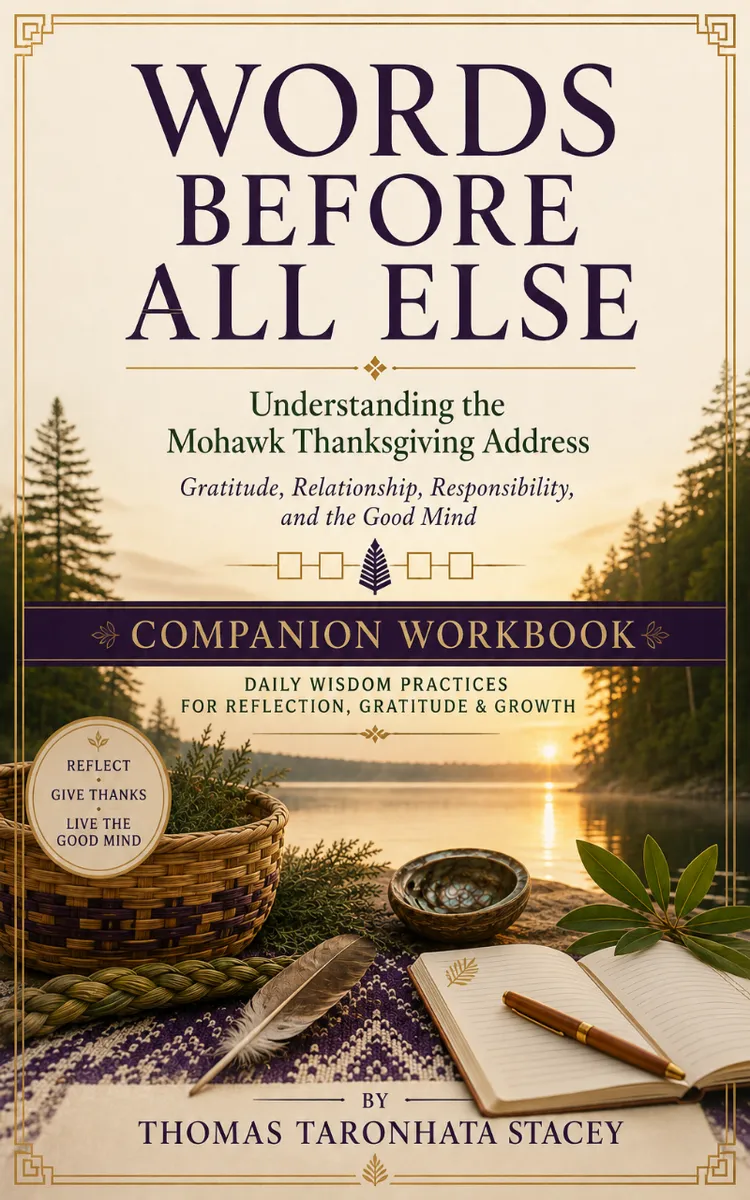
"Words Before All Else Companion Workbook" is a workbook by Anonymous with 25 chapters and approximately 35,265 words. Fillable workbook with reflective exercises and a 7-day practice plan.
This book was created using Inkfluence AI, an AI-powered book generation platform that helps authors write, design, and publish complete books. It was made with the Workbook Generator.
Frequently Asked Questions
What is "Words Before All Else Companion Workbook" about?
Fillable workbook with reflective exercises and a 7-day practice plan
How many chapters are in "Words Before All Else Companion Workbook"?
The book contains 25 chapters and approximately 35,265 words. Topics covered include Cover Page and Workbook Promise, Welcome Page: Your Intention, How to Use This Workbook, Personal Reflection vs Daily Wisdom, and more.
Who wrote "Words Before All Else Companion Workbook"?
This book was written by Anonymous and created using Inkfluence AI, an AI book generation platform that helps authors write, design, and publish books.
How can I create a similar workbook?
You can create your own workbook using Inkfluence AI. Describe your idea, choose your style, and the AI writes the full book for you. It's free to start.
Write your own workbook with AI
Describe your idea and Inkfluence writes the whole thing. Free to start.
Start writingCreated with Inkfluence AI


