

Read the first chapter
The whole of chapter one, free. About 8 min. Turn the pages with the arrows, your keyboard, or a swipe.
Chapter 1
The First Clue Your Brain Skips
The detail that disappears first feels like the last thread of a ribbon slipping from her fingers - an intimate loss that pulls at her in ways she hardly admits. As she follows the faint trail of clues, each vanishing fact becomes a quiet promise of reunion, a soft ache guiding her toward the father she’s been searching for. In the hush between questions, that missing piece turns into a tender beacon, urging her to keep looking until what’s lost comes home.
What is the first thing you fail to notice when a familiar story goes wrong? It is often not the strange event at the center, but the ordinary detail sitting beside it: the unlocked door, the missing receipt, the pause before an answer, the object that should have been there and was not.
Human attention is drawn toward movement, danger, novelty, and explanation. Once the mind has found a pattern that seems to make sense, it quietly removes whatever does not fit. The result is not usually a deliberate lie. It is a cleaner story than reality supplied.
That quiet cleaning process is the subject here. The question is not simply why people miss clues. It is why the most visible clue can become invisible when it appears too familiar, too small, or too inconvenient to the explanation already taking shape.
What if the detail you call “obvious” is the one your mind has edited most carefully?
The Brain Prefers a Finished Story
In 1848, workers building a railway through Vermont watched a tamping iron pass through the head of Phineas Gage, a foreman supervising the project. The accident was extraordinary, but the historical importance of the case rests partly on something less dramatic: how later accounts selected, simplified, and repeated details about Gage’s personality. The story became a neat demonstration of brain injury and character change, even though the surviving evidence is more complicated than the familiar version suggests.
This is a common feature of memorable accounts. A confusing event enters public memory as a sequence with a beginning, a cause, and a result. Details that support the sequence remain visible. Details that interrupt it fade, even when they were present in the original record.
The mind has good reasons for doing this. Attention is limited, and the world delivers more information than any nervous system can examine equally. The brain therefore relies on expectations. A person entering a bakery notices the smell of bread more readily than the location of the fire extinguisher. A mechanic listening to an engine hears a familiar fault before noticing a new vibration that does not belong to the pattern.
This filtering can be useful. Without it, every ordinary object would demand equal attention: the road sign, the color of a passing car, the position of a cloud, the exact rhythm of footsteps. But the same efficiency creates a weakness. Once an explanation becomes available, perception begins to serve the explanation.
The famous invisible gorilla experiment made this weakness unusually clear. Participants watching people pass a basketball were asked to count the passes. A person in a gorilla suit crossed the scene, yet many viewers failed to see it. The important point was not that the gorilla was hidden. It was plainly visible. The counting task changed what counted as relevant, and the obvious became functionally absent.
A clue can disappear without being concealed.
Familiarity Is a Form of Camouflage
The most easily missed detail is often the one that looks ordinary. A burglar forcing a window attracts attention; the window that had been left open earlier may not. A missing tool in a workshop can be overlooked because the bench is crowded with tools that are still present. In a hospital, a patient’s unusual complaint may receive less attention when it is attached to a familiar diagnosis.
This is partly a problem of inattentional blindness, the failure to notice an unexpected object or event when attention is occupied elsewhere. It is also related to change blindness, in which people fail to detect a change between two views of the same scene. In both cases, seeing is not a complete recording of the world. It is an encounter between incoming information and the mind’s current priorities.
Film editors use a related principle. A cut can occur across a small change in position, lighting, or object placement, and viewers may not notice because the story supplies continuity. The mind repairs the gap. It assumes that the scene remains stable unless the change matters to the plot.
Daily life works in much the same way. If a person is expected to be at work, a colleague may register an empty chair but not treat it as evidence. If a familiar machine makes an unfamiliar sound, the first response may be to classify it as “the usual noise.” Expectations turn observations into background.
The Skip-Edit Check names the point at which this happens. Before asking what an event means, it asks which visible fact was passed over because it seemed too ordinary to matter. The check is not a formula or a demand to distrust every impression. It is a way of locating the cut in the mental film - the place where the mind moved from observation to explanation without marking the transition.
History is full of such cuts. During the investigation of the Mary Celeste, found adrift in the Atlantic in 1872, the ship’s missing crew became the central mystery. The vessel itself was seaworthy, its cargo largely intact, and its lifeboat absent. Later retellings emphasized ghosts, pirates, and mutiny. Yet the ship’s ordinary details - water, alcohol cargo, weather, damage to equipment, and the condition of the provisions - were repeatedly reorganized to serve whichever theory was most attractive.
The mystery did not begin with a lack of facts. It began with facts competing for attention.
When Explanation Arrives Too Early
A surprising feature of memory is that remembering is not simply retrieving a stored recording. It is a reconstruction. Each retelling can strengthen the general meaning of an event while weakening peripheral details, especially details that do not fit the version already being told.
This helps explain why eyewitness testimony can feel certain and still be inaccurate. Confidence may grow as a story becomes familiar. The witness remembers not only the original scene but also later questions, newspaper accounts, conversations, and assumptions. Over time, the source of a detail can disappear while the detail itself remains.
The effect is especially strong when a question contains an assumption. Asking, “How fast was the car going when it hit the truck?” encourages the mind to accept that a truck was present and that a collision occurred in the described form. The wording does not merely request information. It frames the scene in advance.
The surprise is this: a question can hide a clue by making an assumption feel like an observation. The listener may answer the question while never examining whether its premise was true. That changes the mystery completely. The missing clue may not be an object in the scene; it may be the unnoticed assumption built into the description of the scene.
This matters because explanations often arrive before attention has finished its work. Once a cause is named - carelessness, theft, bad weather, faulty equipment - later observations are interpreted as support. Contradictory facts become exceptions. Ordinary facts become irrelevant. The story grows more coherent as the evidence grows less visible.
A brief anecdote from aviation illustrates the danger. In 1977, two Boeing 747s collided on the runway at Tenerife in the Canary Islands, killing hundreds of people. The disaster involved weather, radio communication, airport congestion, and decisions made under pressure. Investigations did not reduce the event to one villainous mistake. They examined how assumptions, ambiguous language, authority, and an obstructed view combined. The obvious detail - two aircraft occupying the same runway - was the final fact. The hidden story lay in the ordinary communications and expectations that made that fact possible.
The last visible error is rarely the first unnoticed one.
The Case of the Unseen Door
On the evening of October 22, 1964, a fire broke out in the New York City subway station at Union Square. The event is remembered as a disaster involving smoke, panic, and the difficulty of evacuating an underground space. Yet public emergencies often reveal the same attention problem found in smaller mysteries: people focus on the visible threat and overlook the structure that determines how the threat moves.
A door is a useful example because it is both conspicuous and easy to ignore. In a station, doors are part of the architecture. They do not announce themselves unless they are locked, blocked, or opening. During an emergency, however, the direction of a door, the position of a stairwell, or the location of a service passage can determine whether people move toward safety or into congestion. The object is visible throughout. Its significance appears only after the expected route fails.
The same pattern appears in the investigation of the Station nightclub fire in Rhode Island in 2003. Pyrotechnics ignited foam soundproofing around the stage, and the fire spread rapidly. Investigators and later accounts examined the materials, the crowd, the exits, the building’s use, and the decisions that shaped the event. The central clue was not merely that a fire began. It was that an environment designed for ordinary entertainment contained conditions that made an ordinary escape route inadequate.
An exit can be obvious and still be functionally hidden. People may not recognize it as an exit, may follow the crowd toward the familiar entrance, or may assume that the route used to enter is the safest route to leave. The physical opening is present; the mental map has edited it out.
That is the Skip-Edit Check in its clearest form. It separates what was visible from what was treated as relevant. A door, a pause, an absent object, or an unasked question may have been in plain sight, but the surrounding story assigned it no importance.
The Mind’s Clean Copy
The hidden detail is rarely hidden because people are foolish. It is hidden because perception is economical, memory is reconstructive, and explanations provide order faster than reality does. A clean story is easier to remember than a cluttered one, but the clutter may contain the clue.
The deepest mystery is not that human beings overlook facts. It is that we can overlook them while feeling that we have seen the whole scene. Somewhere between observation and explanation, the mind makes a cut - and leaves no mark to show where it happened.
Perhaps every familiar story contains an unexamined door, waiting at the edge of the frame.
End of chapter one. 4 more chapters in the full book.
Swipe or use the arrows to turn the page

What's inside: 5 chapters
- 1. The First Clue Your Brain Skips
- 2. Why Patterns Feel Like Proof
- 3. The Interview That Finds the Missing
- 4. Red Herrings and the Cost of Certainty
- 5. Unlocking the Real Explanation Loop
About this book
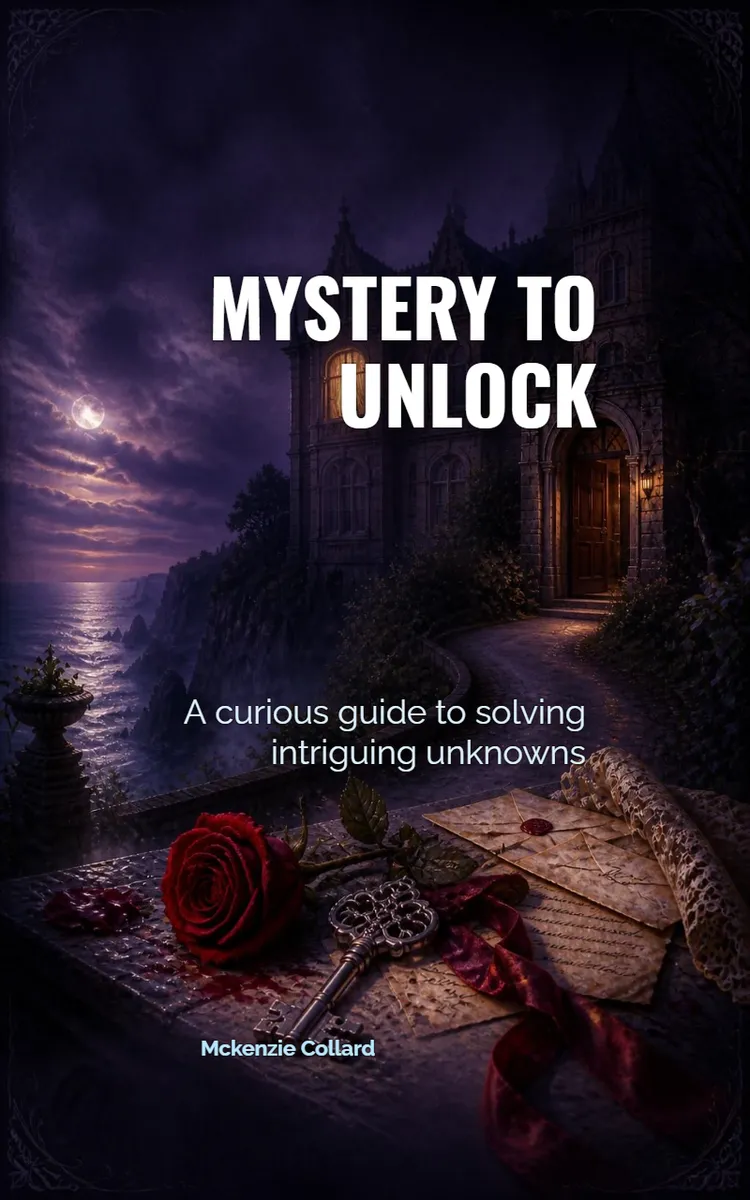
"Mystery To Unlock" is a curiosity book by Mckenzie Collard with 5 chapters and approximately 7,693 words. Exploring mysteries and unlocking hidden explanations.
This book was created using Inkfluence AI, an AI-powered book generation platform that helps authors write, design, and publish complete books.
Frequently Asked Questions
What is "Mystery To Unlock" about?
Exploring mysteries and unlocking hidden explanations
How many chapters are in "Mystery To Unlock"?
The book contains 5 chapters and approximately 7,693 words. Topics covered include The First Clue Your Brain Skips, Why Patterns Feel Like Proof, The Interview That Finds the Missing, Red Herrings and the Cost of Certainty, and more.
Who wrote "Mystery To Unlock"?
This book was written by Mckenzie Collard and created using Inkfluence AI, an AI book generation platform that helps authors write, design, and publish books.
Write your own curiosity book with AI
Describe your idea and Inkfluence writes the whole thing. Free to start.
Start writingCreated with Inkfluence AI


