
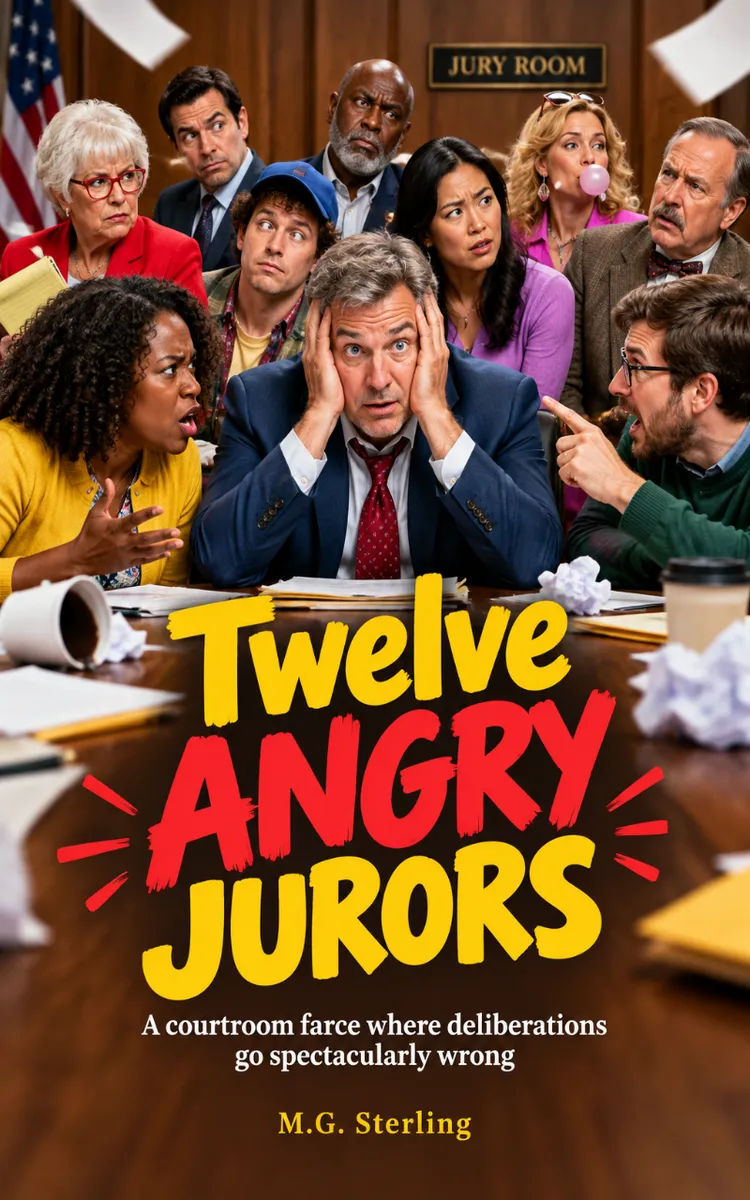

Read the first chapter
The whole of chapter one, free. About 12 min. Turn the pages with the arrows, your keyboard, or a swipe.
Chapter 1
The Jury-Room Door Jam
The bailiff’s key turned halfway, stopped, and made a noise like a spoon dropped into a garbage disposal.
“Deliberation room,” he announced, with the confidence of a man naming a destination he had no intention of visiting.
Mara Bell stood at the front of the twelve-person cluster, clutching her folder against her ribs. The courthouse corridor smelled of floor wax, wet wool, and the cinnamon gum Judge Pritchard had been chewing during the instructions. Behind her, twelve strangers waited beneath a flickering fluorescent tube, each holding the expression of someone who had been promised a chair and received a traffic jam.
“We’re already two minutes late,” Mara said.
“Two minutes is not late,” said Harold Pike, who wore a watch large enough to qualify as courtroom evidence. “Two minutes is a rounding error.”
“It is a rounding error with a locked door,” said Celia Dunn.
The bailiff tried the key again. The lock clicked. The door did not move.
Mara glanced at the narrow corridor. At one end stood a brass drinking fountain with a handwritten sign reading OUT OF ORDER, PLEASE DO NOT LEAN. At the other, a framed photograph of the courthouse from 1912 showed the same hallway, apparently with better ventilation and fewer jurors blocking it.
The bailiff pushed the door.
It shifted inward half an inch and stopped against something.
“Furniture,” he said.
“What kind of furniture?” asked Lionel Graves.
“The obstructive kind.”
Mara looked over her shoulder. “Could everyone give him room?”
The twelve jurors attempted to give him room.
They gave him the exact opposite.
Harold stepped left, directly into Celia. Celia stepped right, directly into Priya Shah, who was balancing three sharpened pencils, a water bottle, and a packet of crackers. The crackers burst open. A pale shower of crumbs scattered across the polished floor and slid toward the door like tiny, determined witnesses.
“Please don’t step on those,” Priya said.
“I’m not stepping on them,” Harold said.
“You are standing on them.”
“I’m standing near them.”
“Your left shoe has a cracker attached.”
Harold lifted his shoe. A triangular saltine clung to the sole.
Mara pressed her fingers to her forehead, then lowered them before anyone could mistake the gesture for a headache. She had wanted one simple thing: get everyone inside, sit in the assigned seats, and begin the first vote before the court reporter finished her coffee. The case itself was complicated enough. The room did not need to become part of it.
“Everyone stay where you are,” Mara said.
“That’s what we’re doing,” said Lionel. “The problem is that where we are is too many places at once.”
The bailiff leaned against the door with his shoulder. The old wood groaned. Somewhere inside the room, a metal object scraped across the floor.
“Something’s wedged behind it,” he said.
“Could it be the table?” asked Nina Alvarez.
“It could be a rhinoceros,” said the bailiff. “We’ll know when it moves.”
He pulled the door toward himself. It opened another inch, then snapped shut with enough force to rattle the framed photograph.
A gust of stale air escaped through the gap. It carried the smell of dust, old coffee, and the faint medicinal odor of the courthouse’s industrial carpet.
Mara peered through the opening. “I can see a table leg.”
“Excellent,” said Harold. “The furniture is identified.”
“Can you reach it?” she asked.
The bailiff extended one arm through the gap. His sleeve caught on the latch plate. He tugged. The door opened just far enough for his elbow to enter, then closed on his jacket.
“Don’t pull,” Mara said.
“I’m not pulling.”
“You are attached to the door.”
“I’m negotiating with the door.”
The jurors shifted again. The corridor seemed to contract around them. A passing clerk stopped at the far end, saw the twelve people packed across the hall, and turned around without asking questions.
Mara set her folder on the windowsill. “We need a system.”
“Systems are how doors become complicated,” said Lionel.
“Everybody has been standing here for four minutes.”
“Five,” Harold corrected.
“Then we have five minutes of evidence that standing here is not working.”
Celia raised her hand, though no one had asked a question. “The door may be swollen.”
“From humidity?” Priya asked.
“From age.”
“Can doors swell from age?”
“This one has had a difficult life,” Celia said.
The bailiff freed his jacket and stepped back. “We can get maintenance.”
“How long?” Mara asked.
“Depends where they are.”
“Where are they?”
“Usually somewhere else.”
Mara looked at the door. The lower hinge sagged. A brass plate near the handle had been polished bright by generations of impatient hands. The door was not locked anymore. It was simply refusing to cooperate, which made it the most experienced participant in the proceeding.
“Could we push together?” she said.
The bailiff nodded. “On three.”
The jurors arranged themselves as best they could. Mara placed both palms against the door. Behind her, Harold placed one hand on her shoulder for balance.
“Not on me,” Mara said.
“I need leverage.”
“Find the wall.”
“I’m already near the wall.”
“You are on my coat.”
“I thought it was the wall.”
“It has buttons.”
The bailiff counted. “One. Two. Three.”
They pushed.
The door moved.
So did the crowd.
Mara’s folder slid off the windowsill and landed open on the floor. Priya’s water bottle rolled beneath Harold’s foot. Harold slipped, grabbed Celia, Celia grabbed Lionel, and Lionel caught the bailiff by the belt.
The door slammed shut.
The water bottle continued rolling, passed through the legs of two jurors, struck the baseboard, and returned with the steady purpose of a courthouse official.
“Everyone all right?” Mara asked.
“My crackers have been crushed,” Priya said.
“My belt has been compromised,” said the bailiff.
Harold examined the sole of his shoe. “The door pushed back.”
“It did not push back,” Celia said. “It resisted.”
“Resistance is a form of pushing.”
Mara retrieved her folder. Her notes had slid into a disorderly fan, mixing witness names with the judge’s instructions and one grocery receipt she did not remember putting there. She gathered them against her knee.
“New plan,” she said. “We need someone inside the room.”
“There is no one inside the room,” said Nina.
“Then someone needs to become inside the room.”
The bailiff looked at the gap. “I could crawl through.”
“You’re the only person with the key,” Mara said.
“I could crawl through with the key.”
“And if the door closes?”
“I’d be inside with the key.”
“And we’d be outside with the door.”
He considered this. “That is a drawback.”
Lionel crouched and inspected the opening. “I’m the narrowest.”
“You are wearing a raincoat over a suit,” said Celia.
“The raincoat compresses.”
“It does not,” said Priya. “It makes you shaped like a suitcase.”
Mara spotted the folding chair propped against the wall. “We can use that to hold the door open.”
The chair was old, wooden, and painted the same institutional beige as the corridor. The bailiff wedged it beneath the handle while Mara held the door open. For one bright second, the room appeared accessible.
“Go,” she said.
No one moved.
“Why is no one moving?”
“Because the opening is six inches,” said Nina.
“Someone can widen it.”
“How?”
Mara looked at the chair. “Remove the obstruction.”
The bailiff pushed again. The chair legs squealed. The door widened to eight inches. A table leg appeared, followed by the edge of a rolling office chair.
“Pull the chair out,” Mara said.
The bailiff reached in and grabbed the chair’s back.
At that exact moment, Harold decided to help by pushing from the other side of the corridor. His shoulder struck the door. The bailiff pulled. The rolling chair shot forward.
It emerged through the gap with the sudden speed of an animal escaping a trap.
The bailiff let go. The chair rolled down the corridor, bumped the drinking fountain, and spun in a slow circle beneath the photograph of the courthouse. Its five wheels squeaked in five different pitches.
The jurors watched it pass.
“It has a better route than we do,” Lionel said.
Mara seized the chair before it could reach the stairs. She dragged it back, its wheels complaining over the waxed floor.
“Put it against the door,” she said.
“Which side?” asked Priya.
“The room side.”
“There isn’t a room side yet.”
Mara closed her eyes for one second. Behind her eyelids, the twelve jurors became numbered pieces on a board. Harold was too broad for the gap. Lionel had the wrong coat. Celia would argue with the hinges if given time. Priya had crackers everywhere. Nina was carrying a handbag large enough to contain a small legal department.
“Fine,” Mara said. “We make a chain. Bailiff opens the door. Lionel goes first. Celia follows. Then Nina. Keep moving until you reach the table. Once inside, brace the door.”
“Why me first?” Lionel asked.
“Because you volunteered.”
“I said I was narrowest.”
“That sounded like volunteering.”
He sighed and removed his raincoat. It caught on his watch, then on Harold’s elbow, then on the edge of the windowsill. By the time he freed it, the door had drifted shut.
The bailiff wedged it open again.
“Lionel,” Mara said.
He turned sideways and entered.
His left shoulder passed through. His right shoulder did not.
“Keep going,” Mara said.
“I am at maximum width.”
“Turn.”
“I am turned.”
“Turn the other way.”
“I am already facing the room.”
“Face away from the room.”
Lionel rotated. His belt buckle caught the latch. The door began to close around him.
“Do not leave me in this position,” he said.
Celia pushed from behind. Harold pushed Celia. Priya pushed Harold. The entire line leaned forward, and Lionel slid into the room with a squeak of leather and a loud thump.
“I’m in,” he called.
“Brace the door!”
“With what?”
“The chair!”
“The chair is behind you!”
Lionel reached for it, missed, and grabbed the edge of the jury table instead. The table rolled six inches on its casters. A stack of blank verdict forms slid off one corner and fluttered across the floor.
The door opened wider.
“Next!” Mara shouted.
Celia stepped through, then stopped. “There’s a chair in the way.”
“Move it.”
“I’m trying.”
“You’re sitting in it.”
Celia looked down. She had lowered herself onto the rolling chair without noticing. It began to glide backward.
“Celia,” Mara said.
“I have lost contact with the floor.”
The chair rolled through the doorway, carrying Celia backward into the room. She crossed her arms, preserving her dignity while traveling at a modest but undeniable speed. At the table, the chair struck Lionel’s knee. Lionel grabbed the table. The table rolled. Celia rolled. The verdict forms lifted again and scattered like startled pigeons.
Nina entered next, clutching her handbag. Priya followed, one hand on Nina’s shoulder and the other holding her water bottle. Harold tried to step through behind them and became wedged between the door and the wall, his jacket pocket catching on the handle.
Mara remained in the corridor with the bailiff, half the jurors inside, and one shoe belonging to someone she had not yet identified.
“Whose foot is that?” she asked.
“Mine,” called Harold.
“Why is it under the door?”
“I’m trying to improve my position.”
The bailiff pulled the door wider. Mara pushed Harold’s shoulder. Harold emerged with a red mark across his jacket and the expression of a man who had been personally betrayed by architecture.
The last jurors crowded through. Mara entered last, because somebody had to remember where everyone had gone.
Inside, the jury room looked smaller than it had through the gap. Twelve chairs surrounded a scarred wooden table. A pitcher of water stood beside a stack of paper cups. The air was warm and smelled of dust, coffee, and the lemon cleaner used on surfaces no one was allowed to touch.
“Seats,” Mara said.
The jurors looked at the chairs.
There were twelve of them, but three had rolled away from the table, two faced the wall, one was occupied by Celia, and another had become entangled with the bailiff’s trouser leg.
“I’m taking the chair nearest the door,” Harold announced.
“You are standing nearest the door,” said Nina.
“That was the intention.”
Mara began moving chairs. She pulled one from beneath the table, which sent the table rolling toward the window. Lionel caught it. Priya placed her water bottle on the table, where it immediately began rolling toward the opposite edge.
“Someone stop that,” Mara said.
Harold caught it with his shoe.
“Your foot is in the water,” Priya said.
“It is not.”
“It is touching the bottle.”
“That is not the same thing.”
Mara reached for the ballot box, a small wooden container with a brass slot in its lid. It sat beneath the table, partly hidden behind a chair wheel.
“We need the ballot box on the table,” she said.
She bent down and pulled.
The box did not move.
A wheel squeaked.
Mara pulled again.
The chair beneath the table rolled backward, dragging the ballot box with it. The box slid across the floor, passed under Lionel’s chair, and emerged on the far side just as Celia’s chair began drifting toward it.
“Stop the chair,” Mara said.
“Which chair?” asked Celia.
“The one carrying the box.”
“That is not a chair. That is a transportation system.”
The chair rolled faster. The ballot box bumped over a floor seam and spun halfway around. It glided beneath the table, disappeared behind the tablecloth, and reappeared on the other side, now accompanied by a loose pencil and one of Priya’s crackers.
For a moment, no one moved.
The box continued its slow escape.
Mara lunged. Her hand closed around empty air. Lionel reached under the table and struck his knuckles against the underside. Harold tried to block the chair with his foot, but his shoe met a caster and sent the chair veering left.
The ballot box rolled beneath the table again.
Celia, still seated, drifted after it.
“Somebody catch me,” she said.
Nina grabbed the back of Celia’s chair. The chair stopped. The ballot box did not. It slipped free, rolled between Harold’s ankles, and came to rest against the closed door.
The room fell quiet except for the faint hum of the fluorescent light and the soft tick of Harold’s oversized watch.
Mara straightened, breathing through her nose. The twelve jurors sat, stood, leaned, or remained attached to furniture in positions no seating chart could explain.
The bailiff looked at the box by the door.
“Good news,” he said. “The door is open.”
Mara turned.
The old door had finally swung wide, revealing the corridor, the drinking fountain, and the framed photograph of the courthouse in 1912. The chair that had jammed it stood harmlessly against the wall.
Mara looked back at the ballot box, now safely beneath the jury table and entirely out of reach.
“We’re in,” she said.
Harold checked his watch. “Twenty-three minutes late.”
“Then we should begin.”
“With what?” Lionel asked.
Mara surveyed the room. The chairs pointed in six directions. The verdict forms lay underfoot. Priya’s crackers had reached the far corner. Celia was still holding Nina’s handbag for reasons no one understood.
Mara pulled a chair into place and sat down.
“First,” she said, “we retrieve the ballot box.”
Under the table, the box rolled one inch farther away.
End of chapter one. 5 more chapters and about 13,743 words in the full book.
Swipe or use the arrows to turn the page


What's inside: 6 chapters
- 1. The Jury-Room Door Jam
- 2. Mara’s Unanimous Vote
- 3. The Vanishing Exhibit Label
- 4. The Evidence Cart Escape
- 5. The Courthouse Lobby Ballot
- 6. The Ballot Box Encore
About this book
"Twelve Angry Jurors" is a comedy book by M.G. Sterling with 6 chapters and approximately 13,743 words. A comic courtroom story about jurors and chaotic deliberations.
This book was created using Inkfluence AI, an AI-powered book generation platform that helps authors write, design, and publish complete books. It was made with the AI Novel Writer.
Frequently Asked Questions
What is "Twelve Angry Jurors" about?
A comic courtroom story about jurors and chaotic deliberations
How many chapters are in "Twelve Angry Jurors"?
The book contains 6 chapters and approximately 13,743 words. Topics covered include The Jury-Room Door Jam, Mara’s Unanimous Vote, The Vanishing Exhibit Label, The Evidence Cart Escape, and more.
Who wrote "Twelve Angry Jurors"?
This book was written by M.G. Sterling and created using Inkfluence AI, an AI book generation platform that helps authors write, design, and publish books.
How can I create a similar general book?
You can create your own general book using Inkfluence AI. Describe your idea, choose your style, and the AI writes the full book for you. It's free to start.
Write your own comedy book with AI
Describe your idea and Inkfluence writes the whole thing. Free to start.
Start writingCreated with Inkfluence AI


