
Read the first chapter
The whole of chapter one, free. About 9 min. Turn the pages with the arrows, your keyboard, or a swipe.
Chapter 1
The Door Under the Library Steps
At dusk, the third brass star in Old Marrowgate Public Library’s front step began to sing.
Mara Ellison stopped with one boot on the pavement and one on the lowest slab. The sound was no louder than a fingernail dragged around a glass rim, but it threaded through the traffic hiss and the pigeons’ indignant cooing with impossible precision.
She glanced up at the library.
Its windows reflected the bruised purple sky. The front doors had been chained shut for the evening, though a rectangle of lamplight still shone through the lobby. Somewhere inside, the old pipes clanged. The building looked as it always did: broad, soot-streaked, and faintly disappointed in everyone who entered it.
Mara crouched and pressed two fingers to the brass star.
The singing stopped.
“Well,” she whispered. “That’s either a clue or the library has finally developed opinions.”
“Mrs. Vale says it’s a door.”
Mara turned.
Jon Bell stood beside the newspaper box, his bicycle helmet dangling from one hand. He had the damp, rumpled look of someone who had been chased through several hedges, which was not unusual for Jon. His other hand held a paper bag from the bakery.
“Mrs. Vale says everything is a door,” Mara said.
“She said this one opens.”
“Mrs. Vale also told me the fountain in Bellweather Square was a sleeping giant.”
“It is a sleeping giant.”
“It’s a cracked stone basin with three dead minnows in it.”
Jon lowered his voice. “She found the door when she was shelving atlases. Beneath the front steps. There’s a stairwell going down.”
Mara looked at the steps again. Twelve slabs of gray limestone, each worn into a shallow dip by a century of shoes. The third brass star gleamed under her fingers.
“What’s behind it?”
Jon shrugged, though his eyes had sharpened. “That’s the part she didn’t say.”
“Then why tell me?”
“Because you’re the only person I know who would go looking.”
He held out the bakery bag. A crescent of sugar had leaked through the paper.
Mara took it. “And you?”
“I’m the person who tells you where to look, then waits somewhere with windows.”
“That’s not friendship.”
“That’s excellent friendship. I’m preserving our future conversations.”
The library’s front lamp flickered. Once. Twice.
Mara slipped the pastry into her coat pocket and knelt again. The brass star was not a star at all, she saw now. Its points were tiny screws, worn nearly smooth. Between two of them ran a hairline seam.
She drew the little brass key from the chain around her neck.
It was the only thing she had brought from the locked drawer in her grandmother’s house, apart from a headache and three unanswered questions. The key was no longer than her thumb, with a loop shaped like a rabbit’s ear. Its teeth were strange: uneven, delicate, almost decorative.
Jon watched it appear. “That’s new.”
“It isn’t.”
“It wasn’t around your neck yesterday.”
“You weren’t looking at my neck yesterday.”
“I was looking at your bicycle tire. You had a nail in it.”
“Which you failed to mention.”
“I was distracted by the neck.”
Mara fitted the key into the seam.
Something beneath the stone clicked.
Jon’s smile vanished. “Mara.”
The brass star rotated a quarter turn. The limestone gave a low, reluctant groan.
“Go home,” she said.
“I was already planning to.”
“Then start.”
“Mara - ”
The front door of the library rattled behind them. From inside came a muffled thump, followed by the unmistakable scrape of a chair being dragged across tile.
Mara looked at the dark windows. No figure moved behind them.
The seam widened.
Cold air slid over her knuckles.
Jon took one step backward. “That’s not normal cold.”
“Cold has a normal?”
“Yes. This is basement cold. Basement cold knows things.”
Mara pressed her shoulder against the stone and pushed.
The lowest step lifted with surprising ease, tilting inward like a trapdoor. Dust sifted down. Beneath it lay a narrow opening, black except for a thread of amber light far below.
The library bell over the front doors rang once.
Mara froze.
Jon whispered, “Did you hear that?”
“Yes.”
The bell rang again, though the doors remained chained.
Mara lowered herself into the opening.
Jon caught her sleeve. “You said go home.”
“I changed my mind.”
“You do that at terrible moments.”
“That’s when it’s most useful.”
The stone shifted under her weight. Mara grabbed the edge, boots scraping against brick. The passage below was scarcely wide enough for her shoulders. A metal rung waited beneath her left foot, slick with condensation.
She looked up at Jon.
For one instant, his face was pale in the failing light, his bakery bag crushed against his chest.
“If I’m not back in ten minutes,” she said, “tell Mrs. Vale she was right.”
“About the door?”
“About the giant.”
Then she dropped.
The rung struck her boot. She caught the next one, then the next, descending into the smell of wet stone and old paper. Above her, Jon muttered something that sounded like a prayer but was probably an insult.
The opening narrowed behind her. Mara twisted sideways and slid the last few feet, landing hard on a floor of black tiles.
The trapdoor settled overhead.
Not shut. Not yet.
She stood in a corridor that ran beneath the library steps and continued farther than the building had any right to continue. Brick walls curved inward like the ribs of some buried animal. Thin copper pipes crossed the ceiling, ticking softly as if carrying time instead of water. Along the left wall, little glass windows had been set at ankle height. Behind them, pale gears turned in silence.
Mara touched one pane.
The gear stopped.
Three others began to spin.
“Charming,” she whispered.
Her voice traveled down the corridor and returned altered, stretched thin.
At the far end stood a door painted the same green as the library’s reading-room walls. A brass plate covered its center. No handle showed.
Mara moved toward it.
The tiles were not evenly spaced. Some were square, some narrow, some shaped like blunt wedges. As she crossed them, the copper pipes overhead clicked in sequence.
One. Two. Three.
Then five.
She stopped.
The pipes clicked again, but this time the pattern was different.
Two. One. Four.
Mara looked back at the entrance.
The trapdoor was closed.
She hurried toward it and jumped, reaching for the underside. Her fingertips brushed cold stone. The seam had vanished. She ran her hands across the ceiling, searching for the brass star, the screws, any weakness.
Nothing.
“Mara,” Jon called from above.
His voice came through the stone, faint and warped.
“I’m here.”
“Are you all right?”
“No.”
“What happened?”
“The door decided to become a ceiling.”
There was a pause. “Can you open it?”
“I’m considering several emotionally satisfying options.”
“Try the practical ones first.”
Mara laughed once, breathlessly. She pulled the rabbit-eared key from her neck and held it against the ceiling. No lock. No seam. Only stone sweating cold water onto her wrist.
“Jon, go get someone.”
“Who?”
“Anyone with a crowbar.”
“Mrs. Vale?”
“Not anyone.”
His footsteps retreated across the library steps. Then silence swallowed him.
Mara lowered the key.
The corridor’s far door gave a quiet metallic shudder.
She turned.
A line of light had appeared beneath it.
The door opened inward by an inch.
Mara should have waited. She knew that. Waiting was what sensible people did when a hidden door opened by itself in a corridor beneath a library. Sensible people also did not crawl under front steps at dusk because an old woman had made a remark over a stack of atlases.
The light widened.
Mara went forward.
The green door opened onto a circular room no larger than the library’s reading nook, though the ceiling vanished into darkness above. Shelves curved around the walls, packed with objects rather than books: a porcelain tooth, a compass with two needles, a child’s red mitten, a silver spoon bent into a spiral. Each object rested in a shallow wooden drawer, and each drawer bore a brass number.
At the center stood a waist-high pedestal.
On it lay a key.
Mara stepped inside.
The door swung shut behind her.
A lock turned.
Not one click. Seven.
She ran back and seized the brass plate. It was warm now, almost hot. Scratched into its surface were words so fine she could barely read them.
NOT THE WAY IN.
Mara’s thumb traced the letters.
Below them, a second line emerged as the light shifted.
NOT THE WAY OUT.
The room gave a small, pleased creak.
“Very funny,” she said.
From somewhere above, a mechanism began to wind.
The key on the pedestal trembled. It was larger than hers, made of dark brass, with a circular bow and teeth arranged like the edge of a tiny staircase.
Mara approached it slowly.
A narrow panel opened in the wall. Behind it was a clock face without hands. Instead, five little windows appeared, each holding a painted shape: a crescent, a square, a crescent, a triangle, a square.
The shapes flickered.
A bell chimed once.
The pattern vanished.
New shapes appeared.
Mara stared at them. “You expect me to remember that?”
The clock chimed again.
The room’s shelves began to rotate.
Not quickly. That was worse. Drawers slid past her with soft wooden knocks, numbers blurring into a brass ribbon. The floor shifted beneath her boots, dividing into concentric rings.
Mara grabbed the pedestal.
The key remained still.
A third line of writing surfaced on the brass plate.
WHEN THE HALL TURNS, CHOOSE WHAT DOES NOT BELONG.
The rings under her feet clicked into motion.
The shapes appeared again: crescent, square, crescent, triangle, square.
Mara looked from the wall to the key. A small slot had opened in its bow, shaped exactly like her rabbit-eared key.
Her hand went to the chain at her throat.
The slot was not a keyhole. It was an invitation.
The floor lurched.
Mara jammed her fingers around the clock’s edge and held on as the room spun half a turn. Drawers opened and shut around her. Something inside one of them whispered her name.
She did not look.
The pattern flashed again.
Crescent. Square. Crescent. Triangle. Square.
The odd shape was the triangle. It did not belong.
Mara slapped the triangle window.
The mechanism stopped.
Every drawer slammed shut.
The dark brass key rose from the pedestal, suspended on a thin thread of light. For one bright second, the room seemed to brighten around it.
Then the key dropped.
Mara caught it.
The weight nearly pulled her arm from its socket. It was cold enough to burn. Its teeth clicked against one another, rearranging themselves.
Behind her, the door lock began to turn again.
Mara spun and thrust the key toward the brass plate.
There was no keyhole.
Only the warning.
NOT THE WAY IN.
NOT THE WAY OUT.
A tiny sound came from the center of the plate.
Mara leaned closer.
A keyhole appeared, but it was the wrong shape. Not round, not square, not even the delicate rabbit-ear shape of the key in her hand. It resembled a narrow black eye, tilted sideways.
She tried her own key.
It entered halfway and stopped.
The dark brass key did not enter at all.
The lock turned once more.
The door sealed with a heavy, final clunk.
Mara stood in the circular room, one key in each hand, while the shelves began their slow, patient rotation around her.
On the brass plate, beneath the warning, a final sentence brightened.
THE FIRST DOOR NEVER OPENS TWICE.
End of chapter one. 14 more chapters and about 29,018 words in the full book.
Swipe or use the arrows to turn the page


What's inside: 15 chapters
- 1. The Door Under the Library Steps
- 2. The Clockwork Key That Won’t Turn
- 3. Decoding the Brass Warning’s Cipher
- 4. Larkspur Station’s Platform That Moves
- 5. Eldon Voss in the Ticket Clerk’s Ledger
- 6. The Ink Flood That Erases Names
- 7. Finding the Hidden Rabbit Signpost
- 8. Cinderwood’s Map That Changes Every Breath
- 9. The Greenhouse Door Demands a Memory
- 10. The Train of Ashes Leaves Without Her
- 11. Mara’s Reflection Refuses to Match
- 12. The Clue-Cards Point to a Wrong Door
- 13. Eldon Voss Appears From Tomorrow
- 14. The Rabbit Hole Loses Its Grip
- 15. A New Keyhole Opens for Someone Else
About this book
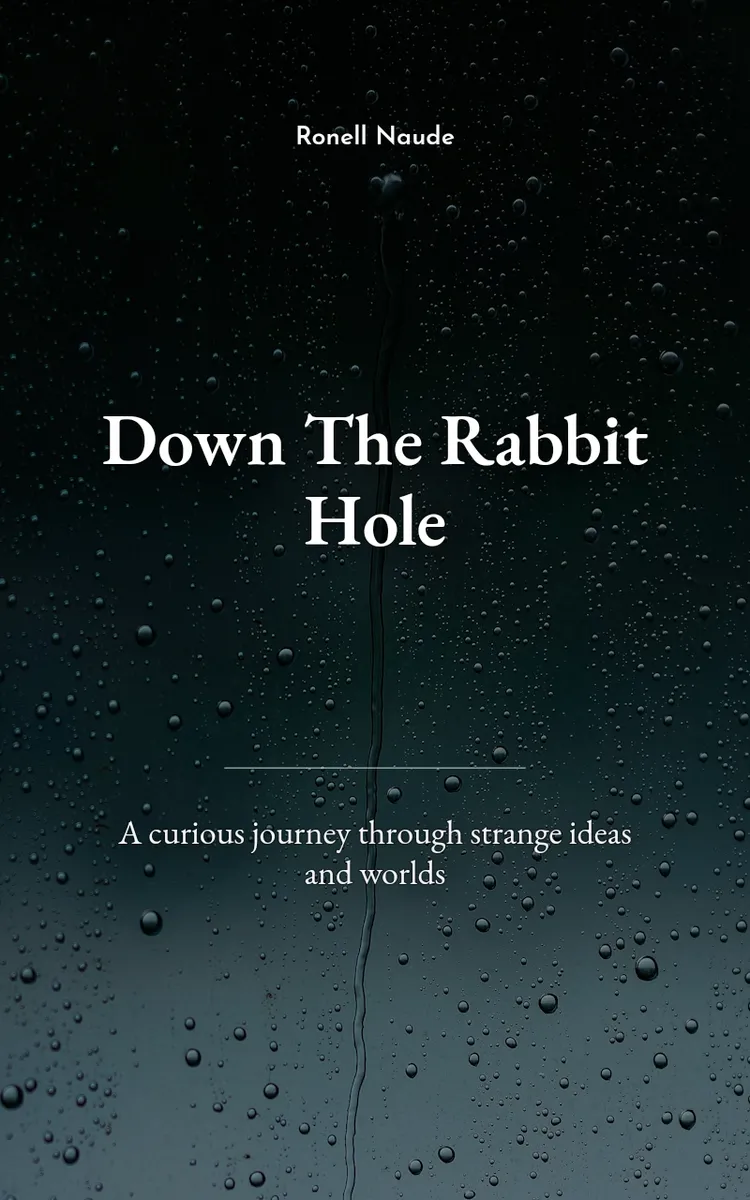
"Down The Rabbit Hole" is a fiction book by Ronell Naude with 15 chapters and approximately 29,018 words. Curiosity-driven exploration of surprising concepts and hidden connections.
This book was created using Inkfluence AI, an AI-powered book generation platform that helps authors write, design, and publish complete books. It was made with the AI Novel Writer.
Frequently Asked Questions
What is "Down The Rabbit Hole" about?
Curiosity-driven exploration of surprising concepts and hidden connections
How many chapters are in "Down The Rabbit Hole"?
The book contains 15 chapters and approximately 29,018 words. Topics covered include The Door Under the Library Steps, The Clockwork Key That Won’t Turn, Decoding the Brass Warning’s Cipher, Larkspur Station’s Platform That Moves, and more.
Who wrote "Down The Rabbit Hole"?
This book was written by Ronell Naude and created using Inkfluence AI, an AI book generation platform that helps authors write, design, and publish books.
How can I create a similar fiction book?
You can create your own fiction book using Inkfluence AI. Describe your idea, choose your style, and the AI writes the full book for you. It's free to start.
Write your own fiction book with AI
Describe your idea and Inkfluence writes the whole thing. Free to start.
Start writingCreated with Inkfluence AI


