

Read the first chapter
The whole of chapter one, free. About 14 min. Turn the pages with the arrows, your keyboard, or a swipe.
Chapter 1
The Debt Stamp That Chases Mira
Mira’s coins clicked like dead insects in her palm as the time-market alleys of Lumenport swallowed her - narrow lanes of stamped metal and glass where every surface pulsed with the soft blue arithmetic of posted rates. She kept her shoulders hunched under the awnings because the kiosks watched with more than cameras; the street-stamp stations listened for the signature of a hand that didn’t belong.
A thin rain had slicked the cobbles, turning them into a mirror that refused to reflect her face the way she needed it to. Somewhere behind her, a debt collector’s bell chimed in a rhythm too precise to be random, and the sound made her stomach clench as if her body already knew she was late. She drew a breath through her teeth and tasted ozone from the kiosk wiring. Her throat felt raw from weeks of speaking in borrowed minutes - begging, bargaining, counting down.
She wasn’t begging now. She was stealing.
The kiosk district narrowed into the Stampway, a corridor of time-stamp stations bolted into the walls like a row of teeth. Each one had a slot for a time-stamp - the small, rectangular token that carried a measured allotment of seconds - and a reader that would log the transaction to the city ledger. Mira needed one thing and one thing only: a time-stamp that hadn’t been claimed yet. If she could get it into her pocket before the kiosk finished its sweep, she could buy passage through the vault that sat farther inland, where the brokers said they would take payment in seconds instead of debt.
Her objective was simple enough to keep her hands steady. The trouble was Lumenport didn’t believe in simple. The city ran on time-currency, and it kept receipts.
The kiosk at the end of the alley blinked a status light from amber to green, then back again, as if it couldn’t decide whether it wanted to be helpful. Mira moved when it flipped to green. She stepped into the kiosk’s thin field of illumination and felt the hairs on her arms lift under the static. Her fingers were cold despite the heat radiating from the power conduits, and she hated that the kiosk could feel it too.
“Hey,” a voice called from the shadow behind her.
Mira didn’t turn. Turning meant acknowledging. She let her gaze stay on the slot where the time-stamp rested on a magnetic cradle, its surface etched with microgrooves that shimmered in the light like silver wire. She’d seen one of these before, in a broken kiosk that still printed the old-style stamps - except this one looked newer, cleaner, with a seal that marked it as unredeemed.
“Broke?” the voice asked again, closer now.
Mira finally pivoted enough to see who’d spoken. A man leaned against the alley wall like he belonged there, his coat cut to hide the bulge of his own wrist-credit unit. His eyes flicked to Mira’s hands, then to her empty coin pouch. He smiled like it hurt him.
“I’m working,” Mira said.
He laughed softly. “Everyone’s working. The market doesn’t run on kindness.”
Mira slid her hand toward the kiosk slot. The cradle was warm, which meant the stamp had been accessed recently. That was good. Recent access meant the kiosk would be less suspicious of timing - less likely to flag a second interaction. She’d practiced on dead stations, mimicking the rhythm of a legitimate swipe, counting the delay between light changes the way some people counted prayers.
The man’s shadow shifted across the wet cobbles. “You’re going to lose,” he said. “The ledger doesn’t care how hungry you are.”
Mira’s pulse stuttered. She kept her eyes on the stamp. “Then don’t watch.”
She pressed her fingertips to the reader panel, the way she’d seen the kiosk clerks do it - two taps, pause, then a third. The panel responded with a faint vibration that traveled up her bones. For one clean second, the kiosk didn’t register her as an intruder.
Then the status light flickered amber.
Her stomach tightened so hard it felt like a clamp. Amber meant the kiosk had begun a verification sweep. It wasn’t supposed to, not while the stamp was unclaimed. A sweep would log the attempted interaction, and the log would carry a credit signature - her signature - back to the ledger.
Mira yanked her hand away and the man straightened, as if he’d been waiting for that exact moment. “Told you,” he said, and the calm in his voice made it worse. “The kiosk knows.”
Mira swallowed. “You’re not a clerk,” she said, buying time.
He tilted his head. “Neither are you.”
Behind them, somewhere in the Stampway, a second kiosk chimed - a quick, bright sound like a coin dropped into a metal throat. It echoed down the alley and multiplied, and Mira felt the air go tense, the way it did before a storm hit the glass.
The man’s gaze sharpened. “Debt stamp alert,” he said, and he didn’t sound surprised. He sounded satisfied.
Mira stared at the stamp on its cradle. It hadn’t moved, but the etched grooves had changed. The lines that used to shimmer now looked like they were being rewritten in real time, the microgrooves rearranging into a pattern that made her skin crawl. The kiosk’s reader panel displayed a single line of text in blocky, city-standard font, projected in ghost-blue onto the metal:
DEBT STAMP DETECTED.
Under it, a time readout began to tick.
Not a countdown. A conversion rate.
It was charging the seconds she’d tried to steal as if they were already spent.
Mira’s breath came out thin. “That’s not - ”
“It is,” the man cut in. “You can steal a stamp, sure. But the city stamps back.”
Mira backed toward the alley mouth, boots slipping on the wet cobbles. The kiosk field pressed against her like a hand on her chest. She could feel the ledger’s attention reaching through the wiring, tugging at the threads of her identity. Somewhere farther away, a clerk would see the alert and decide how to handle it. The trouble was, in Lumenport, handling wasn’t always mercy. Handling was often extraction.
She grabbed the stamp anyway.
Her fingers closed around the token and it was heavier than it should’ve been, as if it carried more than seconds. A jolt ran through her wrist when she lifted it from the cradle. The kiosk let out a sound - an ascending tone that reminded her of train brakes.
The alley’s lights dimmed and then flared, and the status panel flashed red.
Mira didn’t wait to read what red meant. She shoved the stamp into her jacket pocket where it pressed against her ribs like a living thing. The microgrooves in the token pulsed once, then settled, as if it had accepted her as its new owner.
Or as its new debtor.
The man shoved off the wall and stepped into her path. “You can’t leave with that,” he said. “Not without paying.”
“I didn’t - ” Mira started, then cut herself off. The kiosk had already written her attempt into the ledger. Denial was useless. She needed motion.
She tried to dart past him. He moved with practiced efficiency, catching her by the sleeve with two fingers. His grip was light but absolute, like a seal. Mira twisted, yanking her arm free, and the fabric tore with a wet rip. A sharp pain flared in her shoulder, but she refused to let it slow her.
“What did you do?” she demanded, voice rasping.
He didn’t answer directly. His eyes flicked to the stamp bulging her pocket. “You triggered an alarm credit,” he said. “That means your stolen seconds got assigned to a tracking ledger. Retroactive. Weaponized. The city will hunt the time it believes you owe.”
Mira felt her thoughts snag on the word retroactive. “So it counts from when I touched it?”
“From when the kiosk started verifying,” he said. “From the moment it decided you were a thief.”
Mira’s tongue went dry. The ledger wouldn’t just log the theft. It would decide what she owed and then set the repayment window based on how long it took to retrieve the missing time. In Lumenport, time-currency didn’t wait for excuses. It waited for capture.
A sound like distant machinery rolled through the alley - soft at first, then louder. Mira turned her head and saw the Stampway’s wall panels waking. Thin strips of light crawled along the edges of the kiosks like circuitry finding its route. A grid of drones - small, flat things with lens-eyes - lifted from recessed slots along the corridor. They didn’t buzz. They hissed, barely audible, like steam escaping.
The man stepped aside, letting her pass now that the hunt had started. “Run,” he said, and the word came out almost kind.
Mira didn’t know whether to trust him. She kept running anyway, because trust was a luxury measured in seconds she didn’t have.
She sprinted toward the alley mouth, the wet cobbles slick under her shoes, the air cooling as she left the kiosk field’s warmth behind. The stamp in her pocket seemed to throb with each footfall. She could almost feel the ledger’s mathematics building a distance between her and safety.
Behind her, the first drone’s lens clicked. It was close enough that the sound felt like it landed on her spine.
Mira ducked into a side corridor where the walls were scarred with old stamp marks. She pressed her palm against the brick to steady herself and flinched at the cold. The wall was covered in scratched symbols - time codes left by people who’d tried to hide in plain sight. She’d seen them in the under-market, where the desperate traded rumors like currency.
A drone slid into view at the corridor entrance, lens swiveling. Mira pulled her hand back and wiped it on her jacket. The scratches on the wall shifted under her touch, not visibly - something in the material responded. Her skin prickled as if the brick recognized her signature.
A second drone entered, then a third, their lenses turning in sequence like a lock searching for a key. Mira’s stomach sank. The city didn’t just track time; it tracked patterns. If she touched the wrong material, she might feed it more of herself.
She shoved the thought away and ran deeper, into a service passage that smelled of hot metal and old rainwater. The corridor narrowed until she had to twist sideways to fit. Her shoulder pulsed with pain as the torn sleeve flapped against her skin.
Her breath sounded loud in the enclosed space. The drones’ hiss followed, then cut, as if they’d recalculated her path. The silence that followed was worse than the noise. It meant they were waiting for the next move.
Mira reached into her pocket and pulled out the stamp just enough to see its face. The microgrooves had changed again, forming a thin line of text along the token’s edge. She could read it in the same ghost-blue projection the kiosks used, a shimmer that only appeared when she held it under the right angle of light.
ASSIGNED TO: MIRA HALDEN.
Her name, written like a verdict.
Then another line:
REPAYMENT WINDOW: 00:08:47.
The numbers kept ticking, each second a hard bead dropping through a mechanism she couldn’t stop. Mira’s vision tunneled. Eight minutes. Less than the time it took to reach the vault brokers. Less than the time it took to run back out and fight her way through the drones.
She shoved the stamp back into her pocket as the corridor lights flickered, responding to the token’s new status. The ledger wasn’t just tracking her. It was timing her.
A soft click echoed ahead. Not a drone lens. A kiosk door latch.
Mira stumbled forward and found herself at a dead-end where a small time-stamp kiosk had been bolted into the wall, hidden behind a maintenance panel. The panel was unlocked. The slot was empty except for a faint impression on the cradle where a stamp had rested.
It was bait. Or an escape.
She could hear the drones now - closer, careful. Their hiss threaded through the narrow space like a warning. Mira pressed her fingers to the maintenance panel and pulled it open wider, exposing the kiosk’s underside. A thin cable ran from it into the wall, disappearing into the city’s network.
If she used this kiosk, she’d be handing the ledger more data. But if she didn’t, she’d be caught before the repayment window ended, and the city would do what debt always did: take what it was owed.
The stamp in her pocket felt like a weight with teeth.
Mira made a choice without letting herself think too long. She slid the token into the hidden kiosk’s slot.
The moment it clicked into place, the kiosk’s light flared a sharp white. The drones’ hiss stopped mid-breath. In the sudden quiet, Mira heard her own heartbeat and the faint whine of the city network shifting around her.
A line of text spun into view:
TRANSFER ACCEPTED.
Then, beneath it, the cost.
MEMORY DEBIT REQUIRED.
Mira froze so hard her lungs hurt. “No,” she whispered, not because she didn’t believe in rules, but because she’d heard rumors about memory debits and dismissed them as under-market exaggerations. Time theft could be retroactively weaponized, sure. But the city didn’t just take seconds. It took what seconds were made from.
The hidden kiosk’s reader panel warmed under her palm, urging the next prompt. The drones woke again, their hiss returning, but they hesitated at the corridor entrance as if the kiosk’s field had claimed the space.
Mira yanked her hand away, but the system had already started. The world tilted slightly, not physically - mentally. A pressure moved behind her eyes like a tide reaching for a lock.
She saw a flash of her mother’s hands, flour-dusted and steady, guiding Mira’s fingers over a clock face when Mira was small enough to think time could be tamed. The image sharpened, then began to blur at the edges as if something was pulling it out strand by strand.
Mira clamped her teeth down on a sound. Pain wasn’t the worst part. The worst part was the moment she realized she couldn’t tell whether she was remembering or being overwritten.
Behind her, the drones’ lens light flared. They were closing in on the corridor now that the kiosk had marked the area as an active transfer zone.
Mira grabbed the stamp again and tore it free from the hidden cradle before the memory debit could finish its pull. The kiosk screamed - an ugly electronic shriek that made her ears ring - and the maintenance panel shook on its bolts.
Her vision swam. The memory of her mother’s hands flickered, incomplete, like a recorded clip being corrupted.
The repayment window on the stamp edge was still ticking, but now the numbers had changed, jerking into a new format.
REPAYMENT WINDOW UPDATED: 00:03:12.
Shorter.
Not just shorter - different.
Mira’s fingers trembled around the token. The ledger had found a loophole in her panic, and it had recalculated the debt the way a predator recalculates distance. She’d bought herself a few seconds of running time by triggering an aborted memory debit, but the city had decided she still owed.
She shoved the stamp back into her pocket and slammed the maintenance panel shut behind her. The kiosk’s scream faded into a malfunctioning stutter, then cut off as if the system had decided not to spend more power on an uncooperative debtor.
The drones rushed forward anyway, their lens lights cutting through the corridor’s dimness. Mira ran.
She hit the corridor mouth hard, shoulder first, and burst back into the Stampway’s wet daylight. The alley was brighter than it had been, the kiosk station lights now all glowing in a synchronized pattern. People in the market stared without meaning to, faces lit by the same ghost-blue text projected in public space.
A citywide notice scrolled across the kiosk fronts, visible to anyone who could afford to look.
DEBT STAMP PURSUIT ACTIVE.
ASSIGNED DEBTOR: MIRA HALDEN.
The words felt like fingertips on her throat. Mira sprinted toward the vault direction anyway, because there was no other motion left in her. The repayment window was nearly three minutes. The drones would not give up. Neither would the ledger.
Behind her, the man from the first alley called out, voice sharp through the noise of alarms. “You can’t outrun time, Mira!”
She didn’t slow to answer. She didn’t even look back. The only thing she could do was move faster than the city’s math.
Her torn sleeve flapped as she ran, and every step jostled the stamp against her ribs like a heartbeat she didn’t own. Somewhere inside her, the memory of her mother’s flour-dusted hands was thinning, edges fraying.
Mira reached the edge of the time-market alleys where the vault route began - an open corridor lined with access gates and broker terminals. A line of people clustered there, all holding their own tokens like shields, all staring at the same public ledger notice.
At the far end, the first vault gate displayed a status light: scanning.
Mira pressed her palm against the gate’s reader, feeling the cold metal drink her signature. The gate’s light turned amber, then green.
She had seconds. She had movement. She had the stolen stamp.
She didn’t have certainty.
The gate chimed once, clean and official, and a new line appeared in ghost-blue above the slot, smaller than the city notice but heavier than any threat:
REPAYMENT WINDOW LOCKED.
Lethal time debit will activate if debtor fails to complete redemption.
Mira’s mouth went dry. The city had given her entry, yes - but it had also tightened the noose, assigning her a repayment window that would turn into something worse the moment she couldn’t pay in time.
She stepped through the vault gate anyway, because she’d already stolen the first seconds.
Now Lumenport was charging her for the rest.
End of chapter one. 40 more chapters and about 109,025 words in the full book.
Swipe or use the arrows to turn the page


What's inside: 41 chapters
- 1. The Debt Stamp That Chases Mira
- 2. Buying a Breath in the Black Vault
- 3. The Ledger’s Wrong Name
- 4. A Time-Lock That Won’t Let Go
- 5. Mira’s Contract With the Clockwright
- 6. The First Heist That Turns on Her
- 7. Who Stole Mira’s Last Memory?
- 8. Escaping Through the Tram of Seconds
- 9. The Token That Erases Riven Sable
- 10. A Condemned Man’s Final Shortcut
- 11. Following the Buyer Through Dead Air
- 12. The House Where Clocks Lie
- 13. Riven Sable’s Confession of Theft
- 14. The Interest Rate That Eats Cities
- 15. A Map Drawn in Vanishing Seconds
- 16. Rooftop Run Through Collector Fire
- 17. The Choice to Spend Someone Else
- 18. Inside the Collector’s Counting Room
- 19. A Door Made of Borrowed Years
- 20. The Buyer’s Time Reversal Offer
- 21. Riven Sable Betrays the Demonstration
- 22. The Vault Locks on a Countdown
- 23. Chasing the Reversal Mark Through Echoes
- 24. A Childhood District Flooded With Seconds
- 25. Mira Halden’s False Identity Trial
- 26. The Audit That Counts Her Heartbeats
- 27. Keyframe Core in Her Bloodstream
- 28. Running the Subbank Corridors of Interest
- 29. The Engine That Trades Futures
- 30. Mira’s Last Choice Time
- 31. The Hidden Clause in Riven’s Mark
- 32. Reaching Riven Before the Mark Ends
- 33. Riven’s One-Second Bargain
- 34. Portal to the Vault’s First Sale
- 35. Stealing Back the First Seconds
- 36. Riven’s Choice to Live Free
- 37. The City That Forgets Debts
- 38. A New Currency Made of Promises
- 39. The Buyer’s Last Signal Survives
- 40. Paying Forward With Time You Keep
- 41. Final Toll of Seconds
About this book
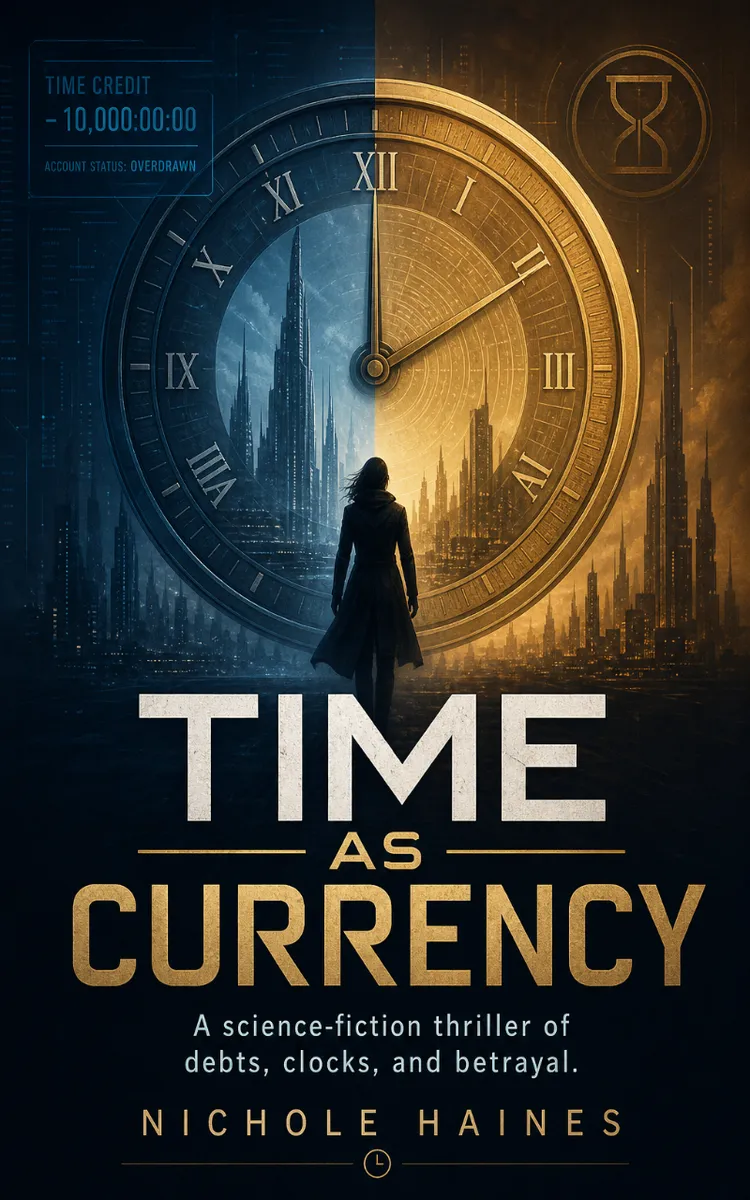
"Time As Currency" is a fiction book by Nichole Haines with 41 chapters and approximately 109,025 words. A science fiction story where time functions as currency.
This book was created using Inkfluence AI, an AI-powered book generation platform that helps authors write, design, and publish complete books. It was made with the AI Novel Writer.
Frequently Asked Questions
What is "Time As Currency" about?
A science fiction story where time functions as currency
How many chapters are in "Time As Currency"?
The book contains 41 chapters and approximately 109,025 words. Topics covered include The Debt Stamp That Chases Mira, Buying a Breath in the Black Vault, The Ledger’s Wrong Name, A Time-Lock That Won’t Let Go, and more.
Who wrote "Time As Currency"?
This book was written by Nichole Haines and created using Inkfluence AI, an AI book generation platform that helps authors write, design, and publish books.
How can I create a similar fiction book?
You can create your own fiction book using Inkfluence AI. Describe your idea, choose your style, and the AI writes the full book for you. It's free to start.
Write your own fiction book with AI
Describe your idea and Inkfluence writes the whole thing. Free to start.
Start writingCreated with Inkfluence AI


