
Read the first chapter
The whole of chapter one, free. About 6 min. Turn the pages with the arrows, your keyboard, or a swipe.
Chapter 1
Reclaiming Your Agency
When the Day Seems to Belong to Everyone Else
Last Tuesday, the service van was in the driveway before sunrise. You had a job booked across town, a supplier waiting on an overdue payment, and a text from your brother asking whether you could help with Mum’s appointment. Then the phone rang. A customer moved the job. The bank flagged a charge. Your teenager needed a ride. By eight-thirty, you were standing in the kitchen, coffee gone cold, thinking, What’s the point? I can’t control anything.
That thought doesn’t arrive because you’re weak. It arrives because life has handed you enough genuine problems to make helplessness sound practical. You can’t control the economy, your aging parents, other people’s moods, or whether a customer keeps their promise. But somewhere inside that pile of facts, your choices are still waiting. They’re quieter than the chaos, but they’re there.
The question isn’t whether life is difficult; it’s whether difficulty gets to make every decision for you.
The Shift From “Nothing I Can Do” to “What’s Mine to Do?”
Old Belief: If I can’t control the whole situation, my choices won’t make much difference.
New Reality: I don’t need control over everything to take ownership of what’s within my reach.
This distinction matters because helplessness often disguises itself as realism. You look at rising costs, unreliable people, family demands, or a workplace that keeps changing the rules. All of that may be true. The trap is treating those truths as proof that your next move doesn’t matter.
Take money. You may not control the mortgage rate or the price of groceries. You can still open the bank app, cancel one unused subscription, call the insurer, or decide not to put another purchase on credit tonight. None of those actions solves the whole problem. They do something more useful: they return you to the part of the situation where your decisions still have weight.
The Agency Compass helps you separate four directions: What I can control, what I can influence, what I must accept, and what I need to stop carrying. It isn’t a way to pretend everything is manageable. It’s a way to stop spending your energy arguing with reality while neglecting the next useful choice.
When a customer cancels at the last minute, you can’t force them to value your time. You can influence the pattern by setting a cancellation policy, confirming appointments, and requiring a deposit. You can control how quickly you respond and whether you let one bad booking ruin the rest of the day. You may have to accept that some people will still complain. You don’t have to carry their disappointment home.
Find the Direction Where Your Choice Still Has Weight
Your brain likes simple explanations under pressure. “They always do this.” “The system is rigged.” “There’s no point trying.” Sometimes those statements contain a piece of truth. But repeated often enough, they become a locked door. The Agency Compass opens a smaller door: What part of this belongs to me?
Ownership isn’t blame. Blame looks backward for someone to punish. Ownership looks forward for the next decision. That difference is important when you’ve made a mistake. Saying, “I should’ve checked the contract before signing,” gives you something to change. Saying, “I’m an idiot; I always mess things up,” gives you shame and no useful instruction.
Signs this pattern is running your life:
1. You spend more time explaining why action won’t work than testing one small action. You’ve already listed every reason the new quote, conversation, or routine will fail before trying it.
2. You wait for someone else to change before making your move. Your partner has to become more organised, your boss has to become fairer, or your adult child has to become responsible before you set a boundary.
3. You confuse resentment with responsibility. You keep doing the job while privately keeping score, then feel angry that nobody notices the sacrifice.
4. You use “I have no choice” for decisions that are merely unpleasant. Staying silent, delaying the call, and continuing the same arrangement may be understandable. They’re still choices.
Agency begins when you stop asking who caused the situation and start asking what your next honest move is.
Questions That Put You Back in the Driver’s Seat
1. Where in your life are you waiting for conditions to become perfect before acting? Name the specific condition. “When work settles down” is vague; “when I have three free hours to sort the paperwork” is clear. Then choose a fifteen-minute version you can do this week.
2. What problem are you calling uncontrollable because the available choice is uncomfortable? Perhaps you can’t control your colleague’s behaviour, but you can document the missed deadlines and raise the issue. Perhaps you can’t control your sibling’s reaction, but you can say what help you can and can’t provide.
3. What are you currently carrying that belongs to another adult? If you’re repeatedly chasing a grown child’s bills, covering a coworker’s missed work, or managing your partner’s appointments, ask what support looks like without taking over. Helping isn’t the same as becoming responsible for the outcome.
4. What would deliberate ownership look like in one ordinary situation this week? Make it concrete. It might mean sending the invoice before leaving the job, putting a boundary in writing, or taking a walk before answering an angry message.
5. If nothing changed for six months, what choice would you wish you had made today? Don’t use the question to frighten yourself. Use it to identify the decision you keep postponing because it may disappoint someone.
Honest answers may feel untidy. You might discover that you have fewer options than you wanted, but more than you admitted. That’s not failure. That’s a usable starting point.
The Seven-Day Agency Compass Challenge
Challenge: Make One Deliberate Move Each Day
For the next seven days, use one real situation each day. Not a theoretical exercise. Choose the invoice, conversation, appointment, repair, bill, or boundary already taking up space in your head.
• Write the situation at the top of a page. - Draw four quick headings: Control, Influence, Accept, Release. - Put the facts under the heading where they belong. - Choose one action from the Control or Influence column. - Complete it within twenty-four hours, even if it takes only ten minutes. - At the end of the day, write one sentence: “My choice changed ___.”
Expected difficulty: Medium
You’ll probably notice your mind arguing with the exercise. It may insist that the action is too small, too late, or unlikely to matter. That’s exactly why the exercise works. Helplessness grows when every action has to solve the entire problem. Agency grows when you prove, repeatedly, that a small decision can alter your position.
You’ll know it’s working when:
• You catch yourself saying “I have no choice” and replace it with a more accurate sentence. - You make one call, request, decision, or boundary without waiting for permission. - You stop replaying someone else’s behaviour long enough to handle your part. - You feel clearer about what you can’t change, rather than merely more frustrated by it. - Your next step becomes visible before the whole path is.
Your Choices Still Count
The world will continue handing you situations you didn’t choose. Some will be unfair. Some will be expensive. Some will arrive wearing the familiar face of family obligation or workplace nonsense. Taking responsibility doesn’t mean pretending otherwise. It means refusing to hand over every remaining choice simply because the first part of the situation wasn’t yours.
• You learned to separate control, influence, acceptance, and release with the Agency Compass. - You saw why ownership is different from blame. - You identified the signs that helplessness may be directing your decisions. - You created a seven-day practice for turning awareness into deliberate action.
You may not control the whole situation, but you are not powerless inside it.
That is the ground we’ll build on next: not grand reinvention, but a closer look at the promises you make to yourself - and whether your daily choices are keeping them.
End of chapter one. 39 more chapters and about 57,928 words in the full book.
Swipe or use the arrows to turn the page


What's inside: 40 chapters
- 1. Reclaiming Your Agency
- 2. Separating Blame from Responsibility
- 3. Updating the Gen X Story
- 4. Choosing Values Over Reflexes
- 5. Making Peace with Imperfection
- 6. Facing the Cost of Avoidance
- 7. Replacing Excuses with Explanations
- 8. Building Self-Trust Through Follow-Through
- 9. Turning Regret into Repair
- 10. Accepting What You Cannot Control
- 11. Designing Habits That Hold
- 12. Keeping Commitments Realistic
- 13. Managing Time Without Self-Deception
- 14. Making Decisions Before Deadlines
- 15. Setting Boundaries Without Guilt
- 16. Listening Before Defending
- 17. Apologizing with Changed Behavior
- 18. Handling Conflict Without Stonewalling
- 19. Asking for Help Early
- 20. Giving Feedback That Builds Trust
- 21. Taking Ownership at Work
- 22. Leading Without the Title
- 23. Repairing Family Patterns
- 24. Showing Up for Aging Parents
- 25. Parenting with Accountable Authority
- 26. Sharing the Invisible Load
- 27. Taking Charge of Your Money
- 28. Protecting Your Health Proactively
- 29. Using Technology Intentionally
- 30. Owning Your Impact on Others
- 31. Responding to Feedback Without Collapse
- 32. Recovering After a Setback
- 33. Staying Accountable Under Stress
- 34. Practicing Courageous Conversations
- 35. Choosing Purpose in Midlife
- 36. Making Change at Any Age
- 37. Building a Circle of Accountability
- 38. Turning Setbacks into Better Systems
- 39. Creating a Personal Accountability Code
- 40. Leaving a Legacy of Ownership
About this book
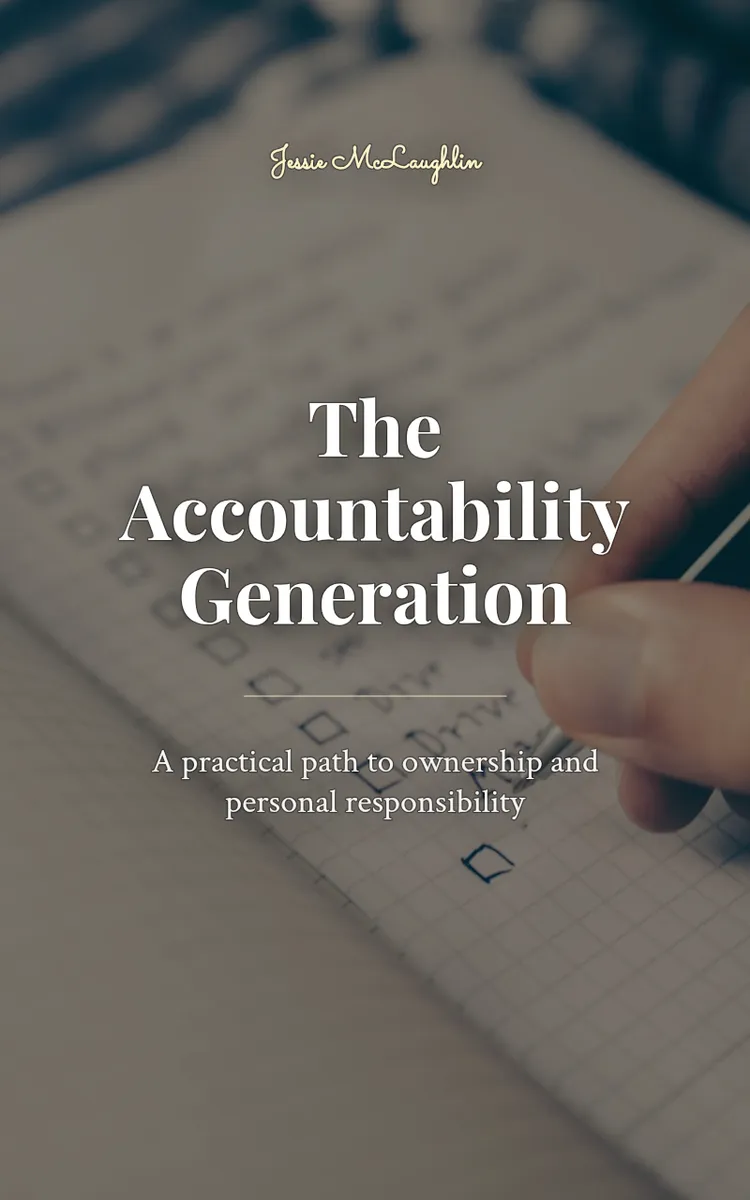
"The Accountability Generation" is a self-help book by Jessie McLaughlin with 40 chapters and approximately 57,928 words. Personal responsibility and accountability among Generation X.
This book was created using Inkfluence AI, an AI-powered book generation platform that helps authors write, design, and publish complete books. It was made with the AI Self-Help Book Writer.
Frequently Asked Questions
What is "The Accountability Generation" about?
Personal responsibility and accountability among Generation X
How many chapters are in "The Accountability Generation"?
The book contains 40 chapters and approximately 57,928 words. Topics covered include Reclaiming Your Agency, Separating Blame from Responsibility, Updating the Gen X Story, Choosing Values Over Reflexes, and more.
Who wrote "The Accountability Generation"?
This book was written by Jessie McLaughlin and created using Inkfluence AI, an AI book generation platform that helps authors write, design, and publish books.
How can I create a similar self-help book?
You can create your own self-help book using Inkfluence AI. Describe your idea, choose your style, and the AI writes the full book for you. It's free to start.
Write your own self-help book with AI
Describe your idea and Inkfluence writes the whole thing. Free to start.
Start writingCreated with Inkfluence AI


