
Read the first chapter
The whole of chapter one, free. About 9 min. Turn the pages with the arrows, your keyboard, or a swipe.
Chapter 1
Who Gets to Define Freedom?
The Question Hidden Inside the Claim
What does it mean to say that an entire racial, ethnic, or religious group “chooses slavery” when the people being described may have had no safe alternative? The question sounds simple until we notice that the word choice can describe a free decision, a decision made under threat, or a decision narrowed by poverty, law, family duty, and fear.
The sweeping claim that Black, Latino, Hispanic, Asian, or Muslim communities would prefer slavery to freedom treats enormous and varied populations as if they shared one mind. It also turns a historical condition into a personality trait. The Consent-and-Coercion Lens offers a more careful way to examine such claims: first ask what pressures were present, then ask what options existed, and only afterward ask whether consent was genuine.
That order matters. A person may sign a contract and still be trapped by hunger. A family may remain in a controlled community because leaving would expose them to violence. A worker may accept an abusive arrangement because the alternative is homelessness. The signature is real; the freedom behind it may not be.
When does a decision remain a choice after the alternatives have been stripped away?
Slavery Was Built on the Destruction of Choice
Slavery is not simply unpleasant work, poverty, or dependence. Its defining feature is the conversion of a person into property or into someone whose movement, labor, family life, and legal identity can be controlled by another. Across history, enslaved people were compelled through violence, law, surveillance, sale, and the threat of punishment. Their labor could be taken, and their relationships could be broken, without their permission.
The Atlantic slave trade shows how badly the language of “preference” fits the historical record. From the sixteenth through the nineteenth centuries, millions of Africans were forcibly transported to the Americas. They did not collectively migrate into plantation labor because of a cultural desire for bondage. They were captured, purchased, confined, transported across an ocean, and sold under systems designed to deny their personhood. The fact that some enslaved people later made choices within that system - choosing work assignments, forming families, preserving religious practices, or negotiating with enslavers - does not turn slavery itself into consent.
A similar confusion appears when historians discuss people who accepted subordinate positions under imperial rule. In colonial South Asia, Southeast Asia, the Caribbean, and Africa, local people sometimes worked within institutions created by foreign powers. They might serve in armies, enter wage labor, or cooperate with administrators. Those actions could reflect calculation, ambition, survival, or opposition to a different local authority. They do not prove that the population as a whole preferred domination. People make decisions inside systems they did not design.
The same distinction applies to modern exploitation. A migrant worker who accepts a job under threat of deportation has made a decision, but the decision may be constrained by immigration law, debt, language barriers, and the needs of relatives at home. Calling that arrangement “free choice” hides the machinery surrounding it.
The Consent-and-Coercion Lens therefore separates three conditions. Coercion involves force or threats that make refusal dangerous. Constrained choice exists when refusal is legally possible but the available alternatives are severely limited. Genuine consent requires meaningful information, the ability to refuse, and a realistic capacity to leave without disproportionate punishment.
These categories overlap in real life. A domestic worker may technically be free to quit while an employer holds her passport. A soldier may volunteer but face prison for leaving after enlistment. A teenager may agree to work for a relative while lacking the power to understand or reject the terms. The vocabulary of choice becomes useful only when it identifies these differences rather than erasing them.
The Trap of Treating Communities as Single Minds
The claim that a racial or religious group “chooses slavery” also depends on a mistaken picture of collective identity. Black Americans are not one political bloc, nor are Latino Americans, Asian Americans, Muslims, or people described by the overlapping and often imprecise label “Hispanic.” These communities contain different national origins, classes, generations, languages, political beliefs, and histories of migration.
Consider Muslim communities. A Muslim refugee from Bosnia, a Somali shopkeeper in Minneapolis, an Indonesian student in London, and a Senegalese farmer may share a religious identity while having sharply different experiences of law, labor, and political power. The same is true of Asian Americans whose families may trace their histories to China, Korea, India, Vietnam, the Philippines, or elsewhere. A single statement about what such people “would always choose” is not an observation about behavior. It is a stereotype presented as a law of human nature.
History repeatedly shows internal disagreement. During the American Civil War, some Black men escaped slavery and joined the Union Army, while others remained near plantations because family members were still enslaved or because escape routes were dangerous. Some free Black people supported emigration schemes; others fought for citizenship in the United States. Their differing choices did not reveal a group preference for bondage. They revealed different risks, resources, and judgments.
In 1942, the United States imprisoned Japanese Americans in camps through an executive order and military enforcement. Families lost homes, businesses, farms, and personal freedom. Some young men from the camps later volunteered for the U.S. Army, including members of the famed 442nd Regimental Combat Team. Their military service cannot reasonably be read as proof that Japanese Americans approved of confinement. It reflected a range of motives: loyalty, resistance to stigma, hope for recognition, pressure from authorities, and the desire to protect family standing. One action can carry several meanings at once.
A striking fact follows: people sometimes cooperate with institutions that are harming them.
That cooperation is not necessarily approval. It may be a way to secure food, protect children, preserve dignity, gain information, or create room for resistance. Enslaved people in the American South used work slowdowns, sabotage, escape, literacy, religious gatherings, and family networks to contest control. Cooperation and resistance were not opposites; they could exist in the same person on the same day.
What the Mind Does Under Pressure
Human decision-making is shaped by the conditions surrounding a choice. Severe threat narrows attention toward immediate survival. Hunger makes a distant promise of freedom less persuasive than food available today. Fear changes how people calculate risk. Social isolation makes dependence on an authority figure feel like the only stable relationship left.
None of this requires a special psychology for any racial, ethnic, or religious group. It is a broadly human response to constrained circumstances. Soldiers in wartime, prisoners, abused partners, indebted workers, and people trapped in trafficking networks may all appear to “stay” when outsiders think leaving is obvious. From a distance, the available alternatives look larger than they feel from inside the situation.
A useful comparison is a contract signed during a flood. The document may contain two signatures, but the surrounding conditions matter. If one party controls the shelter, food, transportation, and information, the agreement cannot be judged as though both parties were bargaining from equal ground. Consent is not a magical quality produced by ink.
Law recognizes parts of this distinction. Modern legal systems often treat agreements obtained through force, fraud, or incapacity as invalid or suspect. Labor law distinguishes ordinary employment from trafficking, and criminal law distinguishes voluntary conduct from conduct produced by threats. These boundaries are imperfect, but they reflect a basic insight: permission has meaning only when refusal is possible.
The same reasoning helps explain why some oppressed people may defend a system that limits them. A plantation worker might seek a less brutal overseer rather than immediate escape because escape could mean capture, separation from family, or death. A migrant may defend an employer who advances money for medical care even while being underpaid. A prisoner may prefer one cellblock to another. Relative safety is not the same as freedom.
This is the point at which sweeping racial claims become especially misleading. They take adaptive behavior under pressure and reinterpret it as evidence of a group’s natural desire for subordination. The behavior is real; the explanation is not.
A Counterintuitive Connection: Dependence Can Look Like Loyalty
The surprising connection is that systems of control often survive not because everyone believes in them, but because they provide small, uneven forms of security. A person may defend the institution that confines them when that institution also controls access to food, housing, wages, education, or protection from an even greater threat.
This matters because outsiders often mistake survival strategies for consent. It changes how we read historical records: a petition for better treatment is not necessarily an endorsement of the system, and a worker’s return to an abusive employer may reflect the absence of safer work rather than a preference for abuse.
The pattern appears in many settings. In the antebellum United States, enslaved people sometimes negotiated for permission to hire themselves out, visit relatives, or cultivate small plots. Those arrangements could improve daily life while leaving the legal structure of slavery intact. The negotiation showed intelligence and agency, but agency inside captivity is not freedom.
A related pattern appeared after emancipation. Freedom from legal ownership did not automatically provide land, wages, safety, or political power. In the American South, many formerly enslaved people entered sharecropping agreements because they lacked access to credit and farmland. Sharecropping was not slavery in the legal sense, but debt, crop liens, violence, and unequal contracts could sharply restrict independence. Describing the decision as a free preference for dependence would miss the economic trap.
The distinction is important beyond Black history. Chinese railroad workers in nineteenth-century North America often entered labor contracts shaped by debt, recruitment networks, and racial exclusion. Mexican agricultural workers have repeatedly faced conditions in which immigration status and employer control weaken the ability to complain or leave. South Asian domestic workers in the Gulf states have sometimes encountered passport confiscation and restrictions on movement. These experiences are not interchangeable, but each shows why a signed agreement cannot settle the question of consent by itself.
A Human Case: Frederick Douglass and the Meaning of Escape
Frederick Douglass was born enslaved in Maryland around 1818. As a child in Baltimore, he encountered literacy, an opportunity forbidden to enslaved people because reading could strengthen independence. He later taught himself and others, worked under several enslavers, and experienced both physical violence and the constant uncertainty of being sold or separated from family.
In 1838, Douglass escaped to the North. His escape did not mean that freedom was secure. Under the Fugitive Slave Act of 1850, enslaved people who reached free states could still be captured and returned, while those who helped them faced punishment. Douglass eventually lived in Britain for a period to reduce the danger of reenslavement, and supporters purchased his legal freedom in 1846.
His life makes the central distinction visible. Douglass had agency throughout enslavement: he learned, taught, worked, formed relationships, resisted, and planned. Yet none of those choices made slavery consensual. His intelligence operated under coercion, and his escape required unusual courage, assistance, timing, and access to networks that many others did not possess.
Douglass also complicates the idea that freedom is merely the absence of a master. He argued for education, political rights, economic independence, and protection under law. Without those conditions, formal freedom could remain vulnerable. The question was not simply whether a person had technically left bondage, but whether society allowed that person to live as a self-directing human being.
What Choice Reveals About Power
The deepest lesson is not that people never choose under pressure. They choose constantly, often with remarkable skill. The lesson is that a choice cannot be understood apart from the forces that shape its alternatives.
When a society explains unequal outcomes by claiming that a group prefers subordination, it shifts attention away from who controls land, law, wages, borders, education, and violence. It turns an arrangement produced by history into an alleged feature of culture. The Consent-and-Coercion Lens restores the missing question: who made the options narrow, and who benefits from calling the result voluntary?
Freedom is not proved by the existence of a decision. It is measured by the meaningful space around that decision - the room to refuse, leave, negotiate, and imagine something different. Human beings can adapt to astonishing constraints, but adaptation should never be mistaken for desire; the line between the two is where the history of power remains most revealing.
End of chapter one. 39 more chapters and about 64,956 words in the full book.
Swipe or use the arrows to turn the page


What's inside: 40 chapters
- 1. Who Gets to Define Freedom?
- 2. The Poll That Asked the Wrong Question
- 3. When a Metaphor Becomes an Accusation
- 4. The Myth of a Single Group Mind
- 5. What History Actually Says About Black Freedom
- 6. Latino Is Not One Political Story
- 7. Asian America’s Many Freedom Struggles
- 8. Muslim Identity Is Not a Political Program
- 9. The False Choice Between Safety and Liberty
- 10. How Power Makes Consent Look Easy
- 11. The Comfort of Familiar Authority
- 12. Why People Defend Unequal Systems
- 13. The Price of Speaking Freely
- 14. When Survival Looks Like Agreement
- 15. The Family Stories That Shape Choice
- 16. Citizenship’s Unequal Promise
- 17. Workplaces That Reward Compliance
- 18. Schools, Discipline, and Learned Obedience
- 19. Policing and the Meaning of Protection
- 20. Faith Communities as Engines of Agency
- 21. The Media’s Shortcut to Stereotype
- 22. Anecdotes Aren’t Evidence of Destiny
- 23. What the Numbers Leave Out
- 24. The Difference Between Choice and Constraint
- 25. Intersectionality Changes the Question
- 26. Coalitions Without Identical Histories
- 27. Resistance Hides in Ordinary Life
- 28. Reform, Revolution, and Competing Routes
- 29. The Politics of Respectability
- 30. Assimilation’s Uneven Bargain
- 31. Nationalism Can Liberate or Exclude
- 32. The Authoritarian Appeal Across Groups
- 33. Why Political Allegiance Shifts
- 34. The Freedom People Mean Differently
- 35. How to Challenge a Sweeping Claim
- 36. Discussing Identity Without Dehumanizing
- 37. When Freedom Requires Material Power
- 38. Measuring Agency Without Stereotypes
- 39. Freedom Is a Practice, Not a Trait
- 40. No People Are Born for Chains
About this book
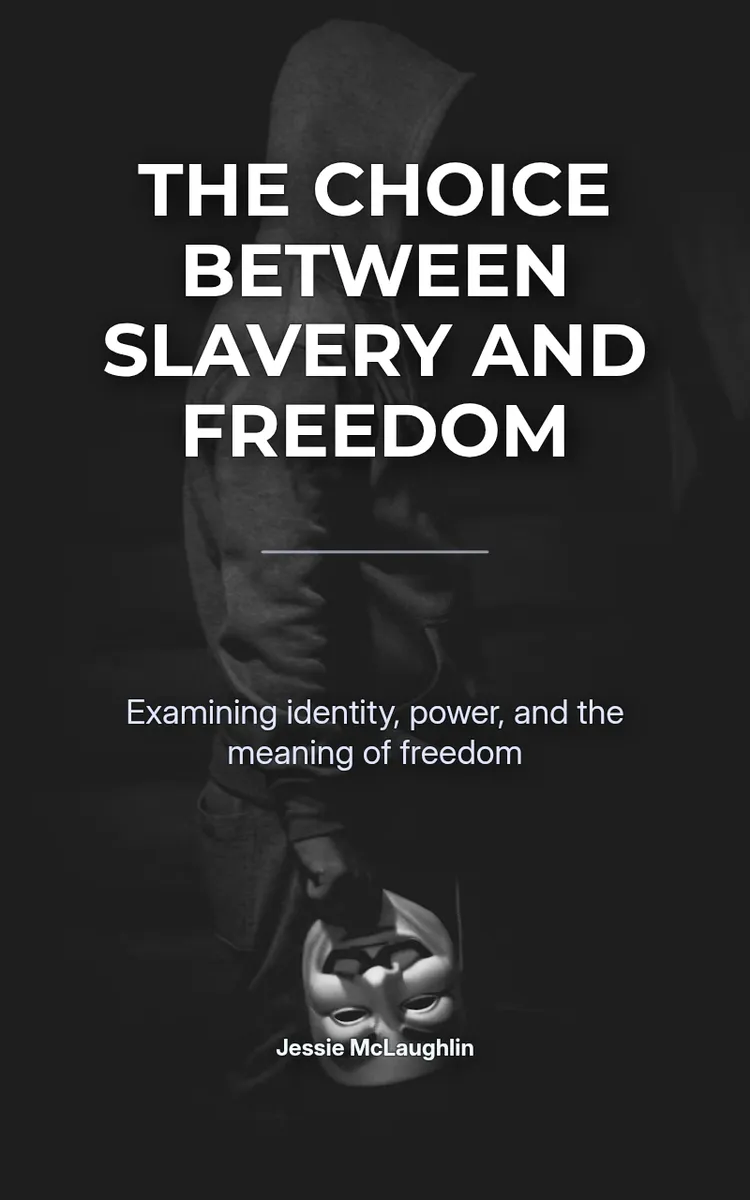
"The Choice Between Slavery And Freedom" is a nonfiction book by Jessie McLaughlin with 40 chapters and approximately 64,956 words. Claims about how racial, ethnic, and religious groups relate to slavery and freedom.
This book was created using Inkfluence AI, an AI-powered book generation platform that helps authors write, design, and publish complete books.
Frequently Asked Questions
What is "The Choice Between Slavery And Freedom" about?
Claims about how racial, ethnic, and religious groups relate to slavery and freedom
How many chapters are in "The Choice Between Slavery And Freedom"?
The book contains 40 chapters and approximately 64,956 words. Topics covered include Who Gets to Define Freedom?, The Poll That Asked the Wrong Question, When a Metaphor Becomes an Accusation, The Myth of a Single Group Mind, and more.
Who wrote "The Choice Between Slavery And Freedom"?
This book was written by Jessie McLaughlin and created using Inkfluence AI, an AI book generation platform that helps authors write, design, and publish books.
Write your own nonfiction book with AI
Describe your idea and Inkfluence writes the whole thing. Free to start.
Start writingCreated with Inkfluence AI


