
Read the first chapter
The whole of chapter one, free. About 11 min. Turn the pages with the arrows, your keyboard, or a swipe.
Chapter 1
The Last Ride After the Party
The porch light stuttered with the bass, slashing the steps white, then jaundiced, then white again, like a pulse trying to decide if it wanted to live. I lingered under that stuttering halo, jacket half-zipped, phone blinking three percent - enough time for one decision, not enough for a second - while the muffled laughter and something sharper from inside pressed against the screen of night.
“I’m not sleeping in that bush,” I said.
Mara Voss looked past me at the hedge, where somebody had already thrown up between two beer cans. “It’s not a bush. It’s landscaping.”
“It has a shoe in it.”
“Then it’s occupied.”
Behind us, the party was collapsing room by room. Music still thudded through the walls, but people had started shouting over it instead of dancing. A guy in a football jersey came out carrying a plastic cup and immediately dropped it on the pavement. Somewhere upstairs, glass broke. Nobody reacted.
I checked my phone again. No new messages. My mother was working overnight. My brother’s apartment was forty minutes away, and his last text had been a blurry picture of a locked door.
Mara leaned against the railing, black hair falling across one eye. Her makeup had survived the party better than I had. The thick eyeliner around her eyes was still sharp. Her lipstick had worn off in the center, leaving a dark rim.
“You can sleep at mine,” she said, softening her voice. I blinked at her. “Your parents?” “They’re gone until Sunday.” “Your house is twenty minutes away.” “I noticed.” “I mean walking.” “We can take the bus,” she offered, like it was the easiest plan in the world.
“The buses stopped an hour ago.”
Mara pulled a set of keys from the pocket of her coat and let them swing from one finger. The metal clicked softly beneath the dying music.
“We can walk,” she said. “Unless you want to negotiate with the landscaping.”
I wanted a bed. That was it. A mattress, a door, somewhere nobody would step over me or spill beer on my shoes. My feet hurt from standing in borrowed sneakers, and the cold had worked through my jeans.
“Fine,” I said.
“Fine,” she repeated, and pushed off the railing.
We left the party without saying goodbye. Nobody noticed. Mara took the side street, away from the porch and its flickering light. I followed, hands shoved into my pockets, listening to our shoes scrape over wet pavement.
She had been walking me home since we were eight. Back then, it was because my mother didn’t like me crossing the main road alone. Mara would hold my wrist whenever traffic came fast around the corner, then act like she hadn’t. We had slept in each other’s rooms so many times that our parents stopped asking who was where. We had shared blankets, passwords, humiliating secrets, and one bathroom during sleepovers where neither of us knocked.
There had never been anything else in it; that was the rule, because there had never needed to be one. “You’re quiet,” Mara said. “I’m tired.” “You’ve been quiet since Tyler tried to fight you.” “He didn’t try to fight me.” “He threw a lamp.” “It missed me.” “That’s usually how throwing things work,” she said. I glanced at her. “You’re one to talk.” “I didn’t throw anything.” “You threatened to stab him with a fork.” “He was touching my records.” “You don’t even like that band.” “I like the record.” The street sloped down toward the bus depot, windows dark. Mara walked fast, her coat flaring around her knees. The silver rings on her fingers caught the passing cars’ light. I kept falling behind and closing the small gap between us. At the next corner she stopped. “You’re bleeding,” she said. I touched my mouth; my thumb came away red. “Tyler’s lamp,” I said. “Still didn’t hit you?” “Corner of the table.” She stepped closer and tipped my face toward the streetlamp, her fingers cool against my jaw. The touch was so familiar I didn’t flinch, she’d cleaned cuts like this when we were kids, after skateboards and fence scrapes, after the time I tried to jump from her garage roof with a bedsheet tied like wings. Mara studied the cut. “It’s not bad,” she said. “Great.” “You’ll live.” “Good. I had plans.” She let go. For a beat neither of us moved, then she turned toward the next block. Her house sat behind a rusted iron fence at the end of a narrow street; it had seemed too big when we were small, now cramped between taller buildings and a line of bare trees. One upstairs window glowed red behind its curtain. Mara unlocked the gate; the hinges shrieked. “Your house is trying to warn us,” I said. “It does that when it’s hungry,” she replied. “Your house is not hungry.” “You don’t know its life.” Inside, the hallway was warm and cluttered: old concert posters on the walls, a leaning stack of magazines by the radiator, the air smelling of dust, candle wax, and years ofcigarette smoke soaked into everything. Mara kicked off her boots and left them by the stairs. I kept mine on. “You can take those off,” she said. “I’m not getting comfortable.” “You’re sleeping here.” “I’m aware.” She gave me that flat look again. “You’re acting like I invited a raccoon inside.” “A raccoon would be more prepared.” Mara moved to the kitchen; I heard a cabinet open and the scrape of glass. “Water?” she called. “Yeah.” She returned with two mismatched glasses, one with a crack running down the side. I drank too fast and felt the cold settle in my stomach. Mara watched me over the rim. “What?” I asked. “You’re still wearing Tyler’s jacket.” I touched the collar absently, the fabric smelling faintly of smoke and something sharp, beer, maybe, or the metallic tang of whatever had happened. “It’s fine,” I said. “Feels like armor.” “It looks like someone else’s armor,” she said softly. “Take it off, come sit.” She pushed open the living room door, and the couch swallowed her shadow. The room smelled of incense and old leather; record sleeves leaned against the bookcase like tired soldiers. On the coffee table, a chessboard sat midgame, pieces askew. Mara sank into the couch and patted the cushion beside her. I hesitated, then sat, keeping distance that felt neither polite nor safe. Her hand found mine on purpose, warm and familiar. “Talk to me,” she said. Her voice sounded small in the big room, like she’d been holding it in all night and was finally letting a little out. I wanted to tell her everything that had happened, the lamp, the fork, the shouting, the hollow thud in my chest when Tyler's laugh turned mean, but the words crowded my throat and wouldn’t line up. Instead I told her about the record, because it was harmless and true: how the sleeve was scuffed at the corner, how the grooves caught the light when I tilted it. She smiled at that, the soft kind that creased her eyes. “You and your records,” she murmured. “They matter.” “Not like you think.” “They matter to you, then they matter.” She shifted closer until our knees touched. The touch”
I looked down. The jacket was black, cheap, and too big in the shoulders. I had grabbed it from a chair near the door because mine had disappeared.
“He said I could borrow it.” “He said, ‘Get your hands off my stuff.’” “Same thing.” “You smell like beer.” “So do you.” “I smell like smoke.” “You smell like both.” She glanced up at the clock over the kitchen door, soft and small. “Go upstairs.” “Where?” “My room.” I laughed once, thinking she was teasing. She wasn’t. “Your parents’ room?” “Locked.” “Couch?” “Sore.” “Floor?” “Cold.” “You’ve got a whole house.” “And one usable mattress.” I followed her up the narrow stairs; the carpet had flattened in the center from years of footsteps, my shoulder brushing the wall as the pipes inside the house gave a polite, hollow knock every few steps. Mara opened her bedroom door.
The room felt smaller than I remembered, or maybe I was the one who’d grown. A black duvet covered the bed, and a string of red lights traced the ceiling. Clothes draped over the back of a chair, books and makeup clustered on the desk, and a tired plant leaned toward the window. I lingered in the doorway as Mara dropped her keys on the desk. “You can sleep on the bed.” “And you?” “I’ll change.” “Where?” “Somewhere that isn’t here.” “That sounds safe.” “Eli.” “What?” “You need somewhere to sleep.” I looked at the bed: the same one from our childhood sleepovers, even if the sheets and the room had shifted around it. I could still see us at eleven, flashlight between us, whispering about ghosts and the girl at school who swore she could read minds. I remembered waking with Mara’s elbow in my ribs and her leaning close in the dark to tell me secrets she trusted me with. The mattress felt a little narrower now. “I can take the floor,” I offered. “You’ll complain about your back.” “I already complain about my back.” “Exactly.” She opened a drawer, drew out a shirt and black shorts. “I’m changing in the bathroom. Don’t steal anything.” “I’m not interested in your stuff.” “That’s what thieves say.” She slipped down the hall and the bathroom door clicked softly shut.
I sat on the edge of the bed. The springs dipped beneath me. My hands smelled faintly of metal from the gate, and my mouth still tasted like cheap beer. Through the wall, I heard the shower turn on. The sound filled the house, steady and close.
I took off Tyler’s jacket and dropped it on the floor.
When Mara came back, she had changed into the shirt and shorts. The shirt hung loose around her thighs. Her bare legs were pale under the red lights. She had wiped away some of her makeup, but the eyeliner remained thick at the corners of her eyes. A black choker circled her throat.
She froze when she caught me watching. “What?” she said. “Nothing.” “You’re staring.” “I’m not.” “You are.” “I’m tired.” “You keep using that.” “Because it’s true.” Mara crossed the room, snatched a cigarette from the desk, rolled it between her fingers without lighting it. “We’ve slept in this bed before,” she said, casual like a dare. “When we were kids.” “We’re still the same people.” “Sure.” Her eyes cut narrow. “What’s that supposed to mean?” “Nothing.” “Then don’t say it like something.” I leaned back on my hands; the mattress complained. “I’m just saying it’s different.” “Because you’re nineteen now?” “Because the room is different.” “The room has always been like this.” “No, it hasn’t.” She scanned the posters, the red lights, the black curtains. “It’s exactly like this.” “It had glow‑in‑the‑dark stars.” “You peeled those off.” “You told me they were stupid.” “They were stupid.” “You cried when I took the last one down.” “I had dust in my eye.” “Both eyes?” Mara’s mouth twitched and then sobered. She sat down beside me, knee pressing mine, small, ordinary contact that felt huge for a beat. The same bed; the same quiet; the same person beside me. Then details cut through: the choker, the bare throat above it, the heavy black rim around her eyes, the way her knee stayed instead of drifting away. Mara struck a match, the flame painting her face from below. She inhaled, held the smoke, let it spill upward. “You can sleep,” she said. “I’m trying.” “No, you’re thinking.” “That’s usually how sleep starts.” “Not with you.” I looked at her. “What do you want me to do?” She tapped ash into a chipped saucer. “Nothing.” The word hung between us. A car passed outside, headlights sweep- sliding across the curtains. Her hand rested on my knee; she didn’t move it. Neither did I. I’d come here because I needed somewhere safe: a locked door, a warm bed, Mara close enough that I could feel her heat through fabric. It“Don’t make it weird,” she said again, softer. Her thumb traced a tiny circle on my knee, slow and meaningless. I wanted to tell her that it already was weird, that every breath between us had doubled into something else, but the words stuck like lint.
She turned toward me fully, cigarette stub between her fingers, the tip glowing like a distant planet. “Are you going to sleep or not?” she asked, not quite a question.
“I’ll try,” I said, and meant it in the most literal way: I would try to stop cataloguing her freckles, the scar on her knuckle, the way her mouth pulled at the words she didn’t say. I would try to let the dark do the rest.
Mara blew smoke slow, watching it make little ghosts that vanished against the ceiling. “You smell like the bus,” she said. “You always smell like the bus.” Her voice was flat, but the observation sounded like a memory being tested.
“You smell like cigarette smoke,” I said, which was both true and tame. She smiled then, a blink-and-it’s-gone thing, the kind that was dangerous because it said she knew how to coax me out of myself.
“You’re terrible at deflection,” she said. “And you always were.”
We lay back, shoulders almost touching. The choker made a tiny scrape against my collarbone when she shifted. The bed folded us together awkwardly, as if it could sense the tension and tried to hide it with lumpy comfort.
Outside, the night murmured: a dog barked, distant music, someone locking a car. Inside, our breaths found a hesitant rhythm. I counted hers against mine, like counting sheep that refused to be dull. At some point, the cigarette went out on the saucer. Mara flicked the ash, then reached for the light on her bedside lamp and hesitated with the switch between wanting and not wanting the room to be seen in full.
“Tell me a stupid story,” she said instead, voice light, like seeking ballast. “Tell me something from when we were dumb kids.”
I thought of the glow-in-the-dark stars, of the way she’d sobered when I pulled the last one off because she refused to be sentimental in front of me. “Remember when you tried to make us a potion out of lemon soda and toothpaste?”
End of chapter one. 7 more chapters and about 12,305 words in the full book.
Swipe or use the arrows to turn the page


What's inside: 8 chapters
- 1. The Last Ride After the Party
- 2. The Bed We Used to Share
- 3. Fishnets in the Hallway
- 4. The Question Behind Her Joke
- 5. Her Knees on the Carpet
- 6. The Silence After
- 7. Just Friends, She Says
- 8. The Unsaid Next Time
About this book
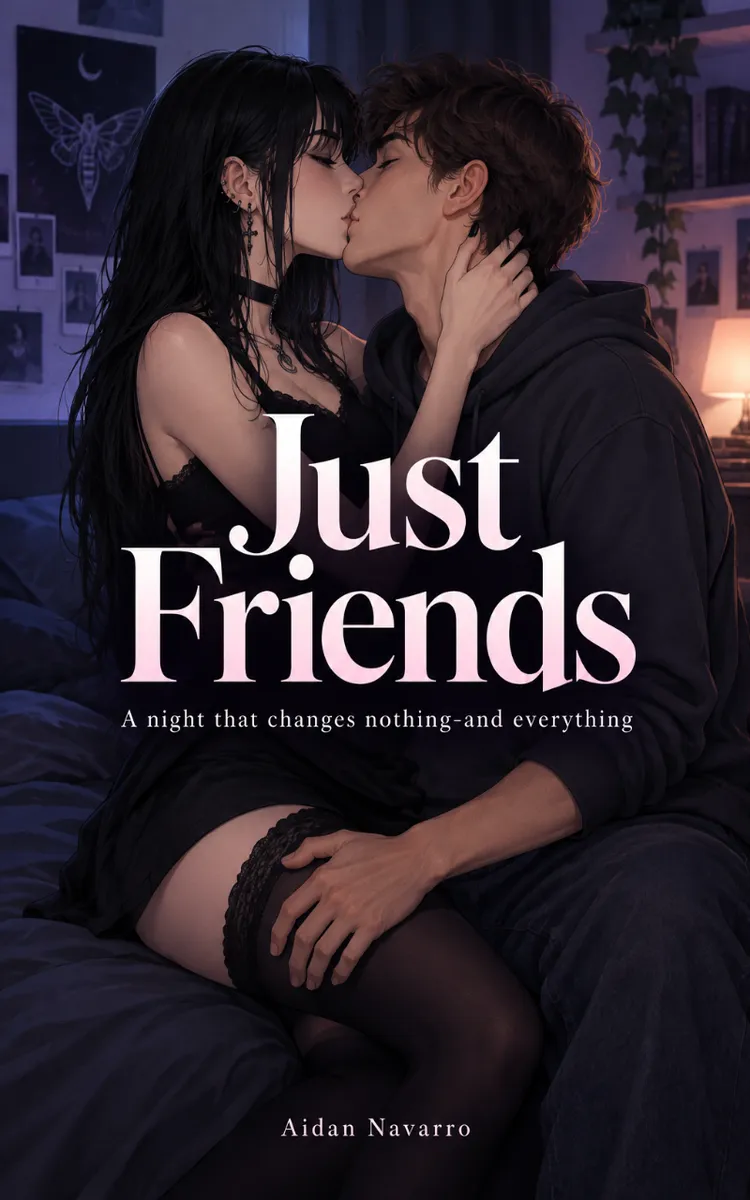
"Just Friends" is a fiction book by Aidan Navarro with 8 chapters and approximately 12,305 words. A young man’s uneasy sexual encounter with his longtime goth best friend.
This book was created using Inkfluence AI, an AI-powered book generation platform that helps authors write, design, and publish complete books. It was made with the AI Novel Writer.
Frequently Asked Questions
What is "Just Friends" about?
A young man’s uneasy sexual encounter with his longtime goth best friend
How many chapters are in "Just Friends"?
The book contains 8 chapters and approximately 12,305 words. Topics covered include The Last Ride After the Party, The Bed We Used to Share, Fishnets in the Hallway, The Question Behind Her Joke, and more.
Who wrote "Just Friends"?
This book was written by Aidan Navarro and created using Inkfluence AI, an AI book generation platform that helps authors write, design, and publish books.
How can I create a similar fiction book?
You can create your own fiction book using Inkfluence AI. Describe your idea, choose your style, and the AI writes the full book for you. It's free to start.
Write your own fiction book with AI
Describe your idea and Inkfluence writes the whole thing. Free to start.
Start writingCreated with Inkfluence AI


