
Read the first chapter
The whole of chapter one, free. About 9 min. Turn the pages with the arrows, your keyboard, or a swipe.
Chapter 1
A Moon Map in Dusty Hands
The brass clock above Hart & Daughter had stopped at 2:17, its minute hand trembling whenever a cart rattled over the street below.
Leena noticed because the room was too quiet for anything else.
She knelt beside her mother’s trunk with a stack of folded dresses at her elbow and dust whitening the knees of her black skirt. The childhood bedroom had shrunk in the years since she had left. The painted moons along the wall seemed closer together now, their silver crescents chipped where Leena had once dragged her bed beneath them to sleep under a sky of her own making.
She lifted another dress from the trunk. Lavender. Her mother had worn it on the night Leena won the school astronomy prize, though she had arrived late, carrying a box of sugared buns and an apology she never explained.
Leena pressed the fabric to her fingers, then set it aside.
“I’m looking for the papers,” she said to the empty room. “That’s all.”
Below, a bell chimed as the shop door opened. Her father’s voice rose through the floorboards, roughened by three days of condolences and silence.
“Just a moment.”
Leena waited until his footsteps moved away. Then she leaned over the trunk again.
The funeral had left the shop crowded with flowers, borrowed chairs, and people who spoke of her mother as if they had known the whole of her. Brave. Practical. Generous. Nobody had mentioned the locked trunk in the attic room, or the way her father’s hand had closed around its key when Leena asked for it.
Nobody except Leena had seen the fear in his face.
She pushed aside a wool coat. Beneath it lay a bundle of old receipts, a cracked hand mirror, and a leather-bound notebook with its pages removed. Her mother had left empty books all over the house, as if every thought had been pulled out and carried elsewhere.
A floorboard creaked in the hallway.
Leena froze.
“Leena?” her father called.
“I’m sorting.”
“You’ve been up there an hour.”
“I know.”
His footsteps stopped outside the door. The latch shifted but did not open.
“There’s nothing in that trunk you need tonight,” he said.
Leena looked at the key lying beside her knee. “Then why did you lock it?”
Silence pressed against the door.
“Your mother kept old things.”
“So do I.”
“Come downstairs.”
“Did she ever tell you what she was doing with them?”
The latch went still.
Leena waited, watching a thread of dust drift through the pale window light. At last her father said, “Your mother was ill. Near the end, she confused memories with plans.”
“She wasn’t confused when she hid the trunk.”
“Leena.”
The warning in his voice was familiar. It belonged to arguments about leaving, about the observatory, about the apprenticeship she had abandoned when her mother’s illness worsened. It was the voice that always turned a question into a door.
Leena turned the key in the lock.
The trunk gave a wooden groan.
Her father’s hand struck the other side of the door. “Don’t force this.”
“I’m not forcing anything.”
She lifted the lid.
The hinges squealed. A stale breath of cedar and camphor rose from inside, carrying the faint metallic scent of old rain. Under the lining, someone had sewn a narrow strip of blue cloth. Leena ran her thumb over it. Her mother had used that same blue thread to mend Leena’s winter coat when she was nine.
The memory came sharply: her mother crouched beside the stove, needle flashing, saying, “The sky doesn’t disappear because clouds cover it.”
Leena pulled the cloth.
The lining tore with a dry rip.
Beneath it, tucked against the trunk’s wooden base, was a folded sheet of stiff paper.
Her breath caught - not from surprise, exactly, but from recognition. The paper was the color of old bone, and across it ran a scatter of black points, some blurred into gray. A star-chart. The constellations were drawn in her mother’s narrow hand, but the lines between them had been rubbed almost away.
At the center, a silver circle marked the moon.
Leena unfolded the chart over her knees.
The door opened.
Her father stood there, one hand braced against the frame. His face had gone pale.
“Put that back,” he said.
The words were so immediate, so frightened, that Leena held the map tighter.
“You knew it was here.”
“I knew your mother kept a chart.”
“What kind?”
“Leena, give it to me.”
“What is it?”
He stepped into the room. The floor dipped beneath his weight, and the old bed frame gave a small wooden knock. “It’s nothing useful.”
“Then you won’t mind telling me why you’re shaking.”
His eyes moved to the silver moon, then away. “Your mother drew maps when she couldn’t sleep.”
“She worked at the shop.”
“She did both.”
“Maps of what?”
“Stars.”
“That isn’t an answer.”
“It’s the only one I have.”
Leena stood, the chart crackling between her hands. The room tilted - not from grief this time, but from the sudden sense that the walls had been listening for years.
Her father reached for the paper.
She stepped back. “Don’t.”
His hand fell.
“You left,” he said quietly. “You went to the city, and when she got worse, you came home angry at everyone. You think there must be some secret that explains why she kept things from you.”
“There is a secret.”
“You want one.”
Leena looked down at the map. Several marks had been pressed so hard into the paper that the points had pierced it. Along the lower edge, a dark smear crossed three lines of stars.
“I want to know why she hid it.”
“Because she knew you’d chase it.”
The answer struck deeper than it should have.
Outside, a wagon rolled past, its wheels thudding over the uneven street. The stopped clock shivered above them.
Leena folded the chart once, carefully. “Chase what?”
Her father closed his eyes.
When he opened them, the fear had hardened into something like anger. “Give me the map.”
“No.”
“You don’t understand what it cost her.”
“Then tell me.”
“I can’t.”
“Can’t, or won’t?”
He looked toward the window. Beyond the glass, the sky was a thin winter blue, washed nearly white above the rooftops. “There are places your mother went that should have remained closed.”
Leena felt the old tug inside her - the one that had drawn her to the observatory dome, to cold lenses and distant lights, to every impossible object that could not be held in a hand. “What places?”
Her father crossed the room in two strides and seized the chart.
The paper tore.
Leena cried out. One corner remained in his hand. The rest stayed with her, jagged along the fold.
For a moment neither moved.
Then a black line on the map slid beneath Leena’s thumb.
Not ink. A seam.
She looked at the trunk.
“Your mother’s false bottom,” she said.
Her father’s expression changed.
That was answer enough.
Leena shoved the chart into her coat pocket and dropped to her knees. She ran her fingers along the trunk’s base, finding the uneven join beneath the torn lining. A narrow brass catch had been worked into the wood, almost invisible under the dust.
Her father grabbed her shoulder. “Stop.”
She twisted free. “You said there was nothing useful.”
“I said stop.”
She pressed the catch.
A panel sprang upward.
Inside lay a small envelope wrapped in oilskin, a stub of white chalk, and a brass compass no larger than a coin. The compass needle spun wildly when Leena lifted it, then settled toward the attic window instead of north.
Her father made a sound low in his throat.
Leena unwrapped the envelope. The paper inside was covered in writing, but most of it had bled into a gray blur. Only a few symbols remained clear: a crescent, three stars, and a column of numbers.
Her mother’s handwriting.
Leena set the chart on the floorboards and placed the compass beside it. The needle swung toward a cluster of stars near the map’s lower edge.
“Those aren’t stars,” her father said.
“What are they?”
“Coordinates.”
“For where?”
“I told you to leave it.”
She matched the numbers on the envelope to the faint marks on the chart. The first two were easy. The third had been smeared, its final digit hidden beneath a thumbprint of black.
Her father knelt opposite her. “Leena, listen to me. Your mother believed she could reach the moon.”
The room seemed to contract around the words.
“Reach it how?”
“Not with a telescope.”
“Then how?”
He looked at the silver circle. “She never said.”
“You knew this whole time?”
“I knew enough to be afraid.”
Leena’s hand tightened around the compass. Its metal was cold, biting into her palm. “You let everyone call her confused.”
“She was dying.”
“She was searching.”
“She was dying while she searched.”
The anger in his voice broke open, and beneath it was the same grief that had bent him over the shop counter every night since the funeral.
Leena glanced at the torn piece of chart in his hand. “What did she find?”
“I don’t know.”
“But you helped her.”
“I drove her to the station once.”
“Where?”
He said nothing.
“Where?”
His jaw worked. “North.”
“That’s not a place.”
“It was enough to get her away from here.”
Leena looked at the coordinates again. The final number had begun to emerge beneath the smear - not because the ink was clearing, but because the paper was warming under her fingers. A thin line appeared, then another.
She shifted closer to the window. Moonlight would not come until night, but the pale daylight revealed a pattern in the paper: pinpricks arranged along the edge, like a trail hidden beneath the drawn stars.
Her mother had not made a map of the sky.
She had made a map of something that used the sky to hide.
Leena took the chalk from the false compartment and marked the first visible coordinate on the floorboards. Then she marked the second. The line between them pointed beyond the town, toward the abandoned salt road and the black ridge that cut the horizon.
Her father watched her. “What are you doing?”
“Finding the place.”
“You’re not going.”
“I haven’t said I was.”
“You don’t have to.”
Leena placed the compass at the crossing point. The needle jerked, then steadied.
A single coordinate surfaced beneath her thumb.
47.19.3.
She whispered it aloud.
Her father stood abruptly, knocking the trunk against the wall. “Give me the chart.”
Leena folded her hand over the mark.
The ink began to fade.
Not gradually. It withdrew in thin, trembling threads from beneath her skin, vanishing into the paper until the coordinate was only half there. She lifted her hand, but the warmth of her touch had already changed it. The number blurred at the edges.
“No,” she said.
She pressed harder.
The remaining ink vanished faster.
Her father reached for her, but Leena pulled the chart to her chest. The paper felt warm now, almost alive, and the moon drawn at its center had lost its silver shine. Around it, the stars dimmed one by one.
Only the coordinate remained.
47.19.3.
Then that, too, began to disappear.
Leena snatched the chalk and wrote the numbers across her wrist before the last mark dissolved. The chalk dragged against her skin, leaving a pale, crooked line.
Her father stared at it.
“Leena,” he said, no longer angry. “You don’t know what’s waiting there.”
She looked toward the window, toward the ridge beyond the rooftops and the road that led into the white distance.
“No,” she said.
The compass needle turned toward the north.
“But she did.”
End of chapter one. 14 more chapters and about 31,015 words in the full book.
Swipe or use the arrows to turn the page


What's inside: 15 chapters
- 1. A Moon Map in Dusty Hands
- 2. Leena and the Night Courier’s Debt
- 3. The Envelope That Refuses Answers
- 4. Crossing the Salt Bridge After Curfew
- 5. Leena Chooses Her Mother’s Lie
- 6. The Key Opens a Locked Airshaft
- 7. Running Through the Lantern Market
- 8. Soren’s Clue and the Wrong Lighthouse
- 9. Leena Confronts Mara Quill’s Bargain
- 10. Calder Wren’s Signal Trap
- 11. When the Moon Map Turns to Ash
- 12. Leena Follows Her Mother’s Footprints
- 13. The Phrase That Opens the Sky Lens
- 14. Leena Touches the Moon’s Shadow
- 15. The Broadcast That Won’t Let Go
About this book
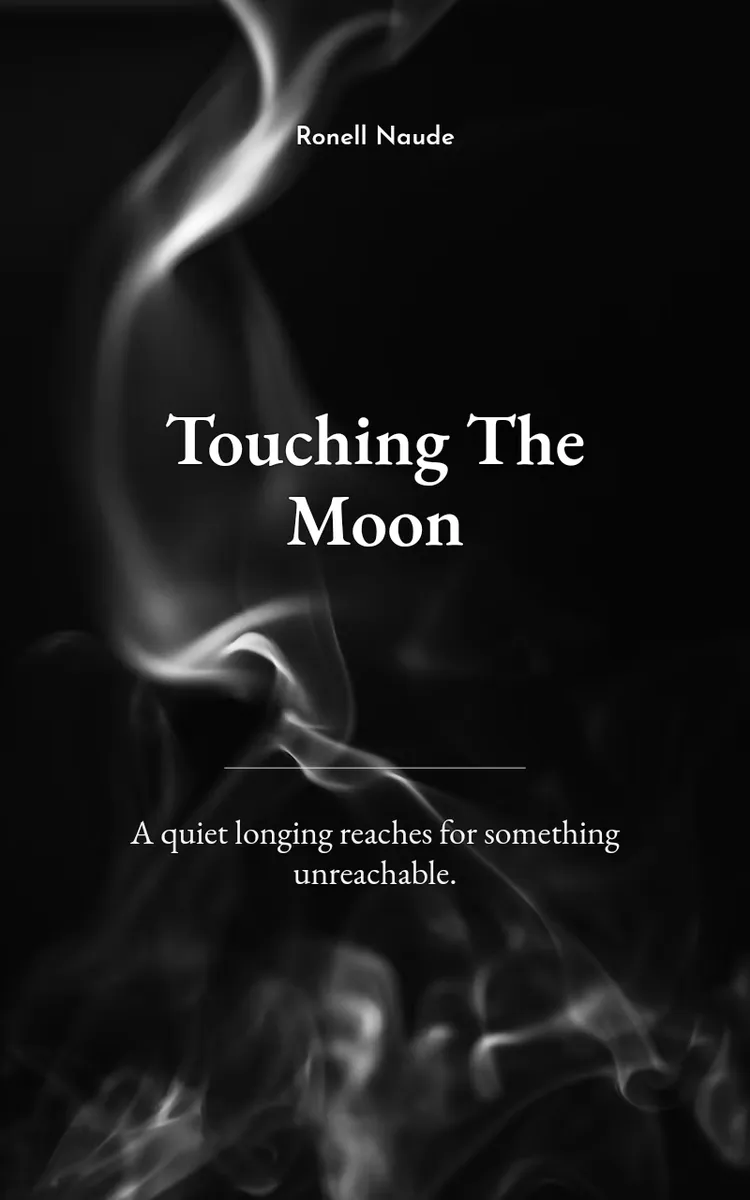
"Touching The Moon" is a fiction book by Ronell Naude with 15 chapters and approximately 31,015 words. A character’s emotional journey toward a distant dream.
This book was created using Inkfluence AI, an AI-powered book generation platform that helps authors write, design, and publish complete books. It was made with the AI Novel Writer.
Frequently Asked Questions
What is "Touching The Moon" about?
A character’s emotional journey toward a distant dream
How many chapters are in "Touching The Moon"?
The book contains 15 chapters and approximately 31,015 words. Topics covered include A Moon Map in Dusty Hands, Leena and the Night Courier’s Debt, The Envelope That Refuses Answers, Crossing the Salt Bridge After Curfew, and more.
Who wrote "Touching The Moon"?
This book was written by Ronell Naude and created using Inkfluence AI, an AI book generation platform that helps authors write, design, and publish books.
How can I create a similar fiction book?
You can create your own fiction book using Inkfluence AI. Describe your idea, choose your style, and the AI writes the full book for you. It's free to start.
Write your own fiction book with AI
Describe your idea and Inkfluence writes the whole thing. Free to start.
Start writingCreated with Inkfluence AI


