
Read the first chapter
The whole of chapter one, free. About 9 min. Turn the pages with the arrows, your keyboard, or a swipe.
Chapter 1
Why God Searches Spike After Midnight
The Hour When the Question Appears
In the early hours of 2008, a British radio producer named Jill Dando became associated with a question that had been asked for centuries but was now being asked through a search box: “Does God hear me?” The wording appeared among the private queries people entered when ordinary conversation had ended, phones had gone quiet, and the blue light of a screen was often the only company in the room.
Search engines do not know whether a person is kneeling beside a bed, sitting in a parked car, or staring at a ceiling. They record only the words and the hour. Yet that combination - an anxious sentence and a dark clock - offers an unusual view of spiritual life. During the day, people ask about prayer, religion, and God in public language. After midnight, the language becomes narrower and more exposed: Does God hear me? Is God angry? Why won’t God answer?
The Midnight Signal Map begins with that change in wording. It follows the movement from public belief to private fear, from doctrine to an unanswered message. The map does not claim that every late-night search is a prayer, or that a timestamp reveals a person’s soul. It shows something more modest and more revealing: when the world grows quiet, questions about divine attention become easier to type.
What does a search for God at 2:17 a.m. reveal that daylight allows us to hide?
The Clock Changes the Question
Midnight is not a magical boundary, but it is a social one. By then, workplaces have closed, children are asleep, messages have slowed, and the small obligations that organize the day have temporarily released their hold. A person who has spent hours answering emails, caring for family, commuting, or performing competence may finally encounter the thought that was waiting underneath everything else.
The search engine becomes useful precisely because it does not require an entrance ceremony. There is no church door, no appointment, no listener to impress. A person can type a sentence that would sound too needy in conversation and receive pages of theology, testimony, skeptical debate, and other people’s attempts to describe the same fear.
The phrase Does God hear me? carries a different weight from “What do Christians believe about prayer?” The second is informational. The first is addressed. It contains an implied recipient and an implied crisis. The user is not merely looking for a definition of prayer; the user is testing whether communication is possible.
That distinction matters because search queries are often compressed records of emotional decisions. People rarely type the whole story. They type the part that has become impossible to hold privately: God, please help me. Does God hear silent prayers? Why does God ignore me when I need him? The grammar shifts between a question for a search engine and a message intended for heaven.
Sleep science helps explain why these questions gather after dark. Human attention is affected by fatigue, reduced distraction, and the natural rise of inward thought that accompanies lying still. Worry can become more repetitive when there are fewer external demands to interrupt it. The mind does not necessarily become more truthful at night, but it becomes less occupied with appearing normal.
A search made at noon may be part of research. The same words entered at 3:00 a.m. may be part of a ritual: wake, reach for the phone, check the time, type the question, read a few results, return to the question. The device records the query, but not the breathing between each step.
From Night Prayers to Search Boxes
Night has long been associated with spiritual uncertainty. In the Hebrew Bible, Jacob wrestles through the night; the Psalms repeatedly ask why God seems distant; the Gospel accounts place some of Jesus’s prayers in darkness or solitude. Monastic communities built their days around night offices, rising before dawn to pray while much of the surrounding world slept.
The modern search box did not invent the midnight question. It changed its address.
Before the internet, a person awake with fear might reach for a prayer book, a Bible, a radio, or a telephone. The late-night religious broadcast served as a kind of public hearth for isolated listeners. Call-in programs allowed strangers to hear their own concerns echoed in the voices of others. Search engines made the exchange more private and more immediate. The individual no longer needed to wait for a program, identify with a denomination, or admit the question aloud.
The history of prayer contains many private technologies: written petitions, devotional cards, rosaries, bedside books, and recorded sermons. The smartphone belongs to the same family, though it is more ambivalent. It can carry a sacred text and a news alert, a prayer app and a stream of frightening images. At 1:40 a.m., a person may move between them with a thumb.
A single sentence can also point to several kinds of distress. Does God hear me? may follow bereavement, illness, financial trouble, a relationship ending, a frightening diagnosis, or a guilt that has not been spoken. The search does not identify the cause. Its value lies elsewhere: it shows that the person has translated an ordinary crisis into a question about divine presence.
That translation is culturally significant. In societies where religious vocabulary remains available but religious institutions are less central to daily life, people may still reach for God when the practical vocabulary of crisis runs out. They may not attend services or describe themselves as devout. Yet the word God remains the name attached to the largest possible listener.
A surprising fact sits inside the midnight pattern: the late-night search is often less about proving that God exists than about determining whether the user still has access to God.
That changes the meaning of the query. The central fear is not always unbelief. It may be abandonment. A person can accept uncertainty about theology and still feel an urgent need to know whether a plea has crossed the distance between a human mind and a divine one. Midnight searches therefore reveal a relational problem, not merely an intellectual one. The user is asking whether the line is open.
The Midnight Signal Map
The Midnight Signal Map follows three signals embedded in these searches: the hour, the wording, and the return.
The hour marks the retreat of social noise. The wording shows whether the person is seeking information, permission, explanation, or contact. A query such as how to pray is different from does God hear silent prayer, which is different again from why did God let this happen? The return - repeated searches across several nights - suggests that the first answer did not settle the question, or that the question is attached to a continuing condition.
None of these signals should be treated as a diagnosis. Search data is incomplete and shaped by the platform itself. Autocomplete may influence wording. A person may search privately, delete the history, or use a different device. Some people search at night because they work night shifts, care for infants, or live in different time zones. The clock is a clue, not a confession extracted under oath.
Still, patterns become meaningful when placed beside the ordinary rituals of digital life. The phone on a bedside table is an alarm clock, a newsstand, a map, a social room, and - occasionally - a chapel without a congregation. Its screen offers immediate access to explanations, but the search for divine attention cannot be resolved in the same way as a question about train times. The device can return words; it cannot verify that God received them.
Consider the small physical details surrounding such a query. The room may be dark except for the screen. The user may be under a blanket, beside a sleeping partner, or in a hospital waiting area. The search is silent, but it may be accompanied by repeated checking of the clock, a glass of water, an unsent message, or a prayer spoken only once because saying it again feels like admitting that the first attempt failed.
The digital record makes these rituals visible only indirectly. Search engines preserve language, not posture. They show recurrence, not tears; sequence, not hesitation. Yet even this partial record is unusually intimate. Public surveys ask people what they believe. Search queries catch them at the point where belief becomes a private need.
A Person in the Quiet
The clearest human setting for the midnight question is not a cathedral but the online forum. On sites such as Reddit, people post under usernames that separate their questions from their ordinary identities. Threads about prayer and divine silence often attract replies from believers, former believers, skeptics, and people who are unsure what they believe but recognize the fear in the original post.
A late-night forum post can contain the same movement as a search query: a concrete problem giving way to a spiritual question. Someone describes an illness in the family, a breakup, debt, panic, or a death anniversary. Then the language turns upward: I prayed, but nothing changed. Does anyone think God heard me? The replies may offer scripture, personal testimony, criticism of religion, or simple recognition. The thread becomes a temporary congregation assembled by algorithms rather than geography.
The setting matters. The poster may be alone in a bedroom while the responses arrive from different time zones. A stranger in Canada answers someone in Ireland; a night-shift worker in the United States responds during a break; another reader says nothing but returns to the page. The exchange is public, yet its emotional origin is private. It resembles a confession placed in a crowded room where no one knows the speaker’s face.
Such forums also expose the limits of reassurance. One reply may say that God hears every prayer. Another may insist that silence is evidence against God. A third may describe years of doubt without resolution. The original question remains suspended among competing interpretations. What the thread provides is not certainty but company - evidence that the question has been asked before and that its asker is not the only person awake with it.
That may explain why the search and the forum often sit close together in a midnight ritual. The user asks the machine, reads a stranger’s account, searches again, and perhaps opens a religious text. These actions do not form a tidy path toward belief or disbelief. They form a circuit around absence. Each turn approaches the same problem from a different direction: if God is listening, why is the answer so difficult to recognize?
The Listener Behind the Screen
The midnight spike in Does God hear me? searches reveals a peculiar feature of modern spiritual life. The internet has made private uncertainty searchable without making it less private. A person can place a question in a global system while preserving the feeling that no human being has been directly addressed.
That is why the search box can resemble both a laboratory instrument and a confessional. It records the pressure points of a culture, but it also receives words that were never meant for public display. The hour gives those words their setting. After midnight, the question is stripped of much of its daytime packaging and reduced to its oldest form: is anyone there, and does my voice reach them?
The answer cannot be found in a timestamp. Yet the timestamp tells us when the question becomes difficult to postpone. Human beings may spend the day surrounded by language and still wait until the world is quiet to ask whether they have been heard. Somewhere between the glowing screen and the sleeping house, a search becomes a small act of address - and the silence that follows remains strangely full of possibility.
End of chapter one. 5 more chapters and about 9,958 words in the full book.
Swipe or use the arrows to turn the page


What's inside: 6 chapters
- 1. Why God Searches Spike After Midnight
- 2. What People Ask God After Tragedy
- 3. Reading Signs in Numbers and Dreams
- 4. When the Feed Cannot Cure Loneliness
- 5. The Atheist’s Private Emergency Prayer
- 6. What Our Search Histories Confess
About this book
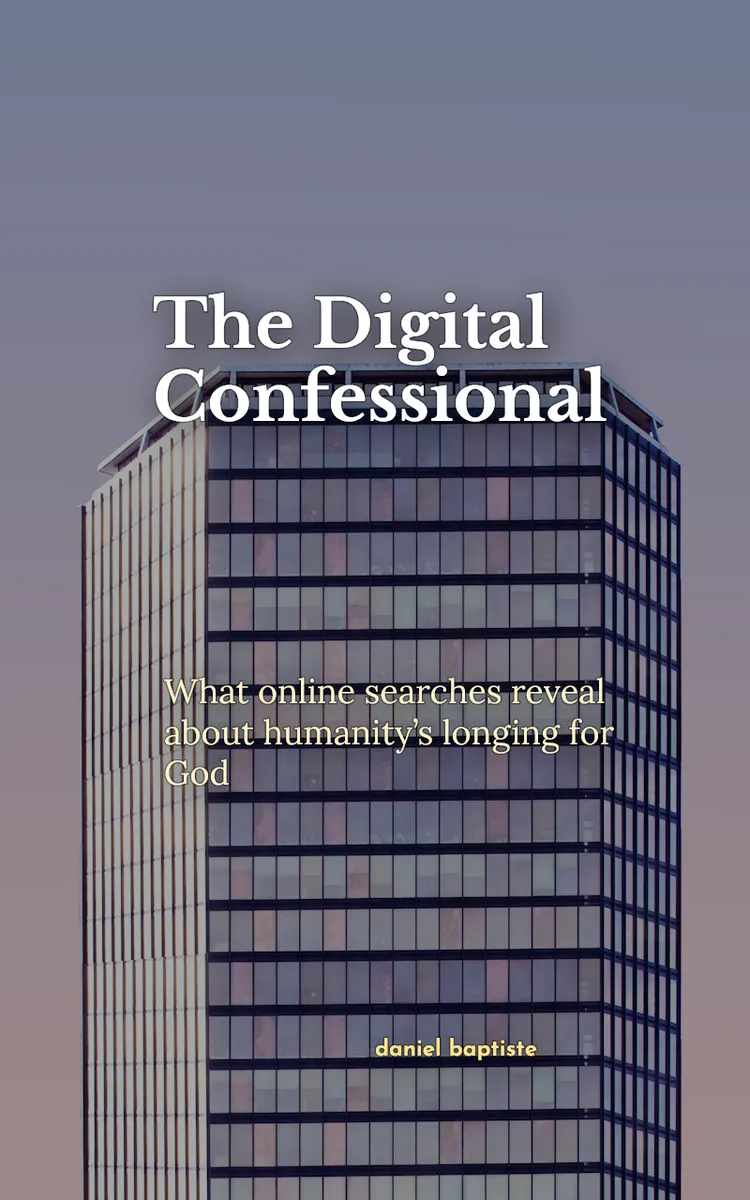
"The Digital Confessional" is a curiosity book by daniel baptiste with 6 chapters and approximately 9,958 words. What anonymous online searches and posts reveal about modern spiritual questions.
This book was created using Inkfluence AI, an AI-powered book generation platform that helps authors write, design, and publish complete books.
Frequently Asked Questions
What is "The Digital Confessional" about?
What anonymous online searches and posts reveal about modern spiritual questions
How many chapters are in "The Digital Confessional"?
The book contains 6 chapters and approximately 9,958 words. Topics covered include Why God Searches Spike After Midnight, What People Ask God After Tragedy, Reading Signs in Numbers and Dreams, When the Feed Cannot Cure Loneliness, and more.
Who wrote "The Digital Confessional"?
This book was written by daniel baptiste and created using Inkfluence AI, an AI book generation platform that helps authors write, design, and publish books.
Write your own curiosity book with AI
Describe your idea and Inkfluence writes the whole thing. Free to start.
Start writingCreated with Inkfluence AI


