
Read the first chapter
The whole of chapter one, free. About 5 min. Turn the pages with the arrows, your keyboard, or a swipe.
Chapter 1
Dill Pickled Green Beans in Jars
At a Glance
Prep: 45 min | Cook: 35 min | Total: 1 hr 20 min | Serves: 6 pints | Difficulty: Medium
Introduction
These dill-pickled green beans stay bright, crisp, and pleasantly tangy, with fresh dill, garlic, and a simple vinegar brine in every jar. The hot-pack method warms the beans and brine before processing, helping the flavors settle while keeping the beans from turning soft.
Use young, slender beans whenever possible. They should snap cleanly when broken and fit into the jars without being bent or crowded. After processing, the beans need at least 24 hours for the brine to season them, though a week in the pantry gives the dill and garlic a fuller flavor. The finished pickles are ready for a relish tray, sandwiches, salads, or a crisp side with supper.
For safety, use vinegar with 5 percent acidity, clean jars, and a boiling-water canner. The vinegar is not just for taste; it keeps the finished beans properly acidic for water-bath canning. Your practical goal is simple: firm beans, a clear brine, and sealed jars that can be stored safely.
Ingredients
• 3 pounds fresh green beans, washed and trimmed - 3 cups white vinegar, 5 percent acidity - 3 cups water - 3 tablespoons pickling salt - 6 garlic cloves, peeled and lightly crushed - 6 fresh dill sprigs - 1½ teaspoons dill seed - ½ teaspoon red pepper flakes, optional - 6 pint canning jars with new lids and screw bands - Boiling water, as needed for the canner
Instructions
1. Prepare the canner and jars, 15 minutes. Place a rack in a boiling-water canner, fill it with water, and begin heating it over medium-high heat. Wash the jars, lids, and bands in hot soapy water. Keep the jars hot in the canner or in a separate pot of simmering water. Do not boil the flat lids unless the package directions call for it.
2. Trim and sort the beans, 10 minutes. Cut off the stem ends and leave the pointed ends intact if they are tender. Cut the beans into pieces that are about ½ inch shorter than the jars. Discard beans that are limp, spotted, or damaged. Ask yourself whether each piece is small enough to stand upright without pressing against the lid.
3. Blanch the beans, 4 minutes. Bring a large pot of water to a full boil. Add the beans and cook for 2 minutes, just until their color brightens and they bend slightly. Move them at once to a bowl of ice water for 2 minutes, then drain well. This quick blanch helps the beans heat evenly without cooking them soft.
4. Make the vinegar brine, 5 minutes. In a stainless-steel or enamel pot, combine the vinegar, water, and pickling salt. Bring the mixture to a steady simmer, about 180°F to 190°F. Stir until the salt dissolves. Keep the brine hot, but do not let it boil hard for a long time.
Pro Tip: Vinegar strength matters. Check the label for 5 percent acidity, and never dilute the vinegar with extra water beyond the recipe measurement.
5. Pack the jars, 10 minutes. Place one garlic clove, one dill sprig, ¼ teaspoon dill seed, and a pinch of red pepper flakes, if using, into each hot pint jar. Pack the beans upright, alternating stem ends when needed. Leave ½ inch of headspace, measured from the top of the beans to the rim.
6. Add the hot brine. Ladle the simmering brine over the beans, keeping the ½-inch headspace. Slide a plastic bubble remover or clean chopstick around the inside edge of each jar to release trapped air. Wipe the rims with a clean, damp cloth. Place the lids on the jars and tighten the bands until they are fingertip-tight.
7. Process the jars, 10 minutes. Set the jars upright on the canner rack. Lower the rack into the canner, making sure the water covers the jar tops by at least 1 inch. Cover the canner and bring the water back to a full boil. Begin timing when the boil returns, then process pint jars for 10 minutes at altitudes up to 1,000 feet.
8. Adjust for altitude and cool, 12 to 24 hours. At 1,001 to 3,000 feet, process for 15 minutes; at 3,001 to 6,000 feet, process for 20 minutes; above 6,000 feet, process for 25 minutes. Turn off the heat, remove the lid, and wait 5 minutes before lifting the jars. Set them upright on a towel, leaving space between them. Let them cool undisturbed for 12 to 24 hours.
9. Check and store the jars. Press the center of each lid. A properly sealed lid should not flex or pop. Remove the bands, wash and dry the jars, and label them with the date. Refrigerate any jar that did not seal and use it within a few weeks. Store sealed jars in a cool, dark, dry place and use them within one year for best quality.
Chef Notes & Variations
The beans may look slightly less bright after processing, but they should remain firm and make a clean snap when served. Keep the jars away from heat and sunlight, since warm storage can weaken quality and fade the dill. Chill a jar before serving for the best crunch. Drain the beans and arrange them beside deviled eggs, sliced ham, grilled chicken, or a cheese plate. They also add a sharp, fresh bite when chopped into potato salad.
For a stronger garlic flavor, use one small clove per pint, but do not add extra fresh vegetables or change the vinegar-to-water ratio. The measured brine is part of the safety plan as well as the flavor balance.
Swap It: Replace the fresh dill sprigs with 1 teaspoon dried dill weed per pint if fresh dill is unavailable. The flavor will be less grassy, but the pickles will still have a clear dill taste. Keep the garlic and vinegar measurements unchanged.
The important checks are easy to remember: 5 percent vinegar, ½ inch headspace, water 1 inch above the jars, and a full boiling-water process. Those four details protect both the quality and safety of your dill-pickled beans.
Quick Version
Blanch 3 pounds trimmed beans for 2 minutes, cool, and pack into six hot pint jars with garlic, dill, and dill seed. Cover with simmering brine made from equal parts 5 percent vinegar and water plus salt, leave ½ inch headspace, and process in a boiling-water canner for 10 minutes, adjusting for altitude.
End of chapter one. 7 more chapters in the full book.
Swipe or use the arrows to turn the page


What's inside: 8 chapters
- 1. Dill Pickled Green Beans in Jars
- 2. Sweet Corn Relish Canning with Peppers
- 3. Zesty Tomato Basil Sauce for Canning
- 4. Garlic-Butter Mushrooms in Hot Water Canning
- 5. Old-Fashioned Chow-Chow Canning with Mustard
- 6. Spicy Pickled Okra with Red Pepper
- 7. Roasted Red Pepper and Eggplant Spread Jars
- 8. Maple-Glazed Beets with Cinnamon Canning
About this book
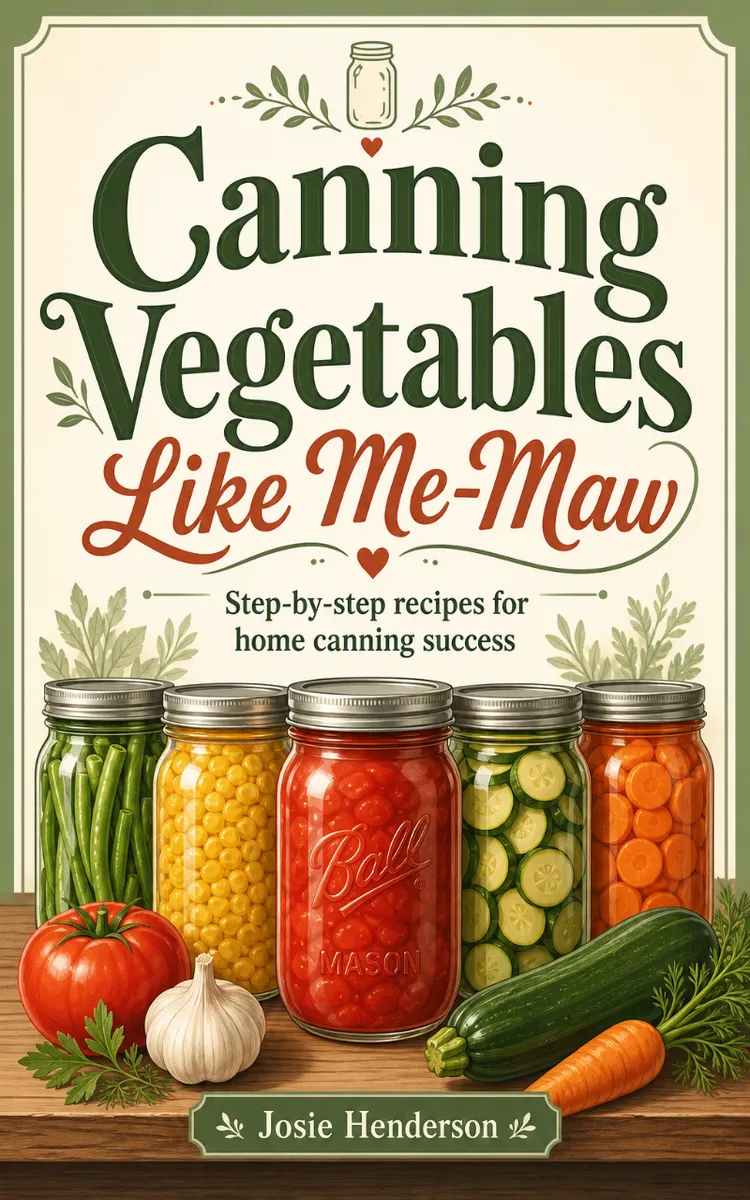
"Canning Vegetables Like Me-Maw" is a cookbook by Josie Henderson with 8 chapters and approximately 9,172 words. Home vegetable canning methods and included recipes.
This book was created using Inkfluence AI, an AI-powered book generation platform that helps authors write, design, and publish complete books. It was made with the AI Cookbook Generator.
Frequently Asked Questions
What is "Canning Vegetables Like Me-Maw" about?
Home vegetable canning methods and included recipes
How many chapters are in "Canning Vegetables Like Me-Maw"?
The book contains 8 chapters and approximately 9,172 words. Topics covered include Dill Pickled Green Beans in Jars, Sweet Corn Relish Canning with Peppers, Zesty Tomato Basil Sauce for Canning, Garlic-Butter Mushrooms in Hot Water Canning, and more.
Who wrote "Canning Vegetables Like Me-Maw"?
This book was written by Josie Henderson and created using Inkfluence AI, an AI book generation platform that helps authors write, design, and publish books.
How can I create a similar cookbook?
You can create your own cookbook using Inkfluence AI. Describe your idea, choose your style, and the AI writes the full book for you. It's free to start.
Write your own cookbook with AI
Describe your idea and Inkfluence writes the whole thing. Free to start.
Start writingCreated with Inkfluence AI


