
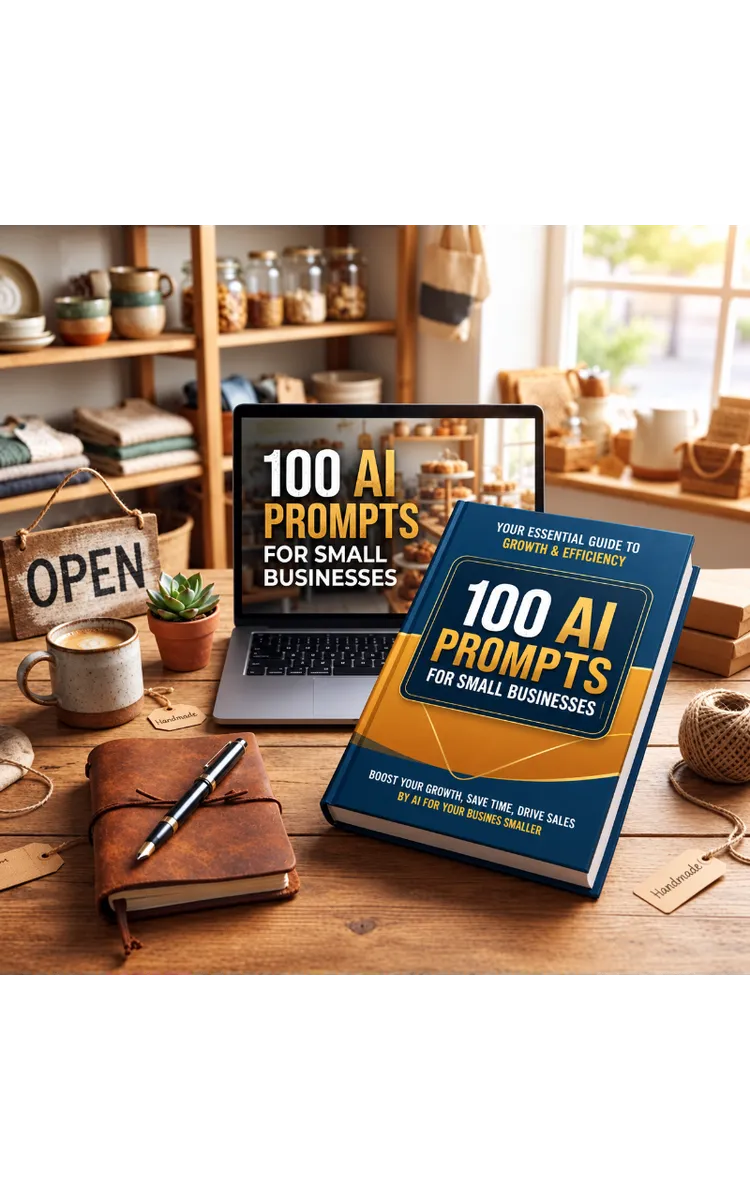
Read the first chapter
The whole of chapter one, free. About 16 min. Turn the pages with the arrows, your keyboard, or a swipe.
Chapter 1
Marketing Prompts (1-34)
Overview
A marketing plan is easier to act on when it names the customer, the problem, the offer, and the next step. The 34 prompts in this chapter help you build those pieces: from a simple marketing plan and customer profile to sharper positioning, stronger offers, campaign ideas, and quick customer research.
Copy each prompt into ChatGPT or a similar free AI assistant, replace the bracketed details, and review the output before using it. The examples focus on practical businesses such as local services, online shops, freelancers, and subscription offers.
The Breakdown
#1: Build a Simple Marketing Plan
Problem: Many small businesses promote whatever comes to mind that week. This creates scattered messages, irregular activity, and no clear way to judge whether marketing is working.
Solution: Ask AI to create a 30-day marketing plan for [BUSINESS NAME]. Include [PRODUCT OR SERVICE], [TARGET CUSTOMER], [COUNTRY OR CITY], [MONTH], [BUDGET], and [MAIN GOAL]. Request weekly objectives, specific actions, suggested channels, content topics, calls to action, and simple measures such as inquiries, bookings, or sales.
Result: You get a usable month-long plan instead of disconnected ideas. Each activity has a purpose and a way to review progress.
#2: Set Marketing Goals
Problem: “Get more customers” is too broad to guide daily decisions. Without a number and a deadline, it is difficult to choose activities or tell whether the plan is on track.
Solution: Use this prompt: “Help me set three practical marketing goals for [BUSINESS NAME] over the next [TIMEFRAME]. My current monthly sales are [AMOUNT], I receive about [NUMBER] inquiries, and my main offer is [OFFER]. Make each goal specific, measurable, realistic, and connected to an action. Include a weekly tracking table.”
Result: Your marketing has clear targets, such as 20 qualified inquiries or 10 booked consultations, rather than vague hopes.
#3: Choose the Best Marketing Channels
Problem: A small business can waste hours trying to post everywhere. The best channel depends on where customers look, what the business sells, and how much time is available.
Solution: Tell AI about [BUSINESS TYPE], [TARGET CUSTOMER], [LOCATION], [PRODUCT OR SERVICE], [AVERAGE PRICE], and [AVAILABLE WEEKLY MARKETING TIME]. Ask it to compare five possible channels, explain the likely use of each, rank them for this business, and recommend one primary and one supporting channel.
Result: You receive a focused channel plan instead of a long list of platforms. This helps protect limited time and budget.
#4: Create a Weekly Marketing Schedule
Problem: Marketing is often postponed because no one has assigned it a place in the week. A plan that does not fit the owner’s actual schedule will not last.
Solution: Ask AI to turn these available work periods - [DAYS AND TIMES] - into a weekly marketing schedule for [BUSINESS NAME]. Include time for creating content, responding to inquiries, following up, checking results, and planning the next week. Keep each task within [NUMBER] minutes.
Result: Marketing becomes a set of manageable work blocks. You can see what to do and when to do it without rebuilding the plan each Monday.
#5: Define the Ideal Customer
Problem: Messages written for “everyone” usually sound general and fail to address a real buying situation. A local gym, for example, should speak differently to a first-time beginner than to an experienced athlete.
Solution: Provide AI with [PRODUCT OR SERVICE], [CUSTOMER AGE RANGE], [LOCATION], [COMMON CUSTOMER TYPE], and [PRICE RANGE]. Ask it to describe the best-fit customer’s situation, goals, frustrations, buying concerns, preferred language, and likely reason for choosing this offer. Tell it to separate facts from assumptions.
Result: You get a practical customer profile that can guide website copy, offers, and campaign ideas without inventing unnecessary personal details.
#6: Segment Customers by Need
Problem: Existing customers may buy the same service for different reasons. One email or advertisement can miss several useful groups.
Solution: Ask AI to divide customers for [BUSINESS NAME] into three to five groups based on need, buying frequency, budget, urgency, or experience level. Include [CUSTOMER DATA OR OBSERVATIONS]. For each group, request its main problem, suitable message, relevant offer, and best call to action.
Result: Your marketing can speak to a specific need instead of sending the same message to every customer.
#7: Map the Customer’s Buying Journey
Problem: Businesses often promote the sale before answering basic questions. A new customer may first need to understand the problem, compare options, check trust, and only then request a quote.
Solution: Use this prompt: “Map the buying journey for a customer considering [PRODUCT OR SERVICE]. Cover five stages: first becoming aware of the problem, learning about solutions, comparing providers, deciding to buy, and returning for another purchase. For each stage, list the customer’s question, concern, useful content, and next action.”
Result: You can match marketing to the customer’s stage instead of asking every visitor to buy immediately.
#8: List Customer Pain Points
Problem: Features describe what you provide, but customers usually act because something is difficult, costly, slow, risky, or frustrating. Missing that problem makes marketing sound like a catalogue.
Solution: Tell AI about [PRODUCT OR SERVICE], [TARGET CUSTOMER], and the situation before purchase. Ask for 10 likely pain points, ranked by urgency, and request a short explanation of how each affects time, money, comfort, confidence, or results. Mark which points need confirmation through customer interviews.
Result: You get specific problems to address in ads, web pages, sales conversations, and offers.
#9: Turn Features into Customer Benefits
Problem: “Three-year warranty,” “online booking,” or “same-day delivery” may be useful, but customers still need to know why each detail matters to them.
Solution: Paste this information into AI: [FEATURES], [PRODUCT OR SERVICE], and [TARGET CUSTOMER]. Ask for a table with four columns: feature, practical meaning, customer benefit, and proof or example. Tell it to avoid exaggerated claims and use plain language.
Result: Technical details become clear reasons to choose the business. The table can support a product page or sales conversation.
#10: Create a Customer Interview Guide
Problem: Quick research often produces weak answers because business owners ask, “Would you buy this?” Customers may say yes politely without describing what they actually do.
Solution: Ask AI to create 10 neutral interview questions for [TARGET CUSTOMER] about [PROBLEM OR PRODUCT IDEA]. Require questions about the customer’s current solution, recent buying experience, cost of the problem, decision factors, and words they use to describe it. Exclude leading questions and requests for compliments.
Result: You get a short interview guide that can reveal real language and buying behavior rather than polite guesses.
#11: Write a Customer Survey
Problem: A survey with 20 broad questions takes too long and produces incomplete answers. Small businesses need focused research they can send by email or a simple form.
Solution: Ask AI to create a survey with no more than eight questions for customers of [BUSINESS NAME]. Include a mix of multiple-choice and short-answer questions about why they bought, what nearly stopped them, what they value most, and what could improve. Add one optional question about future needs.
Result: You have a survey that customers can complete quickly and that produces information you can use in marketing decisions.
#12: Analyze Customer Feedback
Problem: Reviews, messages, and survey responses often sit in separate places. Important patterns - such as repeated complaints about booking or praise for speed - are easy to miss.
Solution: Paste anonymized feedback into AI and request an analysis. Ask it to group comments into repeated needs, complaints, positive points, buying objections, exact customer phrases, and possible improvements. Request the number of comments in each group and ask it not to treat one unusual comment as a general pattern.
Result: Scattered feedback becomes a short list of themes. You can use real customer wording in marketing while spotting problems that need attention.
#13: Write a Brand Positioning Statement
Problem: A business may offer good work but still sound like every competitor. “High quality at great prices” does not explain who the business serves or why it is a better fit.
Solution: Give AI [BUSINESS NAME], [TARGET CUSTOMER], [MAIN PROBLEM], [SERVICE OR PRODUCT], [KEY DIFFERENCE], [LOCATION], and [PROOF]. Ask for five positioning statements using this structure: “For [customer], [business] is the [category] that helps with [problem] by [difference], unlike [alternative].” Keep each under 35 words.
Result: You receive clear starting points for a website headline, profile description, or campaign message.
#14: Find a Clear Point of Difference
Problem: Competitors may offer similar services, prices, and delivery times. A difference that matters must be useful to the customer, not merely interesting to the owner.
Solution: Ask AI to compare [BUSINESS NAME] with [THREE COMPETITOR TYPES OR NAMES]. Provide [SERVICES], [PRICES], [DELIVERY METHOD], [EXPERIENCE], and [CUSTOMER FEEDBACK]. Request possible differences based on speed, simplicity, specialization, service, process, access, or proof. Label each difference as strong, weak, or needing evidence.
Result: You can choose a believable advantage instead of claiming to be “the best” without support.
#15: Create a Message Hierarchy
Problem: Marketing becomes confusing when every feature receives equal attention. Customers need one main idea first, followed by supporting reasons and proof.
Solution: Ask AI to build a message hierarchy for [OFFER]. Include one main promise, three supporting benefits, three proof points, common objections, and one call to action. The message must fit [TARGET CUSTOMER] and remain accurate based on [AVAILABLE EVIDENCE].
Result: Your website, flyer, email, and social posts can repeat the same core message without sounding random.
#16: Improve a Weak Marketing Message
Problem: A message such as “Professional solutions for all your needs” uses space without telling customers what is sold or why they should respond. Weak wording can reduce inquiries even when the service is good.
Solution: Paste the current message into AI and include [PRODUCT OR SERVICE], [TARGET CUSTOMER], [LOCATION], and [DESIRED ACTION]. Ask for five rewrites that state the problem, benefit, difference, and next step. Require plain English, no unsupported claims, and a maximum of [WORD COUNT] words.
Result: You get clearer alternatives that are easier to test across a homepage, advertisement, or business profile.
#17: Build an Offer from a Core Service
Problem: Listing a service and a price may not give customers a strong reason to act now. They may not understand what is included, who it suits, or what happens after purchase.
Solution: Tell AI about [CORE SERVICE], [TARGET CUSTOMER], [PRICE], [DELIVERY TIME], and [CUSTOMER PROBLEM]. Ask it to create three offer versions with a clear outcome, included items, process, timeframe, proof, risk-reducing detail, price presentation, and call to action. Do not add bonuses that the business cannot deliver.
Result: The core service becomes a complete, understandable offer that is easier to compare and buy.
#18: Create a Starter Offer
Problem: New customers may hesitate to commit to a large package, especially when they have not worked with the business before. A smaller first step can reduce uncertainty without discounting everything.
Solution: Ask AI to design a starter offer for [BUSINESS NAME] based on [MAIN SERVICE], [CUSTOMER CONCERN], [NORMAL PRICE], and [DELIVERY CAPACITY]. Include what the customer receives, a suitable price range, limits, upgrade path, and a clear explanation of who should choose it.
Result: You get a low-risk entry offer with clear boundaries and a natural path to the main service.
#19: Package Services into Three Tiers
Problem: One package may be too expensive for some buyers and too limited for others. Customers also struggle when package differences are unclear.
Solution: Ask AI to organize [SERVICES OR FEATURES] into three packages: [BASIC NAME], [STANDARD NAME], and [PREMIUM NAME]. For each, show the best-fit customer, included items, delivery time, price, limits, and upgrade reason. Make the differences meaningful rather than adding random extras.
Result: Customers can compare options quickly, while you can serve different budgets without creating confusing custom quotes.
#20: Create a Limited-Time Offer
Problem: A promotion can lose credibility when the deadline is fake or the discount is unexplained. Poorly planned promotions may also create too many orders for the available capacity.
Solution: Ask AI to create a time-limited campaign for [PRODUCT OR SERVICE] ending on [REAL DATE]. Include the customer problem, offer details, valid reason for the deadline, capacity limit if genuine, terms, channels, and three reminders. Require accurate wording and no false scarcity.
Result: You get a promotion that explains the value and deadline clearly while protecting trust and delivery capacity.
#21: Plan a Seasonal Campaign
Problem: Seasonal marketing often starts too late and focuses only on a discount. Customers may need information, preparation, or booking time before the busy period begins.
Solution: Provide [SEASON OR EVENT], [PRODUCT OR SERVICE], [TARGET CUSTOMER], [IMPORTANT DATE], [ORDER OR BOOKING LEAD TIME], and [BUDGET]. Ask AI for a four-week campaign with weekly goals, message themes, content ideas, email dates, offer details, and a final measurement checklist.
Result: The campaign gives customers enough time to decide and gives the business a clear schedule before demand peaks.
#22: Generate Local Marketing Ideas
Problem: A local business can waste money on broad advertising that reaches people outside its service area. Local opportunities are often more practical and less expensive.
Solution: Tell AI the business type, [CITY OR SERVICE AREA], [TARGET CUSTOMER], [MONTHLY BUDGET], and [AVAILABLE PARTNERS]. Request 15 local marketing ideas grouped into partnerships, community activity, referrals, search visibility, direct outreach, and local content. For each, include the first action, expected effort, and a simple success measure.
Result: You get location-specific ideas that can be tested without a large advertising budget.
#23: Create a Referral Campaign
Problem: Happy customers may recommend a business but forget to do so. A referral request that is vague, badly timed, or difficult to explain will produce few introductions.
Solution: Ask AI to design a referral campaign for [BUSINESS NAME]. Include the best moment to ask, a short customer message, a referral reward that fits [BUDGET OR POLICY], terms, a tracking method, and a reminder sequence. Make the campaign suitable for [CUSTOMER TYPE] and avoid pressuring customers to leave dishonest reviews.
Result: Referral activity becomes a repeatable process with a clear request and a way to track introductions.
#24: Develop a Partnership Campaign
Problem: Businesses with similar customers often operate separately and miss useful partnerships. A vague suggestion to “collaborate” rarely produces a specific action.
Solution: Give AI [BUSINESS TYPE], [CUSTOMER TYPE], [LOCATION], [SERVICES], and three possible partner categories. Ask it to suggest five partnership campaigns. For each, include the shared customer need, partner benefit, joint offer, responsibilities, promotion channels, and a short outreach message.
Result: You receive partnership ideas that explain the value to both businesses rather than asking for a favor.
#25: Create a Campaign Brief
Problem: Marketing tasks become inconsistent when the person writing an ad does not know the campaign goal, audience, offer, or required action. This leads to mixed messages across channels.
Solution: Ask AI to create a one-page campaign brief using [CAMPAIGN NAME], [GOAL], [TARGET CUSTOMER], [OFFER], [KEY MESSAGE], [PROOF], [BUDGET], [DATES], [CHANNELS], and [CALL TO ACTION]. Include required points, words to avoid, content deliverables, approval checks, and success measures.
Result: Anyone working on the campaign has the same instructions. The brief also makes review faster before publishing.
#26: Generate Campaign Angles
Problem: Repeating the same sales message can make a campaign feel stale. A single offer may be relevant for different reasons, such as saving time, reducing risk, or solving an urgent problem.
Solution: Tell AI about [OFFER], [TARGET CUSTOMER], [MAIN PROBLEM], and [PROOF]. Request 10 campaign angles based on different customer priorities: speed, cost control, convenience, confidence, quality, prevention, seasonal timing, expertise, simplicity, and outcome. For each angle, include a headline and one supporting message.
Result: You get varied messages for testing while keeping the same offer and facts.
#27: Turn Customer Questions into Campaign Ideas
Problem: Repeated questions reveal what customers need to understand before buying. If those questions stay in private messages, the same explanation must be written again and again.
Solution: Paste 10 to 20 real customer questions into AI, removing personal information. Ask it to group them by topic and turn each major group into a campaign idea with a headline, key explanation, proof, format, and call to action. Tell it to preserve the customers’ original wording where useful.
Result: Customer conversations become practical marketing content that answers real buying concerns.
#28: Plan a Product Launch
Problem: A launch can become a rush of announcements with no preparation period, explanation, or follow-up. Customers may hear about the product only once and miss the reason to act.
Solution: Provide [PRODUCT], [TARGET CUSTOMER], [PRICE], [LAUNCH DATE], [AVAILABLE PROOF], and [SALES CHANNEL]. Ask AI for a launch plan with preparation, announcement, education, opening, reminder, and follow-up stages. Include the purpose, message, content, email or post idea, and call to action for each stage.
Result: The launch has a sequence that builds understanding before asking for the sale and follows up afterward.
#29: Research Competitor Messages
Problem: Competitor research often stops at copying prices or listing features. That does not show how competitors explain value or where customers may still be underserved.
Solution: Paste public competitor information into AI: [WEBSITE TEXT], [PUBLIC OFFER DETAILS], [REVIEWS], and [BUSINESS TYPE]. Ask it to compare audiences, promises, proof, prices, calls to action, strengths, and gaps. Require a separate section for facts, observations, and questions that need further checking.
Result: You receive a clearer view of the market without treating assumptions as facts or copying another business.
#30: Compare Customer Alternatives
Problem: Customers may compare your offer with doing nothing, doing the work themselves, using a cheaper provider, or choosing a larger company. Ignoring these alternatives leaves important objections unanswered.
Solution: Ask AI to analyze [PRODUCT OR SERVICE] against five alternatives: [ALTERNATIVE 1] through [ALTERNATIVE 5]. For each, list why a customer might choose it, its drawbacks, the situation where your offer is a better fit, and a fair message that explains the difference without attacking competitors.
Result: Your marketing addresses the real choices customers face, not only named competitors.
#31: Run a Quick SWOT Analysis
Problem: A SWOT analysis - strengths, weaknesses, opportunities, and threats - can become a generic list if it is not tied to actual marketing decisions. Broad statements do not show what to do next.
Solution: Give AI [BUSINESS DETAILS], [CUSTOMER FEEDBACK], [COMPETITOR INFORMATION], [BUDGET], and [MARKET OR LOCATION]. Ask for three evidence-based points in each SWOT category, followed by five marketing actions ranked by impact and effort. Mark any point that needs verification.
Result: The analysis produces practical actions, such as improving proof, targeting a neglected customer group, or testing a new channel.
#32: Find Untapped Customer Needs
Problem: A business may focus on its current offer and miss smaller needs around it. Customers might need setup, maintenance, education, faster delivery, or a simpler buying process.
Solution: Ask AI to examine [CURRENT PRODUCT OR SERVICE], [CUSTOMER QUESTIONS], [REVIEWS], and [COMMON COMPLAINTS]. Request 10 unmet or poorly served needs, the evidence for each, the customer group affected, a possible marketing message, and a low-cost way to test the need within 14 days.
Result: You get testable opportunities based on customer problems rather than random product ideas.
#33: Test a Marketing Message
Problem: Owners often choose a message because it sounds good to them. Without a small test, it is hard to know whether customers understand it or respond to it.
Solution: Provide AI with [OFFER], [TARGET CUSTOMER], [CHANNEL], [TEST PERIOD], [BUDGET], and three draft messages. Ask it to create a fair test plan that keeps the audience, offer, and call to action consistent. Include the primary measure, such as qualified inquiries, and a simple rule for deciding what to change.
Result: You can compare messages using useful evidence instead of personal preference. The test also limits wasted spending.
#34: Turn Research into a Marketing Action Plan
Problem: Research has little value if it remains in notes. Customer comments, competitor findings, and survey results must lead to decisions, tests, and deadlines.
Solution: Paste your research into AI, including [CUSTOMER FEEDBACK], [SURVEY RESULTS], [COMPETITOR OBSERVATIONS], [BUSINESS GOAL], and [AVAILABLE RESOURCES]. Ask it to identify the five strongest findings, separate evidence from assumptions, and create a 14-day action plan. Include the message to test, audience, offer, channel, owner, deadline, budget, and success measure for each action.
Result: Research becomes a short execution plan with clear next steps. You can review the evidence after 14 days and decide what to keep, change, or stop.
What Comes Next
The next chapter moves from planning and research into social media prompts for posts, short videos, captions, hooks, content calendars, hashtags, repurposing, and engagement.
End of chapter one. 2 more chapters in the full book.
Swipe or use the arrows to turn the page
What's inside: 3 chapters
- 1. Marketing Prompts (1-34)
- 2. Social Media, Sales, and Customer Service (35-67)
- 3. Business, Product, Research, and Advanced Workflows (68-100)
About this book
"100 AI Prompts For Small Businesses" is a list book by Umwali Laetitia with 3 chapters and approximately 9,971 words. Copy-and-paste AI prompts for small-business marketing, sales, and operations.
This book was created using Inkfluence AI, an AI-powered book generation platform that helps authors write, design, and publish complete books.
Frequently Asked Questions
What is "100 AI Prompts For Small Businesses" about?
Copy-and-paste AI prompts for small-business marketing, sales, and operations
How many chapters are in "100 AI Prompts For Small Businesses"?
The book contains 3 chapters and approximately 9,971 words. Topics covered include Marketing Prompts (1-34), Social Media, Sales, and Customer Service (35-67), Business, Product, Research, and Advanced Workflows (68-100).
Who wrote "100 AI Prompts For Small Businesses"?
This book was written by Umwali Laetitia and created using Inkfluence AI, an AI book generation platform that helps authors write, design, and publish books.
Write your own list book with AI
Describe your idea and Inkfluence writes the whole thing. Free to start.
Start writingCreated with Inkfluence AI


