
Read the first chapter
The whole of chapter one, free. About 7 min. Turn the pages with the arrows, your keyboard, or a swipe.
Chapter 1
Redefining Strength Beyond Comfort
When Ease Starts Making Decisions for You
A gym owner once told me he could tell when business was going too smoothly. His staff handled every problem, his calendar stayed full, and customers kept renewing. He should’ve felt confident. Instead, when a key employee called in sick, he stood behind the counter staring at the schedule like it had personally betrayed him.
Nothing had gone wrong for months. That was the problem.
He hadn’t become incapable. He’d simply stopped practicing discomfort. Every small issue had been solved before it reached him. His confidence was built on smooth conditions, not on his ability to respond when conditions changed.
You may know the pattern. You put off the difficult phone call because there’s still time. You choose the familiar task over the important one. You check your messages, tidy your workspace, or scroll for “just five minutes” before facing the thing that might make you feel exposed. When a plan changes, your first thought isn’t, “What can I do now?” It’s, “Why is this happening to me?”
Then the avoidance quietly charges interest. The job gets heavier in your head. A small repair becomes a crisis because you waited. A conversation becomes frightening because you rehearsed every possible disaster instead of having it. Comfort offers relief today, but it can leave you less prepared tomorrow. Do you recognise yourself in this pattern?
The Question Beneath Your Need for Comfort
What if the life that keeps disappointing you is also the life that keeps you strong?
That question can feel unfair at first. You’re already dealing with enough. Bills, customer complaints, family responsibilities, unfinished jobs, uncertain plans - why would struggle be useful? The answer isn’t that every hardship is good. Some problems are genuinely painful and should be reduced, repaired, or left behind. The shift is recognising that difficulty itself isn’t proof you’re failing. It’s often the place where your confidence gets built.
Confidence based only on comfort is fragile. It says, “I can handle life when people cooperate, money is steady, my body feels good, and the plan works.” Earned confidence says something sturdier: “I can respond when those things don’t happen.” That second kind doesn’t require you to enjoy problems. It requires you to stop treating discomfort as an emergency.
Consider the difference between two workdays. On the first, every appointment runs on time, the supplier delivers early, and no customer asks for a refund. You feel capable. But the feeling depends on the day behaving. On the second, a tool breaks, a customer is angry, and your best worker needs help. You breathe, make the difficult call, adjust the schedule, and finish with a shorter list than you wanted. You’re tired, but something has changed. Your confidence now has evidence behind it.
That’s the beginning of the Earned Strength Compass. It points away from the question, “How do I stay comfortable?” and toward, “What response would make me more capable?” You don’t need to chase hardship. You need to stop wasting the useful difficulty already in front of you.
How Comfort Shrinks Your Response
The weakening usually happens quietly. It can look like this:
1. When you repeatedly remove every small inconvenience from your day, you stop practicing patience, problem-solving, and follow-through. 2. You feel more irritated or uncertain when an unavoidable problem appears. 3. So you delay, complain, blame, or wait for someone else to make the next move. 4. Which leads to less trust in yourself, making the next difficult situation feel even bigger.
The alternative chain is different:
1. When a manageable difficulty appears, you pause before trying to escape it. 2. You feel discomfort, but you name it without turning it into a disaster. 3. So you take one useful action, even if it’s awkward or incomplete. 4. Which leads to evidence that you can meet difficulty, increasing confidence for the next challenge.
Notice what changes. The problem may remain. A late delivery is still late. A hard conversation is still hard. But your position changes. You’re no longer waiting to feel ready before acting. You act, then let readiness catch up.
Try this with one ordinary inconvenience today. If your internet cuts out during work, don’t immediately explode or abandon the task. Use the first ten minutes to write down what you can complete offline, contact support, and rearrange the next hour. That tiny response matters because it teaches your brain, “A disruption is something I can meet.”
Strength is not the absence of pressure; it is your practiced response to pressure.
Take Your Own Strength Reading
These questions aren’t a test you pass by giving impressive answers. They’re a quick reading of where your confidence currently gets its power.
1. When your plan changes unexpectedly, rate your first reaction from 1 to 10. A low number may show flexibility, while a high number can reveal that your confidence depends heavily on control.
2. How often do you choose the easier task when an important task feels uncomfortable? Rate it from 1 to 10. A higher score doesn’t mean you’re lazy. It may show that avoidance has become your fastest way to regulate stress.
3. When something goes wrong, do you usually take one useful action within fifteen minutes? Yes or no. “Yes” suggests you’re building response strength. “No” may reveal that you’re waiting for emotional relief before moving.
4. Can you name three recent difficulties you handled without someone rescuing you? Yes or no. If you can, your confidence has evidence. If you can’t, it may be time to notice how often ease has hidden your own capability.
Use your answers as a starting point, not a verdict. Mostly low ratings and “yes” answers suggest you already have some practice meeting difficulty. Higher ratings and “no” answers point to a specific training ground. Don’t try to fix everything at once. Pick the answer that creates the most friction in your daily life. That’s probably where the Earned Strength Compass has the clearest direction.
The Fifteen-Minute Discomfort Practice
Choose one avoided difficulty and meet it before comfort talks you out of it. This isn’t about creating a dramatic challenge. It’s about using a real, manageable problem to rebuild trust in your response.
1. Name the task - 5 minutes, Easy to Medium. Write one thing you’ve been avoiding because it may create tension, effort, or uncertainty. Make it specific: “Call the supplier about the incorrect order,” not “sort out work.” Set a timer and write the smallest honest next action.
2. Take the first move - within 24 hours, Medium to Hard. Make the call, send the message, open the document, or put on your shoes and begin. Give yourself fifteen focused minutes. You don’t have to finish. You do have to stay with the task long enough to prove that discomfort won’t make the decision for you.
3. Record the evidence - immediately afterward, Easy. Write three lines: what I expected, what actually happened, and what I can handle next time. This matters because your mind may remember the anxiety more vividly than the action. Recording the facts helps confidence grow from evidence instead of mood.
You’ll know it’s working when:
• You start before feeling completely ready. - The problem feels specific rather than like one giant cloud. - You finish with more respect for your ability to respond, even if the outcome isn’t perfect.
Repeat the practice for three days with different small difficulties. Don’t pick something reckless or overwhelming. The point is not to prove you can suffer. The point is to show yourself that a little discomfort can be carried, examined, and answered.
Carrying Strength Into the Next Struggle
Comfort can protect you, but constant comfort can leave you unprepared.
• Confidence built on easy conditions disappears when conditions change. - Difficulty becomes useful when you respond to it instead of automatically escaping it. - The Earned Strength Compass points toward capability, not constant relief. - Small acts of follow-through create evidence that you can trust yourself.
You don’t need a crisis to become stronger. The missed call, delayed payment, awkward conversation, broken tool, and changed schedule are already offering practice. Each one asks the same quiet question: will you let discomfort lead, or will you choose your next action?
The goal isn’t to make life hard for the sake of being hard. It’s to stop confusing a smooth day with proof that you’re strong. Real strength shows up when the day stops cooperating and you still take responsibility for your response.
When the next struggle arrives, what will you do differently before reaching for comfort?
End of chapter one. 7 more chapters and about 12,304 words in the full book.
Swipe or use the arrows to turn the page
What's inside: 8 chapters
- 1. Redefining Strength Beyond Comfort
- 2. Releasing the Need for Instant Rewards
- 3. Taking Ownership Without Self-Blame
- 4. Building Habits Through Daily Friction
- 5. Facing Discomfort Without Avoidance
- 6. Communicating Needs During Conflict
- 7. Recovering Stronger After Setbacks
- 8. Choosing Purpose Over Easy Success
About this book
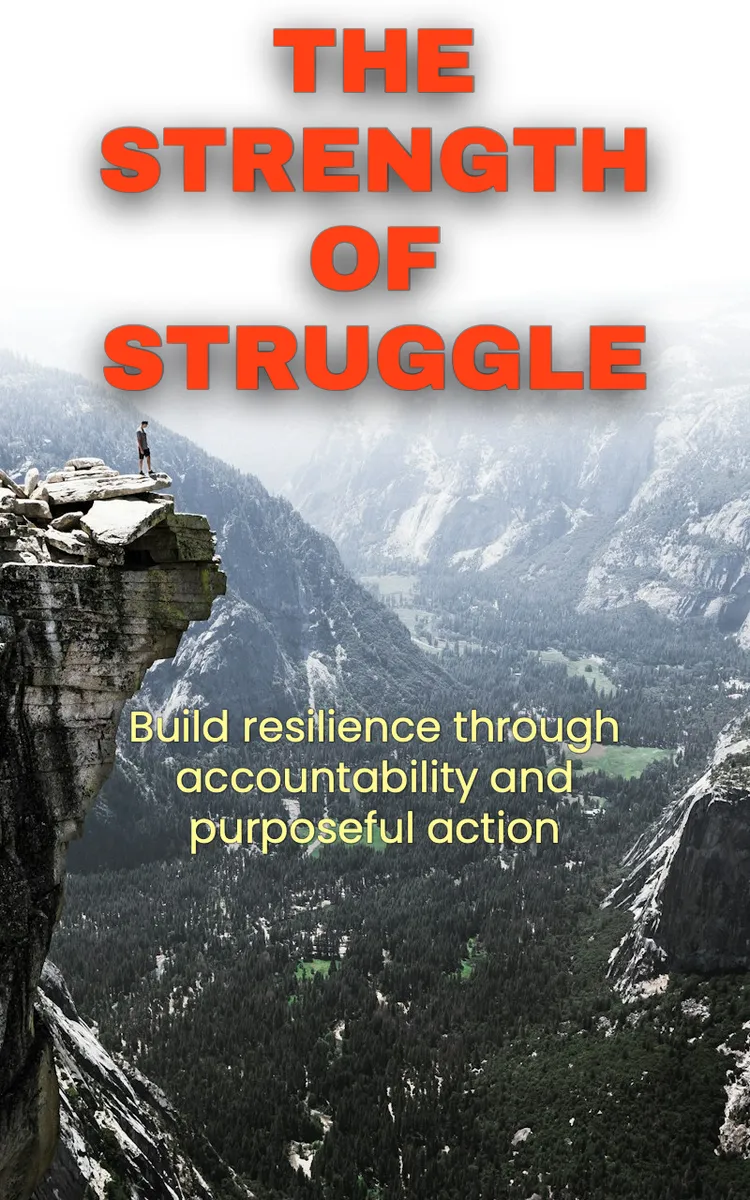
"The Strength Of Struggle" is a self-help book by JJ Ford with 8 chapters and approximately 12,304 words. How everyday struggles build resilience, accountability, and personal growth.
This book was created using Inkfluence AI, an AI-powered book generation platform that helps authors write, design, and publish complete books. It was made with the AI Self-Help Book Writer.
Frequently Asked Questions
What is "The Strength Of Struggle" about?
How everyday struggles build resilience, accountability, and personal growth
How many chapters are in "The Strength Of Struggle"?
The book contains 8 chapters and approximately 12,304 words. Topics covered include Redefining Strength Beyond Comfort, Releasing the Need for Instant Rewards, Taking Ownership Without Self-Blame, Building Habits Through Daily Friction, and more.
Who wrote "The Strength Of Struggle"?
This book was written by JJ Ford and created using Inkfluence AI, an AI book generation platform that helps authors write, design, and publish books.
How can I create a similar self-help book?
You can create your own self-help book using Inkfluence AI. Describe your idea, choose your style, and the AI writes the full book for you. It's free to start.
Write your own self-help book with AI
Describe your idea and Inkfluence writes the whole thing. Free to start.
Start writingCreated with Inkfluence AI


