
Read the first chapter
The whole of chapter one, free. About 6 min. Turn the pages with the arrows, your keyboard, or a swipe.
Chapter 1
Separating Your Identity from Addiction
The Morning You Become a Label
A person wakes after using, sees yesterday’s messages, and feels shame arrive before both feet touch the floor. The phone stays face down. The curtains stay closed. A thought appears: This is who I am now. By breakfast, the thought has grown teeth. You cancel work, avoid someone who cares about you, and promise you’ll “get it together” later.
Then later comes with its own trap. You catch one mistake and use it as evidence for everything: the missed appointment proves you’re unreliable; the relapse proves you’re hopeless; the dark mood proves you’re broken. You may even introduce yourself silently as “an addict” or “a depressed person,” as if those words are your full name. When something good happens, you dismiss it as luck. When something painful happens, you treat it as proof.
The habit isn’t only using a substance or repeating a behavior. It’s shrinking your entire identity around what happened. Do you recognise yourself in that pattern?
What If Addiction Is Something You’re Facing, Not Who You Are?
What if the most honest description of you isn’t “I am addicted,” but “I am a whole person facing addiction”?
That question can feel almost uncomfortable because shame prefers simple labels. A label seems efficient: it explains the past, predicts the future, and gives you one harsh verdict to repeat. But it also hides everything the label leaves out - your patience with a child, your ability to repair a mistake, the work you’ve done, the part of you that still wants a different life.
The Whole-Self Reframe doesn’t ask you to deny addiction or depression. Denial keeps people stuck. It asks you to describe the problem accurately without handing it your entire identity. “I used again” tells the truth about an event. “I’m a failure” turns that event into a life sentence. “Depression is affecting my energy” is honest. “I’m useless” is shame pretending to be a fact.
Consider the difference in an ordinary moment. Before the reframe, you wake late after a difficult night and think, There I go again. I ruin everything. You avoid the email you need to send because answering it would force you to face yourself. After the reframe, you say, I had a setback, and my mood is low. I’m still responsible for the next small choice. You shower, send one sentence to a trusted person, and put the next appointment on your calendar. The day isn’t magically easy. You’ve simply stopped making pain your identity.
The Shame Chain - and the Whole-Self Alternative
Shame often moves quickly enough to feel like truth. Slow it down and you can see the links:
1. When you wake after using, receive a worried text, or notice your mood has crashed, the trigger activates old shame. 2. You feel exposed, guilty, frightened, or numb. 3. So you hide, withdraw, lie, use again, or attack yourself before anyone else can. 4. Which leads to more isolation, more consequences, and stronger proof - at least in your mind - that the shame was right.
The Whole-Self alternative interrupts the chain without pretending the trigger doesn’t matter:
1. When you wake after using, receive a worried text, or notice your mood has crashed, name what happened plainly: “This is a setback and a painful morning.” 2. You feel the shame, but you also notice that feelings are experiences, not identity statements. 3. So you choose one repair action: drink water, answer one safe message, remove access to what you plan to use, or contact your recovery support. 4. Which leads to a small piece of evidence that you are more than the problem: you can respond, repair, learn, and keep moving.
The goal isn’t to feel proud every minute. It’s to stop allowing one painful fact to speak for your whole life.
You are accountable for your actions, but you are larger than your worst action.
Four Honest Checks on Your Self-Image
Use these questions when shame is loud. Rate yourself without trying to earn a good score.
1. From 1 to 10, how strongly do you believe “addiction is what I am” rather than “addiction is something I’m facing”? A high score suggests the problem has taken over your identity language. A lower score shows you’re beginning to separate the condition from the person living through it.
2. Yes or no: After a setback, do you usually avoid people who might care about you? “Yes” may reveal that shame is using isolation as protection. “No” suggests you already have some ability to stay connected while being honest.
3. From 1 to 10, how easily can you name three qualities in yourself that have nothing to do with addiction or depression? A low score doesn’t mean you have no qualities. It means shame has narrowed your attention. A higher score shows your whole self is becoming easier to see.
4. Yes or no: Can you describe one recent mistake without using words such as “always,” “never,” “worthless,” or “hopeless”? “No” points to all-or-nothing thinking, where one event becomes a verdict. “Yes” shows you’re learning to describe behavior without condemning your character.
For the number ratings, a score of 1-3 suggests you may need strong daily reminders and support to challenge the label. A 4-7 suggests the old belief still appears, but you can question it. An 8-10 means you may be able to practice the reframe more independently - while still reaching out when depression makes everything feel heavier. These aren’t grades. They’re a snapshot of the story your mind is telling today.
The Whole-Self Reframe: A Three-Step Challenge
Name the truth without becoming the label
1. Separate the event from the identity. Within the next hour, write one sentence about what happened using observable facts. For example: “I used last night and missed my morning appointment.” Then write: “This is something I did and need to address. It is not the whole of who I am.” Expected difficulty: Medium.
2. Record three pieces of whole-self evidence. Before bed tonight, list three details unrelated to addiction or depression. Keep them concrete: “I made lunch for my daughter,” “I kept an appointment,” “I apologized instead of disappearing,” or “I noticed the urge before acting.” This works because shame filters out evidence that doesn’t fit its verdict. You’re training your attention to include the rest of the picture. Expected difficulty: Easy.
3. Take one repair action within twenty-four hours. Choose one action that matches the situation: send an honest message, reschedule the appointment, tell your support person what happened, or remove one route to getting the substance. Don’t wait until you feel worthy. Repair is how you gather new evidence about yourself. Expected difficulty: Hard.
You’ll know it’s working when...
• You catch yourself saying, “I made a harmful choice,” instead of “I am harmful.” - You can name a strength or value even on a low-mood day. - After a setback, you take one repair step before shame convinces you to disappear.
You Are the Person Who Can Recover
You are not required to hate yourself in order to change.
The Whole-Self Reframe gives you a more accurate place to stand. You can admit the damage addiction has caused and still recognise your capacity to heal. You can take responsibility without turning responsibility into self-punishment. You can feel depressed without treating depression’s message - nothing will change - as a prophecy.
Keep these truths close:
• Addiction and depression describe struggles you’re experiencing; they do not contain your entire identity. - Shame turns actions into labels, while honest language keeps actions specific and changeable. - A setback is information and a call for repair, not proof that recovery is impossible. - Each small response - telling the truth, staying connected, or making amends - builds evidence of the person you’re becoming.
Try asking yourself tonight: If I stopped calling myself the problem, what part of the real problem could I finally face - and what would my next honest step be?
End of chapter one. 4 more chapters and about 7,224 words in the full book.
Swipe or use the arrows to turn the page
What's inside: 5 chapters
- 1. Separating Your Identity from Addiction
- 2. Finding Support That Fits
- 3. Managing Cravings and Low Moods
- 4. Building Routines That Support Recovery
- 5. Preparing for Setbacks Without Shame
About this book
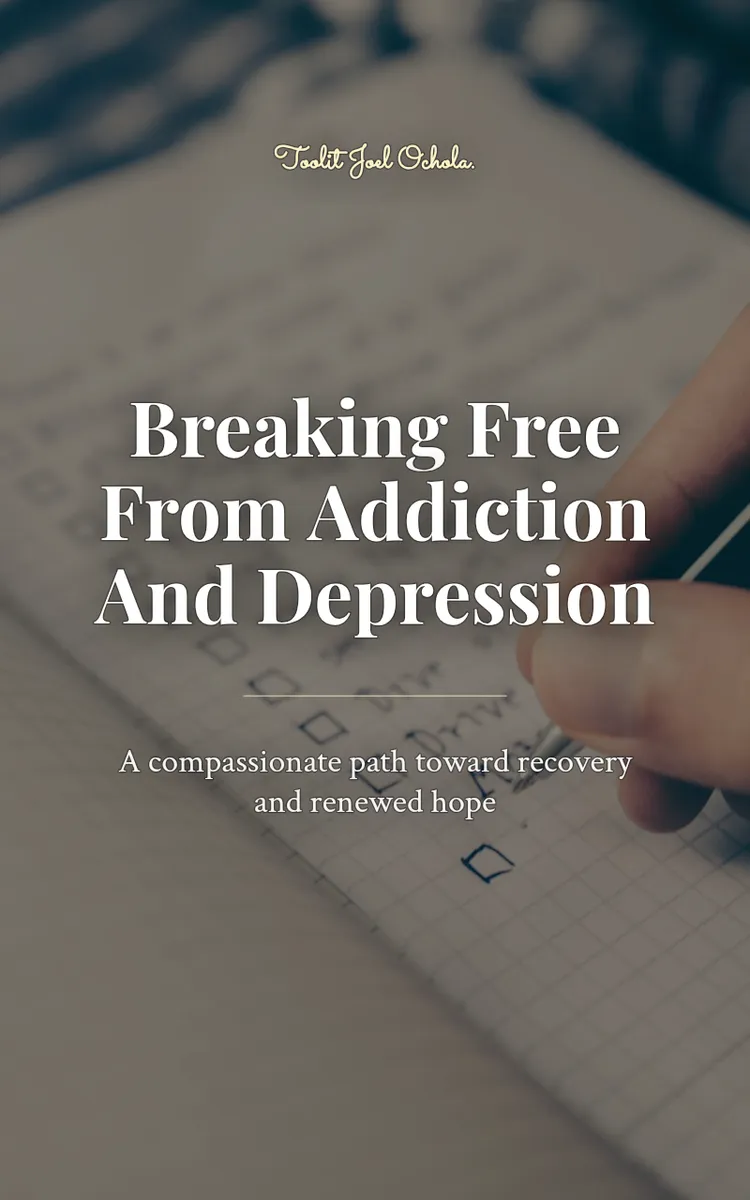
"Breaking Free From Addiction And Depression" is a self-help book by Toolit Joel Ochola. with 5 chapters and approximately 7,224 words. Practical self-help for overcoming addiction-related depression and rebuilding wellbeing.
This book was created using Inkfluence AI, an AI-powered book generation platform that helps authors write, design, and publish complete books. It was made with the AI Self-Help Book Writer.
Frequently Asked Questions
What is "Breaking Free From Addiction And Depression" about?
Practical self-help for overcoming addiction-related depression and rebuilding wellbeing
How many chapters are in "Breaking Free From Addiction And Depression"?
The book contains 5 chapters and approximately 7,224 words. Topics covered include Separating Your Identity from Addiction, Finding Support That Fits, Managing Cravings and Low Moods, Building Routines That Support Recovery, and more.
Who wrote "Breaking Free From Addiction And Depression"?
This book was written by Toolit Joel Ochola. and created using Inkfluence AI, an AI book generation platform that helps authors write, design, and publish books.
How can I create a similar self-help book?
You can create your own self-help book using Inkfluence AI. Describe your idea, choose your style, and the AI writes the full book for you. It's free to start.
Write your own self-help book with AI
Describe your idea and Inkfluence writes the whole thing. Free to start.
Start writingCreated with Inkfluence AI


