
Read the first chapter
The whole of chapter one, free. About 6 min. Turn the pages with the arrows, your keyboard, or a swipe.
Chapter 1
How Your Brain Fills the Gaps
The Story Your Mind Finishes
At 4:47 p.m., a customer sends a short message: “Can you call me?” Nothing else. You’re standing in the back of your shop, halfway through a repair, with grease on your hands and three jobs waiting. For the next twenty minutes, the message keeps returning.
Maybe they’re unhappy. Maybe you missed something. Maybe they’re about to cancel a large order.
You don’t have enough information to know. Still, your mind starts building an explanation. By the time you call, you’re tense and defensive. The customer simply wants to ask whether you can fit in another job next week.
The gap between the message and the phone call was filled by your brain. How often are you making choices based on a story your mind supplied before the facts arrived?
From Missing Information to Made-Up Certainty
Old Belief: I respond to what happened.
New Reality: I respond to what happened plus the meaning my mind added.
Your brain is constantly trying to turn scattered details into a complete experience. A facial expression, a delayed reply, a bill that feels higher than expected - these are pieces of information. Your mind connects them, guesses what’s missing, and creates a story that feels solid enough to act on.
That ability is useful. If you hear a strange rattle in your vehicle, you don’t need to inspect every part before becoming cautious. Your brain notices a pattern and prepares you to respond. The trouble begins when a guess feels like a fact.
Suppose a customer looks at your estimate, goes quiet, and says, “I need to think about it.” You might decide they think your price is unreasonable. You might immediately offer a discount. But perhaps they’re checking their schedule, waiting for a payment to clear, or comparing two start dates. The missing information changes the choice you make. You may lower your price when patience - or one clear question - would have served you better.
The same process shapes happiness. If a friend doesn’t invite you to dinner, your mind may fill the gap with “They’re avoiding me.” You withdraw. The friendship feels colder, which seems to confirm the original story. Your first interpretation has quietly helped create the experience you feared.
The Missing-Piece Map offers a simple pause. Separate what you directly know from what your mind supplied. Then ask what other pieces could fit. You’re not trying to become suspicious of every thought. You’re giving yourself enough room to choose instead of merely react.
When the Missing-Piece Map Takes Over
Your mind fills gaps most aggressively when something matters to you. Uncertainty about money, respect, health, work, or belonging can make a small clue feel enormous. The brain prefers a complete story - even an unpleasant one - to an unfinished question.
A useful way to notice this process is to name three parts: the fact, the filling, and the choice. The fact is what a camera or recording device could capture. The filling is your interpretation. The choice is what you do because of that interpretation.
For example: the fact is “My partner read my message and didn’t reply for six hours.” The filling is “They’re angry with me.” The choice is “I send three sharp follow-up messages.” Once you see the pieces, the choice becomes easier to examine.
Signs this pattern is running your life:
1. You treat silence as an answer. A delayed reply becomes rejection, disrespect, or bad news without a direct statement to support it.
2. You make fast decisions to escape uncertainty. You cancel, apologize, spend, quit, or agree mainly because not knowing feels uncomfortable.
3. You remember your interpretation more clearly than the original event. Weeks later, you recall “They were against me,” though the actual words were much less certain.
4. You collect evidence for one story. Each new detail is used to prove your first guess, while details that don’t fit are brushed aside.
A missing piece can guide your behavior, but it doesn’t deserve to become the whole picture.
This is why awareness matters. Your brain isn’t trying to sabotage you. It’s trying to protect you from confusion and delay. But a protective guess can still lead to an expensive decision, a needless argument, or a missed opportunity.
Questions That Put You Back in the Room
1. What is one recent decision you made from a feeling of certainty, even though you had incomplete information? Write down the exact facts available at the time. Then write the conclusion you drew. Seeing the two side by side often reveals how much extra material your mind added.
2. When someone is quiet or slow to respond, what explanation do you usually reach for first? Is it rejection, criticism, disappointment, or loss of control? Your first explanation may point to an old fear rather than the current situation.
3. What action do you take when your story feels true? Do you send another message, offer a discount, become cold, or avoid asking a direct question? The action matters because it shows how an invisible interpretation becomes a visible result.
4. What are three other explanations that fit the same facts? If a coworker leaves a meeting without speaking to you, possible explanations might include tiredness, a personal emergency, or simple distraction. You don’t have to believe all three. You’re loosening the grip of the first story.
5. What information would actually settle the question? Sometimes the answer is a calm conversation. Sometimes it’s waiting until tomorrow, checking the paperwork, or asking for the customer’s priorities. Name the missing piece instead of wrestling with every possible story.
These questions aren’t meant to make you endlessly analyze ordinary life. They’re most useful when a choice feels urgent, emotional, or strangely personal. That’s usually when your mind is doing the most filling.
The Seven-Day Missing-Piece Map
Challenge: Map One Gap a Day
For the next seven days, choose one moment each day when you notice uncertainty shaping your mood or behavior. Use the following notes in your phone or on paper:
• Fact: What happened that could be recorded plainly? - Story: What meaning did your mind add? - Feeling: What emotion followed? - Choice: What did you do, or what are you tempted to do? - Missing piece: What information would give you a clearer view? - Next move: What is one calm action that doesn’t depend on your story being true?
Keep each entry under five minutes. Don’t choose only dramatic moments. A small example - such as assuming a late delivery means a supplier is unreliable - can teach you as much as a difficult argument.
Expected difficulty: Medium
You’ll know it’s working when:
• You catch yourself saying, “That’s my interpretation,” rather than “That’s what happened.” - You pause before sending a message meant to force reassurance. - You ask a clearer question instead of making a faster assumption. - You notice two or three possible explanations without feeling required to solve them immediately. - Your next action becomes smaller, calmer, and more connected to what you actually know.
The goal isn’t to replace every negative thought with a cheerful one. That can feel fake, and your mind will know it. The goal is to make your thinking more accurate and your choices less controlled by invisible guesses.
A Fuller Picture, One Piece at a Time
Your brain will always complete patterns. It has to. Without that ability, a half-heard sentence, a familiar face, or a changing situation would remain disconnected fragments. The answer isn’t to stop imagining. It’s to notice when imagination has crossed the line into certainty.
• You learned to separate a direct fact from the story built around it. - You saw how incomplete information can shape spending, conversations, work decisions, and relationships. - You practiced the Missing-Piece Map: fact, story, feeling, choice, missing piece, next move. - You found a way to pause without becoming passive or lost in analysis.
Happiness becomes easier to choose when you stop mistaking your first explanation for the whole truth.
The next time a gap appears, you don’t need to fill it immediately. You can hold the unfinished moment long enough to ask a better question. That small pause changes what you notice - and, with it, what you’re able to choose.
End of chapter one. 38 more chapters and about 57,959 words in the full book.
Swipe or use the arrows to turn the page
What's inside: 39 chapters
- 1. How Your Brain Fills the Gaps
- 2. Seeing the Mind’s Simulations
- 3. Why Prediction Feels Like Fact
- 4. Naming Your Emotional Blind Spots
- 5. Updating the Story of Yourself
- 6. Questioning Your Happiness Forecast
- 7. Escaping the Ideal-Life Fantasy
- 8. Choosing Values Over Applause
- 9. Making Peace with Uncertainty
- 10. Revising the Meaning of Failure
- 11. Escaping the Comparison Loop
- 12. Making Better Everyday Decisions
- 13. Testing Choices Before Committing
- 14. Choosing Goals You Can Live
- 15. Building Habits That Lift Mood
- 16. Designing a Happier Environment
- 17. Practicing Attention on Purpose
- 18. Making Gratitude Feel Specific
- 19. Savoring What Is Already Good
- 20. Balancing Pleasure with Meaning
- 21. Strengthening Everyday Relationships
- 22. Listening Beyond Your Assumptions
- 23. Asking Clearly for What You Need
- 24. Setting Boundaries Without Resentment
- 25. Repairing Conflict with Perspective
- 26. Making Work Feel More Meaningful
- 27. Redefining Success on Your Terms
- 28. Spending Money for Real Well-Being
- 29. Making Room for Rest
- 30. Responding Wisely to Difficult Emotions
- 31. Recovering from Disappointment
- 32. Building Resilience Through Small Wins
- 33. Learning from Your Actual Experience
- 34. Keeping a Useful Happiness Record
- 35. Adapting When Life Changes
- 36. Finding Purpose in Ordinary Days
- 37. Turning Kindness into a Practice
- 38. Creating Your Personal Happiness Plan
- 39. Synthesizing Happiness as You Go
About this book
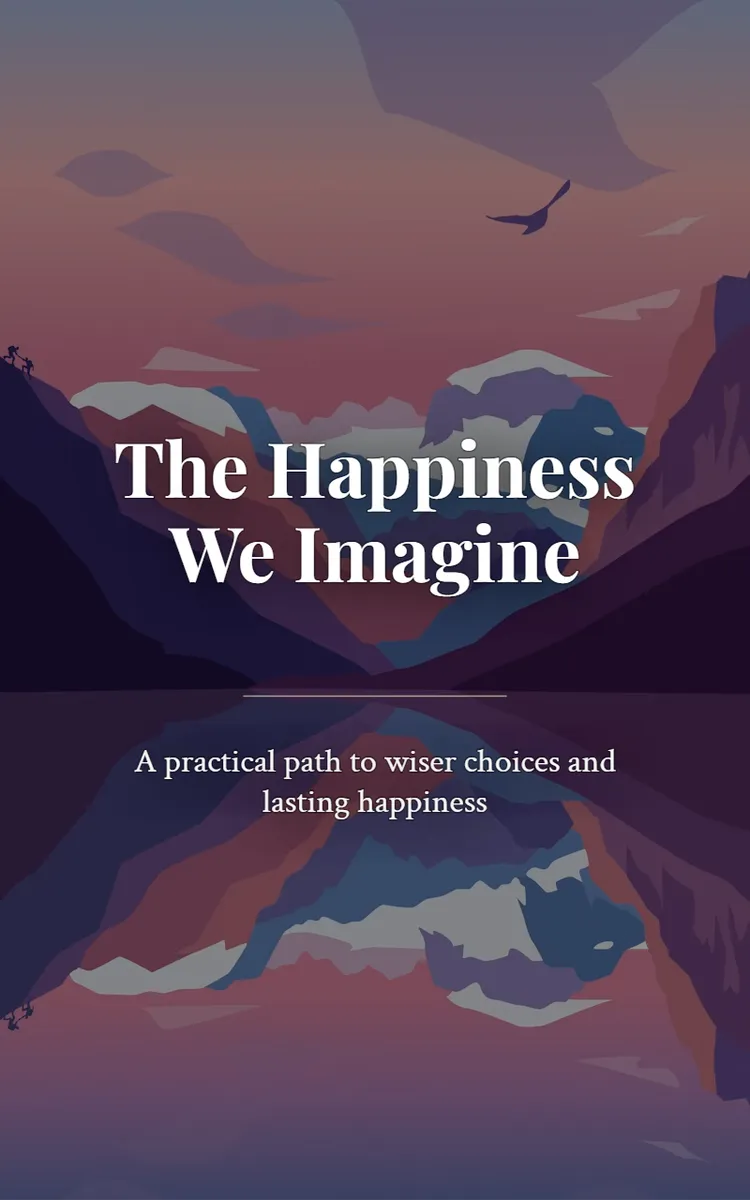
"The Happiness We Imagine" is a self-help book by Anonymous with 39 chapters and approximately 57,959 words. How imagination shapes decisions and how behavior can cultivate happiness.
This book was created using Inkfluence AI, an AI-powered book generation platform that helps authors write, design, and publish complete books. It was made with the AI Self-Help Book Writer.
Frequently Asked Questions
What is "The Happiness We Imagine" about?
How imagination shapes decisions and how behavior can cultivate happiness
How many chapters are in "The Happiness We Imagine"?
The book contains 39 chapters and approximately 57,959 words. Topics covered include How Your Brain Fills the Gaps, Seeing the Mind’s Simulations, Why Prediction Feels Like Fact, Naming Your Emotional Blind Spots, and more.
Who wrote "The Happiness We Imagine"?
This book was written by Anonymous and created using Inkfluence AI, an AI book generation platform that helps authors write, design, and publish books.
How can I create a similar self-help book?
You can create your own self-help book using Inkfluence AI. Describe your idea, choose your style, and the AI writes the full book for you. It's free to start.
Write your own self-help book with AI
Describe your idea and Inkfluence writes the whole thing. Free to start.
Start writingCreated with Inkfluence AI


