

Read the first chapter
The whole of chapter one, free. About 11 min. Turn the pages with the arrows, your keyboard, or a swipe.
Chapter 1
Prayer as Ministry
Prayer as Faith-Filled Service Before God
A hospital room, a prison cell, and a local church prayer gathering may look unrelated, yet Scripture places them within the same ministry: believers bringing people and circumstances before God. When the church prays, it does not merely express religious feeling. It serves the living God, agrees with his revealed will, and participates in his work in the world. Paul therefore describes prayer as a ministry when he urges “supplications, prayers, intercessions, and thanksgivings” for all people (1 Timothy 2:1).
This foundation matters because prayer is often reduced either to private comfort or to a method for obtaining desired results. Scripture presents a fuller vision. Prayer is fellowship with the Father through the Son, empowered by the Holy Spirit, offered in faith, governed by God’s will, and directed toward the good of others and the advance of God’s kingdom. Earlier teaching about God’s character, Christ’s saving work, and the Spirit’s presence reaches practical expression here: prayer is how redeemed people serve before God.
Learning Objectives
• Define prayer biblically, including the significance of key Hebrew and Greek terms.
• Explain prayer’s purposes, scope, and place within Christian ministry.
• Distinguish faith-filled intercession from fear-driven prayer and attempts to control others.
Prayer begins with God’s initiative. The Father invites his children to approach him through Christ (Hebrews 4:14-16). Jesus says, “When you pray, say: ‘Father’” (Luke 11:2). The Greek word proseuchē, commonly translated “prayer,” points to directed communion with God; it is not merely inward reflection. Another Greek term, enteuxis, translated “intercession,” carries the sense of approaching on behalf of another (1 Timothy 2:1). In the Old Testament, the Hebrew verb palal means to pray or intercede, emphasizing an appeal made before God (1 Samuel 1:10-15). These terms show prayer as personal approach and representative service.
Prayer is also an act of faith. Faith does not mean persuading God to surrender his wisdom. It means trusting his character and responding to his promise. “Without faith it is impossible to please him” (Hebrews 11:6), and Jesus teaches, “Whatever you ask in prayer, believe that you have received it, and it will be yours” (Mark 11:24). Faith therefore rests on God’s revealed will rather than human desire. First John 5:14 gives the necessary boundary: “If we ask anything according to his will he hears us.”
Ask yourself: when a prayer request is presented, is the request shaped by Scripture, or only by urgency? The distinction matters. Jesus prayed in Gethsemane, “Not my will, but yours, be done” (Luke 22:42). That surrender was not unbelief; it was perfect faith in the Father’s wisdom. Biblical faith can ask boldly while remaining submitted.
Prayer’s purposes are broad. It includes worship and thanksgiving (Psalm 95:6; Philippians 4:6), confession of sin (Psalm 32:5; 1 John 1:9), petition for needs (Matthew 6:11), intercession for others (Ephesians 6:18), spiritual resistance (Matthew 6:13; Ephesians 6:10-18), healing (James 5:14-16), guidance (Acts 13:2-3), and the strengthening of mission (2 Thessalonians 3:1). These are not separate religious activities disconnected from ministry. They are ways believers serve God and people through dependence upon him.
The scope of prayer reaches “all people,” rulers, enemies, churches, workers, the sick, the oppressed, and those who do not yet know Christ (1 Timothy 2:1-4; Matthew 5:44; Colossians 4:2-4). Prayer does not authorize us to control another person’s will. Jesus commands prayer for enemies, not prayer that manipulates them into serving our preferences (Matthew 5:44). The aim is blessing, repentance, justice, salvation, and God’s will - not domination.
Jesus both taught and modeled this ministry. He withdrew to lonely places to pray (Luke 5:16), prayed before selecting the Twelve (Luke 6:12-13), prayed for Peter’s faith (Luke 22:31-32), gave thanks before multiplying bread (John 6:11), and prayed for the unity and sanctification of his people (John 17:9-23). He also corrected public prayer performed to gain human approval (Matthew 6:5-8). Prayer’s value is not measured by volume, length, or public recognition, but by truthful dependence on God.
The Holy Spirit leads this service. “The Spirit himself intercedes for us with groanings too deep for words” (Romans 8:26), and believers are commanded to pray “in the Holy Spirit” (Jude 20). This includes listening to Scripture, receiving wisdom, recognizing burdens, and allowing the Spirit to direct petitions. Spiritual language and supernatural gifts belong within the Spirit’s ministry, but they must serve edification and order (1 Corinthians 12:7-11; 14:26-33). Faith-filled confession likewise means agreeing with God’s truth. We confess Christ as Lord (Romans 10:9), confess sin honestly (1 John 1:9), and speak God’s promises with trust, while refusing to treat words as a technique that forces God’s hand (2 Corinthians 1:20; James 4:3).
History gives visible examples of prayer’s ministry. In 1857, a modest prayer meeting begun by Jeremiah Lanphier in New York City grew rapidly during a season of spiritual awakening; contemporary reports record large gatherings devoted to confession, intercession, and evangelistic concern. In 1949, Duncan Campbell’s ministry during the Hebrides Revival was closely associated with sustained prayer and repentance, though accounts of revival should be weighed carefully and tested by Scripture. More recently, medical literature has documented cases in which people experienced unexpected recovery, while also showing that prayer studies do not place God under laboratory control. Christians may gratefully testify to healing, but they must not shame the sick or promise a uniform outcome. Scripture calls the church to pray for healing (James 5:14-16) and to trust God amid suffering (2 Corinthians 12:7-10).
The central definition can now be stated plainly: prayer is faith-filled service before God in which believers, through Christ and by the Holy Spirit, worship, confess, ask, intercede, resist evil, and seek the fulfillment of God’s will. Its supernatural results depend on God’s sovereign action, not on human pressure. The practical takeaway is to evaluate every prayer by three questions: Does it honor God? Does it agree with Scripture? Does it seek the good of people rather than control them?
The Ministry Pattern: Approach, Agreement, and Action
A useful biblical pattern for prayer ministry has three movements: approach God, agree with God, and act in obedience. These movements are not a rigid formula, but they help prevent prayer from becoming either vague emotion or self-directed demand.
Approach - Come to God through Jesus with reverence and confidence. Hebrews 10:19-22 grounds access to God in Christ’s blood, not in the intercessor’s spiritual performance. The believer may come boldly, but boldness is not arrogance. It is confident access based on grace. A church leader praying for a grieving family, for example, does not approach God claiming personal authority over every outcome. The leader approaches as one welcomed by the Father through the Son.
Agreement - Let Scripture and the Holy Spirit shape the request. Jesus teaches disciples to pray, “Your kingdom come, your will be done” (Matthew 6:10). Agreement includes naming God’s promises, confessing sin, rejecting fear, and asking for wisdom. When Paul prayed about his “thorn,” he asked repeatedly for its removal, but received sustaining grace rather than the outcome he first requested (2 Corinthians 12:7-10). Faith was present both in the request and in the continued obedience.
Action - Receive and obey the direction God gives. Prayer is not an escape from ministry; it equips ministry. The church in Acts prayed, received boldness, and spoke the word (Acts 4:29-31). The believers at Antioch fasted and prayed, then sent Barnabas and Saul into mission (Acts 13:1-4). Prayer may lead to a hospital visit, a financial gift, a difficult conversation, a public stand for justice, or patient waiting. James warns against offering religious words to people in need while withholding practical help (James 2:15-17).
A prayer ministry must also distinguish petition from intercession. Petition asks God to act regarding a need, as in “Give us this day our daily bread” (Matthew 6:11). Intercession brings another person or group before God, as Moses did for Israel after the golden calf (Exodus 32:30-32), and as Jesus does for his disciples (John 17:6-19). Both are service, but intercession requires the discipline of seeking another’s good rather than using prayer to rehearse personal resentment.
Prayer warfare must be equally biblical. Paul identifies spiritual opposition but directs believers to stand in God’s armor, truth, righteousness, faith, salvation, Scripture, and prayer (Ephesians 6:10-18). The goal is not sensational language or fear-driven speculation. It is steadfast resistance to sin, deception, accusation, and demonic opposition under Christ’s authority. Jesus answered Satan with Scripture (Matthew 4:1-11). The church prays for deliverance, but it does not magnify darkness above Christ’s victory (Colossians 2:15).
Fear can distort prayer in two directions. It may produce panic, as though God were reluctant to help, or it may produce controlling prayers aimed at forcing people to change. Scripture answers both distortions. Jesus says, “Do not be anxious” about necessities, because the Father knows what his children need (Matthew 6:25-33). Paul directs believers to present requests with thanksgiving, and promises God’s guarding peace (Philippians 4:6-7). Prayer for a rebellious person should seek repentance and restoration, not emotional pressure or manipulation (Galatians 6:1; 2 Timothy 2:25-26).
The ministry of prayer therefore includes discernment. A request for healing should be made with compassion and faith, while refusing condemnation when healing is delayed. A request for provision should be joined to stewardship and generosity (Philippians 4:19; 2 Corinthians 9:6-11). A request for justice should be joined to personal righteousness and mercy (Micah 6:8; Luke 18:7-8). Prayer does not replace responsible action; it directs responsible action under God.
The takeaway is simple but demanding: approach God through Christ, agree with Scripture by the Spirit, and act in obedience. This pattern keeps prayer centered on ministry rather than self-display.
A Worked Example of Intercession for Healing and Wisdom
Consider the biblical instruction in James 5:14-16: when someone is sick, the elders of the church are to pray, anoint with oil in the Lord’s name, confess sins, and call upon God for healing. The passage provides a concrete ministry pattern while also preserving humility before God.
• Identify the need accurately.
The request is for a church member facing a serious illness. The elders do not claim that every symptom is caused by personal sin, because Jesus rejects that simplistic conclusion in John 9:1-3. They gather medical information respectfully and encourage appropriate treatment, since Luke was a physician and accompanied Paul (Colossians 4:14).
• Clarify the ministry purpose.
The purpose is not to demonstrate the elders’ power or pressure the sick person into a public testimony. The purpose is to seek healing, peace, wisdom, and God’s glory. Jesus prayed for Lazarus’s situation in a way that directed attention to the Father’s glory (John 11:4, 41-42).
• Approach through Christ.
The elders confess their dependence on Jesus, the mediator between God and humanity (1 Timothy 2:5). They do not rely on a special building, emotional intensity, or a formula. They come because Christ gives access and because James commands the church to pray.
• Listen for the Spirit’s direction.
They read James 5:14-16, Psalm 103:1-5, and Romans 8:26-28. They ask whether there is any known sin requiring confession, without turning the illness into an accusation. They invite the sick person to share concerns and consent to anointing, because ministry must honor the person’s dignity and freedom (1 Corinthians 14:40; 1 Peter 5:2-3).
• Make a faith-filled request.
The prayer asks specifically for healing, wisdom for physicians, strength for the family, and grace for each day. It rejects fear and refuses to command God as though he were obligated by human speech. The elders may say, “Father, in Jesus’ name, we ask you to heal this body and guide every decision. We trust your will shall be done, and give this family peace and courage.”
• Act on the answer God gives.
If the person improves, the church gives thanks and records the testimony carefully rather than exaggerating details (Luke 17:15-18). If treatment continues, the church continues practical care and prayer. If the person dies, the church does not declare that insufficient faith caused the death. It grieves in hope because Christ is the resurrection and the life (John 11:25-26; 1 Thessalonians 4:13-18). This is not a compromise of faith but confidence that God is working his will for his good pleasure.
• Evaluate the ministry by Scripture.
The elders ask whether they honored the sick person, followed James, welcomed medical wisdom, resisted fear, and kept Christ central. The outcome is not measured only by immediate physical recovery. Healing is a biblical hope and promise, but faithful ministry also includes peace, repentance, endurance, reconciliation, and witness to Christ.
Final result: the church prays boldly for healing while submitting the outcome to God, caring for the whole person, and refusing both fear and manipulation. That is faith-filled service before God. It leaves room for miracles without turning prayer into a technique, and it leaves room for lament without treating lament as unbelief. Faith-filled prayer is agreeing with God's Word and trusting Him to hear our prayer.
Practice and Answer Key
• Define prayer as ministry in one sentence.
Hint: Include the believer’s access to God, the role of Christ and the Spirit, and service toward others.
• A church member asks you to pray that a relative will be forced to end a relationship. How should you reshape the request?
Hint: Compare Matthew 5:44, Galatians 6:1, and 1 Timothy 2:1-4.
• What is the difference between petition and intercession?
Hint: Use the Lord’s Prayer and Moses’s prayer for Israel as examples.
• Why does praying “according to God’s will” not mean praying without faith?
Hint: Read 1 John 5:14, Mark 11:24, and Luke 22:42 together.
• List two actions that may follow a prayer meeting for a sick person.
Hint: James 5:14-16 and James 2:15-17 connect prayer with both spiritual and practical care.
Answer Key: Prayer is faith-filled service before God through Christ and by the Spirit, seeking God’s will and the good of people. A controlling request should become prayer for wisdom, repentance, protection, and restoration. Petition presents a need; intercession presents another person before God. Submission to God’s will is faith because it trusts his character and wisdom while asking boldly. Appropriate actions include anointing and continued prayer, medical support, meals, transportation, and care for the family. When the church prays this way, prayer becomes more than preparation for ministry: it is ministry itself.
End of chapter one. 32 more chapters and about 66,985 words in the full book.
Swipe or use the arrows to turn the page


What's inside: 33 chapters
- 1. Prayer as Ministry
- 2. Biblical Words for Prayer
- 3. Prayer in the Biblical Story
- 4. God’s Character and Prayer
- 5. Jesus’ Teaching on Prayer
- 6. The Lord’s Prayer
- 7. Jesus’ Prayerful Practice
- 8. Prayer in the Early Church
- 9. Faith, Trust, and Asking
- 10. Confession and the Spoken Word
- 11. Praying God’s Will
- 12. The Holy Spirit in Prayer
- 13. Praying in the Spirit
- 14. Intercession for Others
- 15. Abraham, Moses, and Intercession
- 16. Hannah, David, and Lament
- 17. Daniel’s Disciplined Prayer
- 18. Fasting and Prayer
- 19. Spiritual Warfare and Prayer
- 20. Healing Prayer and Anointing
- 21. Miracles and Divine Response
- 22. How God Answers Prayer
- 23. Persistence Without Presumption
- 24. Prayer, Fear, and Anxiety
- 25. Consent, Agency, and Prayer
- 26. Corporate Prayer Leadership
- 27. Prayer in Pastoral Ministry
- 28. Prayer and Mission
- 29. Historical Prayer Movements
- 30. Contemporary Prayer Testimonies
- 31. Researching Prayer and Healing
- 32. Theologians and Prayer Traditions
- 33. Prayer Ministry Resources
About this book
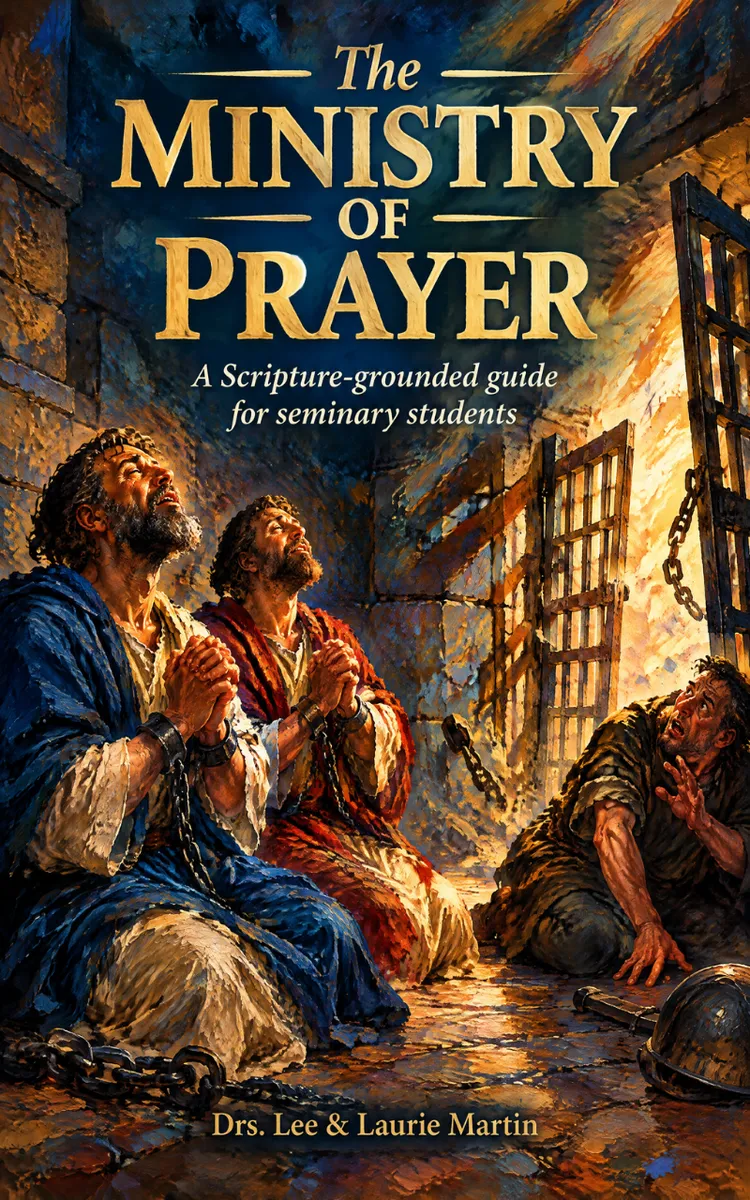
"The Ministry Of Prayer" is a education book by Drs. Lee & Laurie Martin with 33 chapters and approximately 66,985 words. Biblical prayer ministry, intercession, spiritual warfare, faith, and the Holy Spirit.
This book was created using Inkfluence AI, an AI-powered book generation platform that helps authors write, design, and publish complete books. It was made with the AI Lesson Plan Generator.
Frequently Asked Questions
What is "The Ministry Of Prayer" about?
Biblical prayer ministry, intercession, spiritual warfare, faith, and the Holy Spirit
How many chapters are in "The Ministry Of Prayer"?
The book contains 33 chapters and approximately 66,985 words. Topics covered include Prayer as Ministry, Biblical Words for Prayer, Prayer in the Biblical Story, God’s Character and Prayer, and more.
Who wrote "The Ministry Of Prayer"?
This book was written by Drs. Lee & Laurie Martin and created using Inkfluence AI, an AI book generation platform that helps authors write, design, and publish books.
How can I create a similar education book?
You can create your own education book using Inkfluence AI. Describe your idea, choose your style, and the AI writes the full book for you. It's free to start.
Write your own education book with AI
Describe your idea and Inkfluence writes the whole thing. Free to start.
Start writingCreated with Inkfluence AI


