

Read the first chapter
The whole of chapter one, free. About 10 min. Turn the pages with the arrows, your keyboard, or a swipe.
Chapter 1
The Harbor Pages Exchange
Julia Hart pressed the last brass thumbtack into the corkboard and watched it bend.
“Of course,” she muttered. “Even office supplies can sense fear.”
The flyer sagged beneath the tack, its blue border curling in the damp October air that slipped through the propped-open shop door. HARBOR PAGES LETTER EXCHANGE, it announced in careful lettering. WRITE TO SOMEONE NEW. NO NAMES REQUIRED. OPT IN. Julia had printed two hundred copies and trusted none of them to stay flat.
Outside, Sweetwater Harbor smelled of rain, salt, and chimney smoke. Inside, Harbor Pages smelled of paper, cinnamon from the café next door, and the nervous energy of people arriving early to see whether her idea would become a community tradition or an embarrassing pile of envelopes.
She wanted the room full.
Not merely busy. Not politely interested. Full enough that no one could dismiss the exchange as another charming little project destined to fade after the centennial decorations came down.
At half past six, the bell above the door gave up trying to keep count.
People crowded between the fiction shelves and the display table Julia had cleared for the project. A dozen envelopes lay in neat rows beneath handwritten signs: FIRST LETTERS, RESPONSES, SEALED FOR DELIVERY. Each participant had filled out a small card choosing what they were comfortable sharing - books, history, recipes, local walks, nothing personal. Julia had made the rules plain. No pressure. No promises. No contact beyond the exchange unless both people agreed.
Still, every time someone dropped a letter into the basket, she felt as if they were placing a small, bright piece of trust in her hands.
“Julia,” Rose called from the front window, “the basket is full.”
“It’s supposed to be full.”
“It is full enough to become a fire hazard.”
Julia turned sideways through the crowd. Rose stood beside the old reading chair, one hand braced on its carved wooden arm and the other holding an envelope decorated with a tiny painted lighthouse.
“That one is not going in the basket,” Julia said.
Rose lifted her eyebrows. “Then where does it go?”
“Your pocket, apparently.”
Rose smiled and tucked it into her cardigan. “You’re very authoritative tonight.”
“I’m wearing the clipboard.”
“That explains everything.”
The bell rang again. Marcus Hale stepped inside, bringing a gust of cold air and the sharp, wet scent of the harbor with him.
Julia’s fingers tightened around the clipboard.
Marcus was thirty-four, though he carried himself like a man who had spent ten years expecting every room to produce evidence against him. His dark hair was wet at the temples. He wore a gray coat, a notebook tucked under one arm, and the expression he reserved for public meetings, bad statistics, and Julia Hart when she had just made an announcement he intended to question.
His gaze moved over the crowded shop before settling on her.
“Looks successful,” he said.
It was not quite praise. With Marcus, praise usually arrived disguised as a warning.
“Thank you,” Julia said. “I’ve been practicing.”
“For what?”
“Being successful.”
A few people nearby laughed. Marcus’s mouth shifted, almost a smile, but the expression vanished before she could decide whether she had imagined it.
He stepped farther inside. The door swung shut, muting the rain and trapping them all in the warm, close shop. His shoulder brushed a hanging strand of paper stars. He caught one before it fell, smoothed its crease with his thumb, and pinned it back into place.
Julia noticed the gesture despite herself. Marcus handled fragile things carefully when he thought no one was watching.
“You came to cover the launch?” she asked.
“I came to ask questions.”
“There’s a refreshments table.”
“I saw it.”
“Then you may ask questions while holding a biscuit. It makes you look less threatening.”
“I’m not threatening.”
“You wrote that the inn’s recovery appeal had ‘more sentiment than documentation.’”
His attention sharpened. “That was accurate.”
The room seemed to contract around them. Conversation continued in pockets, but Julia felt the shift. People were listening without appearing to listen. The inn sat three blocks uphill, its faded white porch facing the water. The centennial committee had chosen it as the centerpiece of the town’s history display, and the recovery appeal was meant to restore the roof, repair the foundation, and reopen several rooms before the summer celebrations.
Julia had volunteered Harbor Pages as a place to collect letters connected to the town’s history. Marcus had written that the appeal’s public figures did not yet explain where every dollar would go.
“Accurate isn’t the same as fair,” she said.
“It is when the missing details matter.”
“They’re working on the details.”
“After the donations started?”
“After people realized the forms were written for accountants instead of neighbors.”
His jaw tightened. “Neighbors deserve to know what they’re giving to.”
“And donors deserve not to have their hope treated like evidence of stupidity.”
The words landed harder than she intended. Marcus glanced toward the people nearest the letter table, then lowered his voice.
“I didn’t call anyone stupid.”
“You didn’t have to. You made generosity sound reckless.”
“I made uncertainty sound uncertain.”
Julia laughed once, without humor. “There’s your favorite shield.”
His eyes flicked to her face. “You think skepticism is a shield?”
“I think you use it whenever caring would require you to stand somewhere visible.”
For a second, the noise in the shop fell away. Marcus looked as if she had reached across the argument and touched something he kept covered.
Then he closed the notebook.
“That’s a convenient theory from someone who printed ‘no names required’ in letters large enough to read from the street.”
The remark struck closer than it should have. Julia glanced at the flyers, at the careful promise of anonymity.
“I’m giving people room to be honest.”
“Or room to avoid consequences.”
“Not everyone wants to be cross-examined before writing a sentence.”
“I’m not cross-examining anyone.”
“You arrived with a notebook.”
“I’m a journalist.”
“You say that as if it excuses the notebook.”
A woman at the response table asked Julia where to find the blank cards. Julia turned away before Marcus could answer for her.
“They’re beside the fountain pens,” she called. “Please choose only one. We’re not opening a stationery store tonight.”
The woman laughed, and the tension loosened enough for Julia to breathe.
She moved through the crowd, showing people how to fold their letters, explaining the color-coded tabs, reminding a nervous man that he could withdraw his card at any point. The work steadied her. A child’s hand reached for a stack of envelopes; Julia redirected it gently. Someone spilled cider near the biography shelf. Rose found a towel. The café sent over another tray of biscuits.
Across the room, Marcus spoke with two members of the centennial committee. He listened more than he talked, but his questions made one of them frown. When he looked back at Julia, his expression had hardened again.
She hated how easily she noticed him.
The crease between his brows. The way he rolled his pen between his fingers when waiting for an answer. The quiet competence with which he repaired the paper star. Attraction was inconvenient enough without attaching itself to a man who could turn her project into a paragraph about misplaced civic enthusiasm.
At eight, Julia climbed onto the low wooden step behind the counter and tapped a spoon against a mug.
The shop gradually quieted.
“Thank you for coming,” she said. “The Harbor Pages Letter Exchange is simple. You write only what you choose. You receive a letter from someone else who has chosen to participate. If you want to continue writing, you may mark that on your response card. If you don’t, no one will ask why.”
A man near the history shelf raised his hand. “Can we write about the inn?”
“You can write about the inn, the harbor, books, your grandmother’s pie crust, or the fact that Marcus Hale is glaring at the refreshments.”
Marcus looked toward the tray. “I’m not glaring.”
“You’re interrogating the biscuits.”
The room laughed. Even Marcus did, briefly. The sound was lower than she expected, warm enough to unsettle her.
Julia looked down at her notes before he could see that she had noticed.
“The centennial is next year,” she continued, “and this town has more stories than the committee can fit on a display board. Some of them belong in conversation, not behind glass. If you have an old letter, a memory, or a story you’re willing to share, you can tell us. But tonight, we begin with one page at a time.”
Applause rose around her, uneven but genuine.
For one bright moment, Julia had what she wanted. The crowded shop. The envelopes disappearing into willing hands. People leaning toward one another instead of away. The project had begun.
Then Marcus approached the counter.
“Congratulations,” he said.
She climbed down from the step. “That sounded almost sincere.”
“It was sincere.”
The directness disarmed her more than criticism would have. “You’re allowed to be both sincere and difficult. Most people manage it.”
“I have one more question.”
“Of course you do.”
“Your project is collecting historical material connected to the centennial. Is any of it going to the inn’s recovery appeal?”
“Some participants may write about it.”
“That wasn’t my question.”
“No, your question was designed to make a welcoming letter exchange sound like an unreported fundraising campaign.”
His face closed. “If money changes hands, people need clarity.”
“No money changes hands here.”
“Not yet.”
Julia stared at him. “You came into my shop on opening night to warn me that hope might be suspicious?”
“I came because the appeal is under scrutiny, and your project may bring more attention to it.”
“More attention is the point. The town needs to care.”
“The town needs facts.”
“Those aren’t enemies.”
“They become enemies when people use one to avoid the other.”
A silence opened between them, too sharp to cross.
Julia lowered her voice. “You could have asked me for the records instead of implying the whole effort is careless.”
“I did ask.”
“By email. With a deadline and three follow-up questions.”
“Because no one answered the first one.”
“I was busy keeping this place from collapsing under the weight of everyone’s expectations.”
His gaze moved over the shop - the crowded shelves, the wet coats, the overflowing basket. When he looked back, something in his expression had changed.
“You don’t have to carry all of it alone,” he said.
The words were quiet. Not a challenge. Not an accusation.
Julia felt the dangerous pull of being seen and reached for wit before it could catch her.
“Is that concern, Marcus?”
His shoulders stiffened. There it was - the retreat, fast and practiced.
“It’s a logistical observation.”
“Of course.”
“I’m saying the project deserves clear boundaries.”
“And I’m saying your article could scare people away before they understand what we’re doing.”
“Then help me understand.”
She should have welcomed that. Instead, she heard the hidden demand: prove you’re not careless. Prove this matters. Prove you deserve the trust you’re asking for.
“I don’t need your permission to build something good,” she said.
“No. But you may need more than good intentions to protect it.”
The argument had drawn Rose’s attention. She stood several feet away, holding her lighthouse envelope, her expression gentle and concerned.
Julia looked at the letter basket. Every envelope represented someone who had chosen to risk a little honesty. She had promised them safety, and already Marcus was making her wonder whether she could provide it.
“Write what you need to write,” she said. “I’ll keep doing the work.”
Marcus nodded once. “I will.”
He turned toward the door.
“Marcus.”
He stopped.
She almost apologized. The impulse surprised her. Instead, she said, “The inn’s financial records are being organized. I’ll send you what I can verify.”
His hand rested on the door handle. “Thank you.”
It was the first uncomplicated thing either of them had said.
Then he left.
Cold air rushed in after him, stirring the flyers and lifting the corner of the project sign. Julia watched the door swing shut. Behind her, someone dropped a pen. Rose began gathering the finished letters into the basket.
“Successful evening,” Rose said carefully.
Julia looked at the full room, the crowded table, the stack of new names waiting to be matched.
“Yes,” she said.
The word should have felt triumphant. Instead, Marcus’s warning followed her through the applause, threading itself into the promise she had made.
The exchange had launched. People were ready to write.
And now Julia had to decide how much truth she could offer before the man determined to question everything made her afraid to be known at all.
End of chapter one. 7 more chapters in the full book.
Swipe or use the arrows to turn the page


What's inside: 8 chapters
- 1. The Harbor Pages Exchange
- 2. A Letter Without a Name
- 3. The Inn’s Uneasy Welcome
- 4. The Numbers Behind the Appeal
- 5. The Letter at the Archive
- 6. The Meeting in the Storm
- 7. The Editor’s Boundary
- 8. Words Spoken Face to Face
About this book
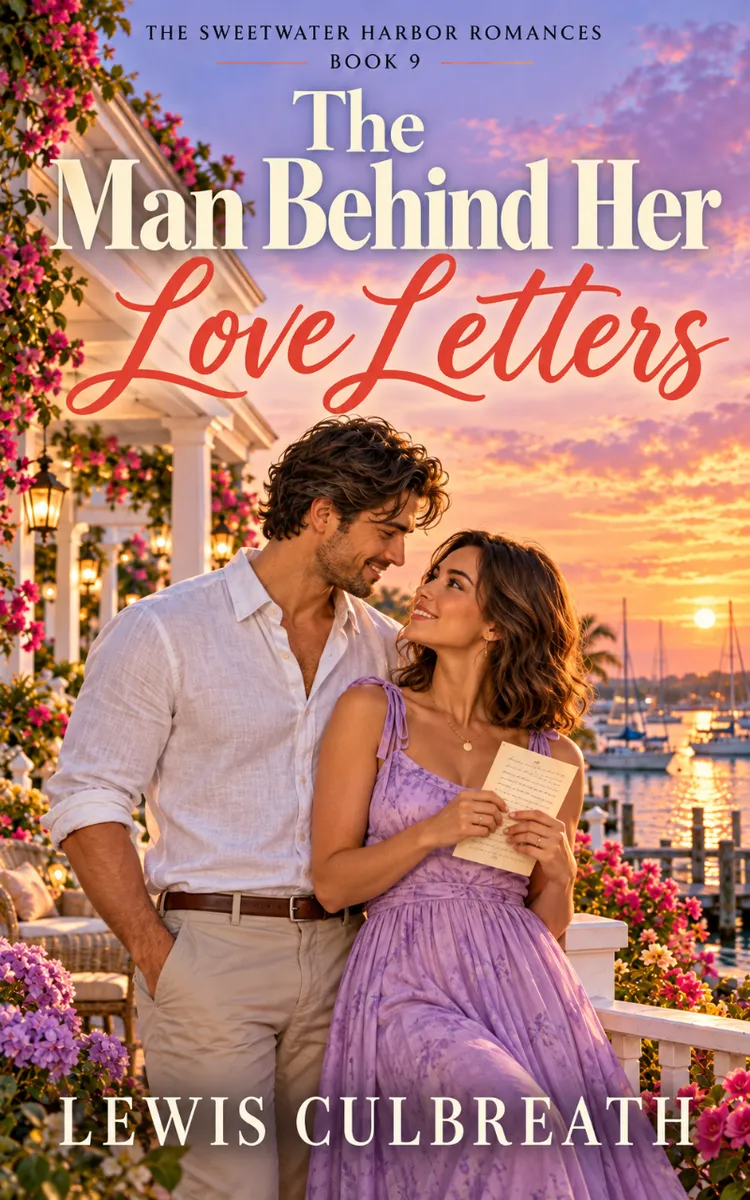
"The Man Behind Her Love Letters" is a romance book by Lewis Culbreath with 8 chapters and approximately 20,428 words. Anonymous letter writers discover their emotional connection amid small-town conflict.
This book was created using Inkfluence AI, an AI-powered book generation platform that helps authors write, design, and publish complete books. It was made with the AI Romance Novel Writer.
Frequently Asked Questions
What is "The Man Behind Her Love Letters" about?
Anonymous letter writers discover their emotional connection amid small-town conflict
How many chapters are in "The Man Behind Her Love Letters"?
The book contains 8 chapters and approximately 20,428 words. Topics covered include The Harbor Pages Exchange, A Letter Without a Name, The Inn’s Uneasy Welcome, The Numbers Behind the Appeal, and more.
Who wrote "The Man Behind Her Love Letters"?
This book was written by Lewis Culbreath and created using Inkfluence AI, an AI book generation platform that helps authors write, design, and publish books.
How can I create a similar romance book?
You can create your own romance book using Inkfluence AI. Describe your idea, choose your style, and the AI writes the full book for you. It's free to start.
Write your own romance book with AI
Describe your idea and Inkfluence writes the whole thing. Free to start.
Start writingCreated with Inkfluence AI


